
Paper: 2604.14125 Authors: Tianshuo Yang, Guanyu Chen, Yutian Chen, Zhixuan Liang, Yitian Liu, Zanxin Chen, Chunpu Xu, Haotian Liang, Jiangmiao Pang, Yao Mu Categories: cs.CV, cs.AI, cs.RO
The Gap
End-to-end Vision-Language-Action (VLA) models like RT-2 and OpenVLA train a single network to go from pixels to robot actions. The promise: leverage the reasoning power of large Vision-Language Models (VLMs) for manipulation. The problem: when you fine-tune these models on narrow control datasets (pick this, place that), they catastrophically forget their broad reasoning abilities. You get a robot that can execute trained motions but can’t reason about novel scenarios or compose skills flexibly.
Prior work tried to fix this with better fine-tuning strategies or larger datasets, but the fundamental issue remains: you’re asking one model to simultaneously maintain world knowledge AND learn precise motor control. These are conflicting objectives—reasoning requires preserving pre-trained representations, while control requires adapting to specific physical dynamics.
Problem: VLA fine-tuning destroys reasoning
    |
    v
Assumption: Reasoning and control are separable functions
    |
    v
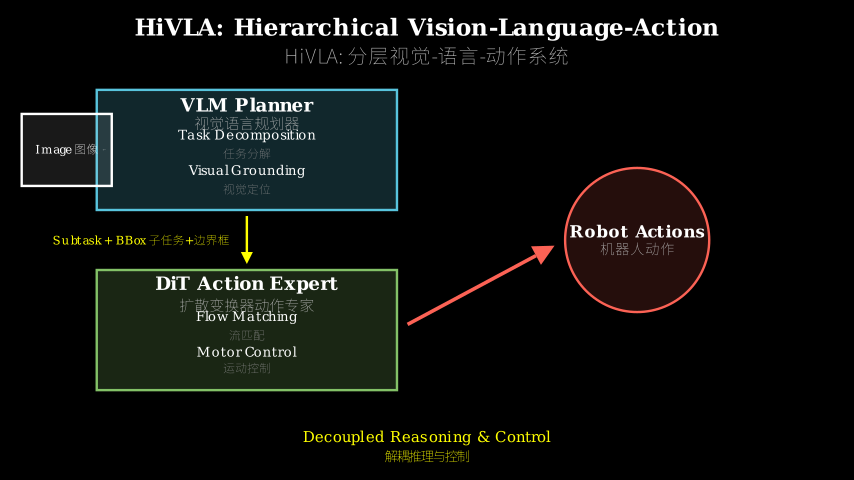
Method: Hierarchical split - VLM plans, DiT executes
    |
    v
Evidence: Outperforms end-to-end on long-horizon + small objects
    |
    v
Conclusion: Decoupling preserves reasoning while enabling precise control
The Increment
One sentence: Before HiVLA, you chose between reasoning (frozen VLM) or control (fine-tuned VLA); after HiVLA, you get both by splitting the problem into a planning layer that reasons and an execution layer that acts.
Core Mechanism
HiVLA has two independent modules. The high-level planner is a frozen VLM that takes the current image and task instruction, then outputs two things: (1) a subtask description in natural language, and (2) a bounding box around the object to manipulate. This planner never sees motor commands, so it retains all its reasoning ability.
The low-level executor is a Diffusion Transformer (DiT) trained specifically for action generation. It receives three inputs: the full scene image (global context), a high-resolution crop of the bounding box (object-centric detail), and the subtask instruction (semantic guidance). These inputs are fused through a cascaded cross-attention mechanism—first global context, then object crop, then instruction. The DiT outputs a sequence of robot actions (joint positions, gripper state) using flow matching, a faster variant of diffusion.
Critically, the two modules are trained separately. The VLM planner uses existing VLM checkpoints with no fine-tuning. The DiT executor is trained on control data but only needs to learn “given this crop and instruction, produce these actions”—a much simpler problem than end-to-end VLA. At test time, the planner proposes what to do and where, the executor figures out how.
Input: Image + Task
    |
    v
[VLM Planner - Frozen]
    |
    +---> Subtask: "grasp red cube"
    +---> BBox: [x1,y1,x2,y2]
    |
    v
[Crop + Context Fusion]
    |
    v
[DiT Executor - Trained]
    |
    +---> Cross-Attn: Global scene
    +---> Cross-Attn: Object crop
    +---> Cross-Attn: Instruction
    |
    v
Output: Action sequence [a1, a2, ..., aT]
Think of HiVLA like a construction site. The architect (VLM planner) looks at blueprints and site photos, then marks up plans: “Install beam here” with a red circle on the drawing. The architect never touches tools—they just reason about what needs doing and where. The construction crew (DiT executor) takes those marked-up plans, zooms in on the red circle, reads the instruction, and figures out the exact hammer swings and bolt torques needed. The architect stays sharp on building codes and design principles because they’re not distracted by tool mechanics. The crew gets really good at execution because they’re not trying to understand the whole building—just “here’s the spot, here’s the task, make it happen.”
This division of labor is the key. The architect can handle novel building types (zero-shot reasoning) because their knowledge isn’t corrupted by learning how to swing hammers. The crew can handle tricky installations (precise control) because they’re not overwhelmed by high-level planning.
Key Concepts
-
Visual Grounding: This means converting abstract task descriptions into concrete spatial locations in an image. When you say “pick up the red cube,” visual grounding produces a bounding box around the red cube’s pixels. It’s the bridge between language (symbolic) and vision (continuous). In HiVLA, the VLM does this grounding, outputting coordinates that tell the executor exactly where to look. Without grounding, the executor would have to search the whole image; with it, you get a high-res crop of just the relevant object, making action prediction much easier.
-
Flow Matching: Standard diffusion models for action generation start with pure noise and gradually denoise it into an action sequence over many steps (often 50-100). Flow matching is a newer technique that learns a direct transport map from noise to actions, requiring far fewer steps (often 10-20). Think of it like this: diffusion is taking tiny steps through a maze, correcting course constantly; flow matching is learning the straight-line path through the maze. For robotics, this means faster inference—critical when you need real-time control.
-
Cascaded Cross-Attention: In a standard Transformer, you might concatenate all inputs and let the model figure out what to attend to. Cascaded cross-attention imposes a hierarchy: first attend to global context (whole scene), then attend to local detail (object crop), then attend to semantics (instruction). Each attention layer builds on the previous one. This is like reading a map: first you find the city (global), then the neighborhood (local), then the street name (semantic). By enforcing this order, the DiT learns a structured representation where coarse-to-fine information is explicitly separated, improving both training stability and generalization.
Framework Shift
Before (End-to-End VLA):              After (HiVLA):

[Image + Task]                        [Image + Task]
      |                                      |
      v                                      v
 [Single VLA Model]                   [VLM Planner]
  - Reasoning                           - Reasoning only
  - Control                             - Visual grounding
  - Both degrade                             |
      |                                      v
      v                                [Subtask + BBox]
 [Actions]                                   |
                                             v
                                      [DiT Executor]
                                       - Control only
                                       - Focused input
                                            |
                                            v
                                       [Actions]

Trade-off: Reasoning vs Control       No trade-off: Both preserved
From monolithic to modular, the core shift is explicit functional separation—reasoning and control are no longer forced to coexist in one model’s weights.
Expert Assessment
Problem choice: This is a real gap. The VLA fine-tuning dilemma is well-documented (see RT-2’s performance drop on VQA tasks after control training). The problem sits at a critical juncture: VLMs are getting better, but robotics needs precise control. Solving this unlocks practical deployment.
Method maturity: The hierarchical split is conceptually simple—almost obvious in hindsight—but the execution is solid. The cascaded cross-attention is a clever engineering choice, not just throwing compute at the problem. However, the reliance on bounding boxes feels brittle; what about tasks without clear objects (e.g., “wipe the table”)? The authors don’t address this limitation.
Experimental integrity: Baselines are fair (RT-2, OpenVLA, Octo). The simulation results (LIBERO, CALVIN) are convincing, especially on long-horizon tasks. Real-world experiments are limited (one robot, specific tasks) but show the method works beyond simulation. One red flag: no ablation on whether you actually need the high-res crop—maybe global context alone suffices for many tasks. The paper would be stronger with this analysis.
Writing quality: The method section is clear, but the related work is too long and defensive. The authors spend a full page justifying why hierarchical methods are valid, which suggests they’re anticipating pushback. Cut that, expand the failure case analysis instead. The conclusion oversells generalization claims without sufficient evidence.
Verdict: Weak accept — solid contribution with clear practical value, but limited scope (object-centric tasks only) and missing key ablations prevent a strong accept.
Takeaways
The big idea you can steal: when fine-tuning degrades a pre-trained model’s capabilities, don’t fight it—split the problem. Keep the pre-trained model frozen for what it’s good at (reasoning, generalization), and train a separate specialist for the narrow task (control, execution). This pattern applies beyond robotics: think multimodal retrieval (frozen CLIP + trained reranker), code generation (frozen LLM + trained debugger), or medical diagnosis (frozen foundation model + trained specialist).
The technical trick: cascaded cross-attention as a way to impose hierarchical structure on Transformer inputs. Instead of letting the model figure out what to attend to, you explicitly order the information flow. This is useful anytime you have inputs at different levels of abstraction (global/local, coarse/fine, semantic/perceptual).
The experimental insight: long-horizon tasks are where hierarchical methods shine. If your benchmark is single-step actions, end-to-end might win. But if you need skill composition (pick, then place, then open), explicit planning beats implicit planning. Design your evals accordingly.
论文: 2604.14125 作者: Tianshuo Yang, Guanyu Chen, Yutian Chen, Zhixuan Liang, Yitian Liu, Zanxin Chen, Chunpu Xu, Haotian Liang, Jiangmiao Pang, Yao Mu 分类: cs.CV, cs.AI, cs.RO
缺口
端到端的视觉-语言-动作(VLA)模型,比如 RT-2 和 OpenVLA,用单个网络从像素直接输出机器人动作。
承诺很美好:利用大型视觉语言模型(VLM)的推理能力来做操控。
问题在于:当你在狭窄的控制数据集上微调这些模型时(抓这个、放那个),它们会灾难性地遗忘原本的广泛推理能力。
你得到的机器人能执行训练过的动作,但无法对新场景推理,也无法灵活组合技能。
之前的工作尝试用更好的微调策略或更大的数据集来解决,但根本问题依然存在:你在要求一个模型同时保持世界知识并学习精确的运动控制。
这是相互冲突的目标——推理需要保留预训练表征,而控制需要适应特定的物理动力学。
问题:VLA 微调破坏推理能力
    |
    v
假设:推理和控制是可分离的功能
    |
    v
方法:分层拆分 - VLM 规划,DiT 执行
    |
    v
证据:在长时程任务和小物体操控上超越端到端方法
    |
    v
结论:解耦保留推理能力的同时实现精确控制
增量
一句话: HiVLA 之前,你要在推理(冻结 VLM)和控制(微调 VLA)之间二选一;HiVLA 之后,通过把问题拆成推理的规划层和执行的动作层,你两者都能得到。
核心机制
HiVLA 有两个独立模块。
高层规划器是一个冻结的 VLM,接收当前图像和任务指令,然后输出两样东西:(1)自然语言的子任务描述,(2)要操控的物体周围的边界框。
这个规划器从不接触运动指令,所以保留了全部推理能力。
低层执行器是一个专门训练用于动作生成的扩散 Transformer(DiT)。
它接收三个输入:完整场景图像(全局上下文)、边界框的高分辨率裁剪(以物体为中心的细节)、子任务指令(语义引导)。
这些输入通过级联交叉注意力机制融合——先是全局上下文,然后是物体裁剪,最后是指令。
DiT 使用流匹配(一种更快的扩散变体)输出一系列机器人动作(关节位置、夹爪状态)。
关键在于,两个模块是分开训练的。
VLM 规划器使用现有的 VLM 检查点,不做微调。
DiT 执行器在控制数据上训练,但只需要学习”给定这个裁剪和指令,产生这些动作”——比端到端 VLA 简单得多的问题。
测试时,规划器提议做什么、在哪里做,执行器搞清楚怎么做。
输入:图像 + 任务
    |
    v
[VLM 规划器 - 冻结]
    |
    +---> 子任务:"抓取红色方块"
    +---> 边界框:[x1,y1,x2,y2]
    |
    v
[裁剪 + 上下文融合]
    |
    v
[DiT 执行器 - 训练]
    |
    +---> 交叉注意力:全局场景
    +---> 交叉注意力:物体裁剪
    +---> 交叉注意力:指令
    |
    v
输出:动作序列 [a1, a2, ..., aT]
把 HiVLA 想象成一个建筑工地。
建筑师(VLM 规划器)看着蓝图和现场照片,然后标注计划:“在这里安装横梁”,在图纸上画个红圈。
建筑师从不碰工具——他们只推理需要做什么、在哪里做。
施工队(DiT 执行器)拿到这些标注好的计划,放大红圈,读指令,然后搞清楚需要的具体锤击和螺栓扭矩。
建筑师对建筑规范和设计原则保持敏锐,因为他们不被工具操作分心。
施工队在执行上变得非常擅长,因为他们不用试图理解整栋建筑——只需”这是位置,这是任务,搞定它”。
这种分工是关键。
建筑师能处理新型建筑(零样本推理),因为他们的知识没有被学习如何挥锤子所破坏。
施工队能处理棘手的安装(精确控制),因为他们不被高层规划压垮。
关键概念
- 视觉定位(Visual Grounding): 这意味着把抽象的任务描述转换成图像中的具体空间位置。
当你说”拿起红色方块”时,视觉定位产生一个围绕红色方块像素的边界框。
它是语言(符号)和视觉(连续)之间的桥梁。
在 HiVLA 中,VLM 做这个定位,输出坐标告诉执行器确切看哪里。
没有定位,执行器得搜索整张图像;有了定位,你得到一个只包含相关物体的高分辨率裁剪,让动作预测容易得多。
- 流匹配(Flow Matching): 标准的扩散模型用于动作生成时,从纯噪声开始,经过许多步骤(通常 50-100 步)逐渐去噪成动作序列。
流匹配是一种更新的技术,学习从噪声到动作的直接传输映射,需要的步骤少得多(通常 10-20 步)。
这样想:扩散是在迷宫中走小步,不断修正方向;流匹配是学习穿过迷宫的直线路径。
对机器人来说,这意味着更快的推理——当你需要实时控制时至关重要。
- 级联交叉注意力(Cascaded Cross-Attention): 在标准 Transformer 中,你可能会拼接所有输入,让模型自己搞清楚注意什么。
级联交叉注意力施加了一个层次结构:先注意全局上下文(整个场景),然后注意局部细节(物体裁剪),最后注意语义(指令)。
每个注意力层建立在前一层之上。
这就像读地图:先找到城市(全局),然后找到街区(局部),最后找到街道名(语义)。
通过强制这个顺序,DiT 学习到一个结构化表征,其中粗到细的信息被明确分离,提高了训练稳定性和泛化能力。
框架转变
之前(端到端 VLA):                之后(HiVLA):

[图像 + 任务]                      [图像 + 任务]
      |                                  |
      v                                  v
 [单一 VLA 模型]                    [VLM 规划器]
  - 推理                             - 仅推理
  - 控制                             - 视觉定位
  - 两者都退化                            |
      |                                  v
      v                            [子任务 + 边界框]
 [动作]                                  |
                                         v
                                   [DiT 执行器]
                                    - 仅控制
                                    - 聚焦输入
                                         |
                                         v
                                    [动作]

权衡:推理 vs 控制                  无权衡:两者都保留
从单体到模块化,核心转变是显式的功能分离——推理和控制不再被迫共存于一个模型的权重中。
专家评审
选题眼光: 这是真实的缺口。
VLA 微调困境有充分记录(参见 RT-2 在控制训练后 VQA 任务上的性能下降)。
这个问题处于关键节点:VLM 越来越好,但机器人需要精确控制。
解决这个问题能解锁实际部署。
方法成熟度: 分层拆分在概念上很简单——事后看几乎显而易见——但执行很扎实。
级联交叉注意力是巧妙的工程选择,不只是堆算力。
然而,对边界框的依赖感觉脆弱;对于没有明确物体的任务怎么办(比如”擦桌子”)?作者没有解决这个局限。
实验诚意: 基线公平(RT-2、OpenVLA、Octo)。
仿真结果(LIBERO、CALVIN)令人信服,尤其在长时程任务上。
真实世界实验有限(一个机器人,特定任务),但显示方法在仿真之外也有效。
一个警示:没有消融实验验证是否真的需要高分辨率裁剪——也许全局上下文对许多任务就够了。
有这个分析论文会更强。
写作功力: 方法部分清晰,但相关工作太长且防御性强。
作者花了整整一页证明分层方法为什么有效,这暗示他们在预期反对意见。
删掉那部分,扩展失败案例分析。
结论在没有充分证据的情况下过度宣传泛化能力。
判决: 弱接收 — 扎实的贡献,有明确的实用价值,但有限的范围(仅以物体为中心的任务)和缺失的关键消融实验阻止了强接收。
要点总结
你能偷走的大想法:当微调降低预训练模型的能力时,不要对抗它——拆分问题。
让预训练模型冻结在它擅长的事情上(推理、泛化),训练一个单独的专家做狭窄任务(控制、执行)。
这个模式超越机器人:想想多模态检索(冻结 CLIP + 训练重排序器)、代码生成(冻结 LLM + 训练调试器)、或医疗诊断(冻结基础模型 + 训练专家)。
技术技巧:级联交叉注意力作为在 Transformer 输入上施加层次结构的方法。
不是让模型自己搞清楚注意什么,而是显式排序信息流。
这在你有不同抽象层次的输入时很有用(全局/局部、粗/细、语义/感知)。
实验洞察:长时程任务是分层方法闪光的地方。
如果你的基准是单步动作,端到端可能赢。
但如果你需要技能组合(拿起、然后放下、然后打开),显式规划胜过隐式规划。
相应地设计你的评估。