
Paper: 2606.02556 Authors: Anshun Asher Zheng, Kanishka Misra, David I. Beaver, Junyi Jessy Li Categories: cs.CL
The Gap
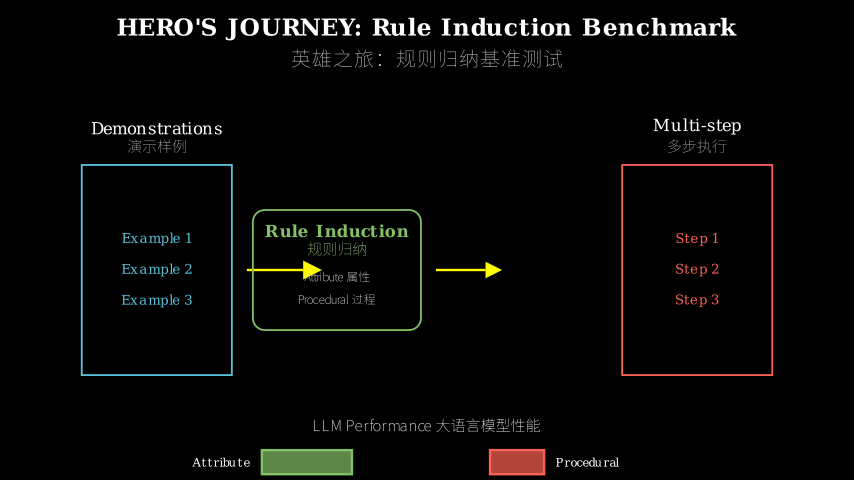
LLMs have shown impressive performance on single-shot reasoning tasks, but we don’t know if they can induce hidden rules from demonstrations and then execute multi-step plans based on those rules. Prior work evaluates either rule induction (pattern recognition from examples) or planning (multi-step execution) in isolation. This paper tests both together in a controlled setting: can models watch a few examples, figure out the underlying rule, and then act on that rule through a sequence of actions?
Problem: Rule induction + execution untested as integrated capability
   |
   v
Assumption: Text games provide controllable test environment
   |                    with observable action sequences
   v
Method: HERO'S JOURNEY benchmark
   |      - 8 tasks (attribute vs procedural)
   |      - 4 rule structures per task
   |      - Controllable lexical grounding
   v
Evidence: Models succeed on attribute tasks (70-80%)
   |       but struggle on procedural tasks (30-50%)
   |       Execution bottleneck > surface semantics
   v
Conclusion: LLMs can induce simple rules but lack
            robust procedural reasoning capacity
The Increment
One sentence: Before this paper, we knew LLMs could recognize patterns or plan actions separately; after, we know they fail at the junction where pattern recognition must guide sequential execution.
Core Mechanism
HERO’S JOURNEY constructs tasks in text-based game environments where an agent observes 3-5 demonstration episodes, then must complete a new episode by inferring and applying the hidden rule. Each task has four structural variants: conjunctive rules (e.g., “collect items with property A AND property B”), disjunctive rules (“property A OR property B”), negation rules (“NOT property A”), and exception rules (“property A EXCEPT when condition C”).
The benchmark separates tasks into two families. Attribute tasks require identifying object properties (e.g., “collect red items” or “collect items that are not fragile”). Procedural tasks require inferring action sequences (e.g., “always unlock before opening” or “use item X then item Y”). Each task also controls lexical grounding: some use concrete words (“red,” “unlock”), others use abstract placeholders (“property-7,” “action-B”) to test whether models rely on world knowledge shortcuts.
Demonstration Phase          Test Phase
==================          ===========
Episode 1: [observations]   New episode starts
  Agent actions: A, B, C       |
  Outcome: Success             v
                           Model must:
Episode 2: [observations]   1. Induce hidden rule
  Agent actions: D, E, F       |
  Outcome: Success             v
                           2. Generate action sequence
Episode 3: [observations]      |
  Agent actions: G, H          v
  Outcome: Success          3. Execute until goal reached
                               or failure
         |
         v
    [Hidden Rule]
    (never shown)
Think of HERO’S JOURNEY as a cooking class where you watch three chefs make different dishes, but the instructor never tells you the core technique they’re all using. You have to notice the pattern (always sear meat before braising, always bloom spices in oil first) and then cook your own dish using that technique. The attribute tasks are like noticing ingredient patterns (“they all use acidic elements”), while procedural tasks are like noticing technique sequences (“they always do X before Y”). The lexical grounding control is like testing whether you can still recognize the technique when ingredients have unfamiliar names written in a foreign script.
Key Concepts
-
Rule Induction: The process of inferring a general principle from specific examples. Not memorization (storing exact patterns) and not interpolation (blending between seen cases), but extracting the abstract rule that generated the examples. For instance, if you see someone unlock three different doors before opening them, rule induction means concluding “doors must be unlocked before opening” rather than memorizing those three specific door-opening sequences. The induced rule must generalize to new doors you’ve never seen.
-
Identifiability: Whether a rule can be uniquely determined from the given demonstrations, or whether multiple rules could explain the same observations. If someone always picks red apples from a basket containing red and green apples, the rule could be “pick red items” or “pick apples” (if only apples are red). The demonstrations don’t distinguish between these hypotheses. HERO’S JOURNEY ensures identifiability by design: the demonstrations always contain enough information to pinpoint exactly one rule from the four structural variants.
-
Execution Bottleneck: The performance gap introduced by having to act out a plan, not just state it. A model might correctly identify the rule (“collect fragile items”) but fail during execution because it makes action errors (trying to pick up an item already in inventory, moving to the wrong location). This separates “knowing what to do” from “successfully doing it,” revealing whether the limiting factor is reasoning or operational control.
Framework Shift
Before (mainstream approach):        After (this paper):

Rule Induction Alone:                Integrated Test:

[Examples] --> [Rule]                [Examples] --> [Rule]
                                            |
Test: State the rule                       v
                                     [Action Sequence]
                                            |
Planning Alone:                            v
                                     [Goal Achievement]
[Goal + Rules] --> [Plan]
                                     Test: Execute using
Test: Generate plan                  induced rule
From evaluating capabilities in isolation to testing the handoff between induction and execution, the core shift is measuring whether understanding translates to operational competence.
Expert Assessment
Problem choice: This is a real gap. The field has strong benchmarks for reasoning (GSM8K, Big-Bench) and planning (ALFWorld, WebShop), but few test whether models can bootstrap from observations to goal-directed behavior without explicit rule statements. The text game framing is clever—it provides natural grounding for multi-step tasks while maintaining experimental control.
Method maturity: Solid engineering with meaningful design choices. The four rule structures create difficulty gradients, and the lexical grounding control directly tests reliance on world knowledge. However, the demonstration phase is limited to 3-5 episodes. Would models improve with more examples? The paper doesn’t explore this, which feels like a missed opportunity to characterize sample efficiency.
Experimental integrity: Baselines are reasonable (GPT-4, Claude, Llama models), and the evaluation distinguishes rule induction accuracy from execution success, which is essential. The finding that “process execution adds an execution bottleneck” is backed by ablation studies. But the paper lacks error analysis—what types of procedural rules are hardest, and why? Are models failing at temporal reasoning, causal chaining, or state tracking?
Writing quality: The introduction is crisp, but the results section drowns in tables. Figure 3 (showing task performance) should be the centerpiece, but it’s buried. The discussion of “induction-specific steering methods” (prompt engineering techniques) feels tacked on—it works for attribute tasks but not procedural tasks, and the paper doesn’t explain why. Rewriting Section 5 to focus on error patterns instead of method variations would make this paper much stronger.
Verdict: weak accept — Identifies an important capability gap and provides a clean testbed, but the analysis doesn’t go deep enough to explain why procedural induction fails or how to fix it.
Takeaways
Practitioners working on agentic systems should steal the two-phase evaluation structure: test rule induction separately from execution, then measure both together. This reveals whether your system’s bottleneck is understanding or acting. The lexical grounding control is also worth adopting—testing with abstract tokens (“action-7” instead of “unlock”) exposes whether your model relies on linguistic shortcuts rather than genuine reasoning.
For researchers, the key insight is that attribute-based rules (properties of objects) are learnable by current LLMs, but procedural rules (sequences of actions with temporal or causal structure) remain a frontier. If you’re building reasoning systems, focus on temporal and causal representation—that’s where the capability ceiling is.
论文: 2606.02556 作者: Anshun Asher Zheng, Kanishka Misra, David I. Beaver, Junyi Jessy Li 分类: cs.CL
缺口
大语言模型在单次推理任务上表现出色,但我们不知道它们能否从演示中归纳出隐藏规则,然后基于这些规则执行多步计划。
此前的工作要么单独评估规则归纳(从示例中识别模式),要么单独评估规划(多步执行)。
这篇论文在可控环境中同时测试两者:模型能否观察几个示例,推断出底层规则,然后通过一系列动作来应用该规则?
问题:规则归纳 + 执行尚未作为集成能力被测试
   |
   v
假设:文本游戏提供可控测试环境
   |      具有可观测的动作序列
   v
方法:HERO'S JOURNEY 基准
   |      - 8 个任务(属性型 vs 过程型)
   |      - 每个任务 4 种规则结构
   |      - 可控的词汇基底
   v
证据:模型在属性型任务上成功(70-80%)
   |       但在过程型任务上挣扎(30-50%)
   |       执行瓶颈 > 表层语义
   v
结论:大语言模型能归纳简单规则,但缺乏
      稳健的过程推理能力
增量
一句话: 这篇论文之前,我们知道大语言模型能分别识别模式或规划动作;
之后,我们知道它们在模式识别必须指导顺序执行的交界处失败了。
核心机制
HERO’S JOURNEY 在基于文本的游戏环境中构建任务,智能体观察 3-5 个演示回合,然后必须通过推断和应用隐藏规则来完成新回合。
每个任务有四种结构变体:合取规则(例如”收集具有属性 A 且属性 B 的物品”)、析取规则(“属性 A 或属性 B”)、否定规则(“非属性 A”)和例外规则(“属性 A 除非条件 C”)。
基准将任务分为两个系列。
属性型任务需要识别对象属性(例如”收集红色物品”或”收集非易碎物品”)。
过程型任务需要推断动作序列(例如”总是先解锁再打开”或”先使用物品 X 再使用物品 Y”)。
每个任务还控制词汇基底:有些使用具体词汇(“红色”、“解锁”),其他使用抽象占位符(“属性-7”、“动作-B”)来测试模型是否依赖世界知识捷径。
演示阶段                  测试阶段
========                  ========
回合 1:[观察结果]        新回合开始
  智能体动作:A, B, C       |
  结果:成功                v
                        模型必须:
回合 2:[观察结果]        1. 归纳隐藏规则
  智能体动作:D, E, F       |
  结果:成功                v
                        2. 生成动作序列
回合 3:[观察结果]          |
  智能体动作:G, H          v
  结果:成功             3. 执行直到达成目标
                           或失败
         |
         v
    [隐藏规则]
    (从不展示)
把 HERO’S JOURNEY 想象成一堂烹饪课,你看三位厨师做不同的菜,但教练从不告诉你他们都在使用的核心技巧。
你必须注意到模式(总是先煎肉再炖,总是先在油中爆香料),然后用这个技巧做你自己的菜。
属性型任务就像注意食材模式(“他们都用了酸性元素”),而过程型任务就像注意技巧序列(“他们总是先做 X 再做 Y”)。
词汇基底控制就像测试当食材有陌生的外文名称时,你是否还能识别出技巧。
关键概念
- 规则归纳: 从具体示例中推断一般原则的过程。
不是记忆(存储确切模式),也不是插值(在已见案例之间混合),而是提取生成示例的抽象规则。
例如,如果你看到有人在打开三扇不同的门之前都先解锁,规则归纳意味着得出结论”门必须在打开前解锁”,而不是记住那三个特定的开门序列。
归纳出的规则必须泛化到你从未见过的新门。
- 可识别性: 给定的演示能否唯一确定一条规则,或者多条规则可以解释相同的观察结果。
如果有人总是从包含红色和绿色苹果的篮子里挑红苹果,规则可能是”挑红色物品”或”挑苹果”(如果只有苹果是红色的)。
演示无法区分这些假设。
HERO’S JOURNEY 通过设计确保可识别性:演示总是包含足够的信息,从四种结构变体中精确定位唯一一条规则。
- 执行瓶颈: 由于必须执行计划而不仅仅是陈述计划而引入的性能差距。
模型可能正确识别了规则(“收集易碎物品”),但在执行过程中失败,因为它犯了动作错误(试图捡起已在库存中的物品,移动到错误位置)。
这将”知道做什么”与”成功做到”分离开来,揭示限制因素是推理还是操作控制。
框架转变
之前(主流方法):              之后(本文方法):

仅规则归纳:                    集成测试:

[示例] --> [规则]               [示例] --> [规则]
                                       |
测试:陈述规则                          v
                                [动作序列]
                                       |
仅规划:                                v
                                [达成目标]
[目标 + 规则] --> [计划]
                                测试:使用归纳
测试:生成计划                   的规则执行
从孤立评估能力到测试归纳与执行之间的交接,核心转变是衡量理解是否转化为操作能力。
专家评审
选题眼光: 这是个真实的缺口。
该领域有强大的推理基准(GSM8K、Big-Bench)和规划基准(ALFWorld、WebShop),但很少有测试模型能否在没有明确规则陈述的情况下从观察引导到目标导向行为。
文本游戏框架很巧妙——它为多步任务提供了自然基底,同时保持实验控制。
方法成熟度: 工程扎实,设计选择有意义。
四种规则结构创造了难度梯度,词汇基底控制直接测试对世界知识的依赖。
但是,演示阶段限于 3-5 个回合。
模型会随着更多示例而改进吗?
论文没有探索这一点,感觉错失了表征样本效率的机会。
实验诚意: 基线合理(GPT-4、Claude、Llama 模型),评估区分了规则归纳准确性和执行成功率,这是必不可少的。
“过程执行增加了执行瓶颈”的发现由消融研究支持。
但论文缺乏错误分析——哪些类型的过程规则最难,为什么?
模型是在时序推理、因果链接还是状态跟踪上失败?
写作功力: 引言简洁,但结果部分淹没在表格中。
图 3(显示任务性能)应该是核心,但被埋没了。
关于”归纳特定引导方法”(提示工程技术)的讨论感觉很随意——它适用于属性型任务但不适用于过程型任务,论文没有解释原因。
重写第 5 节以专注于错误模式而不是方法变体会让这篇论文强得多。
判决: 弱接收 — 识别了重要的能力缺口并提供了干净的测试平台,但分析不够深入,无法解释为什么过程归纳失败或如何修复它。
要点总结
从事智能体系统的实践者应该借鉴两阶段评估结构:分别测试规则归纳和执行,然后一起衡量两者。
这揭示了系统的瓶颈是理解还是行动。
词汇基底控制也值得采用——用抽象标记测试(“动作-7”而不是”解锁”)暴露了模型是否依赖语言捷径而不是真正的推理。
对于研究人员,关键洞见是基于属性的规则(对象的属性)可以被当前的大语言模型学习,但过程规则(具有时序或因果结构的动作序列)仍然是前沿。
如果你在构建推理系统,专注于时序和因果表示——那是能力上限所在。