
Paper: 2603.28766 Authors: Zimu Zhang, Yucheng Zhang, Xiyan Xu, Ziyin Wang, Sirui Xu, Kai Zhou, Bing Zhou, Chuan Guo, Jian Wang, Yu-Xiong Wang Categories: cs.CV
The Gap
Human motion synthesis has made strides in full-body movement, but hands remain a blind spot. Existing whole-body models treat hands as simplified appendages, missing the micro-choreography that makes manipulation believable: which finger contacts when, how digits flex in coordination, how two hands negotiate shared tasks. Prior datasets either lack bimanual sequences entirely or capture them at insufficient fidelity to train models that understand dexterous collaboration. The result: generated motions where hands float through objects or fingers move in anatomically impossible ways.
Problem: Whole-body models lose hand detail
   |
   v
Assumption: Fine-grained features (contact, flexion)
            can be extracted and described separately
   |
   v
Method: Curate high-fidelity bimanual data +
        Decoupled annotation (features -> LLM descriptions)
   |
   v
Evidence: Diffusion/autoregressive models generate
          coherent bimanual motion; scaling improves quality
   |
   v
Conclusion: Unified data+annotation foundation enables
            realistic dexterous motion synthesis
The Increment
One sentence: Before HandX, generating realistic bimanual hand motion required either sacrificing finger detail in whole-body models or working with sparse, low-quality hand-only data; after HandX, researchers have a curated dataset with fine-grained bimanual sequences and scalable semantic annotations that enable training models to synthesize coordinated, contact-aware hand interactions.
Core Mechanism
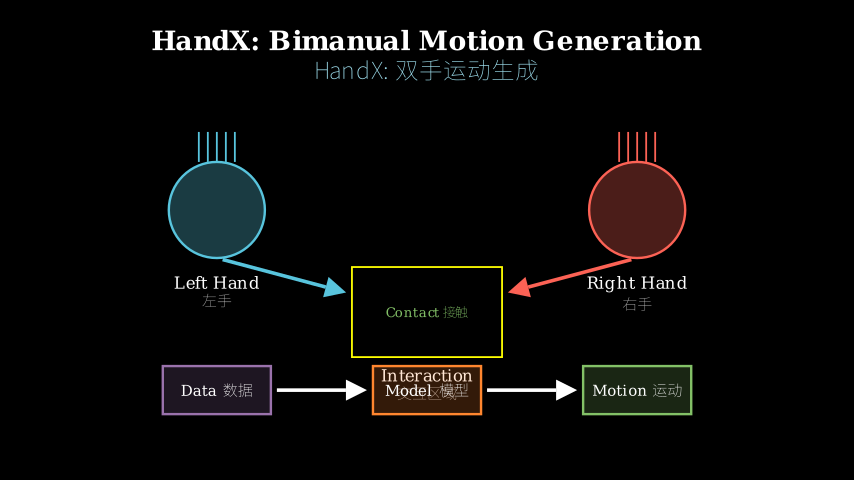
HandX operates in three stages. First, data consolidation: the authors filter existing motion capture datasets for quality, removing sequences with tracking errors or unnatural artifacts, then collect new bimanual interaction data targeting underrepresented scenarios like tool use and object manipulation with detailed finger tracking. Second, decoupled annotation: instead of directly describing entire motion sequences (which scales poorly), they extract representative motion features—contact events (when/where fingers touch objects), finger flexion patterns (joint angle trajectories), hand poses—then feed these structured features to a large language model that generates semantically rich natural language descriptions aligned with the extracted cues. Third, model training: they benchmark both diffusion models (which denoise motion sequences iteratively) and autoregressive models (which predict motion frame-by-frame) using the annotated data, supporting versatile conditioning modes like text prompts, partial motion, or contact constraints.
Data Flow:

Raw mocap -> Quality filter -> Curated sequences
                                      |
                                      v
                            Feature extraction
                            (contact, flexion, pose)
                                      |
                                      v
                            LLM reasoning -> Text descriptions
                                      |
                                      v
                            Training data (motion + text)
                                      |
                                      v
                    Diffusion/Autoregressive models
                                      |
                                      v
                            Generated bimanual motion
Think of HandX as a film production pipeline for hand motion. Raw mocap footage is like unedited dailies—some takes are unusable due to tracking glitches (the quality filter is the editor’s first pass). The feature extraction stage is like a script supervisor noting key actions: “left thumb contacts object at frame 42, right index finger flexes 30 degrees.” These notes go to a screenwriter (the LLM) who turns sparse cues into rich scene descriptions: “grasping a mug handle while the other hand steadies the base.” Finally, the trained models are actors who’ve studied these annotated scenes and can now improvise new performances that follow the same choreographic logic—coordinated timing, realistic contact, anatomically plausible finger motion.
Key Concepts
-
Decoupled annotation: Traditional motion annotation asks humans to watch sequences and write descriptions—expensive and inconsistent at scale. Decoupled annotation splits this into two steps: first, algorithms extract objective motion features (contact points, joint angles) that are cheap to compute and consistent; second, an LLM converts these structured features into natural language. This is like having a sensor log the temperature and humidity, then asking a weather reporter to describe the conditions—the sensor handles precision, the reporter handles semantics. The key insight: motion features are compressible representations that preserve the information needed for semantic description while being far easier to extract automatically than full natural language annotations.
-
Contact-aware generation: Most motion models treat space as empty—hands move through trajectories without considering when fingers should touch objects. Contact-aware generation explicitly models contact events as constraints: the model learns that certain hand poses correlate with contact (e.g., finger flexion + proximity to object surface = grasp), and during generation, it can be conditioned on desired contact patterns. Imagine a pianist: their fingers don’t just move through space, they must strike specific keys at precise moments. Contact-aware models learn this coupling between motion and interaction, producing hands that engage with the world rather than pantomiming in a vacuum.
-
Bimanual coordination: When two hands collaborate, they’re not independent—one hand’s motion constrains the other’s. Threading a needle requires one hand to hold the thread steady while the other positions the needle; the timing and relative positioning must be synchronized. Bimanual coordination means the model learns these inter-hand dependencies: if the left hand grasps an object, the right hand’s approach trajectory adjusts to complement, not collide. Prior models treated hands as separate entities; HandX’s dataset captures sequences where hands work together, teaching models the grammar of two-handed collaboration.
Framework Shift
Before (whole-body models):          After (HandX):

Full body motion                     Full body motion
      |                                    |
      v                                    v
  [Hands as                          [Hands with
   simplified                         fine-grained
   endpoints]                         finger dynamics]
      |                                    |
      v                                    v
  Generic motion                     Contact-aware
  descriptions                       feature-based
                                     descriptions
      |                                    |
      v                                    v
  Hands float                        Hands interact
  through objects                    realistically
From treating hands as low-resolution appendages to modeling them as high-fidelity interaction surfaces, the core shift is elevating hands from motion endpoints to primary actors with their own detailed choreography.
Expert Assessment
Problem choice: This is a genuine gap. Anyone who’s tried to generate realistic manipulation knows hands are the Achilles heel—existing models produce uncanny valley interactions where fingers phase through objects or move in anatomically impossible ways. The problem sits at the intersection of motion synthesis and embodied AI, increasingly relevant as robotics and VR demand believable hand behavior. Not manufactured.
Method maturity: The decoupled annotation strategy is clever—it sidesteps the annotation bottleneck by leveraging LLMs for semantic richness while keeping feature extraction algorithmic. However, the paper leans on scale (more data, bigger models) rather than architectural innovation. The diffusion and autoregressive baselines are standard; no novel inductive biases for hand structure or contact physics. It’s solid engineering more than conceptual breakthrough.
Experimental integrity: Baselines are fair—they compare against recent whole-body and hand-specific models. The newly proposed hand-focused metrics (contact accuracy, finger flexion error) are appropriate, though I’d want to see user studies validating perceptual quality. One concern: the scaling experiments show clear trends, but the largest model is still relatively small by modern standards. The claim that “larger models produce more coherent motion” needs validation at truly large scale before it’s a law rather than an observation.
Writing quality: The abstract and introduction are crisp, but the method section buries the decoupled annotation strategy under implementation details. Section 3.2 should lead with the conceptual insight (why decouple?) before diving into feature types. The evaluation section is thorough but repetitive—consolidating ablation results into a single table would improve readability. The related work undersells how this differs from concurrent hand motion papers.
Verdict: weak accept — Addresses a real problem with a practical solution and releases valuable data, but the method is more incremental than transformative; the field will use the dataset more than adopt the specific techniques.
Takeaways
The decoupled annotation pattern transfers beyond motion: anytime you need semantic descriptions of structured data at scale, consider extracting compressible features first, then using LLMs to generate natural language from those features rather than raw data. This two-stage approach is cheaper and more consistent than end-to-end annotation.
For anyone building interaction models (robotics, VR, animation), the contact-aware conditioning framework is immediately useful: explicitly model contact events as first-class constraints rather than hoping the model learns them implicitly. This applies to any domain where actions have physical consequences—grasping, tool use, locomotion on uneven terrain.
The scaling observation (larger models + more data = better coordination) suggests that bimanual motion is a capacity-hungry task. If you’re working with limited compute, focus on single-hand or constrained bimanual scenarios rather than trying to cover the full space of two-handed interactions with a small model.
论文: 2603.28766 作者: Zimu Zhang, Yucheng Zhang, Xiyan Xu, Ziyin Wang, Sirui Xu, Kai Zhou, Bing Zhou, Chuan Guo, Jian Wang, Yu-Xiong Wang 分类: cs.CV
缺口
人体运动合成在全身动作上取得了进展,但手部仍是盲区。
现有的全身模型把手当作简化的附属物,丢失了让操作可信的微观编排:哪根手指何时接触、手指如何协调弯曲、两只手如何协商共同任务。
先前的数据集要么完全缺乏双手序列,要么捕捉精度不足,无法训练理解灵巧协作的模型。
结果是:生成的动作中,手穿过物体漂浮,或手指以解剖学上不可能的方式移动。
问题:全身模型丢失手部细节
   |
   v
假设:细粒度特征(接触、弯曲)
    可以单独提取和描述
   |
   v
方法:整理高保真双手数据 +
    解耦标注(特征 -> LLM描述)
   |
   v
证据:扩散/自回归模型生成
    连贯的双手运动;规模提升质量
   |
   v
结论:统一的数据+标注基础设施
    实现真实的灵巧运动合成
增量
一句话: HandX之前,生成真实的双手运动要么在全身模型中牺牲手指细节,要么使用稀疏、低质量的纯手部数据;HandX之后,研究者有了精选数据集,包含细粒度双手序列和可扩展的语义标注,能训练模型合成协调的、接触感知的手部交互。
核心机制
HandX分三个阶段运作。
第一,数据整合:作者过滤现有动作捕捉数据集的质量,移除有跟踪错误或不自然伪影的序列,然后收集新的双手交互数据,针对代表性不足的场景如工具使用和物体操作,带有详细的手指跟踪。
第二,解耦标注:不直接描述整个运动序列(扩展性差),而是提取代表性运动特征——接触事件(手指何时何地触碰物体)、手指弯曲模式(关节角度轨迹)、手部姿态——然后将这些结构化特征输入大语言模型,生成与提取线索对齐的语义丰富的自然语言描述。
第三,模型训练:他们用标注数据对比测试扩散模型(迭代去噪运动序列)和自回归模型(逐帧预测运动),支持多种条件模式如文本提示、部分运动或接触约束。
数据流:

原始动捕 -> 质量过滤 -> 精选序列
                            |
                            v
                      特征提取
                  (接触、弯曲、姿态)
                            |
                            v
                  LLM推理 -> 文本描述
                            |
                            v
                  训练数据(运动+文本)
                            |
                            v
              扩散/自回归模型
                            |
                            v
                  生成的双手运动
把HandX想象成手部运动的电影制作流程。
原始动捕素材像未剪辑的样片——有些镜头因跟踪故障无法使用(质量过滤是剪辑师的初筛)。
特征提取阶段像场记记录关键动作:“左手拇指在第42帧接触物体,右手食指弯曲30度”。
这些笔记交给编剧(LLM),把稀疏线索转化为丰富的场景描述:“抓握杯柄的同时另一只手稳住底座”。
最后,训练好的模型是研究过这些标注场景的演员,现在能即兴表演遵循相同编排逻辑的新动作——协调的时序、真实的接触、解剖学上合理的手指运动。
关键概念
- 解耦标注: 传统运动标注让人类观看序列并写描述——成本高且大规模下不一致。
解耦标注分两步:首先,算法提取客观运动特征(接触点、关节角度),计算成本低且一致;其次,LLM将这些结构化特征转换为自然语言。
这就像让传感器记录温度和湿度,然后让气象播报员描述天气状况——传感器处理精度,播报员处理语义。
关键洞察:运动特征是可压缩的表示,保留语义描述所需的信息,同时比完整的自然语言标注更容易自动提取。
- 接触感知生成: 大多数运动模型把空间当作空的——手沿轨迹移动而不考虑手指何时应该触碰物体。
接触感知生成显式地将接触事件建模为约束:模型学习某些手部姿态与接触相关(如手指弯曲+接近物体表面=抓握),生成时可以基于期望的接触模式进行条件化。
想象钢琴家:他们的手指不只是在空间中移动,必须在精确时刻敲击特定琴键。
接触感知模型学习运动与交互之间的耦合,产生与世界互动的手,而非在真空中比划。
- 双手协调: 两只手协作时不是独立的——一只手的运动约束另一只手。
穿针引线需要一只手稳住线,另一只手定位针;时序和相对位置必须同步。
双手协调意味着模型学习这些手间依赖:如果左手抓握物体,右手的接近轨迹会调整以配合而非碰撞。
先前模型把手当作独立实体;HandX的数据集捕捉手协同工作的序列,教会模型双手协作的语法。
框架转变
之前(全身模型):                之后(HandX):

全身运动                        全身运动
    |                              |
    v                              v
[手作为                        [手带有
 简化的                         细粒度的
 端点]                          手指动态]
    |                              |
    v                              v
通用运动                        接触感知的
描述                            基于特征的
                                描述
    |                              |
    v                              v
手穿过                          手真实地
物体漂浮                        交互
从把手当作低分辨率附属物到将其建模为高保真交互表面,核心转变是将手从运动端点提升为有自己详细编排的主要角色。
专家评审
选题眼光: 这是真实的缺口。
任何尝试过生成真实操作的人都知道手是致命弱点——现有模型产生诡异的交互,手指穿过物体或以解剖学上不可能的方式移动。
问题位于运动合成和具身AI的交叉点,随着机器人和VR需要可信的手部行为,越来越相关。
不是人造的。
方法成熟度: 解耦标注策略很巧妙——通过利用LLM获得语义丰富性同时保持特征提取算法化,绕过了标注瓶颈。
然而,论文依赖规模(更多数据、更大模型)而非架构创新。
扩散和自回归基线是标准的;没有针对手部结构或接触物理的新颖归纳偏置。
这更多是扎实的工程而非概念突破。
实验诚意: 基线公平——他们与最近的全身和手部专用模型对比。
新提出的手部聚焦指标(接触准确度、手指弯曲误差)是合适的,但我想看用户研究验证感知质量。
一个担忧:规模实验显示明确趋势,但最大模型按现代标准仍相对较小。
“更大模型产生更连贯运动”的声称需要在真正大规模上验证,才能从观察变成定律。
写作功力: 摘要和引言简洁,但方法部分把解耦标注策略埋在实现细节下。
3.2节应该先讲概念洞察(为什么解耦?)再深入特征类型。
评估部分彻底但重复——将消融结果整合到单个表格会提高可读性。
相关工作低估了这与同期手部运动论文的差异。
判决: 弱接收 — 用实用方案解决真实问题并发布有价值的数据,但方法更多是渐进而非变革性的;该领域会更多使用数据集而非采纳具体技术。
要点总结
解耦标注模式可迁移到运动之外:任何时候需要大规模结构化数据的语义描述,考虑先提取可压缩特征,然后用LLM从这些特征而非原始数据生成自然语言。
这种两阶段方法比端到端标注更便宜、更一致。
对于构建交互模型的人(机器人、VR、动画),接触感知条件化框架立即可用:显式地将接触事件建模为一等约束,而非希望模型隐式学习它们。
这适用于任何动作有物理后果的领域——抓握、工具使用、不平地形上的运动。
规模观察(更大模型+更多数据=更好协调)表明双手运动是容量饥渴的任务。
如果计算资源有限,专注于单手或受约束的双手场景,而非试图用小模型覆盖双手交互的全部空间。