
Paper: 2605.02832 Authors: Vicente Pelechanoa, Antoni Mestre, Manoli Albert, Miriam Gil Categories: cs.AI, cs.HC, cs.SE
The Gap
Existing human-AI collaboration research treats task allocation as a binary switch: either the human does it or the AI does it. Adaptive systems like contextual bandits learn to pick the “best” agent for each task, but they ignore organizational realities—compliance requirements, oversight mandates, human skill preservation. When governance enters the picture, it’s bolted on afterward as a constraint that kills efficiency.
The gap: no one has built governance into the learning loop as a first-class design variable. We lack frameworks that let organizations explore the tradeoff space—“If we require human oversight on 30% of AI decisions instead of 10%, what happens to throughput, error rates, and worker fatigue?”—before committing to a policy.
Problem: Binary allocation ignores operational context
   |
   v
Assumption: Governance can be parameterized, not just enforced
   |
   v
Method: Rule-based filter + contextual bandit over 5 collaboration modes
   |
   v
Evidence: Manufacturing shows governance reduces fatigue without killing performance
   |
   v
Conclusion: Governance is a tunable design variable, not pure overhead
The Increment
One sentence: Before HAAS, governance was a post-hoc constraint on learned policies; after HAAS, governance becomes a pre-deployment design parameter you can sweep to find acceptable tradeoffs.
Core Mechanism
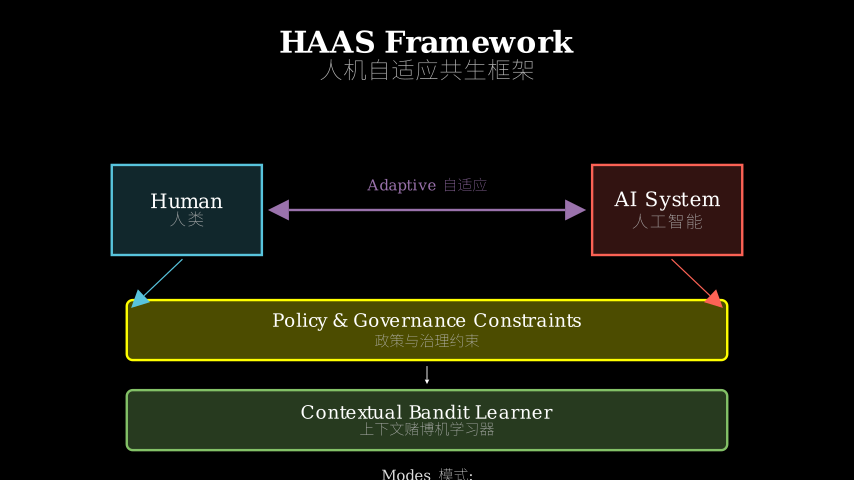
HAAS has two coupled components. First, a rule-based expert system encodes governance constraints—“AI cannot work alone on safety-critical tasks,” “humans must review all high-stakes decisions”—and filters the action space before learning begins. Second, a contextual bandit observes task features (complexity, stakes, human fatigue) and outcome feedback (quality, time, workload), then learns to select among five collaboration modes: human-only, human-led with AI assist, equal partnership, AI-led with human oversight, AI-only.
The task-agent fit is represented through five cognitive dimensions: perceptual load, memory demand, decision complexity, motor precision, and temporal pressure. Each task gets a profile; each mode has a suitability function. The expert system uses these profiles to prune infeasible modes before the bandit sees the task. The bandit then picks from what remains, observes the outcome, and updates its policy.
The framework runs on a reproducible benchmark spanning software engineering (code review, bug triage, test generation) and manufacturing (quality inspection, assembly sequencing, maintenance scheduling). Governance strength is parameterized as a single dial: loose (few constraints), moderate (oversight on high-stakes tasks), tight (human involvement required for most decisions).
Task arrives with cognitive profile
   |
   v
[Expert System] <--- Governance rules (tunable)
   |
   +---> Filters 5 modes to feasible subset
   |
   v
[Contextual Bandit] <--- Task features + history
   |
   +---> Selects mode from feasible set
   |
   v
Execution: Human/AI/Both perform task
   |
   v
Outcome: Quality, time, fatigue measured
   |
   +---> Feedback to bandit
Think of HAAS as a restaurant kitchen with a head chef (expert system) and a line cook (bandit). The head chef enforces health codes and kitchen rules—“no raw chicken near salad station,” “sous chef must check all desserts.” These rules are non-negotiable but adjustable by management. The line cook learns which stations handle which dishes best, but only gets to assign tasks the head chef has approved. Tighter health codes mean fewer station options, but the line cook still learns to optimize within those constraints. The kitchen’s performance depends on both the rules and the cook’s learned assignments.
Key Concepts
-
Collaboration mode spectrum: Instead of “human or AI,” HAAS defines five modes along an autonomy gradient. Human-only means the AI is off. Human-led means the AI suggests but the human decides and acts. Equal partnership means both contribute to decision and execution. AI-led means the AI decides and acts but the human monitors and can intervene. AI-only means no human in the loop. The key insight: most real work happens in the middle three modes, not the extremes, and the right mode depends on task properties and organizational policy.
-
Governance as a design variable: Traditional view treats governance as a binary—either you comply or you don’t. HAAS parameterizes it: governance strength is a continuous dial that changes which collaboration modes are feasible for which tasks. Loose governance allows AI-only on most tasks. Tight governance forces human oversight even on routine decisions. The framework lets you simulate “what if we move the dial from 3 to 7?” and see the operational consequences before changing actual policy. This turns compliance from a constraint into a design space you can explore.
-
Workload buffering: In manufacturing, the paper finds that tighter governance can reduce human fatigue while maintaining or improving performance. The mechanism: when governance forces AI-led mode instead of AI-only, the human monitors rather than executes, which is less physically taxing but still catches errors. The AI handles routine load; the human provides oversight. This breaks the usual framing where governance is pure overhead—sometimes the overhead is actually a workload redistribution that benefits the human.
Framework Shift
Before (mainstream approach):        After (this paper):

  Task --> [Learner] --> Assign       Task --> [Governance Filter]
             |                                      |
             v                                      v
        Human or AI                         Feasible modes {H, H+A, H=A, A+H, A}
             |                                      |
             v                                      v
    [Governance Check]                      [Learner] --> Select mode
             |                                      |
        Accept/Reject                               v
                                              Execute & Learn

Governance is a gate                  Governance shapes the action space
One sentence: From post-hoc filtering of learned policies to pre-learning shaping of the decision space, the core shift is treating governance as a parameter that defines what the learner can explore rather than what it must avoid.
Expert Assessment
Problem choice: Real gap. Organizations deploying AI face this daily—how much autonomy to grant, how much oversight to require—but lack tools to reason about it systematically. The binary framing (human vs AI) is indeed a strawman in practice; the five-mode spectrum is a better model of operational reality.
Method maturity: The expert system + bandit architecture is straightforward, almost obvious in hindsight, which is a compliment. The cognitive dimensions (perceptual load, memory demand, etc.) are borrowed from human factors literature without much novelty, but they’re fit-for-purpose. The benchmark is the real contribution—reproducible, multi-domain, with realistic task distributions. The bandit is off-the-shelf (Thompson sampling), which is fine; the innovation is in the problem formulation, not the learning algorithm.
Experimental integrity: Baselines are fair (pure human, pure AI, random mode selection, bandit without governance). The manufacturing result—tighter governance reducing fatigue—is surprising and well-documented with workload metrics. The software engineering results are less dramatic, which the authors acknowledge. One weakness: the governance policies are hand-designed, not learned or derived from real organizational constraints. The paper positions this as a feature (interpretability), but it limits generalizability.
Writing quality: The abstract and introduction are crisp. The related work section is thorough but could be trimmed. The experimental section buries the lead—the workload buffering result should be front and center, not in a subsection. The discussion is honest about limitations (no real deployment, synthetic benchmark, hand-crafted rules). The paper would benefit from a “practitioner’s guide” section: if you’re a manager, here’s how to use HAAS to explore your governance options.
Verdict: weak accept — Solid problem formulation and a useful framework, but the experimental results are mixed (strong in manufacturing, weak in software), and the lack of real-world deployment limits impact claims.
Takeaways
For system designers: The five-mode autonomy spectrum is immediately useful. Stop thinking “human or AI” and start designing for the middle modes—AI-led with human oversight, human-led with AI assist. These are where most operational value lives.
For policy makers: Governance strength as a tunable parameter is the key idea. Before locking in a compliance policy, simulate it: run your task distribution through HAAS with different governance settings and measure the operational consequences. The paper shows this is tractable.
For researchers: The workload buffering effect—governance reducing fatigue by redistributing load—deserves deeper investigation. It suggests that human-AI collaboration design should optimize for human experience, not just task performance. The cognitive dimensions framework is a starting point for modeling task-agent fit; extending it to capture domain-specific factors (trust, skill decay, learning curves) would increase its power.
Steal this: The idea of a “governance workbench”—a pre-deployment sandbox where you can explore policy tradeoffs before organizational commitment. This applies beyond human-AI allocation: any system where you’re balancing autonomy, oversight, and operational constraints.
论文: 2605.02832 作者: Vicente Pelechanoa, Antoni Mestre, Manoli Albert, Miriam Gil 分类: cs.AI, cs.HC, cs.SE
缺口
现有的人机协作研究将任务分配视为二元开关:要么人做,要么AI做。
自适应系统如上下文赌博机会学习为每个任务选择”最佳”执行者,但它们忽略了组织现实——合规要求、监督强制、人类技能保留。
当治理进入画面时,它是事后螺栓式加装的约束,扼杀效率。
缺口在于:没人把治理嵌入学习循环作为一等设计变量。
我们缺乏让组织探索权衡空间的框架——“如果我们要求人类监督30%而非10%的AI决策,吞吐量、错误率和工人疲劳会发生什么?“——在承诺某项政策之前。
问题:二元分配忽略运营情境
   |
   v
假设:治理可参数化,而非仅强制执行
   |
   v
方法:规则过滤器 + 上下文赌博机覆盖5种协作模式
   |
   v
证据:制造业显示治理降低疲劳且不损性能
   |
   v
结论:治理是可调设计变量,非纯开销
增量
一句话: HAAS之前,治理是学习策略的事后约束;HAAS之后,治理成为部署前可扫描的设计参数,用于找到可接受的权衡点。
核心机制
HAAS有两个耦合组件。
第一,基于规则的专家系统编码治理约束——“AI不能独立处理安全关键任务”,“人类必须审查所有高风险决策”——并在学习开始前过滤动作空间。
第二,上下文赌博机观察任务特征(复杂度、风险、人类疲劳)和结果反馈(质量、时间、工作负荷),然后学习从五种协作模式中选择:纯人类、人类主导+AI辅助、平等伙伴、AI主导+人类监督、纯AI。
任务-执行者匹配通过五个认知维度表示:感知负荷、记忆需求、决策复杂度、运动精度、时间压力。
每个任务获得一个画像;每种模式有一个适配函数。
专家系统用这些画像在赌博机看到任务前剪枝不可行模式。
赌博机然后从剩余选项中挑选,观察结果,更新策略。
框架运行在跨软件工程(代码审查、bug分类、测试生成)和制造业(质量检验、装配排序、维护调度)的可复现基准上。
治理强度被参数化为单一旋钮:宽松(少量约束)、适中(高风险任务需监督)、严格(多数决策需人类参与)。
任务携带认知画像到达
   |
   v
[专家系统] <--- 治理规则(可调)
   |
   +---> 将5种模式过滤为可行子集
   |
   v
[上下文赌博机] <--- 任务特征 + 历史
   |
   +---> 从可行集中选择模式
   |
   v
执行:人类/AI/双方执行任务
   |
   v
结果:质量、时间、疲劳被测量
   |
   +---> 反馈给赌博机
把HAAS想象成一个餐厅厨房,有主厨(专家系统)和线厨(赌博机)。
主厨执行卫生规范和厨房规则——“生鸡肉不能靠近沙拉台”,“副厨必须检查所有甜点”。
这些规则不可商量但可由管理层调整。
线厨学习哪个工作站最擅长处理哪道菜,但只能分配主厨批准的任务。
更严格的卫生规范意味着更少的工作站选项,但线厨仍在这些约束内学习优化。
厨房的表现取决于规则和厨师的学习分配。
关键概念
- 协作模式谱: HAAS不用”人类或AI”,而是定义沿自主梯度的五种模式。
纯人类意味着AI关闭。
人类主导意味着AI建议但人类决策并执行。
平等伙伴意味着双方都参与决策和执行。
AI主导意味着AI决策并执行但人类监控并可干预。
纯AI意味着无人类在环。
关键洞见:多数真实工作发生在中间三种模式,而非极端,正确模式取决于任务属性和组织政策。
- 治理作为设计变量: 传统观点将治理视为二元——要么合规要么不合规。
HAAS将其参数化:治理强度是连续旋钮,改变哪些协作模式对哪些任务可行。
宽松治理允许多数任务纯AI。
严格治理即使在常规决策上也强制人类监督。
框架让你模拟”如果我们把旋钮从3调到7会怎样?“并在改变实际政策前看到运营后果。
这将合规从约束变成可探索的设计空间。
- 工作负荷缓冲: 在制造业中,论文发现更严格的治理可在保持或提升性能的同时降低人类疲劳。
机制:当治理强制AI主导模式而非纯AI时,人类监控而非执行,这在体力上更轻松但仍能捕获错误。
AI处理常规负荷;人类提供监督。
这打破了治理是纯开销的常规框架——有时开销实际上是有益于人类的工作负荷再分配。
框架转变
之前(主流方法):                之后(本文方法):

  任务 --> [学习器] --> 分配       任务 --> [治理过滤器]
             |                                |
             v                                v
        人类或AI                      可行模式 {H, H+A, H=A, A+H, A}
             |                                |
             v                                v
    [治理检查]                         [学习器] --> 选择模式
             |                                |
        接受/拒绝                             v
                                        执行并学习

治理是一道门                          治理塑造动作空间
一句话: 从事后过滤学习策略到预学习塑造决策空间,核心转变是将治理视为定义学习器可探索内容的参数,而非必须避免的内容。
专家评审
选题眼光: 真实缺口。
部署AI的组织每天都面临这个问题——授予多少自主权,要求多少监督——但缺乏系统推理的工具。
二元框架(人类vs AI)在实践中确实是稻草人;五模式谱是运营现实的更好模型。
方法成熟度: 专家系统+赌博机架构直截了当,事后看几乎显而易见,这是赞美。
认知维度(感知负荷、记忆需求等)借自人因文献没什么新意,但适用。
基准是真正的贡献——可复现、多领域、有现实任务分布。
赌博机是现成的(汤普森采样),这没问题;创新在问题表述,而非学习算法。
实验诚意: 基线公平(纯人类、纯AI、随机模式选择、无治理赌博机)。
制造业结果——更严格治理降低疲劳——令人惊讶且有工作负荷指标充分记录。
软件工程结果不那么戏剧化,作者承认了。
一个弱点:治理策略是手工设计的,非学习或从真实组织约束推导。
论文将此定位为特性(可解释性),但限制了泛化性。
写作功力: 摘要和引言简洁。
相关工作部分详尽但可精简。
实验部分埋没了重点——工作负荷缓冲结果应该放在最前面,而非小节中。
讨论对局限性诚实(无真实部署、合成基准、手工规则)。
论文会受益于”实践者指南”部分:如果你是管理者,这是如何用HAAS探索治理选项的方法。
判决: 弱接收 — 扎实的问题表述和有用的框架,但实验结果参差(制造业强,软件弱),缺乏真实世界部署限制了影响力声明。
要点总结
给系统设计者: 五模式自主谱立即可用。
停止思考”人类或AI”,开始为中间模式设计——AI主导+人类监督、人类主导+AI辅助。
这些是多数运营价值所在。
给政策制定者: 治理强度作为可调参数是关键想法。
在锁定合规政策前,模拟它:用不同治理设置在HAAS中运行你的任务分布并测量运营后果。
论文显示这是可行的。
给研究者: 工作负荷缓冲效应——治理通过再分配负荷降低疲劳——值得深入研究。
它表明人机协作设计应优化人类体验,而非仅任务性能。
认知维度框架是建模任务-执行者匹配的起点;扩展它以捕获领域特定因素(信任、技能衰退、学习曲线)会增加其威力。
偷走这个: “治理工作台”的想法——一个部署前沙盒,你可以在组织承诺前探索政策权衡。
这适用于人机分配之外:任何你在平衡自主、监督和运营约束的系统。