Paper: 2604.06126 Authors: Pranjal Aggarwal, Graham Neubig, Sean Welleck Categories: cs.LG, cs.AI
The Gap
Existing computer-use agent research focuses on toy tasks: clicking through e-commerce sites, adjusting OS settings, maybe filling out a form. These benchmarks use 5-20 software applications, tasks complete in under 50 steps, and have minimal connection to actual economic activity. The problem isn’t that researchers don’t want harder tasks — it’s that creating environments for complex software (CAD tools, medical imaging systems, enterprise databases) requires weeks of manual setup per application. You need to install dependencies, configure settings, populate realistic data, and verify everything works. This doesn’t scale.
The boundary: we can’t study agents on economically valuable tasks because environment creation is a human bottleneck.
Problem: Manual environment creation doesn't scale
    |
    v
Assumption: Environment setup is itself a task agents can do
    |
    v
Method: Multi-agent pipeline (coder + auditor) automates setup
    |
    v
Evidence: 200 apps -> 10K+ tasks, tasks require 500+ steps
    |
    v
Conclusion: Agents can now train on real economic workflows
The Increment
One sentence: Before this paper, computer-use benchmarks covered toy tasks on ~20 apps; after, we have 10K+ realistic tasks across 200 economically grounded applications.
Core Mechanism
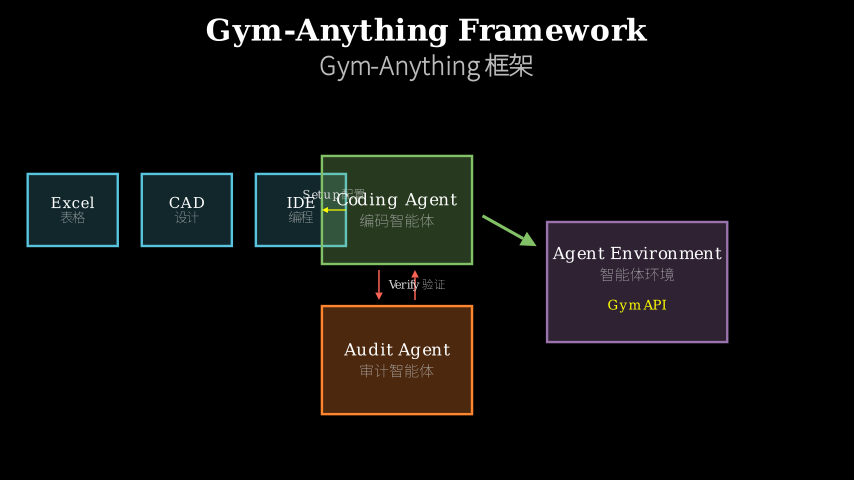
Gym-Anything treats environment creation as a coding task. You give it a software application and a task description. A coding agent writes bash scripts to install the software, download real-world datasets (research papers for reference managers, DICOM files for medical viewers, CAD models for engineering tools), configure settings, and produce evidence that setup succeeded (screenshots, log files, API responses). An audit agent then reviews this evidence against a quality checklist: Is the software actually installed? Is the data realistic? Can the task be completed?
The pipeline runs iteratively. If the auditor finds issues (“the database has no tables” or “the screenshot shows an error dialog”), the coder tries again. Once the auditor approves, the environment is packaged with train/test splits. The authors applied this to 200 applications selected from a taxonomy of U.S. occupations weighted by GDP contribution — so you get medical imaging software, astronomical data analysis tools, enterprise resource planning systems, not just web browsers.
Input: Software + Task Description
    |
    v
+------------------+
| Coding Agent     |  Writes setup scripts
| - Install deps   |  Downloads real data
| - Configure app  |  Produces evidence
+------------------+
    |
    v
Evidence: Screenshots, logs, API responses
    |
    v
+------------------+
| Audit Agent      |  Checks quality
| - Software works?|  Reviews evidence
| - Data realistic?|  Against checklist
+------------------+
    |
    +---> Fail: Loop back to coder
    |
    +---> Pass: Package environment
Think of it like a restaurant opening. The coding agent is the contractor who installs equipment, stocks ingredients, and sets up the kitchen. They take photos and write reports to prove everything’s ready. The audit agent is the health inspector who checks against a list: Is the fridge cold? Are ingredients fresh? Is the stove working? If something’s wrong, the contractor fixes it. Once approved, the restaurant opens for business (the environment is ready for agent training).
The key insight: environment creation has structure. You always need installation, data, configuration, and verification. By framing this as a multi-agent task with explicit evidence and auditing, you can automate what previously required human expertise for each application.
Key Concepts
-
Evidence-based setup: Instead of just running scripts and hoping they work, the coding agent must produce artifacts (screenshots showing the app launched, log files confirming data loaded, API calls returning expected results). The auditor reviews these artifacts against a checklist. This mirrors how humans verify complex setups — you don’t trust the script, you check the outcome. It’s the difference between “I ran
npm install” and “here’s a screenshot of the dev server running on port 3000.” -
Long-horizon tasks: Most benchmarks have tasks completing in 10-50 steps (click here, type that, submit). CUA-World-Long has tasks requiring 500+ steps — like processing a batch of medical images through multiple analysis stages, or configuring an enterprise system with dozens of interdependent settings. These aren’t artificially lengthened; they reflect real workflows where you navigate complex software, wait for computations, handle errors, and iterate. The challenge shifts from “can the agent click buttons” to “can it maintain context and recover from failures over extended interactions.”
-
Economic grounding: The authors built a taxonomy of occupations from U.S. Bureau of Labor Statistics data, weighted by GDP contribution. So instead of picking random software, they selected applications used in high-value occupations: radiologists use medical imaging tools, astronomers use data analysis software, engineers use CAD systems. This ensures the benchmark reflects tasks people actually get paid to do, not just tasks that are easy to automate.
Framework Shift
Before (mainstream approach):        After (this paper):

Human manually creates env           Agent pipeline creates env
    |                                    |
    v                                    v
[Web browser]                        [Coder writes setup]
[Simple e-commerce]                      |
[~20 apps]                               v
[<50 steps/task]                     [Auditor verifies]
                                         |
Limited to what humans                   v
can manually set up                  [200 apps, 10K+ tasks]
                                     [500+ steps/task]

                                     Scales to any software
One sentence: From human-bottlenecked toy environments to agent-automated realistic workflows, the core shift is treating environment creation itself as an automatable task.
Expert Assessment
Problem choice: This is a real gap. The field has been stuck on WebShop and MiniWoB for years because nobody wants to spend months setting up CAD software environments. The economic grounding is smart — it forces the benchmark toward tasks that matter, not just tasks that are easy to measure. The problem sits at the intersection of scaling (how do we get more environments?) and realism (how do we get tasks that reflect actual work?).
Method maturity: The multi-agent setup is straightforward but effective. The evidence-based auditing is the clever bit — it’s not just “did the script exit 0?” but “can you prove the environment works?” This mirrors how humans actually verify complex setups. However, the paper doesn’t deeply explore failure modes: what happens when the coder and auditor get stuck in a loop? How often does the pipeline produce broken environments that pass auditing? The distillation experiments (2B model outperforming 4B models) suggest the data quality is high, but more ablations on the auditing process would strengthen the claims.
Experimental integrity: The baselines are fair — they compare against existing benchmarks (WebArena, OSWorld) and show CUA-World is harder. The test-time auditing (VLM reviews trajectories and provides feedback) is a nice touch, though the improvement (11.5% → 14.0%) is modest. The 500+ step tasks are genuinely long-horizon, not artificially padded. One concern: the paper doesn’t report inter-annotator agreement on task quality or how many generated environments were discarded. Without this, it’s hard to assess the pipeline’s reliability.
Writing quality: The paper front-loads motivation well but rushes through the technical details. The auditing checklist (Appendix) should be in the main text — it’s central to understanding how quality is enforced. The taxonomy of occupations is mentioned but not visualized; a figure showing GDP-weighted coverage would make the economic grounding more concrete. The distillation experiments feel tacked on; they’d be stronger as a separate contribution or integrated more tightly with the environment creation story.
Verdict: weak accept — Solves a real scaling problem with a practical method, but the evaluation could be more rigorous and the writing could better highlight the core contributions.
Takeaways
Steal the evidence-based verification pattern: When automating complex setups (infrastructure, data pipelines, test environments), don’t just check exit codes — require the automation to produce artifacts (logs, screenshots, API responses) and have a separate process audit them. This catches silent failures and makes debugging tractable.
Use economic grounding to prioritize: If you’re building a benchmark or dataset, weight your selection by real-world value (GDP, user time, market size). This forces you toward tasks that matter and away from tasks that are just easy to measure.
Test-time auditing as a general pattern: The idea of a separate model reviewing completed trajectories and providing feedback is underexplored. It’s not just for computer-use agents — any multi-step generation task (code, proofs, plans) could benefit from a critic that identifies what’s missing or wrong, then feeds that back for refinement.
论文: 2604.06126 作者: Pranjal Aggarwal, Graham Neubig, Sean Welleck 分类: cs.LG, cs.AI
缺口
现有的计算机使用智能体研究聚焦于玩具任务:在电商网站上点点点、调整操作系统设置、也许填个表单。
这些基准测试使用5到20个软件应用,任务在50步内完成,与实际经济活动几乎没有联系。
问题不在于研究者不想要更难的任务——而是为复杂软件(CAD工具、医学影像系统、企业数据库)创建环境需要每个应用花费数周的手工设置。
你需要安装依赖、配置设置、填充真实数据、验证一切正常。
这无法规模化。
边界在于:我们无法在有经济价值的任务上研究智能体,因为环境创建是人力瓶颈。
问题:手工环境创建无法规模化
    |
    v
假设:环境设置本身是智能体可以完成的任务
    |
    v
方法:多智能体流水线(编码器+审计器)自动化设置
    |
    v
证据:200个应用 -> 1万+任务,任务需要500+步骤
    |
    v
结论:智能体现在可以在真实经济工作流上训练
增量
一句话: 这篇论文之前,计算机使用基准覆盖约20个应用上的玩具任务;之后,我们有了跨越200个经济基础应用的1万+真实任务。
核心机制
Gym-Anything将环境创建视为编码任务。
你给它一个软件应用和任务描述。
编码智能体编写bash脚本来安装软件、下载真实世界数据集(参考文献管理器的研究论文、医学查看器的DICOM文件、工程工具的CAD模型)、配置设置,并产生设置成功的证据(截图、日志文件、API响应)。
审计智能体然后根据质量检查清单审查这些证据:软件真的安装了吗?数据真实吗?任务能完成吗?
流水线迭代运行。
如果审计器发现问题(“数据库没有表”或”截图显示错误对话框”),编码器再试一次。
一旦审计器批准,环境就被打包成训练/测试分割。
作者将此应用于200个应用,这些应用从按GDP贡献加权的美国职业分类中选出——所以你得到医学影像软件、天文数据分析工具、企业资源规划系统,而不仅仅是网页浏览器。
输入:软件 + 任务描述
    |
    v
+------------------+
| 编码智能体       |  编写设置脚本
| - 安装依赖       |  下载真实数据
| - 配置应用       |  产生证据
+------------------+
    |
    v
证据:截图、日志、API响应
    |
    v
+------------------+
| 审计智能体       |  检查质量
| - 软件工作?     |  审查证据
| - 数据真实?     |  对照检查清单
+------------------+
    |
    +---> 失败:循环回编码器
    |
    +---> 通过:打包环境
把它想象成餐厅开业。
编码智能体是承包商,安装设备、备货、布置厨房。
他们拍照片、写报告来证明一切就绪。
审计智能体是卫生检查员,对照清单检查:冰箱冷吗?食材新鲜吗?炉子能用吗?如果有问题,承包商修复它。
一旦批准,餐厅开业(环境准备好供智能体训练)。
关键洞察:环境创建有结构。
你总是需要安装、数据、配置和验证。
通过将其框架化为带有明确证据和审计的多智能体任务,你可以自动化以前每个应用都需要人类专业知识的工作。
关键概念
- 基于证据的设置:编码智能体不是只运行脚本然后希望它们工作,而是必须产生工件(显示应用启动的截图、确认数据加载的日志文件、返回预期结果的API调用)。
审计器根据检查清单审查这些工件。
这反映了人类如何验证复杂设置——你不信任脚本,你检查结果。
这是”我运行了npm install”和”这是开发服务器在3000端口运行的截图”之间的区别。
- 长时程任务:大多数基准的任务在10到50步内完成(点这里、输入那个、提交)。
CUA-World-Long的任务需要500+步骤——比如通过多个分析阶段处理一批医学图像,或配置具有数十个相互依赖设置的企业系统。
这些不是人为拉长的;它们反映真实工作流,你在其中导航复杂软件、等待计算、处理错误、迭代。
挑战从”智能体能点击按钮吗”转变为”它能在扩展交互中维持上下文并从失败中恢复吗”。
- 经济基础:作者从美国劳工统计局数据构建了职业分类,按GDP贡献加权。
所以不是随机挑选软件,而是选择高价值职业使用的应用:放射科医生使用医学影像工具,天文学家使用数据分析软件,工程师使用CAD系统。
这确保基准反映人们实际获得报酬去做的任务,而不仅仅是容易自动化的任务。
框架转变
之前(主流方法):                之后(本文方法):

人工手动创建环境                  智能体流水线创建环境
    |                                 |
    v                                 v
[网页浏览器]                      [编码器编写设置]
[简单电商]                            |
[约20个应用]                          v
[<50步/任务]                      [审计器验证]
                                      |
受限于人类能                          v
手动设置的范围                    [200个应用,1万+任务]
                                  [500+步/任务]

                                  扩展到任意软件
一句话:从人力瓶颈的玩具环境到智能体自动化的真实工作流,核心转变是将环境创建本身视为可自动化的任务。
专家评审
选题眼光:这是真缺口。
该领域在WebShop和MiniWoB上卡了好几年,因为没人想花几个月设置CAD软件环境。
经济基础很聪明——它迫使基准朝向重要的任务,而不仅仅是容易衡量的任务。
问题位于规模化(我们如何获得更多环境?)和真实性(我们如何获得反映实际工作的任务?)的交叉点。
方法成熟度:多智能体设置直接但有效。
基于证据的审计是巧妙之处——不仅仅是”脚本退出0了吗?“而是”你能证明环境工作吗?“这反映了人类实际如何验证复杂设置。
然而,论文没有深入探索失败模式:当编码器和审计器陷入循环时会发生什么?流水线多久产生一次通过审计但实际损坏的环境?蒸馏实验(2B模型优于4B模型)表明数据质量高,但更多关于审计过程的消融实验会加强主张。
实验诚意:基线公平——他们与现有基准(WebArena、OSWorld)比较,显示CUA-World更难。
测试时审计(VLM审查轨迹并提供反馈)是个好点子,尽管改进(11.5% → 14.0%)不大。
500+步任务是真正的长时程,不是人为填充。
一个担忧:论文没有报告任务质量的标注者间一致性,或有多少生成的环境被丢弃。
没有这个,很难评估流水线的可靠性。
写作功力:论文前面动机做得好,但技术细节匆忙。
审计检查清单(附录)应该在正文中——它对理解如何执行质量至关重要。
职业分类被提及但没有可视化;一个显示GDP加权覆盖的图会使经济基础更具体。
蒸馏实验感觉是附加的;作为单独贡献或与环境创建故事更紧密集成会更强。
判决:弱接收 — 用实用方法解决了真实的规模化问题,但评估可以更严格,写作可以更好地突出核心贡献。
要点总结
偷走基于证据的验证模式:当自动化复杂设置(基础设施、数据管道、测试环境)时,不要只检查退出码——要求自动化产生工件(日志、截图、API响应),并让单独的流程审计它们。
这能捕获静默失败,使调试变得可行。
使用经济基础来排优先级:如果你在构建基准或数据集,按真实世界价值(GDP、用户时间、市场规模)加权你的选择。
这迫使你朝向重要的任务,远离仅仅容易衡量的任务。
测试时审计作为通用模式:单独模型审查完成的轨迹并提供反馈的想法未被充分探索。
它不仅适用于计算机使用智能体——任何多步生成任务(代码、证明、计划)都可以从识别缺失或错误内容的批评者中受益,然后将其反馈用于改进。