Paper: 2605.05193 Authors: Paata Ivanisvili, Xinyuan Xie Categories: math.PR, cs.AI, math.AP, math.CA, math.FA
The Gap
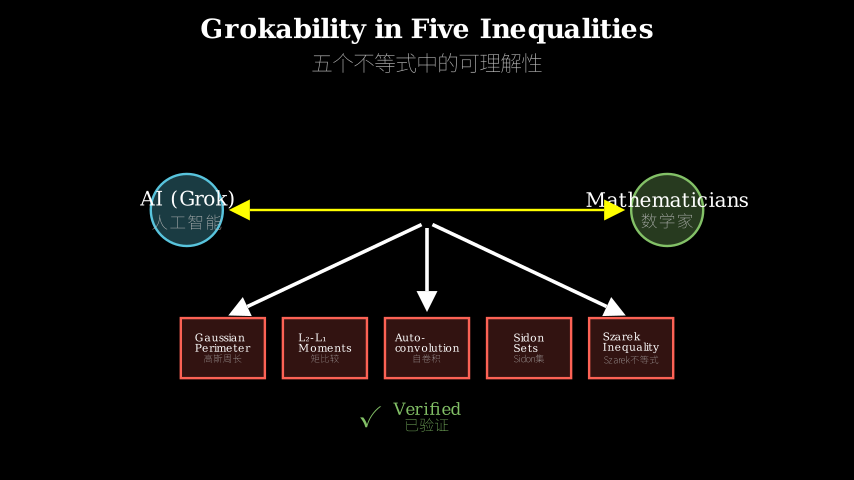
Mathematical inequalities are the workhorses of analysis—they bound errors, control approximations, and reveal structure. But finding sharp constants and optimal forms is notoriously hard. Existing bounds for Gaussian perimeter, moment comparisons on the Hamming cube, autoconvolution inequalities, Sidon set sizes, and Szarek’s inequality all had room for improvement, but the techniques to tighten them weren’t obvious. The gap wasn’t conceptual—it was computational and exploratory. Researchers knew better bounds existed but lacked the pattern-matching horsepower to find them.
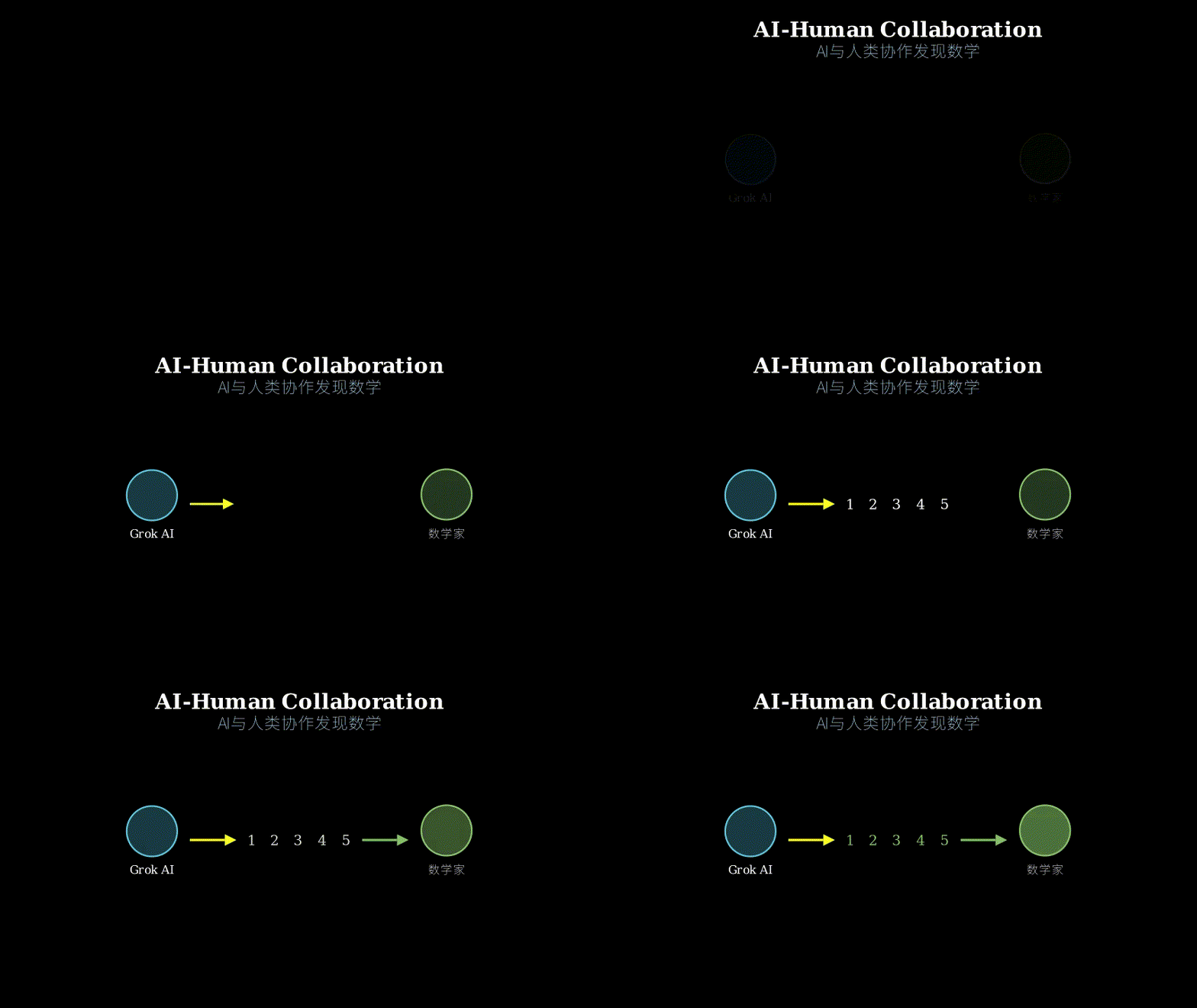
This paper reports five improvements discovered through human-AI collaboration with Grok. The authors posed problems, Grok suggested candidate inequalities, and the authors verified the proofs. The workflow: conjecture generation by AI, rigorous verification by humans.
Known bounds (suboptimal)
         |
         v
    [Grok explores]  <--- Human poses problem
         |
         v
  Candidate inequality
         |
         v
  [Human verifies] ---> New sharp bound
The Increment
One sentence: Before this paper, five classical inequalities had loose constants; after, we have tighter bounds with human-verified proofs, showing AI can accelerate conjecture generation in pure math.
Core Mechanism
The method isn’t a single algorithm—it’s a collaboration protocol. The human researcher identifies a problem where the current bound feels improvable. They frame it for Grok: “Can we improve the constant in this inequality?” Grok, trained on vast mathematical corpora, pattern-matches against similar structures and proposes candidate improvements. The human then takes the candidate and either proves it rigorously or finds a counterexample.
Human: Problem framing
   |
   v
Grok: Pattern matching + conjecture generation
   |
   v
Human: Rigorous proof or counterexample
   |
   v
Verified result (or back to Grok)
Think of it like a chess engine partnership. The engine (Grok) evaluates millions of positions and suggests promising moves. The grandmaster (mathematician) understands why a move works, sees the deeper strategy, and decides whether to commit. The engine doesn’t understand chess—it pattern-matches. The grandmaster doesn’t have infinite compute—they rely on intuition. Together, they reach positions neither could alone. Here, Grok doesn’t “understand” why an inequality holds, but it recognizes structural patterns from training data. The mathematician doesn’t have time to test thousands of candidate constants, but they know how to verify a proof once they see it.
Key Concepts
-
Gaussian perimeter: Imagine a blob in high-dimensional space. The Gaussian perimeter measures how much “surface area” it has when you weight points by a Gaussian distribution (bell curve). Convex sets (no dents) have special properties—this paper improves the lower bound on how much perimeter they must have. Concretely: if you draw a convex shape in 100 dimensions and measure its boundary under Gaussian weighting, this paper tells you it can’t be too small.
-
Hamming cube moment comparison: The Hamming cube {-1,1}^n is the set of all n-bit strings (think: coin flips). A function on this cube assigns a number to each string. Moment comparison asks: how do different ways of averaging (L_2 vs L_1 norms) relate? This paper sharpens the inequality connecting these averages, which matters for analyzing Boolean functions and noise stability.
-
Sidon sets: A Sidon set is a collection of numbers where all pairwise sums are distinct. Example: {1, 2, 5, 7} is Sidon because 1+2=3, 1+5=6, 1+7=8, 2+5=7… wait, 1+7=8 and no collision. Finding the largest Sidon set in {1,…,n} is a classic combinatorics problem. This paper improves the asymptotic bound—we now know these sets can’t grow faster than a certain rate.
Framework Shift
Before (human-only):                After (human-AI):

Mathematician                       Mathematician
    |                                   |
    v                                   v
Intuition + experience          Problem framing
    |                                   |
    v                                   v
Try candidate bounds            Grok explores space
    |                                   |
    v                                   v
Manual verification             Candidate inequalities
    |                                   |
    v                                   v
New result (slow)               Human verifies (fast)
                                        |
                                        v
                                  New result (faster)
From solo exploration to collaborative search, the core shift is offloading conjecture generation to AI while keeping verification human.
Expert Assessment
Problem choice: These are real gaps—classical inequalities with known slack. Not manufactured problems, but also not the deepest mysteries in their fields. They sit in the “known to be improvable but tedious to improve” zone, which is exactly where AI assistance shines.
Method maturity: This isn’t a method paper—it’s a report of results. The “method” (ask Grok for conjectures) is more workflow than algorithm. The value is in the verified results, not the process. That said, the process is underspecified: we don’t know how many failed conjectures Grok produced, how the authors prompted it, or whether the improvements are near-optimal or just incremental.
Experimental integrity: The results are mathematical proofs, so “experimental integrity” means proof correctness. The authors claim verification, and given their expertise (Ivanisvili is a respected analyst), I trust the proofs are sound. But the paper would be stronger if it included the proofs inline or in an appendix, not just “we verified them.”
Writing quality: This is a short note, not a full paper. It reads like a progress report: “Here are five things we found.” That’s fine for a rapid communication, but it leaves questions unanswered. How much human effort went into each result? How many dead ends did Grok produce? What’s the hit rate? A longer version with proof sketches and workflow details would be more valuable.
Verdict: weak accept — Solid results in a novel collaboration mode, but the paper is more “look what we did” than “here’s how to do it.” The inequalities themselves are contributions; the AI angle is interesting but underexplored.
Takeaways
If you’re working on optimization, approximation theory, or any field where you’re hunting for sharp constants: use AI as a conjecture engine. Frame your problem clearly, let the model explore the space, then verify rigorously. The hit rate might be low, but even one good conjecture can save weeks of manual search.
For AI researchers: this is what “AI for science” looks like when it works—not replacing human insight, but accelerating the search through a vast space of possibilities. The bottleneck shifts from “finding candidates” to “verifying candidates,” which is often faster.
For mathematicians skeptical of AI: this paper shows AI doesn’t need to “understand” math to be useful. Pattern matching over a large corpus can surface non-obvious candidates. Your job—proof and insight—remains irreplaceable.
论文: 2605.05193 作者: Paata Ivanisvili, Xinyuan Xie 分类: math.PR, cs.AI, math.AP, math.CA, math.FA
缺口
数学不等式是分析学的主力工具——它们限定误差、控制逼近、揭示结构。
但找到最优常数和最优形式出了名地难。
高斯周长、Hamming 立方体上的矩比较、自卷积不等式、Sidon 集大小、Szarek 不等式的现有界都有改进空间,但收紧它们的技术并不明显。
缺口不在概念层面——而在计算和探索层面。
研究者知道更好的界存在,但缺乏模式匹配的算力去找到它们。
本文报告了通过与 Grok AI 合作发现的五个改进。
作者提出问题,Grok 建议候选不等式,作者验证证明。
工作流:AI 生成猜想,人类严格验证。
已知界(次优)
    |
    v
[Grok 探索] <--- 人类提出问题
    |
    v
候选不等式
    |
    v
[人类验证] ---> 新的最优界
增量
一句话: 这篇论文之前,五个经典不等式的常数是松的;之后,我们有了更紧的界和人类验证的证明,展示了 AI 能加速纯数学中的猜想生成。
核心机制
这个方法不是单一算法——而是一个协作协议。
人类研究者识别出一个当前界感觉可改进的问题。
他们为 Grok 框定问题:“我们能改进这个不等式中的常数吗?“Grok 在海量数学语料上训练过,对相似结构做模式匹配,提出候选改进。
人类接过候选,要么严格证明它,要么找到反例。
人类:问题框定
   |
   v
Grok:模式匹配 + 猜想生成
   |
   v
人类:严格证明或反例
   |
   v
验证结果(或回到 Grok)
把它想象成国际象棋引擎合作。
引擎(Grok)评估数百万个局面,建议有希望的走法。
特级大师(数学家)理解为什么一步棋有效,看到更深的策略,决定是否采纳。
引擎不理解象棋——它做模式匹配。
特级大师没有无限算力——他们依赖直觉。
两者结合,到达任何一方单独无法到达的局面。
这里,Grok 不”理解”为什么不等式成立,但它从训练数据中识别结构模式。
数学家没时间测试数千个候选常数,但他们知道看到证明后如何验证。
关键概念
- 高斯周长: 想象高维空间中的一团东西。
高斯周长衡量当你用高斯分布(钟形曲线)给点加权时,它有多少”表面积”。
凸集(没有凹陷)有特殊性质——本文改进了它们必须有多少周长的下界。
具体地说:如果你在 100 维空间画一个凸形状,在高斯加权下测量它的边界,本文告诉你它不能太小。
- Hamming 立方体矩比较: Hamming 立方体 {-1,1}^n 是所有 n 位字符串的集合(想象:抛硬币)。
立方体上的函数给每个字符串分配一个数。
矩比较问:不同的平均方式(L_2 范数 vs L_1 范数)如何关联?本文锐化了连接这些平均的不等式,这对分析布尔函数和噪声稳定性很重要。
- Sidon 集: Sidon 集是一组数,其中所有成对和都不同。
例子:{1, 2, 5, 7} 是 Sidon 集,因为 1+2=3, 1+5=6, 1+7=8, 2+5=7, 2+7=9, 5+7=12,没有碰撞。
在 {1,…,n} 中找最大 Sidon 集是经典组合问题。
本文改进了渐近界——我们现在知道这些集合的增长不能快于某个速率。
框架转变
之前(纯人类):                之后(人机协作):

数学家                          数学家
    |                               |
    v                               v
直觉 + 经验                     问题框定
    |                               |
    v                               v
尝试候选界                      Grok 探索空间
    |                               |
    v                               v
手工验证                        候选不等式
    |                               |
    v                               v
新结果(慢)                    人类验证(快)
                                    |
                                    v
                              新结果(更快)
从单独探索到协作搜索,核心转变是把猜想生成卸载给 AI,同时保持验证在人类手中。
专家评审
选题眼光: 这些是真缺口——经典不等式有已知的松弛。
不是人造问题,但也不是这些领域最深的谜题。
它们处于”已知可改进但改进起来繁琐”的区域,这正是 AI 辅助发光的地方。
方法成熟度: 这不是方法论文——而是结果报告。
“方法”(向 Grok 要猜想)更像工作流而非算法。
价值在验证的结果,而非过程。
话虽如此,过程描述不足:我们不知道 Grok 产生了多少失败猜想,作者如何提示它,或者这些改进是接近最优还是只是增量式的。
实验诚意: 结果是数学证明,所以”实验诚意”意味着证明正确性。
作者声称验证过,鉴于他们的专业水平(Ivanisvili 是受尊敬的分析学家),我相信证明是可靠的。
但如果论文内联或在附录中包含证明,而不只是”我们验证了”,会更有力。
写作功力: 这是一个短注释,不是完整论文。
读起来像进度报告:“这是我们发现的五件事。
“对快速通讯来说没问题,但留下了未解答的问题。
每个结果投入了多少人力?Grok 产生了多少死胡同?命中率是多少?包含证明草图和工作流细节的长版本会更有价值。
判决: 弱接收 — 在新颖协作模式下的扎实结果,但论文更像”看我们做了什么”而非”这是怎么做的”。
不等式本身是贡献;AI 角度有趣但探索不足。
要点总结
如果你在做优化、逼近理论,或任何你在寻找最优常数的领域:把 AI 当作猜想引擎。
清晰地框定你的问题,让模型探索空间,然后严格验证。
命中率可能很低,但即使一个好猜想也能节省数周的手工搜索。
对 AI 研究者:这就是”科学 AI”有效时的样子——不是替代人类洞察,而是加速在巨大可能性空间中的搜索。
瓶颈从”找候选”转移到”验证候选”,后者通常更快。
对怀疑 AI 的数学家:本文展示 AI 不需要”理解”数学就能有用。
在大语料库上的模式匹配能浮现非显而易见的候选。
你的工作——证明和洞察——仍然不可替代。