Paper: <img alt=“2604.03190” src=“https://e1a4c9d0d2f9f737c5e1.ucr.io/-/preview/https://api.urlbox.io/v1/NTYqWgJv5s0qDIxN/jpeg?url=https%3A%2F%2Farxiv.org%2Fabs%2F2604.03190&full_page=true&width=1024&max_height=2048&quality=80” />
Authors: Saleh Sargolzaei
Categories: cs.LG, cs.AI
The Gap
Standard Transformer attention is a “one-pass” estimator. It looks at the keys, calculates a softmax weight, and blends the values. If that blend is slightly off—maybe the softmax was too peaky or a key was noisy—the layer has no way to fix it. It just hands the error to the next layer. Prior work like “Tukey’s Twicing” tried to fix this by re-running the same projections, but it lacked the flexibility to catch information the first pass missed entirely.
This paper addresses the “unforgiving” nature of single-pass attention by embedding the principle of Gradient Boosting (fitting to residuals) directly inside the attention mechanism itself.
[ One-pass Attention ] -> [ Static Softmax Weight ] -> [ Error Accumulation ]
           |                       |                          |
           v                       v                          v
[ Problem: No Feedback ] -> [ Assumption: Error is ] -> [ Method: Boosted ]
[  Loop within Layer   ]    [  Learned & Gatable   ]    [    Attention    ]
           |                       |                          |
           v                       v                          v
[ Evidence: WikiText ] <--- [ 4.3 PPL Reduction  ] <--- [ Result: Better ]
[  103 Benchmark     ]      [ vs Standard Attn   ]      [ Representation ]
The Increment
One sentence: Before this paper, attention was a single shot at guessing context; after this paper, it’s a two-stage process where the second stage specifically targets and fixes the first stage’s mistakes.
Core Mechanism
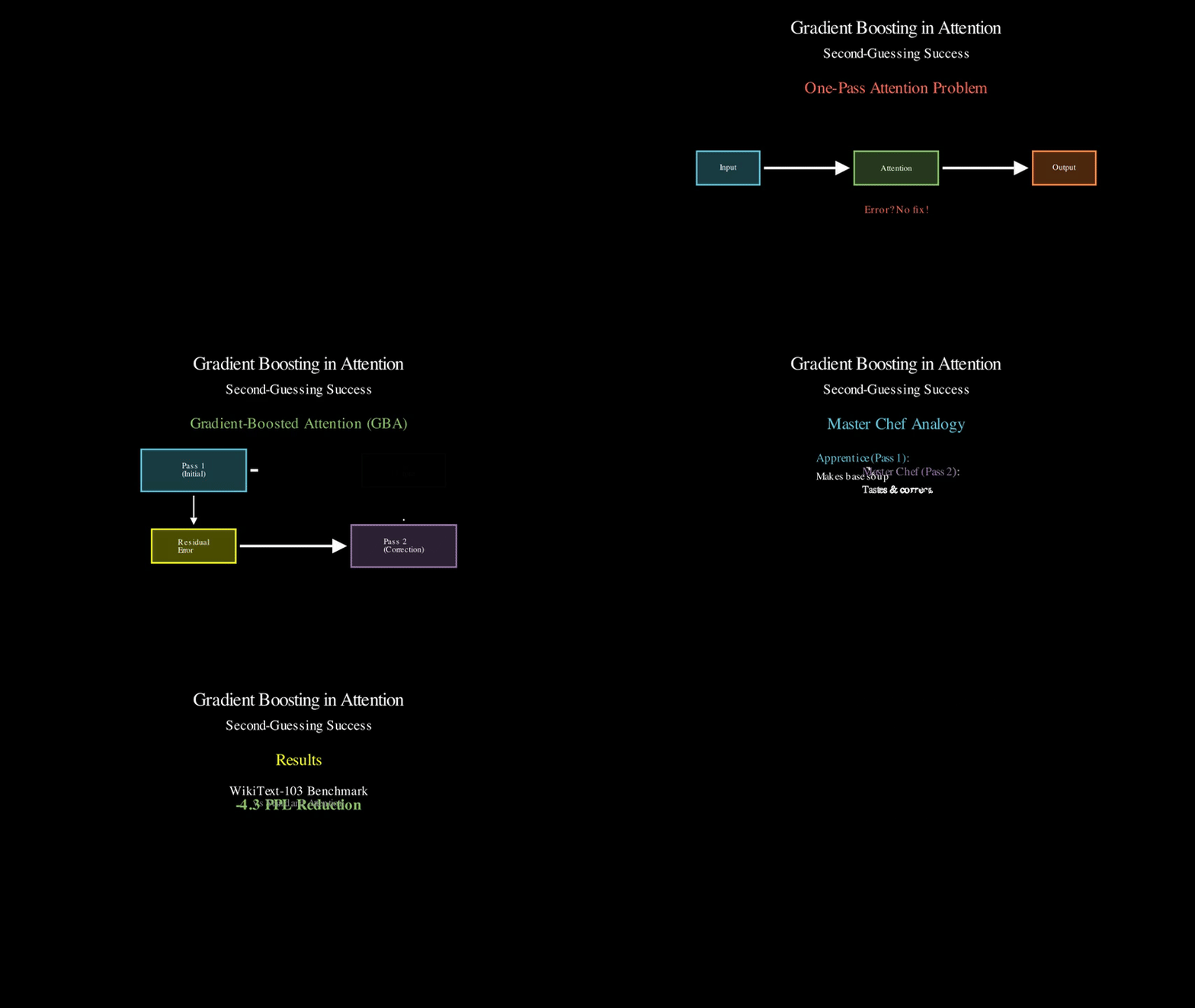
The method, called Gradient-Boosted Attention (GBA), splits the attention operation into two steps. The first pass is your standard Query-Key-Value interaction. It produces an initial output. The “residual” (the gap between what we have and what we need) is then calculated.
In the second pass, the same queries attend to the same keys, but they use a separate set of learned projections specifically optimized to predict that residual error. A learnable gate (the “shrinkage” parameter from boosting theory) then scales this correction before it’s added back to the first output. This allows the model to “double-check” its work and refine its focus.
Input X --> [ Proj 1 ] --> [ Attn 1 ] --------+-----> Output Y
               |                               ^
               |                               | (Add)
               +---------> [ Error Calc ]      |
                               |               |
                           [ Proj 2 ] --> [ Attn 2 ] (Correction)
                               |               ^
                           [  Gate  ] ---------+
To understand GBA, think of a Master Chef and an Apprentice.
- The Apprentice (Pass 1) prepares the base soup. They follow the recipe (learned weights) and do their best, but it’s never perfect.
- The Master Chef (Pass 2) doesn’t start a new soup from scratch. Instead, they taste the Apprentice’s work, identify exactly what’s missing (the Residual), and add a specific “correction” (a dash of salt or a squeeze of lime).
- The Gate is the Chef’s restraint—they don’t dump the whole bottle of salt in; they add just enough to perfect the flavor. Without the Master’s second taste, the dish would go to the customer (the next layer) with whatever flaws the Apprentice left behind.
Key Concepts
- Tukey’s Twicing: A classical statistical technique where you fit a model to your data, then fit the *same model to the resulting residuals. GBA improves on this by using different weights for the second fit.
- Shrinkage: In Gradient Boosting, you don’t add 100% of the new model’s prediction. You scale it down (e.g., by 0.1). GBA makes this scale factor a learnable, per-dimension gate.
- Hopfield-style Update: The paper links this to associative memory. One pass “cleans” the query, but multiple passes can actually collapse similar queries into a more stable “fixed point” in memory.
Framework Shift
Before (Standard Attention):         After (Boosted Attention):
[ Q, K, V ]                          [ Q, K, V ] (Base)
     |                                    |
  [Attn]                               [Attn] ----> [Residual]
     |                                    |            |
  [Out ]                               [Out ] <--- [Attn_Fix] (Boost)
One sentence: From “Fire-and-forget” to “Iterative refinement,” the core shift is the explicit modeling of the attention residual within a single layer.
Expert Assessment
Problem choice: Real. We’ve known for a while that Transformers are “over-parameterized but under-calculated” in single steps. Applying boosting at this granularity is a logical evolution of the “Deep Equilibrium” or “Recurrent” Transformer ideas.
Method maturity: It’s a clever use of classical stats. Using separate projections for the correction pass is the “secret sauce” here—it prevents the second pass from just repeating the same bias as the first.
Experimental integrity: The baselines are solid. Matching the parameters of a “wider” baseline is the right way to prove that the *structure matters, not just the extra weights. A ~4 point perplexity drop on WikiText-103 is non-trivial.
Writing quality: The math linking this to Friedman’s GBM is elegant, but the section on Hopfield updates feels a bit “tacked on” to appeal to the current trend in associative memory research. It could be clearer.
Verdict: Strong Accept — It provides a mathematically grounded, empirically successful way to make individual attention layers much more powerful without just stacking more of them.
Takeaways
Practitioners can “steal” the idea of Residual Projections. If you have a component that is struggling with accuracy, don’t just make it bigger. Try adding a “correction head” that looks at the first head’s output and learns to predict the error. This is often more parameter-efficient than simply doubling the hidden dimension.
论文: Gradient Boosting within a Single Attention Layer 作者: Saleh Sargolzaei 分类: cs.LG, cs.AI
缺口
标准的 Transformer 注意力机制是一种“单次博弈”。 它查阅键(Keys),计算 Softmax 权重,然后融合值(Values)。 如果这个融合过程稍有偏差——比如 Softmax 权重分配太极端,或者某个键包含了噪音——这个层完全没有办法自我修复。 它只能把这个误差丢给下一层。 此前像“Tukey’s Twicing”这样的研究尝试通过重新运行相同的投影来修复,但它缺乏灵活性,无法捕捉到第一遍扫描完全漏掉的信息。
这篇论文针对单次注意力“不容错”的局限,将梯度提升(Gradient Boosting,即针对残差建模)的原理直接嵌入到了注意力机制内部。
[ 单次注意力 ] -> [ 静态 Softmax 权重 ] -> [ 误差累积 ]
      |                 |                    |
      v                 v                    v
[ 问题:层内  ] -> [ 假设:误差是   ] -> [ 方法:提升式 ]
[ 缺乏反馈    ]    [ 可学习且可控的 ]    [ 注意力机制 ]
      |                 |                    |
      v                 v                    v
[ 证据:Wiki  ] <--- [ 困惑度降低 4.3  ] <--- [ 结论:更优的 ]
[ Text-103    ]      [ 优于标准注意力  ]      [ 特征表示     ]
增量
一句话: 在这篇论文之前,注意力是盲目的一次性推测;在这篇论文之后,它变成了一个两步走的动态过程,第二步专门盯着第一步的错误进行修补。
核心机制
这种方法被称为梯度提升注意力(GBA)。 它将注意力操作分为两步。 第一遍是标准的 Q-K-V 交互,产生一个初始输出。 然后计算“残差”(即我们已经拥有的和我们真正需要的之间的差距)。
在第二遍中,相同的查询(Queries)再次查找相同的键(Keys),但它们使用的是一套完全独立的学习投影权重。 这套权重专门为了预测第一遍的残差误差而优化。 最后,一个可学习的门控参数(来自提升理论中的“收缩”参数)会对这个纠错项进行缩放,然后加回初始输出中。 这让模型能够“复核”自己的工作并精细化焦点。
输入 X --> [ 投影 1 ] --> [ 注意力 1 ] --------+-----> 输出 Y
               |                                 ^
               |                                 | (累加)
               +---------> [ 误差计算 ]          |
                               |                 |
                           [ 投影 2 ] --> [ 注意力 2 ] (纠错)
                               |                 ^
                           [ 门控 ] -------------+
为了理解 GBA,我们可以把它想象成大厨与学徒的关系。
- 学徒(第一遍)负责熬制底汤。 他们按照菜谱(学习到的权重)尽力而为,但总是不够完美。
- 大厨(第二遍)不会从头再熬一锅汤。 相反,大厨会品尝学徒的作品,精准找出缺失的味道(残差),然后加入特定的“补救措施”(比如一勺盐或几滴青柠汁)。
- 门控则是大厨的克制——他们不会把整瓶盐都倒进去,而是恰到好处地提升风味。 如果没有大厨的“回过头再尝一口”,这道菜(数据)就会带着学徒留下的瑕疵直接送到客人(下一层)面前。
关键概念
- Tukey’s Twicing: 一种经典的统计技术,先用模型拟合数据,再用**同一个模型拟合产生的残差。 GBA 的进步在于它为第二次拟合使用了不同*的权重。
- 收缩 (Shrinkage): 在梯度提升中,你不会 100% 加上新模型的预测。 你会按比例缩小(比如乘以 0.1)。 GBA 将这个比例变成了一个可学习的、逐维度的门控。
- Hopfield 式更新: 论文将其与关联记忆联系起来。 单次扫描只是“清洗”查询,而多次迭代可以将相似的查询坍缩到记忆中更稳定的“不动点”。
框架转变
之前(主流方法):                之后(本文方法):
[ Q, K, V ]                       [ Q, K, V ] (基础)
     |                                 |
  [注意力]                         [注意力] ----> [残差]
     |                                 |            |
  [输出 ]                          [输出 ] <--- [纠错注意力] (提升)
一句话:从“打完收工”到“迭代精炼”,核心转变是在单个层内实现了对注意力残差的显式建模。
专家评审
选题眼光: 极具洞察力。 我们早就知道 Transformer 在单步计算上往往是“参数过剩但计算不足”。 在如此细的粒度上应用提升算法,是“深度平衡”或“递归”Transformer 理念的逻辑演进。
方法成熟度: 这是对经典统计学的巧妙运用。 在纠错步骤使用独立的投影权重是这里的“神来之笔”——它防止了第二遍计算只是简单重复第一遍的偏差。
实验诚意: 基线设置非常扎实。 专门对比了一个“参数量对齐的加宽基线”,这有力证明了是结构在起作用,而不仅仅是堆砌了更多权重。 在 WikiText-103 上降低 4 个点左右的困惑度是非常显著的提升。
写作功力: 将其与 Friedman 的梯度提升机(GBM)联系起来的数学推导非常优雅。 但关于 Hopfield 更新的那部分感觉有点像是为了迎合当前关联记忆的研究热点而“硬塞”进去的,逻辑可以更清晰一些。
判决: 强接收 — 它提供了一个数学基础扎实、实验结果成功的方法,让单个注意力层变得更强大,而不需要简单地堆叠更多层。
要点总结
实践者可以“偷”走 残差投影 (Residual Projections) 这个点子。 如果你发现某个组件的精度遇到了瓶颈,不要只是把它变大。 尝试增加一个“纠错头”,让它观察第一个头的输出并学习预测误差。 这种做法通常比单纯增加隐藏层维度更具参数效率。