
Paper: 2603.12264 Authors: Mingxin Liu, Ziqian Fan, Zhaokai Wang, Leyao Gu, Zirun Zhu, Yiguo He, Yuchen Yang, Changyao Tian, Xiangyu Zhao, Ning Liao Categories: cs.CV
The Gap
Existing image editing benchmarks — think EditBench, Emu Edit, or HIVE — are built around natural images and everyday instructions. “Make the sky pink.” “Remove the dog.” “Add a hat.” These test whether a model can follow surface-level instructions, but they don’t ask whether the model understands anything. The implicit assumption is that editing is a perceptual task, not a reasoning task.
That assumption breaks down the moment you ask a model to edit a physics diagram so that the force vectors are consistent with Newton’s third law, or to modify a historical map so the territorial boundaries reflect post-WWI treaties. Now the model needs to know something — and know that it knows it. Current benchmarks have no way to probe this.
The gap is real: unified multimodal models are increasingly marketed as joint understanding-reasoning-generation systems, but there’s no benchmark that actually stresses the reasoning-generation interface under domain-specific constraints.
Problem: Benchmarks test perception, not knowledge-grounded reasoning
    |
    v
Assumption: Discipline-specific editing requires implicit knowledge retrieval
    |         + structured constraint satisfaction
    v
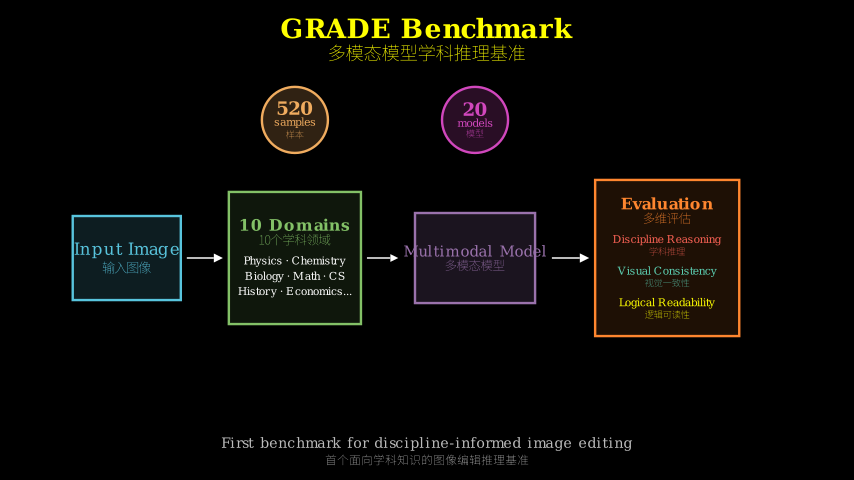
Method: 520 samples x 10 domains, multi-dim eval
    |    (Discipline Reasoning + Visual Consistency + Logical Readability)
    v
Evidence: 20 models tested, large performance gaps exposed
    |
    v
Conclusion: Current models fail at knowledge-intensive editing;
            gap points to next frontier for unified multimodal models
The Increment
One sentence: Before GRADE, there was no way to tell whether a multimodal model was editing images with genuine domain knowledge or just pattern-matching on visual surface features — now there is.
Core Mechanism
GRADE is a benchmark, not a model, so the “method” here is the benchmark construction and evaluation protocol. The dataset contains 520 samples spanning 10 academic disciplines: natural sciences (physics, chemistry, biology, math, geography) and social sciences (history, economics, politics, art, music). Each sample consists of a source image, a discipline-informed editing instruction, a reference edited image, and metadata tagging the domain and reasoning type.
The editing instructions are deliberately implicit — they don’t spell out the rule, they assume the model knows it. “Adjust the circuit diagram so the current flows correctly” doesn’t tell you Kirchhoff’s laws; you’re supposed to know them. This is the key design choice that separates GRADE from prior work.
Evaluation uses three dimensions scored jointly: Discipline Reasoning (does the edit reflect correct domain knowledge?), Visual Consistency (does the edited image remain coherent and artifact-free?), and Logical Readability (is the result interpretable and unambiguous?). The authors use a combination of automated metrics and model-based scoring across 20 open-source and closed-source models.
Input: [Source Image] + [Implicit Discipline Instruction]
    |
    v
Model Output: [Edited Image]
    |
    +---> Discipline Reasoning Score
    |         (is the domain knowledge correct?)
    |
    +---> Visual Consistency Score
    |         (is the image coherent?)
    |
    +---> Logical Readability Score
              (is the result interpretable?)

Aggregated -> GRADE Score -> Cross-model comparison
Think of GRADE like a professional licensing exam for image editing models. A regular benchmark is like a driving test — it checks whether you can operate the vehicle. GRADE is like a medical board exam — it checks whether you actually know medicine before letting you touch a patient. The three evaluation dimensions map cleanly: Discipline Reasoning is the clinical knowledge section, Visual Consistency is the practical skills section, and Logical Readability is the communication section. A model that aces the driving test but fails the board exam is exactly the failure mode GRADE is designed to catch — and apparently, most current models are in that bucket.
Key Concepts
-
Discipline-informed editing: This means the editing instruction encodes a domain constraint that the model must retrieve from training knowledge, not from the image itself. The image doesn’t tell you that the arrow is wrong — you need to know the underlying rule. It’s the difference between “make this line longer” (perceptual) and “fix this free-body diagram so it obeys equilibrium” (knowledge-grounded). The latter requires the model to act as a domain expert, not just a pixel manipulator.
-
Implicit vs. explicit instruction: An explicit instruction says “rotate the force vector 90 degrees clockwise.” An implicit instruction says “correct the force diagram.” The second form is harder because the model must first infer what’s wrong, then decide what to do. GRADE uses implicit instructions throughout, which is why it’s a harder and more realistic test of reasoning capability.
-
Multi-dimensional evaluation: Single-metric evaluation (like FID or CLIP score) collapses everything into one number and loses information. GRADE’s three-axis scoring lets you see *where a model fails — a model might produce visually clean edits that are domain-incorrect, or domain-correct edits that look like artifacts. Separating these dimensions gives a diagnostic profile, not just a ranking.
Framework Shift
Before (mainstream approach):        After (this paper):

  Natural image editing                Discipline-specific editing
  [photo] -> [instruction] ->          [diagram/chart/map] ->
  [edited photo]                       [implicit knowledge instruction] ->
                                       [corrected image]

  Eval: pixel similarity,              Eval: domain correctness
        CLIP alignment,                      + visual coherence
        human preference                     + logical readability

  Assumption: editing = perception     Assumption: editing = perception
                                                  + knowledge retrieval
                                                  + constraint satisfaction

  Models tested on: "add rain"         Models tested on: "fix the
  "remove car" "change color"          thermodynamic cycle diagram"
From surface-level instruction following to knowledge-grounded constraint satisfaction, the core shift is treating image editing as a reasoning task, not just a generation task.
Expert Assessment
Problem choice: This is a real gap, not a manufactured one. The field has been building increasingly capable unified models and claiming they “reason,” but the benchmarks haven’t kept pace. GRADE is a logical next step and fills a genuine hole. It’s not the most technically ambitious paper, but it’s the right paper to write right now.
Method maturity: The benchmark construction is solid but not particularly novel in methodology — curating domain-specific samples and designing multi-dimensional rubrics is established practice. The real contribution is the *content (what domains, what instructions, what evaluation axes), not a new evaluation technique. The implicit instruction design is the sharpest idea here and deserves more theoretical grounding than it probably gets.
Experimental integrity: Testing 20 models is thorough and the cross-model comparison is credible. The main concern is the model-based scoring for Discipline Reasoning — using another model to judge domain correctness is a known reliability issue, especially in specialized domains where the judge model may itself be unreliable. The paper should be scrutinized on how they validate the scoring pipeline, particularly for niche domains like music theory or political science.
Writing quality: The abstract and intro are clean. The section most likely to be undercooked is the analysis and ablation section — papers like this often report numbers without deeply explaining *why models fail in specific domains. A richer qualitative failure analysis, domain by domain, would elevate this from a benchmark paper to a genuinely diagnostic contribution.
Verdict: weak accept — solid, timely benchmark that fills a real gap, but the evaluation reliability and depth of analysis need more scrutiny before the community should treat the numbers as ground truth.
Takeaways
The implicit instruction design is directly stealable. If you’re building any evaluation that wants to test reasoning rather than instruction following, structuring prompts to assume knowledge rather than state it is a clean way to force the model to demonstrate understanding. You can apply this in code generation evals, math reasoning evals, or any domain where “knowing the rule” matters.
The three-axis evaluation decomposition is also worth borrowing. Whenever you’re evaluating a generative system that has to satisfy multiple independent constraints simultaneously, collapsing to a single score hides the failure mode. Separating correctness, coherence, and interpretability as independent axes gives you a diagnostic profile that’s actually useful for model development.
Finally, the framing of “knowledge-intensive editing” as a distinct capability class is a useful mental model. It suggests a clean research agenda: first get the knowledge retrieval right, then get the generation right, then get them to compose. Current models apparently can’t do step one reliably, which is a useful thing to know.
论文: 2603.12264 作者: Mingxin Liu, Ziqian Fan, Zhaokai Wang, Leyao Gu, Zirun Zhu, Yiguo He, Yuchen Yang, Changyao Tian, Xiangyu Zhao, Ning Liao 分类: cs.CV
缺口
现有的图像编辑基准——EditBench、Emu Edit、HIVE 这类——都建立在自然图像和日常指令之上。 “把天空变成粉色。""去掉那只狗。""加顶帽子。” 这些测试的是模型能不能跟着指令走,但从不追问模型是否真的”懂”什么。
背后的隐含假设是:图像编辑是感知任务,不是推理任务。
这个假设一碰到学科场景就垮了。 让模型修改一张物理受力图,使力向量符合牛顿第三定律——模型得知道这条定律,还得知道自己知道。 让模型调整一张历史地图,使领土边界反映一战后的条约——模型得有历史知识,不是只会挪像素。
当前基准完全无法探测这种能力。 而统一多模态模型越来越被定位为”理解-推理-生成”一体化系统,却没有任何基准真正压测推理与生成的接口。 这个缺口是真实的。
问题:现有基准只测感知,不测知识驱动的推理
    |
    v
假设:学科编辑需要隐式知识检索 + 结构化约束满足
    |
    v
方法:520 样本 x 10 学科,三维评估协议
    |    (学科推理 + 视觉一致性 + 逻辑可读性)
    v
证据:20 个模型测试,暴露大规模性能缺口
    |
    v
结论:当前模型在知识密集型编辑上普遍失败;
      缺口指向统一多模态模型的下一个前沿
增量
一句话:GRADE 出现之前,没有办法判断多模态模型是在用真正的学科知识编辑图像,还是只在视觉表面特征上做模式匹配——现在有了。
核心机制
GRADE 是基准,不是模型,所以”方法”在这里指的是基准构建和评估协议。
数据集包含 520 个样本,横跨 10 个学术学科:自然科学(物理、化学、生物、数学、地理)和社会科学(历史、经济、政治、艺术、音乐)。 每个样本由四部分组成:源图像、学科编辑指令、参考编辑结果、以及标注领域和推理类型的元数据。
编辑指令刻意设计为隐式——不说明规则,假设模型已经知道。 “调整电路图使电流方向正确”不会告诉你基尔霍夫定律,你应该自己知道。 这是 GRADE 与此前工作最核心的设计差异。
评估采用三个维度联合打分:学科推理(编辑是否体现了正确的领域知识?)、视觉一致性(编辑后的图像是否连贯无伪影?)、逻辑可读性(结果是否清晰可解读?)。 作者在 20 个开源和闭源模型上运行了完整评估。
输入:[源图像] + [隐式学科指令]
    |
    v
模型输出:[编辑后图像]
    |
    +---> 学科推理得分
    |         (领域知识是否正确?)
    |
    +---> 视觉一致性得分
    |         (图像是否连贯?)
    |
    +---> 逻辑可读性得分
              (结果是否可解读?)

汇总 -> GRADE 分数 -> 跨模型比较
把 GRADE 想象成图像编辑模型的职业资格考试。
普通基准像驾照考试——测你会不会开车。 GRADE 像医师执照考试——测你在动手之前是不是真的懂医学。
三个评估维度的映射很干净:学科推理对应临床知识笔试,视觉一致性对应实操技能,逻辑可读性对应医患沟通能力。 一个模型通过了驾照考试却挂在执照考试上,正是 GRADE 要抓的失败模式——而实验结果显示,大多数当前模型都在这个坑里。
关键概念
-
学科驱动编辑:编辑指令里编码了一个领域约束,模型必须从训练知识中检索这个约束,而不是从图像本身读取。 图像不会告诉你箭头画错了——你需要知道背后的规则。 这是”把这条线画长一点”(感知任务)和”修正这张受力图使其满足平衡条件”(知识驱动任务)的本质区别。 后者要求模型充当领域专家,而不只是像素操作员。
-
隐式指令 vs 显式指令:显式指令说”把力向量顺时针旋转 90 度”。 隐式指令说”修正这张受力图”。 第二种更难,因为模型必须先推断出哪里错了,再决定怎么改。 GRADE 全程使用隐式指令,这是它比现有基准更难、也更贴近真实推理能力的原因。
-
多维评估:单一指标(比如 FID 或 CLIP 分数)把所有信息压缩成一个数字,丢失了诊断价值。 GRADE 的三轴打分让你看到模型在哪里失败——有的模型生成的图像视觉干净,但领域知识是错的;有的模型知识对了,但图像出现伪影。 把这些维度分开,得到的是诊断画像,而不只是排行榜。
框架转变
之前(主流方法):                    之后(本文方法):

  自然图像编辑                          学科专业图像编辑
  [照片] -> [指令] ->                   [图表/地图/乐谱] ->
  [编辑后照片]                          [隐式知识指令] ->
                                        [修正后图像]

  评估:像素相似度                      评估:领域知识正确性
        CLIP 对齐                             + 视觉连贯性
        人类偏好                              + 逻辑可读性

  假设:编辑 = 感知                     假设:编辑 = 感知
                                                  + 知识检索
                                                  + 约束满足

  测试:"加雨效果"                      测试:"修正热力学循环图"
        "去掉汽车"                            "调整领土边界"
        "换颜色"                              "纠正和声进行"
从表面指令跟随到知识驱动的约束满足,核心转变是把图像编辑从生成任务重新定义为推理任务。
专家评审
选题眼光:这是真缺口,不是人造缺口。 领域一直在构建越来越强的统一模型并声称它们”会推理”,但基准没有跟上。 GRADE 是合乎逻辑的下一步,填补了一个真实的空白。 技术上不算最有野心的论文,但它是现在该写的那篇论文。
方法成熟度:基准构建扎实,但方法论本身没有特别新颖的地方——策划领域样本、设计多维评分是成熟做法。 真正的贡献在于内容(选什么领域、怎么写指令、评什么维度),而不是新的评估技术。 隐式指令设计是全文最锋利的想法,但它得到的理论支撑可能不够充分。
实验诚意:测试 20 个模型是认真的,跨模型比较有说服力。 主要隐患在于学科推理维度的模型打分——用另一个模型来判断领域知识是否正确,在专业领域(尤其是音乐理论、政治学这类)裁判模型本身可能也不可靠。 评分流水线的验证方式值得仔细审查。
写作功力:摘要和引言写得干净。 最可能偷懒的地方是分析与消融实验部分——这类论文经常只报数字,不深入解释模型在具体领域为什么失败。 如果能做一个逐领域的定性失败分析,这篇论文就从”基准论文”升级成了真正有诊断价值的贡献。
判决:弱接收——填补了真实缺口、时机合适的扎实基准,但评估可靠性和分析深度在社区把这些数字当作标准之前还需要更多审视。
要点总结
隐式指令设计可以直接借用。 如果你在构建任何想测试推理而非指令跟随的评估,把提示词设计成”假设模型已知规则”而非”明确说明规则”,是一种干净的方式来强迫模型展示真正的理解。 这个思路可以迁移到代码生成评估、数学推理评估,或任何”知道规则”本身就是能力的领域。
三轴评估分解也值得借鉴。 只要你在评估一个需要同时满足多个独立约束的生成系统,把分数压缩成单一数字就会掩盖失败模式。 把正确性、连贯性、可解读性分开打分,得到的诊断画像对模型开发才真正有用。
“知识密集型编辑”作为一个独立能力类别的框架,本身也是一个有用的思维模型。 它暗示了一个清晰的研究议程:先把知识检索做对,再把生成做对,最后让两者组合起来。 当前模型在第一步上就普遍失败——知道这一点,本身就有价值。