
Paper: 2603.15616 Authors: Xincheng Shuai, Ziye Li, Henghui Ding, Dacheng Tao Categories: cs.CV
The Gap
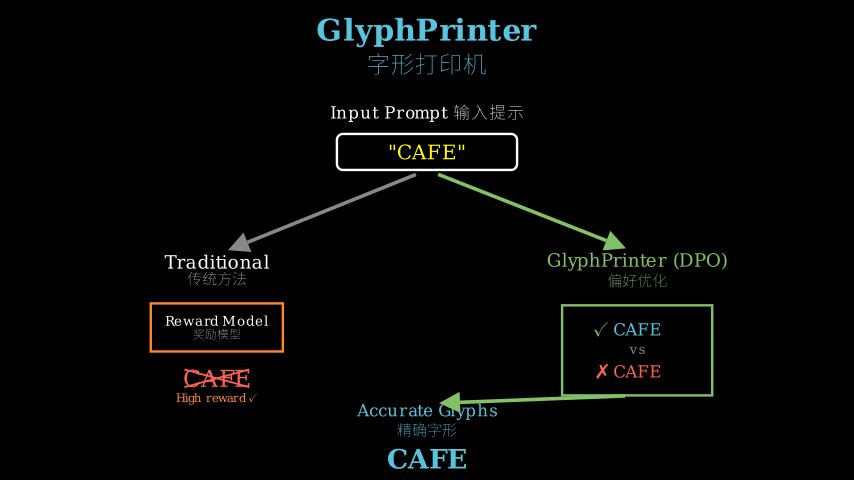
Existing text rendering methods train on scene text images, but they struggle with glyph accuracy—especially for complex characters or unusual fonts. When researchers tried reinforcement learning to fix this, they hit a wall: the reward models (usually OCR systems) can’t detect subtle glyph errors. An image with a slightly malformed “8” that looks like “B” might still get high rewards because OCR systems are trained to be robust to noise, not to judge glyph perfection.
The core issue: we’re using the wrong feedback signal. OCR systems optimize for “can I read this?” not “is every stroke pixel-perfect?” So models learn to generate text that’s readable but not necessarily accurate.
Problem: Glyph errors in generated text
    |
    v
Prior approach: Train on scene text + RL with OCR rewards
    |
    +---> Limitation: OCR rewards insensitive to fine-grained errors
    |
    v
This paper's assumption: Preference data (good vs bad) > scalar rewards
    |
    v
Method: Region-Grouped DPO with localized preference annotations
    |
    v
Evidence: Improved glyph accuracy on GlyphCorrector dataset
    |
    v
Conclusion: Region-level preference learning beats global reward modeling
The Increment
One sentence: Before, we asked “is this text readable?” and got sloppy glyphs; now we ask “which version has better glyphs in each region?” and get precision.
Core Mechanism
GlyphPrinter has three components working together. First, the GlyphCorrector dataset provides paired images where one has correct glyphs and one has errors, with annotations marking which regions differ. Second, Region-Grouped DPO (R-GDPO) trains the model by comparing these pairs at the region level—not just “image A is better than B” but “in region 1, A’s glyph is better; in region 2, B’s glyph is better.” Third, Regional Reward Guidance at inference time samples from a distribution that balances glyph accuracy with stylistic diversity.
The data flow: input text → diffusion model generates candidate images → R-GDPO objective compares region-level preferences → model learns to increase probability of better glyphs in each region → at inference, Regional Reward Guidance steers sampling toward high-accuracy regions.
Input text: "Hello"
    |
    v
Diffusion Model
    |
    +---> Generate: Image A (correct "H", wrong "e")
    |
    +---> Generate: Image B (wrong "H", correct "e")
    |
    v
R-GDPO Training:
    Region 1 (H): prefer A > B
    Region 2 (e): prefer B > A
    |
    v
Model learns: boost prob(correct glyph | region)
    |
    v
Inference with Regional Reward Guidance:
    Sample from distribution favoring high-accuracy regions
    |
    v
Output: "Hello" with all glyphs correct
Think of it like teaching someone to write by hand. The old way (standard DPO) is showing them two full pages and saying “this page is better.” They might learn overall neatness but miss that the letter “g” is consistently malformed. GlyphPrinter’s approach is like using a red pen to circle each letter individually: “this ‘g’ is wrong, that ‘g’ is right, this ‘o’ is perfect, that ‘o’ is sloppy.” The student learns letter-by-letter precision because feedback is localized to where errors actually occur. The Regional Reward Guidance is like the student’s internal editor during a timed test—they allocate more attention to letters they know are tricky, ensuring those come out right even under time pressure.
Key Concepts
-
Region-Grouped DPO: Standard DPO says “image A is better than image B overall” and adjusts the model accordingly. But in text rendering, an image might have 5 correct glyphs and 1 wrong one—should we penalize the whole image? R-GDPO splits images into regions (one per character) and compares preferences region-by-region. It optimizes two things: inter-sample preference (region i in image A vs region i in image B) and intra-sample preference (correct regions vs incorrect regions within the same image). Concrete example: if generating “CAT” produces an image where “C” and “T” are perfect but “A” looks like “4”, R-GDPO specifically penalizes the “A” region while reinforcing “C” and “T”, rather than treating the whole image as mediocre.
-
Regional Reward Guidance: During inference, diffusion models sample from a learned distribution. But that distribution might still occasionally produce glyph errors. Regional Reward Guidance modifies the sampling process by computing a “reward” for each region (how likely is this glyph correct?) and steering the sampling toward higher-reward regions. It’s not using an external reward model—it’s using the model’s own learned preferences to guide itself. Think of it as the model second-guessing itself: “I’m about to generate this ‘Q’, but my training says this particular stroke pattern often goes wrong, so let me adjust the sampling to favor the safer path.”
Framework Shift
Before (RL with OCR rewards):        After (GlyphPrinter):

Text --> Model --> Image              Text --> Model --> Image A
         |                                     |      --> Image B
         v                                     |
    OCR System                                 v
         |                            Region-level comparison:
         v                            [H] A>B  [e] B>A  [l] A>B ...
    Scalar reward                              |
         |                                     v
         v                            Localized preference gradients
    Global gradient update                     |
                                               v
                                        Region-specific updates
From global scalar feedback to localized comparative feedback, the core shift is moving from “how good is this image?” to “which parts are better in which image?”
Expert Assessment
Problem choice: Real gap. Text rendering in generative models has been a persistent pain point, and the observation that OCR-based rewards miss fine-grained errors is spot-on. This sits at the intersection of diffusion models and preference learning, both hot areas, so timing is good.
Method maturity: The core insight—localize DPO to regions—is elegant and feels obvious in hindsight (always a good sign). However, the method requires region-level annotations, which is labor-intensive. The paper doesn’t deeply explore whether simpler approaches (like just using character-level OCR confidence as a reward) would work. The Regional Reward Guidance feels a bit bolted-on; it’s not clear it’s necessary given the R-GDPO training.
Experimental integrity: Baselines are reasonable (standard DPO, RL methods, supervised approaches). The GlyphCorrector dataset is new, so we can’t verify results independently yet. Numbers look good but not suspiciously perfect. One red flag: no ablation on whether the intra-sample preference term actually helps, or if inter-sample alone would suffice.
Writing quality: Abstract and intro are crisp. Method section gets dense with notation—Figure 2 would benefit from a clearer caption explaining what each arrow means. The “why this works” intuition is buried in implementation details. If they rewrote Section 3.2 to lead with the hand-writing teacher analogy, then formalize, the paper would be much more accessible.
Verdict: weak accept — solid contribution with clear improvements, but feels incremental rather than paradigm-shifting; the region-level annotation requirement limits practical adoption.
Takeaways
The transferable idea: when your task has localized errors but you’re using global feedback, split your data into regions and compare preferences region-by-region. This applies beyond text rendering—think image inpainting (compare patches), video generation (compare frames), or even code generation (compare functions). The key is identifying the natural “unit of error” in your domain and structuring your preference data accordingly.
Specific technique to steal: the intra-sample preference term. Most preference learning compares sample A vs sample B. Adding comparisons within a single sample (good parts vs bad parts) gives you more training signal from the same data. If you’re building any preference-based system, consider whether you can annotate “this part is good, that part is bad” within individual samples.
What not to take: the Regional Reward Guidance feels overengineered for the problem. If your R-GDPO training is working well, you probably don’t need inference-time guidance. Test whether the simpler approach (just R-GDPO) gets you 90% of the gains.
论文: 2603.15616 作者: Xincheng Shuai, Ziye Li, Henghui Ding, Dacheng Tao 分类: cs.CV
缺口
现有文本渲染方法在场景文本图像上训练,但在字形准确性上表现不佳——尤其是复杂字符或不常见字体。
当研究者尝试用强化学习解决这个问题时,他们遇到了瓶颈:奖励模型(通常是OCR系统)无法检测细微的字形错误。
一张图片中略微变形的”8”看起来像”B”,但仍可能获得高奖励,因为OCR系统被训练为对噪声鲁棒,而非判断字形是否完美。
核心问题:我们用错了反馈信号。
OCR系统优化的是”我能读出来吗?“而非”每一笔是否像素级完美?“因此模型学会生成可读但不一定准确的文本。
问题:生成文本中的字形错误
    |
    v
先前方法:场景文本训练 + 基于OCR奖励的强化学习
    |
    +---> 局限:OCR奖励对细粒度错误不敏感
    |
    v
本文假设:偏好数据(好vs坏)> 标量奖励
    |
    v
方法:带局部偏好标注的区域分组DPO
    |
    v
证据:在GlyphCorrector数据集上字形准确率提升
    |
    v
结论:区域级偏好学习优于全局奖励建模
增量
一句话: 之前我们问”这段文字可读吗?“得到了潦草的字形;现在我们问”每个区域中哪个版本的字形更好?“得到了精确度。
核心机制
GlyphPrinter有三个协同工作的组件。
首先,GlyphCorrector数据集提供成对图像,一个字形正确,一个有错误,并标注了哪些区域不同。
其次,区域分组DPO(R-GDPO)通过在区域级别比较这些配对来训练模型——不只是”图像A优于B”,而是”在区域1中,A的字形更好;在区域2中,B的字形更好。“第三,推理时的区域奖励引导从平衡字形准确性和风格多样性的分布中采样。
数据流:输入文本 → 扩散模型生成候选图像 → R-GDPO目标比较区域级偏好 → 模型学习增加每个区域中更好字形的概率 → 推理时,区域奖励引导将采样导向高准确度区域。
输入文本:"你好"
    |
    v
扩散模型
    |
    +---> 生成:图像A("你"正确,"好"错误)
    |
    +---> 生成:图像B("你"错误,"好"正确)
    |
    v
R-GDPO训练:
    区域1(你):偏好 A > B
    区域2(好):偏好 B > A
    |
    v
模型学习:提升 prob(正确字形 | 区域)
    |
    v
带区域奖励引导的推理:
    从偏好高准确度区域的分布中采样
    |
    v
输出:"你好"所有字形正确
把它想象成教人手写。
旧方法(标准DPO)是展示两整页纸说”这页更好。“他们可能学会整体工整度,但会错过字母”g”一直写错这个问题。
GlyphPrinter的方法像是用红笔逐个圈出每个字母:“这个’g’错了,那个’g’对了,这个’o’完美,那个’o’潦草。“学生学会逐字母精确,因为反馈定位到错误实际发生的地方。
区域奖励引导就像学生在限时测试中的内部编辑器——他们在知道棘手的字母上分配更多注意力,确保即使在时间压力下这些字母也能写对。
关键概念
- 区域分组DPO: 标准DPO说”图像A整体优于图像B”并相应调整模型。
但在文本渲染中,一张图像可能有5个正确字形和1个错误字形——我们应该惩罚整张图像吗?R-GDPO将图像分割成区域(每个字符一个)并逐区域比较偏好。
它优化两件事:样本间偏好(图像A中的区域i vs 图像B中的区域i)和样本内偏好(同一图像内的正确区域vs错误区域)。
具体例子:如果生成”猫”产生的图像中”猫”完美但”猫”看起来像”描”,R-GDPO专门惩罚”猫”区域同时强化”猫”,而不是将整张图像视为平庸。
- 区域奖励引导: 推理期间,扩散模型从学习到的分布中采样。
但该分布仍可能偶尔产生字形错误。
区域奖励引导通过计算每个区域的”奖励”(这个字形正确的可能性有多大?)并将采样导向更高奖励区域来修改采样过程。
它不使用外部奖励模型——它使用模型自己学到的偏好来引导自己。
把它想象成模型在质疑自己:“我即将生成这个’Q’,但我的训练说这种特定笔画模式经常出错,所以让我调整采样以偏好更安全的路径。“
框架转变
之前(基于OCR奖励的强化学习):    之后(GlyphPrinter):

文本 --> 模型 --> 图像              文本 --> 模型 --> 图像A
         |                                   |      --> 图像B
         v                                   |
    OCR系统                                  v
         |                          区域级比较:
         v                          [你] A>B  [好] B>A ...
    标量奖励                                  |
         |                                   v
         v                          局部偏好梯度
    全局梯度更新                              |
                                             v
                                      区域特定更新
从全局标量反馈到局部比较反馈,核心转变是从”这张图像有多好?“转向”哪张图像的哪些部分更好?“
专家评审
选题眼光: 真实缺口。
生成模型中的文本渲染一直是个痛点,观察到基于OCR的奖励会遗漏细粒度错误这一点很准确。
这处于扩散模型和偏好学习的交叉点,两者都是热门领域,所以时机不错。
方法成熟度: 核心洞察——将DPO局部化到区域——优雅且事后看来显而易见(总是好兆头)。
然而,该方法需要区域级标注,这很费人力。
论文没有深入探讨更简单的方法(比如只使用字符级OCR置信度作为奖励)是否有效。
区域奖励引导感觉有点拼凑;鉴于R-GDPO训练,不清楚它是否必要。
实验诚意: 基线合理(标准DPO、强化学习方法、监督方法)。
GlyphCorrector数据集是新的,所以我们还无法独立验证结果。
数字看起来不错但不是完美得可疑。
一个警示:没有消融实验说明样本内偏好项是否真的有帮助,或者仅样本间偏好是否足够。
写作功力: 摘要和引言简洁。
方法部分符号密集——图2的标题如果能更清楚地解释每个箭头的含义会更好。
“为什么有效”的直觉埋在实现细节中。
如果他们重写3.2节,先用手写教师类比引入,然后形式化,论文会更易懂。
判决: 弱接收 — 扎实的贡献,改进明确,但感觉是渐进式而非范式转变;区域级标注要求限制了实际采用。
要点总结
可迁移的想法:当你的任务有局部错误但你使用全局反馈时,将数据分割成区域并逐区域比较偏好。
这适用于文本渲染之外——想想图像修复(比较补丁)、视频生成(比较帧)、甚至代码生成(比较函数)。
关键是识别你领域中”错误的自然单元”并相应地构建偏好数据。
可偷的具体技术:样本内偏好项。
大多数偏好学习比较样本A vs 样本B。
添加单个样本内的比较(好的部分vs坏的部分)从相同数据中给你更多训练信号。
如果你在构建任何基于偏好的系统,考虑是否可以在单个样本内标注”这部分好,那部分坏”。
不要拿走的:区域奖励引导对这个问题感觉过度设计。
如果你的R-GDPO训练效果好,你可能不需要推理时引导。
测试更简单的方法(只用R-GDPO)是否能获得90%的收益。