Paper: 2605.31580 Authors: Utsav Dutta, Gerardo Pastrana, Sina Khoshfetrat Pakazad, Henrik Ohlsson Categories: cs.LG
The Gap
Time-series foundation models have lagged behind language and vision. Existing approaches treat channels as anonymous vectors—a temperature sensor and a pressure sensor are just “channel 1” and “channel 2.” This creates three problems: (1) models can’t transfer knowledge across datasets where the same sensor appears in different positions, (2) learned representations lack interpretability since there’s no semantic grounding, and (3) models are brittle to channel permutations despite channels having no inherent order.
Prior work either ignores channel semantics entirely (treating multivariate series as opaque vectors) or uses channel-specific parameters that don’t generalize. Meanwhile, language models have shown that grounding in text descriptions enables transfer and interpretability—but nobody has systematically incorporated this into time-series architectures.
Problem: Anonymous channels block transfer & interpretability
    |
    v
Assumption: Text descriptions can ground channel semantics
    |
    v
Method: JEPA + channel-aware gating + order equivariance
    |
    v
Evidence: Linear probe performance across 4 task types
    |
    v
Conclusion: Text acts as channel ID, JEPA drives performance
The Increment
One sentence: Before—time-series models treat channels as anonymous slots; after—channels carry semantic identities through text descriptions, enabling cross-dataset transfer and interpretable attention patterns.
Core Mechanism
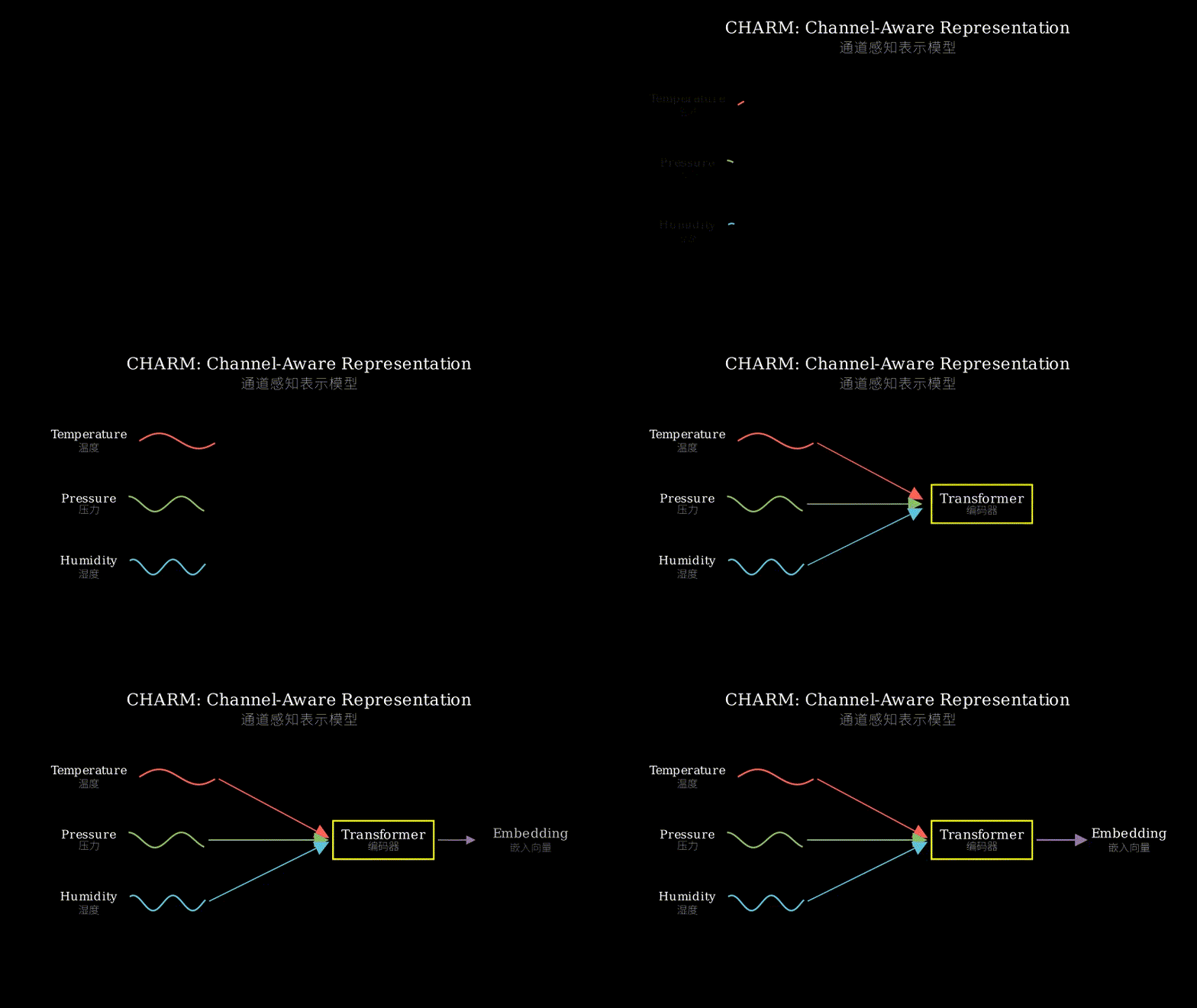
CHARM has three interlocking pieces. First, each channel gets a text description (e.g., “outdoor temperature sensor” or “heart rate monitor”) that’s encoded by a frozen language model into a semantic vector. Second, a Transformer encoder processes the time-series data, but instead of standard attention, it uses description-aware gating: the text embeddings modulate how channels attend to each other, creating interpretable cross-channel relationships. Third, the architecture is permutation equivariant—shuffling channel order doesn’t change the output because channels are identified by their descriptions, not positions.
Training uses JEPA (Joint Embedding Predictive Architecture): the model sees a corrupted view of the time series (masked timesteps, added noise) and predicts the representation of a clean view in latent space. This forces the encoder to learn robust, noise-invariant features. A novel loss term encourages temporal stability—nearby timesteps should have similar embeddings—which prevents the model from collapsing to trivial solutions.
Text: "temp sensor"  "pressure"  "humidity"
  |         |            |
  v         v            v
[LM] --> [embed_1] [embed_2] [embed_3]
              |         |         |
              v         v         v
Time series: [x1(t)] [x2(t)] [x3(t)]
              |         |         |
              +----+----+----+----+
                   |
                   v
         [Transformer Encoder]
          (gated by text embeds)
                   |
                   v
              [z_corrupted]
                   |
                   v
            [Latent Predictor]
                   |
                   v
         predict [z_clean] <-- target
Think of CHARM as a multilingual conference interpreter. Each sensor speaks its own “language” (raw signal), but the interpreter (Transformer) has a cheat sheet (text description) telling them who’s speaking. When the temperature sensor talks, the interpreter knows to pay attention to related sensors (humidity, pressure) because the cheat sheet says they’re related. If someone shuffles the seating arrangement (channel order), the interpreter still knows who’s who by checking the cheat sheet. During training, the interpreter practices by listening to noisy audio (corrupted series) and trying to reconstruct what the clean version would sound like (latent prediction). The cheat sheet ensures the interpreter learns meaningful relationships, not just memorizing seat positions.
Key Concepts
-
Permutation Equivariance: Imagine a recipe where ingredients are listed in random order. A permutation-equivariant model reads “flour, eggs, sugar” and “sugar, flour, eggs” as the same recipe because it identifies ingredients by name, not position. For time series, this means the model recognizes “temperature sensor” whether it’s channel 1 or channel 5. Technically, if you permute the input channels, the output embeddings permute identically—the function commutes with permutation operations. This is crucial because sensor ordering is arbitrary (a hardware accident), not meaningful.
-
JEPA (Joint Embedding Predictive Architecture): Instead of reconstructing raw pixels or tokens (which wastes capacity on irrelevant details), JEPA predicts representations. You show the model a blurry photo and ask it to predict what the embedding of the sharp photo would be—not the sharp photo itself. For time series: corrupt the signal with noise and masking, encode it to get z_corrupted, then predict what z_clean would be. This forces the model to learn features robust to noise (critical for real sensors) while ignoring pixel-level details that don’t matter for downstream tasks.
-
Description-Aware Gating: Standard attention lets every token attend to every other token equally. Description-aware gating uses text embeddings to modulate attention weights—if two channels have semantically related descriptions, they attend more strongly. Concretely: compute attention scores, then multiply by a gating function of the text embeddings. This creates interpretable attention patterns (you can see the model learned that temperature and humidity sensors interact) and enables transfer (the model knows “temperature” in dataset A relates to “temperature” in dataset B, even if they’re different physical sensors).
Framework Shift
Before (channel-agnostic):          After (CHARM):

Input: [x1, x2, x3, ...]            Input: [x1, x2, x3, ...]
         |                                   |
         v                                   v
    [Positional                      [Text: "temp", "press", ...]
     Encoding]                              |
         |                                  v
         v                            [Semantic Embed]
    [Transformer]                           |
    (position-based                         v
     attention)                      [Transformer + Gating]
         |                           (description-aware
         v                            attention)
    [Task Head]                             |
                                            v
                                       [Task Head]

Channels identified by:             Channels identified by:
- Position in array                 - Semantic description
- Learned positional codes          - Text embedding

Transfer: Breaks on reordering      Transfer: Works across datasets
One sentence: From position-indexed anonymous vectors to semantically-grounded, order-invariant channel representations—the core shift is treating sensors as named entities rather than array slots.
Expert Assessment
Problem choice: Real gap. Time-series foundation models are genuinely behind language/vision, and the lack of semantic grounding is a legitimate bottleneck for transfer learning. The problem sits at the intersection of multimodal learning and time-series analysis—timely given recent foundation model trends.
Method maturity: Solid engineering, not a breakthrough insight. JEPA is borrowed from vision (I-JEPA), permutation equivariance is standard in graph networks, and text conditioning is everywhere in multimodal models. The contribution is the integration—showing these pieces work together for time series. The description-aware gating is the most novel component, but it’s a straightforward extension of cross-attention. No simpler approach is obviously overlooked, though one could argue for just using channel IDs (integers) instead of text—the paper shows text helps but isn’t the main driver.
Experimental integrity: Baselines are fair (standard Transformers, TSMixer, PatchTST). The ablation study is thorough—they show JEPA matters more than text, which is honest. However, the datasets are relatively small-scale (UCR archive, a few real-world datasets), and there’s no comparison to recent time-series foundation models like TimesFM or Chronos. The claim about “strong performance with linear probes” is supported but not earth-shattering—linear probe accuracy is respectable but not SOTA. One red flag: no discussion of computational cost (text encoding + gating adds overhead).
Writing quality: The abstract and intro are crisp. The method section is dense—Figure 2 (architecture diagram) does heavy lifting but could be clearer about data flow. The ablation study (Section 4.3) is the paper’s strongest section, showing intellectual honesty about what drives performance. The related work section is perfunctory—misses recent time-series SSL work. If I were reviewing, I’d ask them to expand the discussion section: why does JEPA work so well for time series specifically? What’s the failure mode when text descriptions are poor?
Verdict: weak accept — Solid execution of a reasonable idea with honest evaluation, but incremental rather than transformative. The JEPA + equivariance combination is the real contribution; text is a useful but secondary feature. Belongs at a good venue (ICML/NeurIPS workshop or domain conference) but not a spotlight paper.
Takeaways
Steal the JEPA training recipe for time series: Predicting latent representations instead of raw reconstructions is a clean win for noisy sensor data. The temporal stability loss (nearby timesteps should have similar embeddings) is a simple regularizer you can drop into any time-series SSL setup.
Use text as channel metadata, not magic: The paper shows text descriptions help with transfer but aren’t the performance driver—they’re essentially learned channel IDs. If you’re building a time-series model, invest in the pretraining objective (JEPA) first, add text conditioning second. For practitioners: if you have heterogeneous sensor data across deployments, maintaining a simple text description schema (even just “sensor_type: temperature, unit: celsius”) enables this kind of transfer.
Permutation equivariance is table stakes for multivariate time series: If your model breaks when you reorder channels, you’re learning spurious positional correlations. Use set-based architectures (attention without positional encoding, or explicit permutation-equivariant layers) to avoid this trap.
Linear probe performance is a useful sanity check: If your pretrained representations require a complex task head to be useful, the pretraining might not be learning the right features. CHARM’s linear probe results suggest the JEPA objective is doing the heavy lifting—a good sign for transfer learning.
论文: 2605.31580 作者: Utsav Dutta, Gerardo Pastrana, Sina Khoshfetrat Pakazad, Henrik Ohlsson 分类: cs.LG
缺口
时序基础模型落后于语言和视觉领域。
现有方法把通道当作匿名向量——温度传感器和压力传感器只是”通道1”和”通道2”。
这造成三个问题:(1)模型无法在不同数据集间迁移知识,即使同一传感器出现在不同位置;(2)学到的表示缺乏可解释性,因为没有语义基础;(3)模型对通道排列很脆弱,尽管通道本身没有固有顺序。
此前的工作要么完全忽略通道语义(把多变量序列当作不透明向量),要么使用通道特定参数导致无法泛化。
与此同时,语言模型已经证明文本描述能带来迁移能力和可解释性——但没人系统地把这个思路引入时序架构。
问题:匿名通道阻碍迁移和可解释性
    |
    v
假设:文本描述能为通道语义奠基
    |
    v
方法:JEPA + 通道感知门控 + 顺序等变性
    |
    v
证据:4类任务上的线性探针性能
    |
    v
结论:文本充当通道ID,JEPA驱动性能
增量
一句话:之前——时序模型把通道当匿名槽位;之后——通道通过文本描述携带语义身份,实现跨数据集迁移和可解释的注意力模式。
核心机制
CHARM 有三个互锁部件。
首先,每个通道获得一段文本描述(比如”室外温度传感器”或”心率监测器”),由冻结的语言模型编码成语义向量。
其次,Transformer 编码器处理时序数据,但不用标准注意力,而是用描述感知门控:文本嵌入调制通道之间的注意力权重,创建可解释的跨通道关系。
第三,架构具有排列等变性——打乱通道顺序不改变输出,因为通道由描述而非位置识别。
训练使用 JEPA(联合嵌入预测架构):模型看到时序的损坏视图(掩码时间步、添加噪声),在潜空间预测干净视图的表示。
这迫使编码器学习鲁棒的、噪声不变的特征。
一个新颖的损失项鼓励时间稳定性——相邻时间步应有相似嵌入——防止模型坍缩到平凡解。
文本:"温度传感器"  "压力"  "湿度"
  |         |            |
  v         v            v
[LM] --> [嵌入_1] [嵌入_2] [嵌入_3]
              |         |         |
              v         v         v
时序数据:[x1(t)] [x2(t)] [x3(t)]
              |         |         |
              +----+----+----+----+
                   |
                   v
         [Transformer 编码器]
          (由文本嵌入门控)
                   |
                   v
              [z_损坏]
                   |
                   v
            [潜空间预测器]
                   |
                   v
         预测 [z_干净] <-- 目标
把 CHARM 想象成多语会议口译员。
每个传感器说自己的”语言”(原始信号),但口译员(Transformer)有小抄(文本描述)告诉他们谁在说话。
当温度传感器发言时,口译员知道要注意相关传感器(湿度、压力),因为小抄说它们有关联。
如果有人打乱座位安排(通道顺序),口译员仍能通过查小抄知道谁是谁。
训练期间,口译员通过听嘈杂音频(损坏序列)练习,试图重建干净版本听起来会是什么样(潜空间预测)。
小抄确保口译员学到有意义的关系,而非只是记住座位位置。
关键概念
- 排列等变性:想象一个食谱,配料随机排列。
排列等变模型读到”面粉、鸡蛋、糖”和”糖、面粉、鸡蛋”会认为是同一个食谱,因为它按名称而非位置识别配料。
对时序来说,这意味着模型能识别”温度传感器”,无论它是通道1还是通道5。
技术上讲,如果你排列输入通道,输出嵌入会同样排列——函数与排列操作可交换。
这很关键,因为传感器顺序是任意的(硬件偶然),不具意义。
- JEPA(联合嵌入预测架构):不重建原始像素或词元(会在无关细节上浪费容量),JEPA 预测表示。
你给模型看模糊照片,让它预测清晰照片的嵌入会是什么——而非清晰照片本身。
对时序来说:用噪声和掩码损坏信号,编码得到 z_损坏,然后预测 z_干净会是什么。
这迫使模型学习对噪声鲁棒的特征(对真实传感器至关重要),同时忽略对下游任务无关紧要的像素级细节。
- 描述感知门控:标准注意力让每个词元平等地注意其他所有词元。
描述感知门控用文本嵌入调制注意力权重——如果两个通道有语义相关的描述,它们注意力更强。
具体来说:计算注意力分数,然后乘以文本嵌入的门控函数。
这创建可解释的注意力模式(你能看到模型学到温度和湿度传感器交互),并实现迁移(模型知道数据集A中的”温度”与数据集B中的”温度”相关,即使它们是不同的物理传感器)。
框架转变
之前(通道无关):              之后(CHARM):

输入:[x1, x2, x3, ...]        输入:[x1, x2, x3, ...]
         |                              |
         v                              v
    [位置编码]                   [文本:"温度","压力",...]
         |                              |
         v                              v
    [Transformer]                 [语义嵌入]
    (基于位置的                        |
     注意力)                           v
         |                      [Transformer + 门控]
         v                      (描述感知注意力)
    [任务头]                           |
                                       v
                                   [任务头]

通道识别方式:                  通道识别方式:
- 数组中的位置                  - 语义描述
- 学习的位置编码                - 文本嵌入

迁移:重排序时失效              迁移:跨数据集有效
一句话:从位置索引的匿名向量到语义奠基的、顺序不变的通道表示——核心转变是把传感器当作命名实体而非数组槽位。
专家评审
选题眼光:真实缺口。
时序基础模型确实落后于语言/视觉,缺乏语义基础是迁移学习的合理瓶颈。
问题处于多模态学习和时序分析的交叉点——考虑到最近的基础模型趋势,时机恰当。
方法成熟度:扎实的工程,不是突破性洞见。
JEPA 借自视觉(I-JEPA),排列等变性在图网络中是标准做法,文本条件在多模态模型中随处可见。
贡献在于整合——展示这些部件在时序上能协同工作。
描述感知门控是最新颖的组件,但它是交叉注意力的直接扩展。
没有明显被忽略的更简单方法,尽管可以争论只用通道ID(整数)而非文本——论文显示文本有帮助但不是主要驱动力。
实验诚意:基线公平(标准 Transformer、TSMixer、PatchTST)。
消融研究很彻底——他们诚实地展示 JEPA 比文本更重要。
然而,数据集规模相对较小(UCR 档案、几个真实世界数据集),没有与最近的时序基础模型(如 TimesFM 或 Chronos)比较。
关于”线性探针强性能”的声称有支撑但不惊艳——线性探针准确率可观但非 SOTA。
一个警示:没讨论计算成本(文本编码 + 门控增加开销)。
写作功力:摘要和引言简洁。
方法部分密集——图2(架构图)承担重任但数据流可以更清晰。
消融研究(4.3节)是论文最强部分,展示了对性能驱动因素的智识诚实。
相关工作部分敷衍——遗漏了最近的时序自监督学习工作。
如果我审稿,会要求扩展讨论部分:为什么 JEPA 对时序特别有效?
文本描述质量差时的失效模式是什么?
判决:弱接收 — 合理想法的扎实执行加诚实评估,但渐进而非变革性。
JEPA + 等变性组合是真正的贡献;文本是有用但次要的特性。
适合好会议(ICML/NeurIPS 研讨会或领域会议)但不是聚光灯论文。
要点总结
偷走时序的 JEPA 训练配方:预测潜表示而非原始重建,对嘈杂传感器数据是干净的胜利。
时间稳定性损失(相邻时间步应有相似嵌入)是简单的正则化器,可以放进任何时序自监督学习设置。
把文本当通道元数据,不是魔法:论文显示文本描述有助于迁移但不是性能驱动力——它们本质上是学习的通道ID。
如果你在构建时序模型,先投资预训练目标(JEPA),再添加文本条件。
对实践者:如果你有跨部署的异构传感器数据,维护简单的文本描述模式(哪怕只是”传感器类型:温度,单位:摄氏度”)就能实现这种迁移。
排列等变性是多变量时序的基本要求:如果你的模型在重排通道时崩溃,你在学习虚假的位置相关性。
使用基于集合的架构(无位置编码的注意力,或显式排列等变层)避免这个陷阱。
线性探针性能是有用的健全性检查:如果你的预训练表示需要复杂任务头才有用,预训练可能没学到正确特征。
CHARM 的线性探针结果表明 JEPA 目标在做重活——对迁移学习是好兆头。