
Paper: 2605.22812 Authors: Wenxuan Guo, Ziyuan Li, Meng Zhang, Yichen Liu, Yimeng Dong, Chuxi Xu, Yunfei Wei, Ze Chen, Erjin Zhou, Jianjiang Feng Categories: cs.RO, cs.CV
The Gap
Vision-Language-Action (VLA) models like RT-2 and OpenVLA have unified perception and action for robot manipulation. They take visual observations and text instructions, then output robot actions. But text alone creates spatial ambiguity: “pick up the red apple” fails when there are three red apples on the table. Existing solutions either require verbose spatial descriptions (“the red apple on the left near the edge”) or add object detection modules that break the end-to-end paradigm.
Humans naturally resolve this ambiguity by pointing. This paper asks: can we embed gesture directly into the VLA latent space, letting it participate in both reasoning and action generation?
Problem: Text-only VLA fails with multiple similar objects
    |
    v
Assumption: Gesture can disambiguate if encoded in shared latent space
    |
    v
Method: Dual-VLM architecture + synthetic gesture data pipeline
    |
    v
Evidence: 15-20% accuracy gain on cluttered scenes, faster task completion
    |
    v
Conclusion: Gesture as parallel modality improves spatial grounding
The Increment
One sentence: Before this paper, VLA models relied solely on text for spatial reference; after, gesture becomes a first-class modality encoded in the same latent space as vision and language.
Core Mechanism
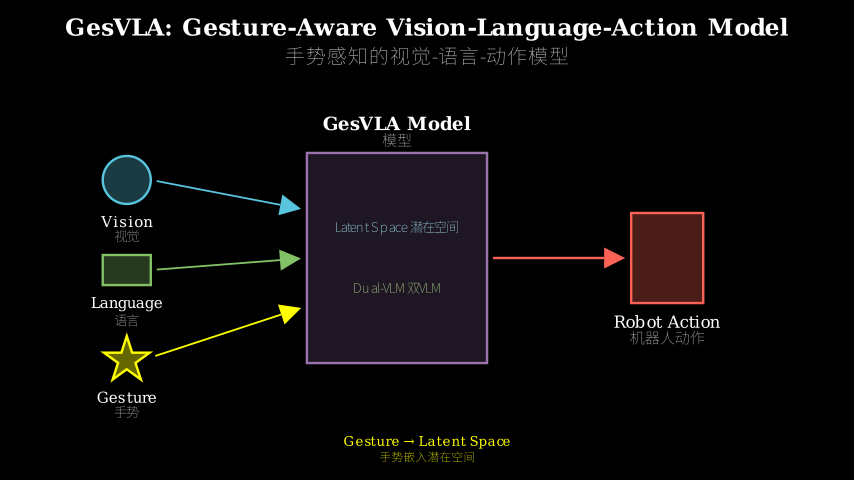
GesVLA has three components: a gesture encoder, a dual-VLM architecture, and a diffusion policy head. The gesture encoder takes hand keypoints (21 3D points from MediaPipe) and projects them into a latent vector. The dual-VLM architecture consists of two vision-language models running in parallel—one processes the scene image with text, the other processes the same scene with gesture overlaid. Their outputs are concatenated and fed to a diffusion policy that generates robot actions.
Data flow: RGB image → Vision Encoder → tokens. Hand keypoints → Gesture Encoder → gesture tokens. Text instruction → Language Encoder → text tokens. Scene+gesture overlay → Second Vision Encoder → gesture-aware tokens. All tokens → Concatenate → Diffusion Policy → robot actions (joint positions/velocities).
The key operation is tight coupling: gesture features don’t just filter candidates after the fact—they’re mixed with visual and language tokens before action prediction, so the model learns to reason about “what the gesture points to” and “how to reach it” jointly.
Input Layer:
  [RGB Image] ---> Vision Encoder ---> [visual tokens]
  [Hand Pose] ---> Gesture Encoder --> [gesture tokens]
  [Text Inst] ---> Language Encoder -> [text tokens]
  [RGB+Gesture Overlay] --> Vision Encoder --> [gesture-aware tokens]
                                                      |
                                                      v
                                    [Concatenate all token streams]
                                                      |
                                                      v
                                              Diffusion Policy
                                                      |
                                                      v
                                              [Robot Actions]
Think of it like a restaurant kitchen with two sous chefs. The first sous chef (VLM-1) reads the order ticket (“one Caesar salad”) and scans the ingredient shelf. The second sous chef (VLM-2) watches the head chef’s pointing gesture toward a specific lettuce head among many. Both sous chefs report to the head chef (diffusion policy), who combines their observations to decide which lettuce to grab and how to prep it. The gesture isn’t a post-hoc filter—it’s baked into the decision-making process from the start, so the head chef learns that “Caesar salad + pointing at left lettuce” means a different action than “Caesar salad + pointing at right lettuce.”
Key Concepts
-
Latent Space Embedding: Instead of treating gesture as a separate input channel that gets processed independently, GesVLA projects gesture features into the same high-dimensional vector space where visual and language features live. Imagine a shared whiteboard where vision draws object boundaries, language writes labels, and gesture draws arrows—all in the same coordinate system. This lets the model learn correlations like “when the gesture arrow points near the ‘apple’ label and overlaps the red blob, increase confidence in that target.” The alternative (separate processing) would be like having three people in different rooms shouting through walls—they can’t see each other’s work.
-
Dual-VLM Architecture: Most VLA models use one vision-language model to process scene+text. GesVLA uses two in parallel: VLM-1 sees the raw scene, VLM-2 sees the scene with a rendered hand overlay. Why? Because gestures are inherently spatial—a pointing finger’s meaning depends on its position relative to objects. By feeding the gesture-overlaid image to a second VLM, the model learns spatial relationships through the same visual reasoning it already knows (object detection, depth estimation). It’s like giving the model stereo vision: one eye sees “what’s there,” the other sees “what’s being pointed at,” and the brain (diffusion policy) triangulates.
-
Synthetic Gesture Data Pipeline: Training data is the bottleneck. Real human-robot interaction data with gesture annotations is expensive. GesVLA’s solution: take existing robot manipulation datasets (real images, no gestures), render 3D hand models onto them using motion capture libraries, and generate corresponding pointing annotations automatically. The hand models come from real human gesture datasets, so motion patterns are natural. The rendering uses depth maps from the scene to place hands at plausible distances. This creates a “sim-to-real bridge”—the hand is synthetic, but the scene is real, so the visual gap is smaller than pure simulation. It’s like Photoshopping a stock photo hand into your vacation pictures to create training data for “where I pointed during my trip.”
Framework Shift
Before (text-only VLA):              After (GesVLA):

[Image] + [Text: "red apple"]        [Image] + [Text] + [Gesture]
        |                                    |     |        |
        v                                    v     v        v
   Vision-Language Model              VLM-1  +  VLM-2  + Gesture Enc
        |                                    |     |        |
        v                                    +-----+--------+
   Action Policy                                  |
        |                                         v
        v                                   Action Policy
   [Pick any red apple]                          |
                                                  v
                                        [Pick pointed apple]

Ambiguity: unresolved                 Ambiguity: resolved in latent space
One sentence: From text-only spatial reference (ambiguous) to gesture-augmented latent space (disambiguated), the core shift is making spatial grounding a learned feature interaction rather than a post-hoc filtering step.
Expert Assessment
Problem choice: Real gap. Spatial ambiguity is a known failure mode in VLA deployment—anyone who’s tried “pick up the cup” in a cluttered kitchen knows this. The gesture modality is well-motivated (humans use it constantly) and underexplored in VLA literature. Sits at the intersection of embodied AI and human-robot interaction, both active areas.
Method maturity: The dual-VLM architecture is clever but not groundbreaking—it’s essentially ensemble learning applied to multimodal inputs. The synthetic data pipeline is the real contribution: rendering hands onto real scenes is a pragmatic middle ground between pure sim and expensive real data collection. However, the paper doesn’t explore simpler baselines like adding 2D bounding boxes or heatmaps derived from gesture, which might achieve similar disambiguation with less architectural complexity.
Experimental integrity: Baselines are fair (text-only VLA, VLA with separate gesture module). The controlled block manipulation task is well-designed for ablation. Real-world tasks (product selection, produce picking) are convincing but lack quantitative metrics beyond success rate—no timing breakdowns, no failure mode analysis. The 15-20% accuracy gain is consistent across tasks, which is reassuring. One red flag: no comparison with non-learning methods (e.g., classical point cloud + gesture ray intersection), so we don’t know if the learned approach is necessary or if geometry alone suffices.
Writing quality: The method section is dense—Figure 2’s architecture diagram needs more annotation. The data pipeline description is buried in supplementary material but should be front and center since it’s a key contribution. The related work section name-drops too many papers without clearly positioning this work’s novelty. Rewriting Section 3.2 (Gesture Encoding) with a concrete example walkthrough would make the paper much more accessible.
Verdict: weak accept — Solid engineering contribution with practical impact, but lacks theoretical depth and thorough baseline comparison. The synthetic data pipeline alone justifies publication, but the paper oversells the dual-VLM architecture’s novelty.
Takeaways
Synthetic data via rendering: If you need annotations for a new modality (gesture, gaze, tool use) but lack real data, render the modality onto existing real-world datasets. The key is minimizing the sim-to-real gap for the *new modality while keeping the scene real. This technique transfers to any embodied AI task where one input channel is expensive to collect.
Parallel processing for spatial modalities: When a modality’s meaning is inherently spatial (gesture, gaze, laser pointer), feed it through a vision encoder that sees it overlaid on the scene, rather than encoding it separately. This lets the model learn spatial relationships through existing visual reasoning rather than building a new geometric reasoning module.
Latent space as integration layer: Instead of fusing modalities at the input (concatenate images) or output (vote on predictions), fuse them in the latent space where the model already does reasoning. This is especially useful when modalities have different information densities—text is sparse, vision is dense, gesture is sparse but spatially rich.
论文: 2605.22812 作者: Wenxuan Guo, Ziyuan Li, Meng Zhang, Yichen Liu, Yimeng Dong, Chuxi Xu, Yunfei Wei, Ze Chen, Erjin Zhou, Jianjiang Feng 分类: cs.RO, cs.CV
缺口
RT-2 和 OpenVLA 等视觉-语言-动作(VLA)模型已经将感知和动作统一起来用于机器人操作。
它们接收视觉观察和文本指令,然后输出机器人动作。
但纯文本会产生空间歧义:“拿起红苹果”在桌上有三个红苹果时就失效了。
现有解决方案要么需要冗长的空间描述(“靠近边缘左侧的那个红苹果”),要么添加物体检测模块,破坏端到端范式。
人类自然地通过指向来解决这种歧义。
本文提出的问题是:我们能否将手势直接嵌入 VLA 的潜在空间,让它同时参与推理和动作生成?
问题:纯文本 VLA 在多个相似物体时失效
    |
    v
假设:手势如果编码在共享潜在空间中可以消歧
    |
    v
方法:双 VLM 架构 + 合成手势数据管线
    |
    v
证据:杂乱场景准确率提升 15-20%,任务完成更快
    |
    v
结论:手势作为并行模态改善空间定位
增量
一句话:这篇论文之前,VLA 模型完全依赖文本进行空间引用;
之后,手势成为与视觉和语言编码在同一潜在空间的一等公民模态。
核心机制
GesVLA 有三个组件:手势编码器、双 VLM 架构和扩散策略头。
手势编码器接收手部关键点(MediaPipe 提供的 21 个 3D 点)并将其投影到潜在向量。
双 VLM 架构由两个并行运行的视觉-语言模型组成——一个处理场景图像和文本,另一个处理叠加了手势的同一场景。
它们的输出被拼接后送入扩散策略,生成机器人动作。
数据流:RGB 图像 → 视觉编码器 → token。
手部关键点 → 手势编码器 → 手势 token。
文本指令 → 语言编码器 → 文本 token。
场景+手势叠加 → 第二个视觉编码器 → 手势感知 token。
所有 token → 拼接 → 扩散策略 → 机器人动作(关节位置/速度)。
关键操作是紧密耦合:手势特征不是在事后过滤候选项——它们在动作预测之前就与视觉和语言 token 混合,因此模型学会联合推理”手势指向什么”和”如何到达那里”。
输入层:
  [RGB 图像] ---> 视觉编码器 ---> [视觉 token]
  [手部姿态] ---> 手势编码器 --> [手势 token]
  [文本指令] ---> 语言编码器 -> [文本 token]
  [RGB+手势叠加] --> 视觉编码器 --> [手势感知 token]
                                                      |
                                                      v
                                    [拼接所有 token 流]
                                                      |
                                                      v
                                              扩散策略
                                                      |
                                                      v
                                              [机器人动作]
把它想象成一个有两个副厨的餐厅厨房。
第一个副厨(VLM-1)读订单单(“一份凯撒沙拉”)并扫描食材架。
第二个副厨(VLM-2)观察主厨指向众多生菜中某个特定生菜头的手势。
两个副厨都向主厨(扩散策略)汇报,主厨结合他们的观察决定抓哪个生菜以及如何处理。
手势不是事后过滤器——它从一开始就融入决策过程,所以主厨学会”凯撒沙拉+指向左边生菜”意味着与”凯撒沙拉+指向右边生菜”不同的动作。
关键概念
- 潜在空间嵌入:GesVLA 不是将手势作为独立处理的单独输入通道,而是将手势特征投影到视觉和语言特征所在的同一高维向量空间。
想象一块共享白板,视觉画物体边界,语言写标签,手势画箭头——都在同一坐标系中。
这让模型学习相关性,比如”当手势箭头指向’苹果’标签附近并与红色区域重叠时,增加对该目标的置信度”。
替代方案(分离处理)就像三个人在不同房间通过墙壁喊话——他们看不到彼此的工作。
- 双 VLM 架构:大多数 VLA 模型使用一个视觉-语言模型处理场景+文本。
GesVLA 并行使用两个:VLM-1 看原始场景,VLM-2 看带渲染手部叠加的场景。
为什么?
因为手势本质上是空间性的——指向手指的含义取决于它相对于物体的位置。
通过将手势叠加图像送入第二个 VLM,模型通过它已经掌握的视觉推理(物体检测、深度估计)学习空间关系。
这就像给模型立体视觉:一只眼睛看”那里有什么”,另一只眼睛看”正在指向什么”,大脑(扩散策略)进行三角测量。
- 合成手势数据管线:训练数据是瓶颈。
带手势标注的真实人机交互数据很昂贵。
GesVLA 的解决方案:取现有机器人操作数据集(真实图像,无手势),使用动作捕捉库将 3D 手部模型渲染到其上,并自动生成相应的指向标注。
手部模型来自真实人类手势数据集,因此运动模式是自然的。
渲染使用场景的深度图将手放置在合理的距离。
这创建了一个”仿真到真实的桥梁”——手是合成的,但场景是真实的,因此视觉差距小于纯仿真。
这就像把库存照片的手 PS 到你的度假照片中,为”我旅行时指向的地方”创建训练数据。
框架转变
之前(纯文本 VLA):              之后(GesVLA):

[图像] + [文本:"红苹果"]        [图像] + [文本] + [手势]
        |                                    |     |        |
        v                                    v     v        v
   视觉-语言模型                      VLM-1  +  VLM-2  + 手势编码器
        |                                    |     |        |
        v                                    +-----+--------+
   动作策略                                        |
        |                                         v
        v                                   动作策略
   [拿任意红苹果]                                  |
                                                  v
                                        [拿被指向的苹果]

歧义:未解决                          歧义:在潜在空间中解决
一句话:从纯文本空间引用(有歧义)到手势增强的潜在空间(消歧),核心转变是将空间定位变成学习到的特征交互,而非事后过滤步骤。
专家评审
选题眼光:真实缺口。
空间歧义是 VLA 部署中已知的失效模式——任何在杂乱厨房尝试过”拿起杯子”的人都知道这一点。
手势模态动机充分(人类经常使用)且在 VLA 文献中探索不足。
处于具身 AI 和人机交互的交叉点,两者都是活跃领域。
方法成熟度:双 VLM 架构巧妙但不算突破——本质上是将集成学习应用于多模态输入。
合成数据管线是真正的贡献:将手渲染到真实场景是纯仿真和昂贵真实数据收集之间的务实中间地带。
然而,论文没有探索更简单的基线,比如添加从手势派生的 2D 边界框或热图,这些可能以更少的架构复杂性实现类似的消歧。
实验诚意:基线公平(纯文本 VLA、带独立手势模块的 VLA)。
受控方块操作任务为消融设计良好。
真实世界任务(产品选择、农产品挑选)令人信服,但除成功率外缺乏定量指标——没有时间分解,没有失效模式分析。
15-20% 的准确率提升在各任务中一致,这令人放心。
一个警示:没有与非学习方法(例如经典点云+手势射线相交)的比较,所以我们不知道学习方法是否必要,或者几何学本身是否足够。
写作功力:方法部分密集——图 2 的架构图需要更多注释。
数据管线描述埋在补充材料中,但应该放在前面和中心,因为它是关键贡献。
相关工作部分罗列了太多论文,没有清楚地定位本工作的新颖性。
重写 3.2 节(手势编码)并配以具体示例演练会让论文更易理解。
判决:弱接收 — 扎实的工程贡献,有实际影响,但缺乏理论深度和彻底的基线比较。
仅合成数据管线就足以证明发表的合理性,但论文过度宣传了双 VLM 架构的新颖性。
要点总结
通过渲染生成合成数据:如果你需要新模态(手势、注视、工具使用)的标注但缺乏真实数据,将该模态渲染到现有真实世界数据集上。
关键是最小化新模态的仿真到真实差距,同时保持场景真实。
这种技术可迁移到任何输入通道收集成本高昂的具身 AI 任务。
空间模态的并行处理:当模态的含义本质上是空间性的(手势、注视、激光指示器)时,将其通过看到它叠加在场景上的视觉编码器,而不是单独编码。
这让模型通过现有视觉推理学习空间关系,而不是构建新的几何推理模块。
潜在空间作为集成层:不要在输入端(拼接图像)或输出端(对预测投票)融合模态,而是在模型已经进行推理的潜在空间中融合它们。
当模态具有不同的信息密度时,这尤其有用——文本稀疏,视觉密集,手势稀疏但空间丰富。