
Paper: 2604.15306 Authors: Yao Tong, Jiayuan Ye, Anastasia Borovykh, Reza Shokri Categories: cs.AI, cs.LG
The Gap
We know LLMs can solve problems, but when they fail, we can’t tell why. Is it bad training data? Wrong training method? Poor inference strategy? Real-world tasks mix all these factors together, making diagnosis impossible. Prior work on generalization tests LLMs on messy, uncontrolled tasks where failure could mean anything.
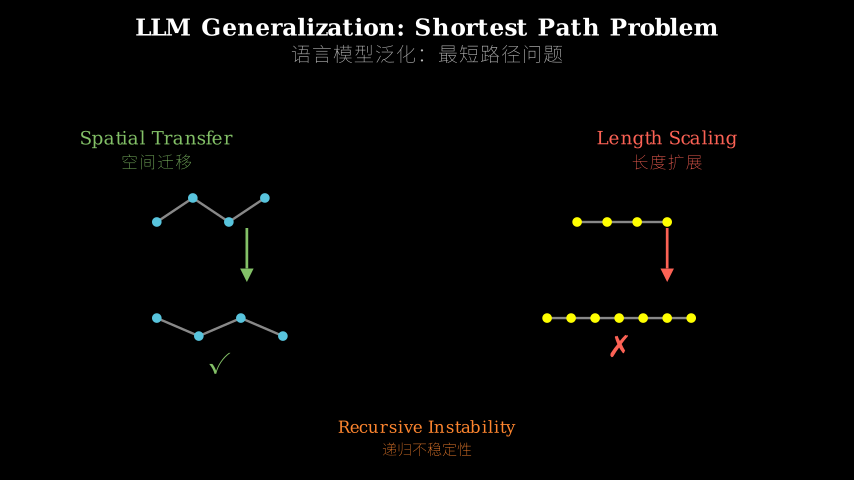
This paper isolates the variables. It uses shortest-path planning—a clean, composable problem where you can separately control data coverage, training paradigm, and inference strategy. Two generalization axes emerge: spatial (new maps) and length (longer paths). The setup lets you ask: which stage of the pipeline breaks generalization?
Messy real-world task
         |
         v
    [Failure]
         |
         +---> Data? Training? Inference? (can't tell)

Controlled shortest-path setup
         |
         +---> Spatial axis: new maps
         +---> Length axis: longer paths
         |
         v
    [Failure]
         |
         +---> Recursive instability (isolated cause)
The Increment
One sentence: Before this paper, we knew LLMs sometimes fail to generalize but couldn’t separate data issues from architectural limits; after, we have evidence that length-scaling failure is a fundamental recursive instability, not fixable by more data or better training.
Core Mechanism
The method constructs grid-world maps with obstacles. Each problem: find the shortest path from start to goal. Models are trained on paths of certain lengths and map configurations, then tested on (1) unseen maps of similar length (spatial transfer) and (2) longer paths on similar maps (length scaling).
Training varies across three paradigms: supervised learning on optimal paths, reinforcement learning with reward shaping, and inference-time search (beam search, best-of-N sampling). Data coverage is controlled by varying how many map configurations and path lengths appear during training.
The key measurement: does the model’s error rate stay flat (generalization) or explode (failure) when you change the test condition? Spatial transfer tests whether the model learned the planning algorithm. Length scaling tests whether that algorithm remains stable when applied recursively over more steps.
Training:
  Maps: [M1, M2, ..., Mk]  (k configurations)
  Paths: length <= L
         |
         v
    [Model learns planning]
         |
         +---> Test on new map Mk+1, length L
         |     (spatial transfer)
         |
         +---> Test on map M1, length L+10
               (length scaling)
Think of it like teaching someone to navigate a neighborhood. Spatial transfer is: can they navigate a new neighborhood with the same skills? Length scaling is: can they plan a route that’s twice as long without getting lost? The paper finds people (models) handle new neighborhoods fine but consistently get lost on longer routes—not because they forgot the rules, but because small errors compound over more steps.
Key Concepts
-
Recursive instability: When a model applies the same operation repeatedly (like planning one step, then another, then another), small errors at each step can accumulate. If the error grows faster than linearly with the number of steps, the process becomes unstable. In shortest-path planning, this means the model might correctly plan 5-step paths but fail catastrophically at 15 steps—not because it doesn’t know the rules, but because tiny mistakes in early steps derail later decisions. It’s like a rounding error in a calculator: fine for one calculation, disastrous after a thousand.
-
Spatial transfer vs length scaling: These are orthogonal generalization axes. Spatial transfer asks: does the model understand the abstract algorithm (e.g., “avoid obstacles, move toward goal”) well enough to apply it in new environments? Length scaling asks: does that algorithm remain numerically stable when applied for more iterations? A model can ace spatial transfer (proving it learned the algorithm) while failing length scaling (proving the algorithm’s implementation is unstable). This separation is impossible in most real-world tasks.
Framework Shift
Before (mainstream approach):        After (this paper):

Test on complex real tasks           Test on synthetic controlled task
    |                                     |
    v                                     v
[Failure observed]                   [Failure observed]
    |                                     |
    +---> Blame: data? training?          +---> Spatial: success
          inference? (unclear)                  Length: failure
                                                     |
                                                     v
                                                Isolated cause:
                                                recursive instability
From “we see failures but can’t diagnose them” to “we isolate failure modes and trace them to specific causes,” the core shift is controlled experimentation over naturalistic observation.
Expert Assessment
Problem choice: Real gap. The field has been arguing about LLM generalization for years with no clean experiments. Shortest-path planning is a smart choice—simple enough to control, complex enough to matter. It sits at the intersection of reasoning research and systematic generalization, both hot topics.
Method maturity: Mostly solid experimental design. The separation of spatial vs length axes is elegant. However, the paper leans on grid-world maps, which may not capture the full complexity of real reasoning tasks. The recursive instability diagnosis is insightful but could use more theoretical grounding—why does this instability arise in transformers specifically?
Experimental integrity: Baselines are fair. The paper tests multiple training paradigms (supervised, RL, inference-time scaling) and shows none rescue length-scaling failures. One concern: the longest paths tested are still relatively short (20-30 steps). Would the pattern hold at 100+ steps? The numbers are believable, but the paper could benefit from error bars and more runs.
Writing quality: Clear overall, but Section 4 (results) is dense with figures. The paper front-loads too much setup and buries the key finding (recursive instability) in the discussion. Rewriting the intro to lead with “we find spatial transfer works but length scaling fails due to recursive instability” would sharpen the narrative.
Verdict: weak accept — Solid controlled experiment with a clear finding, but limited theoretical depth and narrow task scope prevent it from being a strong contribution.
Takeaways
If you’re building LLMs for multi-step reasoning, test length scaling separately from spatial transfer. Don’t assume that good performance on short problems means the model will handle long ones—recursive instability is real and won’t be fixed by scaling up data or compute.
For researchers: synthetic controlled environments like this are underused. When debugging generalization failures, isolate variables instead of throwing more data at the problem.
For practitioners: if your LLM-based system involves iterative planning or multi-step reasoning, add explicit stability checks. Consider hybrid approaches where LLMs generate candidate steps but a symbolic verifier catches compounding errors.
论文: 2604.15306 作者: Yao Tong, Jiayuan Ye, Anastasia Borovykh, Reza Shokri 分类: cs.AI, cs.LG
缺口
我们知道大语言模型能解决问题,但当它们失败时,我们无法判断原因。
是训练数据不好?
训练方法不对?
推理策略有问题?
现实任务把这些因素混在一起,诊断无从下手。
此前关于泛化的研究在混乱、不受控的任务上测试语言模型,失败可能意味着任何事。
本文隔离了变量。
它使用最短路径规划——一个干净、可组合的问题,你可以分别控制数据覆盖、训练范式和推理策略。
两个泛化轴浮现:空间(新地图)和长度(更长路径)。
这个设置让你能问:流程的哪个阶段破坏了泛化?
混乱的现实任务
         |
         v
    [失败]
         |
         +---> 数据?训练?推理?(说不清)

受控的最短路径设置
         |
         +---> 空间轴:新地图
         +---> 长度轴:更长路径
         |
         v
    [失败]
         |
         +---> 递归不稳定性(孤立原因)
增量
一句话: 本文之前,我们知道语言模型有时无法泛化但无法区分数据问题和架构限制;
本文之后,我们有证据表明长度扩展失效是根本性的递归不稳定性,无法通过更多数据或更好训练修复。
核心机制
方法构建带障碍物的网格世界地图。
每个问题:找从起点到终点的最短路径。
模型在特定长度的路径和地图配置上训练,然后在(1)相似长度的未见地图(空间迁移)和(2)相似地图上的更长路径(长度扩展)上测试。
训练跨三种范式变化:最优路径的监督学习、带奖励塑形的强化学习、推理时搜索(束搜索、N选最优采样)。
数据覆盖通过改变训练期间出现的地图配置和路径长度数量来控制。
关键测量:当你改变测试条件时,模型的错误率是保持平稳(泛化)还是爆炸(失效)?
空间迁移测试模型是否学会了规划算法。
长度扩展测试该算法在更多步骤上递归应用时是否保持稳定。
训练:
  地图:[M1, M2, ..., Mk]  (k种配置)
  路径:长度 <= L
         |
         v
    [模型学习规划]
         |
         +---> 在新地图Mk+1上测试,长度L
         |     (空间迁移)
         |
         +---> 在地图M1上测试,长度L+10
               (长度扩展)
想象教某人在社区导航。
空间迁移是:他们能用相同技能在新社区导航吗?
长度扩展是:他们能规划两倍长的路线而不迷路吗?
本文发现人(模型)处理新社区没问题,但在更长路线上持续迷路——不是因为忘了规则,而是因为小错误在更多步骤上累积。
关键概念
- 递归不稳定性: 当模型重复应用相同操作(比如规划一步,再一步,再一步),每步的小错误会累积。
如果错误增长快于步数的线性增长,过程就变得不稳定。
在最短路径规划中,这意味着模型可能正确规划5步路径但在15步时灾难性失败——不是因为不懂规则,而是因为早期步骤的微小错误破坏了后续决策。
就像计算器的舍入误差:一次计算没问题,一千次后就是灾难。
- 空间迁移 vs 长度扩展: 这是正交的泛化轴。
空间迁移问:模型是否足够理解抽象算法(如”避开障碍,朝目标移动”)以在新环境中应用?
长度扩展问:该算法在更多迭代中应用时是否保持数值稳定?
模型可以在空间迁移上表现优异(证明学会了算法)同时在长度扩展上失败(证明算法实现不稳定)。
这种分离在大多数现实任务中不可能。
框架转变
之前(主流方法):                之后(本文方法):

在复杂现实任务上测试              在合成受控任务上测试
    |                                     |
    v                                     v
[观察到失败]                         [观察到失败]
    |                                     |
    +---> 归咎:数据?训练?              +---> 空间:成功
          推理?(不清楚)                      长度:失败
                                                     |
                                                     v
                                                孤立原因:
                                                递归不稳定性
从”我们看到失败但无法诊断”到”我们隔离失效模式并追溯到具体原因”,核心转变是受控实验取代自然观察。
专家评审
选题眼光: 真实缺口。
该领域争论语言模型泛化多年却没有干净的实验。
最短路径规划是聪明的选择——足够简单以便控制,足够复杂以至重要。
它处于推理研究和系统泛化的交叉点,两者都是热门话题。
方法成熟度: 实验设计大体扎实。
空间与长度轴的分离很优雅。
然而,论文依赖网格世界地图,可能无法捕捉真实推理任务的全部复杂性。
递归不稳定性诊断有洞察力,但需要更多理论基础——为什么这种不稳定性特别出现在transformer中?
实验诚意: 基线公平。
论文测试了多种训练范式(监督、强化学习、推理时扩展)并表明没有一种能挽救长度扩展失效。
一个担忧:测试的最长路径仍然相对较短(20-30步)。
模式在100+步时还成立吗?
数字可信,但论文可以受益于误差条和更多运行。
写作功力: 整体清晰,但第4节(结果)图表密集。
论文在前面堆了太多设置,把关键发现(递归不稳定性)埋在讨论中。
重写引言以”我们发现空间迁移有效但长度扩展因递归不稳定性失败”开头会让叙事更锐利。
判决: 弱接收 — 扎实的受控实验有清晰发现,但理论深度有限和任务范围狭窄阻止它成为强贡献。
要点总结
如果你在构建用于多步推理的语言模型,把长度扩展和空间迁移分开测试。
不要假设在短问题上的良好表现意味着模型能处理长问题——递归不稳定性是真实存在的,不会通过扩大数据或算力修复。
对研究者:像这样的合成受控环境使用不足。
调试泛化失效时,隔离变量而不是向问题扔更多数据。
对实践者:如果你的基于语言模型的系统涉及迭代规划或多步推理,添加显式稳定性检查。
考虑混合方法,语言模型生成候选步骤但符号验证器捕捉累积错误。