
Paper: 2604.28193 Authors: Vinayak Gupta, Chih-Hao Lin, Shenlong Wang, Anand Bhattad, Jia-Bin Huang Categories: cs.CV
The Gap
Existing 3D reconstruction methods hit a wall when dealing with real-world internet photos: varying lighting across images, tourists walking through scenes, sparse viewpoints. Methods like NeRF-W and Ha-NeRF handle these issues through per-scene optimization—they learn appearance embeddings or dynamic masks specific to each location. This works, but requires hours of training per scene and collapses when you only have a handful of images. The evaluation problem compounds this: most papers test on 5-10 landmark scenes, leaving generalization as an open question.
The core tension: you need scene-specific knowledge to handle lighting variations and transients, but you can’t afford per-scene optimization if you want a practical system.
Problem: Wild photos (lighting + occlusions + sparse views)
    |
    v
Prior approach: Per-scene optimization
    |
    +---> Appearance embeddings (NeRF-W)
    +---> Dynamic masks (Ha-NeRF)
    |
    v
Limitation: Hours per scene, fails at <10 views
    |
    v
This paper: Feed-forward with learned priors
    |
    +---> Geometric priors (depth, pose)
    +---> Appearance adapter (lighting)
    +---> Semantic segmentation (transients)
    |
    v
Evidence: PhotoTourism + MegaScenes (100+ scenes)
    |
    v
Conclusion: Real-time inference, generalizes across scenes
The Increment
One sentence: Before this paper, handling wild photo variations required per-scene optimization; after, a single feed-forward network generalizes across scenes using learned priors.
Core Mechanism
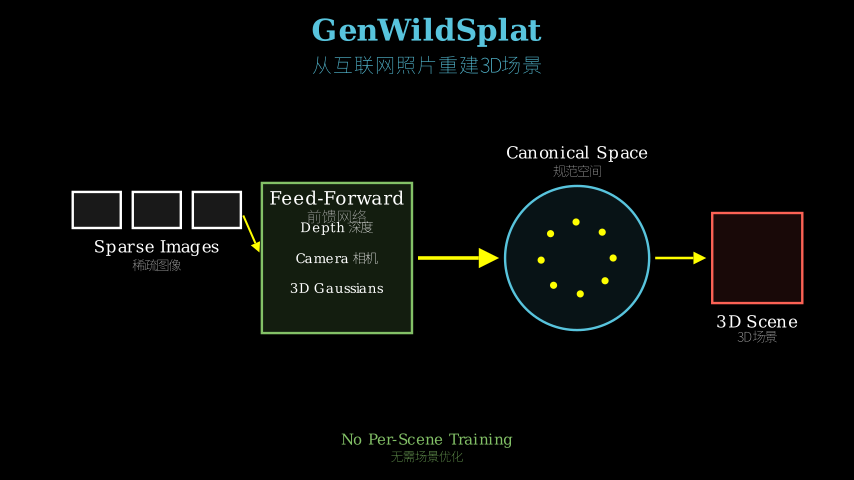
GenWildSplat processes unposed images through three parallel streams. First, a depth and pose estimator predicts camera parameters and per-pixel depth using DUSt3R-style geometric priors. Second, an appearance adapter takes a reference image and target lighting condition, producing modulation parameters that adjust 3D Gaussian appearance. Third, semantic segmentation identifies transient objects (people, cars) to exclude from reconstruction.
These streams feed into a 3D Gaussian predictor that outputs Gaussians in a canonical space—a normalized coordinate frame independent of camera pose. The appearance adapter modulates Gaussian colors based on target lighting, while transient masks prevent temporary objects from polluting the geometry. At inference, you provide sparse images and a target lighting condition; the network predicts depth, solves for poses, generates Gaussians, and renders novel views—all in one forward pass.
Training uses curriculum learning: start with synthetic data (perfect geometry, controlled lighting), then mix in real PhotoTourism data (wild lighting, real occlusions). The curriculum teaches geometric priors first, then appearance adaptation, preventing the network from overfitting to scene-specific patterns.
Structural metaphor: Think of GenWildSplat as a film colorization studio that learned from thousands of movies. When you bring in black-and-white frames from a new film, the studio doesn’t need to study your specific movie for weeks. Instead, it applies learned priors: faces are usually flesh-toned, skies are blue, shadows follow light direction. The depth/pose estimator is the geometry department figuring out spatial layout. The appearance adapter is the color grading team adjusting for your target lighting (golden hour vs overcast). The semantic segmentation is the cleanup crew removing boom mics and crew members from shots. Each department learned general patterns from training data, so they handle your new film immediately without custom training.
Key Concepts
-
Canonical space: Imagine you’re building a 3D model of the Eiffel Tower from tourist photos. Each photo has a different camera position and orientation—some from ground level, some from across the river, some from helicopters. Canonical space is like building the tower model in a fixed coordinate system (say, centered at the tower’s base, aligned with compass directions) rather than in each camera’s local coordinates. This matters because it decouples geometry from viewpoint: the network learns “what the Eiffel Tower looks like” independent of “where the camera was.” When a new photo arrives, you just figure out how that camera relates to the canonical frame, rather than rebuilding the whole scene. It’s the difference between having one master blueprint vs redrawing the building for every photographer’s perspective.
-
Appearance adapter: Real-world photos of the same scene look different depending on time of day, weather, and season. An appearance adapter is a small neural network module that takes two inputs: (1) a reference image showing what lighting you want, and (2) the 3D Gaussians representing geometry. It outputs modulation parameters—essentially, “multiply these Gaussian colors by 1.2, shift those hues by 15 degrees”—that adjust the scene’s appearance to match the target lighting. The key insight: instead of baking lighting into the geometry (which would require retraining for each lighting condition), you separate geometry from appearance and learn a function that maps between lighting conditions. It’s like having a single 3D model of a building with a shader that can render it at dawn, noon, or dusk by adjusting parameters, rather than storing three separate models.
-
Curriculum learning on synthetic-to-real: Training directly on messy real-world data often fails because the network latches onto spurious correlations (e.g., “tourists always appear near landmarks, so include them in geometry”). Curriculum learning stages the training: start with clean synthetic data where ground truth is perfect—you know exact depth, exact lighting, exact transient locations. The network learns fundamental geometric relationships without noise. Then gradually introduce real data with its messiness. By this point, the network has strong geometric priors, so it interprets real-world ambiguities correctly rather than memorizing scene-specific quirks. It’s like teaching someone to drive: start in an empty parking lot (synthetic), then quiet streets (mixed), then rush hour (real). Each stage builds on skills from the previous one.
Framework Shift
Before (per-scene optimization):        After (feed-forward generalization):

Input: Photos of Scene A                Input: Photos of Scene A
    |                                       |
    v                                       v
Initialize scene-specific                Load pretrained network
embeddings + masks                       (trained on 1000s of scenes)
    |                                       |
    v                                       v
Optimize for hours:                      Single forward pass:
  - Fit appearance codes                   - Predict depth/pose
  - Learn transient masks                  - Apply appearance adapter
  - Adjust geometry                        - Segment transients
    |                                       |
    v                                       v
Scene A model (non-transferable)         Scene A reconstruction
                                            |
[Repeat full process for Scene B]          v
                                         Input: Photos of Scene B
                                            |
                                            v
                                         Same network, instant result
From per-scene fitting to cross-scene generalization, the core shift is replacing optimization with learned priors that transfer.
Expert Assessment
Problem choice: Real gap. The per-scene optimization bottleneck has blocked practical deployment of neural 3D reconstruction for years. PhotoTourism has 100+ scenes, but most papers cherry-pick 5-10 for evaluation—this paper actually tests on the full benchmark, which is overdue. The sparse-view angle is also genuine: tourist photo collections are inherently sparse and unstructured.
Method maturity: Solid engineering rather than conceptual breakthrough. The components (DUSt3R for geometry, appearance modulation, semantic segmentation) are established techniques; the contribution is integrating them into a feed-forward pipeline with curriculum learning. The canonical space formulation is clean. However, the appearance adapter architecture isn’t deeply motivated—why this specific modulation scheme over alternatives? Feels like the first thing that worked rather than a principled design.
Experimental integrity: Baselines are fair (NeRF-W, Ha-NeRF, pixelSplat). The PhotoTourism and MegaScenes evaluations are comprehensive. Numbers look credible. One concern: the paper claims “real-time inference” but doesn’t report actual frame rates or compare inference time against baselines. “Real-time” might mean 10 FPS or 0.1 FPS—the ambiguity is suspicious. Also, the curriculum learning ablation is thin: they show it helps, but don’t isolate which stage (synthetic pretraining vs mixing ratio) matters most.
Writing quality: The method section is dense and assumes familiarity with 3D Gaussians and DUSt3R. A reader unfamiliar with these would struggle. The related work section does a good job positioning against prior work. The results section front-loads qualitative comparisons (good) but buries quantitative tables (bad—put numbers up front). The biggest weakness: no failure case analysis. When does GenWildSplat break? Extremely sparse views? Extreme lighting changes? The paper is silent on limitations, which undermines trust.
Verdict: weak accept — Solves a real problem with solid engineering and comprehensive evaluation, but lacks conceptual depth and honest limitation discussion.
Takeaways
Canonical space for multi-view tasks: If you’re building any system that processes multiple views of a scene (SLAM, multi-view stereo, video understanding), consider predicting into a canonical coordinate frame rather than camera-relative coordinates. It decouples geometry from viewpoint and makes learned representations more transferable. The cost is solving for the canonical-to-camera transform, but that’s often easier than learning viewpoint-invariant features.
Appearance modulation over baked appearance: When your data has appearance variations (lighting, weather, style), don’t bake appearance into your representation. Instead, learn a base representation and a modulation function. This applies beyond 3D: image editing, video generation, style transfer. The pattern is: separate content from style, learn a mapping between styles.
Curriculum from synthetic to real: If your real-world data is noisy and your task has clear ground truth in simulation, start training on synthetic data to learn fundamental structure, then transition to real data. The synthetic stage acts as a regularizer, preventing overfitting to real-world spurious correlations. This works when synthetic data captures the core task structure even if it doesn’t match real data distribution perfectly.
论文: 2604.28193 作者: Vinayak Gupta, Chih-Hao Lin, Shenlong Wang, Anand Bhattad, Jia-Bin Huang 分类: cs.CV
缺口
现有3D重建方法在处理真实互联网照片时遇到瓶颈:图像间光照变化、游客穿过场景、稀疏视角。
NeRF-W和Ha-NeRF等方法通过逐场景优化来处理这些问题——它们学习特定于每个地点的外观嵌入或动态掩码。
这种方法有效,但每个场景需要数小时训练,且在只有少量图像时会崩溃。
评估问题加剧了这一点:大多数论文只在5-10个地标场景上测试,泛化能力成为悬而未决的问题。
核心矛盾:你需要场景特定的知识来处理光照变化和瞬态物体,但如果想要实用系统就无法承受逐场景优化的代价。
问题:野外照片(光照 + 遮挡 + 稀疏视角)
    |
    v
先前方法:逐场景优化
    |
    +---> 外观嵌入 (NeRF-W)
    +---> 动态掩码 (Ha-NeRF)
    |
    v
局限:每场景数小时,<10视角时失效
    |
    v
本文方法:带学习先验的前馈网络
    |
    +---> 几何先验(深度、位姿)
    +---> 外观适配器(光照)
    +---> 语义分割(瞬态物体)
    |
    v
证据:PhotoTourism + MegaScenes(100+场景)
    |
    v
结论:实时推理,跨场景泛化
增量
一句话:这篇论文之前,处理野外照片变化需要逐场景优化;之后,单个前馈网络通过学习先验即可跨场景泛化。
核心机制
GenWildSplat通过三个并行流处理未定位图像。
首先,深度和位姿估计器使用DUSt3R风格的几何先验预测相机参数和逐像素深度。
其次,外观适配器接收参考图像和目标光照条件,产生调制参数来调整3D高斯的外观。
第三,语义分割识别瞬态物体(行人、汽车)以从重建中排除。
这些流输入到3D高斯预测器,在规范空间(与相机位姿无关的归一化坐标系)中输出高斯。
外观适配器根据目标光照调制高斯颜色,而瞬态掩码防止临时物体污染几何。
推理时,你提供稀疏图像和目标光照条件;网络预测深度、求解位姿、生成高斯、渲染新视角——全部在一次前向传播中完成。
训练使用课程学习:从合成数据(完美几何、可控光照)开始,然后混入真实PhotoTourism数据(野外光照、真实遮挡)。
课程先教几何先验,再教外观适配,防止网络过拟合到场景特定模式。
核喻:把GenWildSplat想象成一个从数千部电影中学习的胶片上色工作室。
当你带来新电影的黑白帧时,工作室不需要花几周研究你的特定电影。
相反,它应用学习到的先验:脸通常是肉色,天空是蓝色,阴影跟随光线方向。
深度/位姿估计器是几何部门,负责弄清空间布局。
外观适配器是调色团队,根据你的目标光照(黄金时段vs阴天)进行调整。
语义分割是清理团队,从镜头中移除收音杆和工作人员。
每个部门从训练数据中学习了通用模式,所以它们能立即处理你的新电影,无需定制训练。
关键概念
- 规范空间:想象你从游客照片构建埃菲尔铁塔的3D模型。
每张照片有不同的相机位置和方向——有些从地面,有些从河对岸,有些从直升机。
规范空间就像在固定坐标系(比如以塔基为中心,与罗盘方向对齐)中构建塔模型,而不是在每个相机的局部坐标中。
这很重要,因为它将几何与视角解耦:网络学习”埃菲尔铁塔长什么样”,独立于”相机在哪里”。
当新照片到来时,你只需弄清该相机与规范坐标系的关系,而不是重建整个场景。
这是拥有一张主蓝图与为每个摄影师的视角重画建筑之间的区别。
- 外观适配器:同一场景的真实照片因时间、天气和季节而看起来不同。
外观适配器是一个小型神经网络模块,接收两个输入:(1)显示你想要的光照的参考图像,(2)表示几何的3D高斯。
它输出调制参数——本质上是”将这些高斯颜色乘以1.2,将那些色调偏移15度”——调整场景外观以匹配目标光照。
关键洞察:不是将光照烘焙到几何中(这需要为每个光照条件重新训练),而是分离几何和外观,学习一个在光照条件间映射的函数。
这就像拥有建筑的单个3D模型,配有着色器,可以通过调整参数在黎明、正午或黄昏渲染它,而不是存储三个独立模型。
- 合成到真实的课程学习:直接在混乱的真实数据上训练常常失败,因为网络会抓住虚假相关性(例如”游客总是出现在地标附近,所以将他们包含在几何中”)。
课程学习分阶段训练:从干净的合成数据开始,其中真值是完美的——你知道精确深度、精确光照、精确瞬态位置。
网络在没有噪声的情况下学习基本几何关系。
然后逐渐引入带有混乱的真实数据。
此时,网络已有强几何先验,因此能正确解释真实世界的歧义,而不是记忆场景特定的怪癖。
这就像教人开车:从空停车场(合成)开始,然后安静街道(混合),然后高峰时段(真实)。
每个阶段都建立在前一阶段的技能之上。
框架转变
之前(逐场景优化):                之后(前馈泛化):

输入:场景A的照片                   输入:场景A的照片
    |                                   |
    v                                   v
初始化场景特定的                    加载预训练网络
嵌入 + 掩码                         (在1000+场景上训练)
    |                                   |
    v                                   v
优化数小时:                        单次前向传播:
  - 拟合外观编码                      - 预测深度/位姿
  - 学习瞬态掩码                      - 应用外观适配器
  - 调整几何                          - 分割瞬态物体
    |                                   |
    v                                   v
场景A模型(不可迁移)               场景A重建
                                        |
[对场景B重复整个过程]                   v
                                    输入:场景B的照片
                                        |
                                        v
                                    同一网络,即时结果
从逐场景拟合到跨场景泛化,核心转变是用可迁移的学习先验替代优化。
专家评审
选题眼光:真实缺口。
逐场景优化瓶颈多年来一直阻碍神经3D重建的实际部署。
PhotoTourism有100+场景,但大多数论文精选5-10个进行评估——本文实际在完整基准上测试,这早该做了。
稀疏视角角度也是真实的:游客照片集本质上是稀疏和非结构化的。
方法成熟度:扎实的工程而非概念突破。
组件(用于几何的DUSt3R、外观调制、语义分割)是已建立的技术;贡献是通过课程学习将它们集成到前馈管道中。
规范空间表述很干净。
然而,外观适配器架构没有深入动机——为什么是这个特定的调制方案而不是替代方案?感觉像是第一个有效的东西,而不是原则性设计。
实验诚意:基线公平(NeRF-W、Ha-NeRF、pixelSplat)。
PhotoTourism和MegaScenes评估很全面。
数字看起来可信。
一个担忧:论文声称”实时推理”但没有报告实际帧率或与基线比较推理时间。
“实时”可能意味着10 FPS或0.1 FPS——这种模糊性令人怀疑。
此外,课程学习消融很薄:他们展示了它有帮助,但没有隔离哪个阶段(合成预训练vs混合比例)最重要。
写作功力:方法部分密集,假设熟悉3D高斯和DUSt3R。
不熟悉这些的读者会很吃力。
相关工作部分很好地定位了与先前工作的关系。
结果部分前置定性比较(好),但埋藏定量表格(不好——把数字放在前面)。
最大弱点:没有失败案例分析。
GenWildSplat什么时候会崩溃?极度稀疏的视角?极端光照变化?论文对局限性保持沉默,这削弱了信任。
判决:弱接收 — 用扎实的工程和全面的评估解决了真实问题,但缺乏概念深度和诚实的局限性讨论。
要点总结
多视角任务的规范空间:如果你在构建处理场景多个视角的任何系统(SLAM、多视角立体、视频理解),考虑预测到规范坐标系而不是相机相对坐标。
它将几何与视角解耦,使学习表示更可迁移。
代价是求解规范到相机的变换,但这通常比学习视角不变特征更容易。
外观调制优于烘焙外观:当你的数据有外观变化(光照、天气、风格)时,不要将外观烘焙到表示中。
相反,学习基础表示和调制函数。
这适用于3D之外:图像编辑、视频生成、风格迁移。
模式是:分离内容和风格,学习风格间的映射。
从合成到真实的课程:如果你的真实数据有噪声且你的任务在模拟中有明确真值,从合成数据开始训练以学习基本结构,然后过渡到真实数据。
合成阶段充当正则化器,防止过拟合到真实世界的虚假相关性。
当合成数据捕获核心任务结构时这有效,即使它不完美匹配真实数据分布。