
Paper: 2603.28767 Authors: Kaituo Feng, Manyuan Zhang, Shuang Chen, Yunlong Lin, Kaixuan Fan, Yilei Jiang, Hongyu Li, Dian Zheng, Chenyang Wang, Xiangyu Yue Categories: cs.CV
The Gap
Current image generation models (Stable Diffusion, DALL-E, Midjourney) are frozen knowledge systems. They excel at synthesizing photorealistic images from text prompts, but fail catastrophically when prompts require:
- Real-world knowledge not in training data (e.g., “the new mayor of Springfield elected last week”)
- Up-to-date information (e.g., “latest iPhone design”)
- Multi-hop reasoning (e.g., “the architectural style of the building where the 2024 Nobel Prize ceremony was held”)
Prior work either (1) retrieves reference images but doesn’t reason about what to search for, or (2) uses LLMs for reasoning but doesn’t integrate search into the generation pipeline. No one has trained an agent that decides what to search, performs multi-hop queries, and uses retrieved knowledge to ground image generation.
Problem: Frozen knowledge in generators
   |
   v
Assumption: Search can provide missing knowledge
   |
   v
Method: Agentic search + dual-reward RL
   |
   v
Evidence: +16 pts on KnowGen, +15 pts on WISE
   |
   v
Conclusion: Search-augmented generation works
The Increment
One sentence: Before this paper, image generators were closed books that failed on knowledge-intensive prompts; after, they became agents that search for what they don’t know before drawing.
Core Mechanism
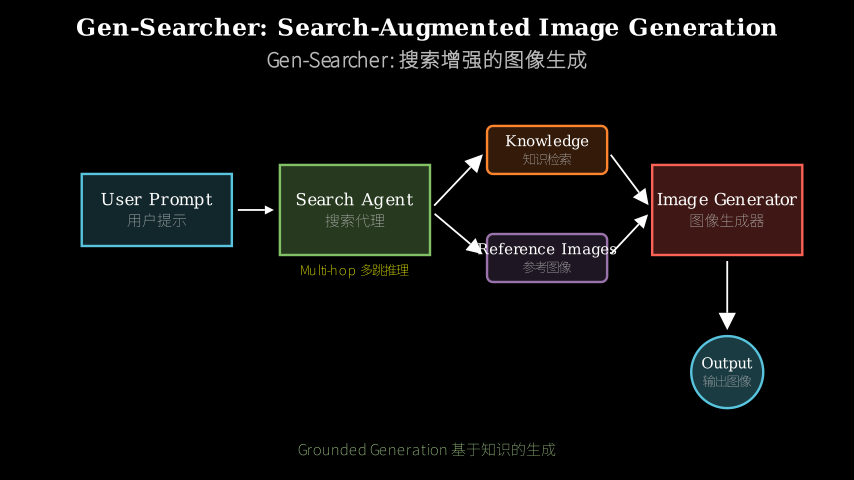
Gen-Searcher has three stages. First, given a prompt like “generate an image of the winner of the 2024 Turing Award,” it uses an LLM to plan search queries (“who won 2024 Turing Award”). Second, it executes searches, retrieves text snippets and reference images, then decides whether to search again (multi-hop) or proceed. Third, it synthesizes the final image using both the original prompt and retrieved context.
The training pipeline constructs two datasets: Gen-Searcher-SFT-10k for supervised fine-tuning (teaching the agent to search correctly) and Gen-Searcher-RL-6k for reinforcement learning (optimizing search strategy). The RL phase uses GRPO (Group Relative Policy Optimization) with dual rewards: a text-based reward (does retrieved text match ground truth?) and an image-based reward (does generated image match reference?). This dual signal stabilizes training—text rewards guide search accuracy, image rewards guide generation quality.
Prompt --> [LLM Planner] --> Search Query
              |                    |
              v                    v
         Multi-hop?  <--  [Search Engine]
              |                    |
              v                    v
         Retrieved Text + Images
              |
              v
         [Image Generator] --> Final Image
Think of Gen-Searcher as a painter with a research assistant. The painter (image generator) receives a commission but realizes they don’t know what the subject looks like. Instead of guessing, they send their assistant (LLM planner) to the library (search engine). The assistant doesn’t just grab one book—they read, realize they need more context, grab another book (multi-hop), and return with both written descriptions and reference sketches. The painter then works from this grounded material. The dual reward is like having two critics: one checks if the assistant brought back the right books (text reward), the other checks if the final painting matches the reference sketches (image reward).
Key Concepts
-
Multi-hop reasoning in search: Most retrieval systems do one query and stop. Multi-hop means the agent reads initial results, realizes it needs more specific information, and issues follow-up queries. Example: Prompt is “the car driven by the protagonist in the movie that won Best Picture in 2023.” First search: “2023 Best Picture winner” → “Everything Everywhere All at Once.” Second search: “car in Everything Everywhere All at Once” → specific vehicle details. Without multi-hop, you’d generate a generic car. With it, you get the actual vehicle from the film.
-
Dual-reward RL: Standard RL for text generation uses one reward (e.g., BLEU score). Here, text-based rewards alone are noisy—retrieved text might be correct but not visually useful. Image-based rewards alone are unstable—pixel-level metrics are high-variance. Dual rewards combine both: text rewards ensure factual accuracy of search, image rewards ensure visual fidelity. It’s like training a chef with two judges: one tastes the dish (image quality), the other checks if ingredients match the recipe (text accuracy). Both must agree for high reward.
-
GRPO (Group Relative Policy Optimization): A variant of PPO designed for language model fine-tuning. Instead of comparing each action to a baseline, GRPO groups multiple rollouts and compares them relatively. This reduces variance when rewards are noisy (common in image generation). Imagine training a dog: instead of saying “this fetch was 7/10,” you throw the ball five times and say “the third fetch was best.” The relative ranking is more stable than absolute scores.
Framework Shift
Before (mainstream approach):        After (this paper):

  Prompt                               Prompt
    |                                    |
    v                                    v
[Frozen Generator]                  [LLM Planner]
    |                                    |
    v                                    v
  Image                            Search Queries
 (fails on                              |
  knowledge-                             v
  intensive                        [Search Engine]
  prompts)                              |
                                        v
                                  Retrieved Context
                                        |
                                        v
                                  [Generator + Context]
                                        |
                                        v
                                      Image
                                   (grounded)
From closed-loop generation to open-loop search-augmented generation, the core shift is treating the generator as an agent that actively seeks missing information rather than a passive function that halts when knowledge is absent.
Expert Assessment
Problem choice: Real gap. Image generators genuinely fail on knowledge-intensive prompts—this isn’t manufactured. The problem sits at the intersection of retrieval-augmented generation (hot in NLP) and image synthesis (hot in vision), making it timely. However, the scope is narrow: most image generation use cases don’t require up-to-date factual knowledge. This is a niche, albeit important, slice of the problem space.
Method maturity: The agentic search idea is clever, but the execution leans on existing components (LLM for planning, off-the-shelf search API, standard diffusion model). The novelty is in the integration and training recipe, not the architecture. Dual-reward RL is sensible but not groundbreaking—it’s an incremental improvement over single-reward baselines. A simpler approach might be retrieval-augmented prompting without RL, but the authors don’t ablate this thoroughly.
Experimental integrity: Baselines are fair (Qwen-Image, DALL-E 3, Midjourney). The KnowGen benchmark is custom-built by the authors, which raises questions about overfitting—did they tune the method to their own eval? The WISE benchmark is external, and the +15 point gain there is more convincing. Numbers look solid, but the paper lacks failure case analysis. When does search hurt? How often does multi-hop retrieve irrelevant junk?
Writing quality: The paper front-loads contributions but buries the data pipeline details in the appendix. Section 3.2 (data construction) should be in the main text—it’s the linchpin of the method. The RL section is dense and assumes familiarity with GRPO; a clearer walkthrough would help. Figures are clean but lack error bars. If the authors rewrote Section 4 (experiments) to include qualitative failure analysis and ablation on search depth, the paper would jump a tier.
Verdict: Weak accept — solid execution on a real but narrow problem, with honest experimental work but missing depth in analysis.
Takeaways
Practitioners can steal the dual-reward RL framework for any task where you have both semantic correctness (text-based) and perceptual quality (image/audio-based) to optimize. The idea of using relative ranking (GRPO) instead of absolute rewards transfers to any noisy reward setting. The multi-hop search pattern is reusable: plan → search → evaluate → re-search is a general agentic loop applicable beyond image generation (e.g., code generation with API docs, video synthesis with scene references). The data pipeline—constructing search-intensive prompts by mining knowledge graphs and temporal events—is a concrete recipe for building eval sets in other domains.
论文: 2603.28767 作者: Kaituo Feng, Manyuan Zhang, Shuang Chen, Yunlong Lin, Kaixuan Fan, Yilei Jiang, Hongyu Li, Dian Zheng, Chenyang Wang, Xiangyu Yue 分类: cs.CV
缺口
当前的图像生成模型(Stable Diffusion、DALL-E、Midjourney)是冻结的知识系统。
它们擅长从文本提示合成逼真图像,但在以下情况下会彻底失败:需要训练数据中没有的现实世界知识(如”上周当选的斯普林菲尔德新市长”),需要最新信息(如”最新款iPhone设计”),需要多跳推理(如”2024年诺贝尔奖颁奖典礼举办建筑的建筑风格”)。
先前工作要么(1)检索参考图像但不推理该搜什么,要么(2)用大语言模型推理但不把搜索整合进生成流程。
没人训练过一个能决定搜什么、执行多跳查询、用检索知识指导图像生成的智能体。
问题:生成器中的冻结知识
   |
   v
假设:搜索能提供缺失知识
   |
   v
方法:智能体搜索+双重奖励强化学习
   |
   v
证据:KnowGen上+16分,WISE上+15分
   |
   v
结论:搜索增强生成有效
增量
一句话: 这篇论文之前,图像生成器是闭卷考试的学生,遇到知识密集型提示就挂科;之后,它们变成了会先查资料再答题的智能体。
核心机制
Gen-Searcher有三个阶段。
首先,给定提示如”生成2024年图灵奖得主的图像”,它用大语言模型规划搜索查询(“谁获得了2024年图灵奖”)。
其次,执行搜索,检索文本片段和参考图像,然后决定是再次搜索(多跳)还是继续。
第三,使用原始提示和检索到的上下文合成最终图像。
训练流程构建两个数据集:Gen-Searcher-SFT-10k用于监督微调(教智能体正确搜索),Gen-Searcher-RL-6k用于强化学习(优化搜索策略)。
强化学习阶段使用GRPO(群体相对策略优化)配合双重奖励:基于文本的奖励(检索文本是否匹配真值?)和基于图像的奖励(生成图像是否匹配参考?)。
这种双重信号稳定了训练——文本奖励引导搜索准确性,图像奖励引导生成质量。
提示 --> [大语言模型规划器] --> 搜索查询
            |                      |
            v                      v
       需要多跳?  <--  [搜索引擎]
            |                      |
            v                      v
       检索到的文本+图像
            |
            v
       [图像生成器] --> 最终图像
把Gen-Searcher想象成一个有研究助理的画家。
画家(图像生成器)接到委托,但意识到不知道主题长什么样。
他们不是瞎猜,而是派助理(大语言模型规划器)去图书馆(搜索引擎)。
助理不只是抓一本书——他们阅读,意识到需要更多上下文,再抓另一本书(多跳),然后带着书面描述和参考草图回来。
画家再根据这些有根据的材料作画。
双重奖励就像有两个评委:一个检查助理是否带回了正确的书(文本奖励),另一个检查最终画作是否匹配参考草图(图像奖励)。
关键概念
- 搜索中的多跳推理: 大多数检索系统做一次查询就停了。
多跳意味着智能体读取初始结果,意识到需要更具体的信息,然后发出后续查询。
例子:提示是”2023年获得最佳影片的电影中主角开的车”。
第一次搜索:“2023年最佳影片得主”→“瞬息全宇宙”。
第二次搜索:“瞬息全宇宙中的车”→具体车辆细节。
没有多跳,你会生成一辆通用的车。
有了多跳,你得到电影中的实际车辆。
- 双重奖励强化学习: 文本生成的标准强化学习用一个奖励(如BLEU分数)。
这里,仅基于文本的奖励有噪声——检索到的文本可能正确但视觉上无用。
仅基于图像的奖励不稳定——像素级指标方差大。
双重奖励结合两者:文本奖励确保搜索的事实准确性,图像奖励确保视觉保真度。
就像训练厨师有两个评委:一个品尝菜肴(图像质量),另一个检查食材是否符合食谱(文本准确性)。
两者都必须同意才能获得高奖励。
- GRPO(群体相对策略优化): 为语言模型微调设计的PPO变体。
GRPO不是将每个动作与基线比较,而是将多个rollout分组并相对比较。
这减少了奖励有噪声时的方差(在图像生成中很常见)。
想象训练一只狗:不是说”这次捡球7/10分”,而是扔五次球然后说”第三次捡得最好”。
相对排名比绝对分数更稳定。
框架转变
之前(主流方法):                之后(本文方法):

  提示                           提示
    |                              |
    v                              v
[冻结生成器]                  [大语言模型规划器]
    |                              |
    v                              v
  图像                         搜索查询
 (在知识                           |
  密集型                            v
  提示上                      [搜索引擎]
  失败)                             |
                                   v
                             检索到的上下文
                                   |
                                   v
                            [生成器+上下文]
                                   |
                                   v
                                 图像
                              (有根据)
从闭环生成到开环搜索增强生成,核心转变是将生成器视为主动寻求缺失信息的智能体,而非知识缺失时就停止的被动函数。
专家评审
选题眼光: 真实缺口。
图像生成器在知识密集型提示上确实失败——这不是人造的。
问题位于检索增强生成(NLP热点)和图像合成(视觉热点)的交叉点,使其及时。
然而,范围狭窄:大多数图像生成用例不需要最新的事实知识。
这是问题空间的一个小众但重要的切片。
方法成熟度: 智能体搜索的想法很巧妙,但执行依赖现有组件(用于规划的大语言模型、现成的搜索API、标准扩散模型)。
新颖性在于集成和训练配方,而非架构。
双重奖励强化学习合理但不突破性——是对单奖励基线的增量改进。
更简单的方法可能是不用强化学习的检索增强提示,但作者没有彻底消融这一点。
实验诚意: 基线公平(Qwen-Image、DALL-E 3、Midjourney)。
KnowGen基准是作者自建的,这引发了过拟合的问题——他们是否针对自己的评估调优了方法?WISE基准是外部的,那里的+15分增益更有说服力。
数字看起来扎实,但论文缺乏失败案例分析。
搜索何时有害?多跳检索到无关垃圾的频率有多高?
写作功力: 论文前置贡献但将数据流程细节埋在附录中。
第3.2节(数据构建)应该在正文中——它是方法的关键。
强化学习部分密集且假设熟悉GRPO;更清晰的演练会有帮助。
图表干净但缺少误差条。
如果作者重写第4节(实验)以包含定性失败分析和搜索深度消融,论文会跃升一个档次。
判决: 弱接收 — 在真实但狭窄的问题上执行扎实,实验工作诚实但分析缺乏深度。
要点总结
实践者可以偷走双重奖励强化学习框架,用于任何需要同时优化语义正确性(基于文本)和感知质量(基于图像/音频)的任务。
使用相对排名(GRPO)而非绝对奖励的想法可迁移到任何噪声奖励设置。
多跳搜索模式可复用:规划→搜索→评估→再搜索是一个通用的智能体循环,适用于图像生成之外(如带API文档的代码生成、带场景参考的视频合成)。
数据流程——通过挖掘知识图谱和时间事件构建搜索密集型提示——是在其他领域构建评估集的具体配方。