Paper: 2607.16190 Authors: Hao Liu, Chenghuan Huang, Ye Huang, Zhiying Wen, Hao Liu, Mohan Zhang, Chen Li, Ziyang Ma, Jing Lyu, Jiangsu Du Categories: cs.CV
The Gap
Video Diffusion Transformers (DiTs) like Wan2.2 generate high-resolution video by processing long spatio-temporal sequences — self-attention on these sequences is brutally expensive. The community has developed training-free sparse attention methods (e.g., AdaSpa, FastDiT) that use adaptive Top- routing to skip low-attention blocks, saving compute without retraining. This works beautifully on a single GPU.
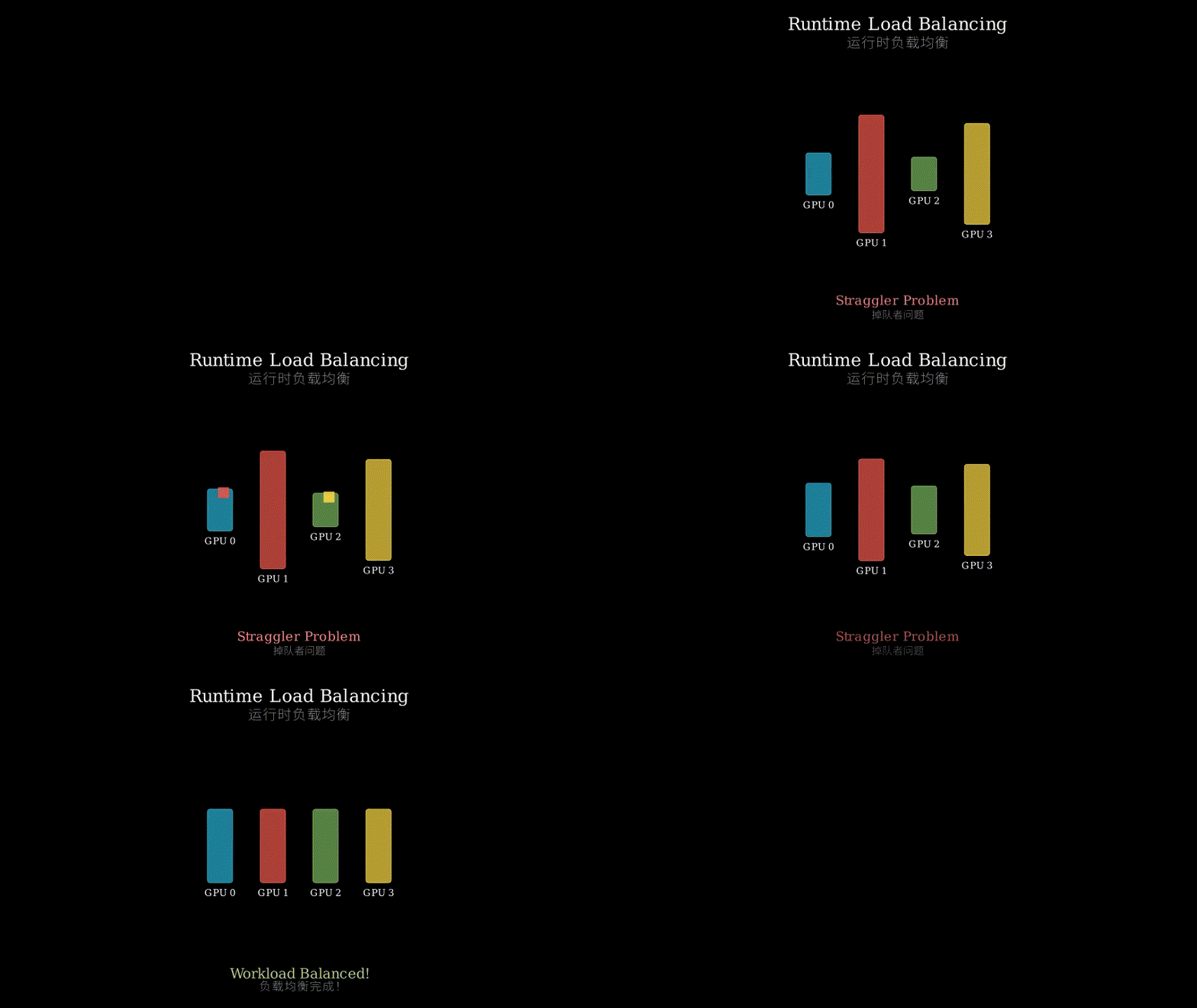
But production video generation uses multi-GPU sequence parallelism — the sequence is sharded across GPUs, each processing its slice. Here’s the problem nobody properly solved: adaptive Top- routing lets each attention head independently choose *how many blocks it attends to. Some heads are “heavy” (they select many blocks), others are “light.” When a heavy head lands on one GPU and light heads land on another, the heavy GPU becomes the bottleneck. The entire pipeline waits for the straggler. The average sparsity might be 70%, but the variance across GPUs kills you.
Prior work either (a) used fixed sparsity patterns (losing adaptivity), (b) ignored the load imbalance (accepting poor GPU utilization), or (c) required retraining to enforce uniform sparsity. Nobody tackled runtime load balancing for adaptive sparse attention under sequence parallelism.
[Problem]
    |
    v
Adaptive Top-p routing
    |
    v
Uneven per-head workload selection
    |
    v
GPU-level load imbalance (straggler effect)
    |
    v
Poor multi-GPU utilization despite sparsity
    |
    v
[FVAttn: Runtime Load Balancing]
    |
    v
Migrate heavy heads + fill idle slack
    |
    v
Balanced GPU utilization
    |
    v
4.4x attention speedup, quality preserved
The Increment
One sentence: Before this paper, adaptive sparse attention saved compute but wasted it again through load imbalance on multi-GPU setups; after this paper, you get both sparsity *and balanced utilization, achieving 4.4× attention speedup and 2× end-to-end DiT inference speedup.
Core Mechanism
FVAttn has three layers that work together:
Layer 1 — Sparse-Routing Frontend: Each attention head uses Top- selection to choose which KV blocks to attend to (preserving adaptivity). A Top- safety floor ensures every head attends to at least blocks (preventing degenerate cases). Blocks are organized with video-aware structure — spatially and temporally neighboring tokens are grouped, which improves cache locality and routing coherence.
Layer 2 — Runtime Load Balancing (RLB): After routing decisions are made but before execution, FVAttn measures the workload per GPU. It identifies the critical path (the GPU with the most total work). Then it migrates a small number of heavy heads from overloaded ranks to underloaded ranks via P2P communication. The key insight: you don’t need to rebalance *everything — just migrating the few heaviest heads shortens the critical path enough.
Layer 3 — Slack-Aware Sparse Augmentation: After migration, some GPUs still have idle slack (they finished their assigned work early). FVAttn fills this slack with additional high-value KV blocks that were previously pruned by Top- — essentially recovering attention quality for free. The scheduling and migration overhead is hidden behind existing computation through overlap.
Frontend                    Runtime                     Execution
-----------                 --------                    ---------
Top-p routing               Measure workload            Execute attention
+ Top-k safety floor            |                           |
        |                       v                           v
        v                   Find critical path        Overlap scheduling
Video-aware block               |                    behind computation
  organization                  v                           |
        |                   Migrate heavy                   |
        v                   heads (P2P)                     v
Per-head block masks            |                    Slack augmentation
        |                       v                    fills idle time
        v                   Fill remaining
Sparse mask ready               slack
Metaphor — The Airport Security Checkpoint: Imagine an airport with multiple security lanes (GPUs). Each passenger (attention head) needs screening (computation), but the time varies — some have complex carry-ons (heavy heads), others breeze through (light lanes). Traditionally, passengers are assigned to lanes at check-in and stuck there, even if lane 3 has a 20-minute line while lane 1 is empty.
FVAttn works like a smart checkpoint manager. First, it groups passengers by flight destination (video-aware block organization) so related passengers are near each other. After initial assignment, it watches the lines form. When lane 3 gets backed up, it reassigns the two passengers with the most complex bags to lane 1 (runtime load balancing via P2P). Now all lanes finish roughly together. But lane 1 still has a little idle time — so the manager sends a few extra passengers who were on standby (slack augmentation), improving overall screening coverage at no extra delay. The reassignment paperwork happens while other passengers are already being screened (overlap).
The beauty: no passenger had to change their bags (no retraining), the manager just shuffled assignments at runtime, and everyone gets through faster.
Key Concepts
-
Rank-Level Straggler Problem: In distributed computing, if you have 4 GPUs and 3 finish in 10ms but the 4th takes 30ms, your effective speed is 30ms — you wasted 60% of your GPU-seconds. With adaptive sparse attention, each head picks its own workload, so the *distribution of work across GPUs is random and sometimes unlucky. The straggler isn’t caused by slow hardware; it’s caused by workload variance from adaptive routing. Example: imagine 8 students sharing a group project where each picks their own task from a menu. If three students all pick the hardest tasks and end up on the same sub-team, that sub-team delays everyone.
-
Top- Routing with Safety Floor: Top- is like saying “attend to the minimum number of blocks whose cumulative attention weight reaches of the total.” This is adaptive — simple regions need few blocks, complex regions need many. The Top- safety floor says “but always attend to at least blocks no matter what.” Without the floor, a head might select zero blocks for a trivial region, causing numerical instability. With it, you get a smooth lower bound on work per head, which also helps with load prediction.
-
Critical Path Shortening: In parallel systems, total time = max(individual times). You don’t need to make everything perfectly equal; you just need to bring down the maximum. FVAttn focuses migration effort on the few heads that are causing the bottleneck — not on perfectly balancing every head. This is like trimming the tallest weed in a garden; a few strategic cuts make the whole lawn look level.
Framework Shift
Before (mainstream approach):          After (this paper):
                                       +---------------------------+
+-------------------+                  | Sparse-Routing Frontend   |
| Adaptive Top-p    |                  | (Top-p + Top-k + video   |
| sparse attention  |                  |  block organization)      |
| (per-head routing)|                  +-------------+-------------+
+--------+----------+                                |
         |                                           v
         v                                  +--------+----------+
  Uneven workload                            | Runtime Load       |
  across GPUs                                | Balancing (RLB)    |
         |                                   | - measure workload |
         v                                   | - migrate heads    |
  Straggler waits                            | - P2P comm         |
  others idle                                +--------+----------+
         |                                            |
         v                                            v
  Poor utilization                           +--------+----------+
  (sparsity wasted)                          | Slack Augmentation  |
                                             | + Overlap           |
                                             | (fill idle GPU time |
                                             |  with useful work)  |
                                             +--------+----------+
                                                      |
                                                      v
                                             Balanced utilization
                                             (sparsity preserved)
From ignoring cross-GPU load distribution to actively managing it at runtime, the core shift is treating sparse attention as a scheduling problem, not just an algorithmic problem.
Expert Assessment
Problem choice: This is a real gap. The video generation community has been racing to make sparse attention work (AdaSpa, SpargeAttention, etc.), but almost all evaluation is single-GPU. Sequence parallelism is becoming standard for production video generation, and the load imbalance issue is a genuine pain point that scales with resolution and sequence length. Well-positioned in the field’s trajectory.
Method maturity: The approach is pragmatic and well-engineered rather than theoretically elegant. The three-layer design (frontend → RLB → slack augmentation) is clean, and each component addresses a specific sub-problem. The insight that you only need to migrate a few heavy heads (not rebalance everything) is good systems thinking. A simpler approach — forcing uniform sparsity per head — would sacrifice the adaptivity that makes Top- valuable in the first place. The authors correctly identified that you should keep the routing adaptive and fix the *distribution at runtime.
Experimental integrity: Testing on Wan2.2 I2V (a real, modern model) with competitive quality metrics is credible. The 4.41× attention speedup and 2.02-2.11× DiT speedup are substantial. Load imbalance reduction from 1.34 to 1.08 is meaningful — not a marginal improvement. However, I’d want to see more ablation on different sequence lengths and GPU counts (how does it scale to 8 or 16 GPUs?). The quality evaluation seems solid but could benefit from user studies beyond automated metrics.
Writing quality: The paper reads well technically but cuts corners on the “why should I care” framing. The introduction spends too much time on general sparse attention history before arriving at the actual contribution. The method section could use a single running example (e.g., a 4-GPU setup with 16 heads) that shows exact numbers flowing through each stage. Section 4 (experiments) would benefit from a wall-clock breakdown showing where the 2× end-to-end speedup comes from — how much is attention, how much is communication savings.
Verdict: weak accept — A solid systems contribution that solves a real bottleneck, but the evaluation could be broader (more scales, more models) and the writing could better highlight the key insight vs. burying it in implementation details.
Takeaways
Three concrete ideas to steal:
-
“Fix the distribution, not the algorithm”: When adaptive algorithms create load imbalance in distributed settings, don’t kill the adaptivity — add a runtime scheduling layer on top. This framing transfers to any adaptive routing system (MoE, dynamic computation graphs, etc.).
-
Critical-path-only optimization: Don’t try to balance everything. Measure the critical path, identify the few items causing it, and migrate just those. This is a general principle for parallel system optimization that applies far beyond attention.
-
Slack-aware augmentation: When your load balancing leaves some workers idle, use that slack to recover quality you sacrificed for speed. This “free lunch” pattern — using otherwise-wasted resources to improve output — shows up in many systems (e.g., using idle CPU cores for prefetching, background garbage collection during I/O waits).
论文: 2607.16190 作者: Hao Liu, Chenghuan Huang, Ye Huang, Zhiying Wen, Hao Liu, Mohan Zhang, Chen Li, Ziyang Ma, Jing Lyu, Jiangsu Du 分类: cs.CV
缺口
视频扩散Transformer(DiT)如Wan2.2生成高分辨率视频时,需要处理极长的时空序列——自注意力计算是主要瓶颈。 社区已经开发了免训练的稀疏注意力方法(如AdaSpa、FastDiT),用自适应Top-路由跳过低注意力块,无需重训练即可节省计算。 这在单GPU上效果很好。
但生产级视频生成使用多GPU序列并行——序列被切分到多个GPU上。 问题在于:自适应Top-路由让每个注意力头独立选择关注多少块。 有些头”重”(选很多块),有些头”轻”。 当重头恰好分到一个GPU,轻头分到另一个GPU时,重GPU就成了瓶颈。 整个管线都在等最慢的那个GPU。 平均稀疏度可能是70%,但GPU间的方差会毁掉一切。
此前的方法要么(a)用固定稀疏模式(丧失自适应性),要么(b)忽略负载不均(接受低GPU利用率),要么(c)需要重训练来强制均匀稀疏。 没有人真正解决序列并行下自适应稀疏注意力的运行时负载均衡问题。
[问题]
    |
    v
自适应 Top-p 路由
    |
    v
每个头的工作量选择不均匀
    |
    v
GPU 级负载不均(掉队者效应)
    |
    v
尽管有稀疏,多GPU利用率仍然很低
    |
    v
[FVAttn:运行时负载均衡]
    |
    v
迁移重负载头 + 填充空闲余量
    |
    v
GPU 利用率均衡
    |
    v
4.4 倍注意力加速,质量保持
增量
一句话: 这篇论文之前,自适应稀疏注意力节省的计算被多GPU负载不均浪费掉了; 这篇论文之后,你同时获得稀疏性和均衡利用率——4.4倍注意力加速,2倍端到端DiT推理加速。
核心机制
FVAttn有三个层次协同工作:
第一层——稀疏路由前端:每个注意力头用Top-选择关注哪些KV块(保留自适应性)。 Top-安全下限确保每个头至少关注个块(防止退化情况)。 块按视频感知的方式组织——空间和时间上相邻的token被分组,提高缓存局部性和路由一致性。
第二层——运行时负载均衡(RLB):路由决策确定后、执行之前,FVAttn测量每个GPU的工作量。 它识别关键路径(工作量最大的GPU),然后通过P2P通信将少数重负载头从过载的rank迁移到欠载的rank。 核心洞察:不需要重新平衡所有东西——只迁移最重的几个头就足以缩短关键路径。
第三层——余量感知稀疏增强:迁移后,部分GPU仍有空闲余量。 FVAttn用额外的高价值KV块填充这些余量——这些块之前被Top-裁剪掉了,相当于免费恢复注意力质量。 调度和迁移的开销通过重叠计算被隐藏。
前端                     运行时                     执行
-----------              --------                   ---------
Top-p 路由               测量工作量                  执行注意力
+ Top-k 安全下限            |                          |
        |                   v                          v
        v               识别关键路径               重叠调度
视频感知块组织               |                   隐藏在计算背后
        |                   v                          |
        v               迁移重负载头                   v
每个头的块掩码              (P2P)                余量增强填充
        |                   v                    空闲时间
        v               用有用工作
稀疏掩码就绪               填充剩余余量
核喻——机场安检通道:想象一个机场有多条安检通道(GPU)。 每个旅客(注意力头)需要安检(计算),但耗时不同——有些行李复杂(重头),有些轻松通过(轻通道)。 传统做法是旅客在值机时被分配到固定通道,即使3号通道排了20分钟而1号空着。
FVAttn像一个聪明的安检经理。 首先,它按航班目的地分组旅客(视频感知块组织),让相关旅客在一起。 初始分配后,它观察队列形成。 当3号通道堵车时,它把行李最复杂的两位旅客重新分配到1号通道(通过P2P运行时负载均衡)。 现在所有通道大致同时完成。 但1号通道还有点空闲时间——经理就派了几位候补旅客过去(余量增强),在不增加延迟的情况下提高了整体安检覆盖率。 重新分配的手续在其他旅客接受安检时就完成了(重叠)。
妙处在于:没有旅客需要改行李(无需重训练),经理只是在运行时调整了分配,所有人都更快通过。
关键概念
-
Rank级掉队者问题:在分布式计算中,如果你有4个GPU,3个在10ms内完成但第4个要30ms,你的有效速度就是30ms——浪费了60%的GPU-秒。 自适应稀疏注意力中,每个头自选工作量,所以GPU间的工作量分布是随机的,有时会很倒霉。 掉队者不是硬件慢造成的,而是自适应路由带来的工作量方差。 类比:8个学生分组做项目,每人从菜单自选任务。 如果三个学生都选了最难的任务并恰好分在同一组,那个组就会拖累所有人。
-
带安全下限的Top-路由:Top-就像说”选择累积注意力权重达到总权重的最少块数”。 这是自适应的——简单区域需要少量块,复杂区域需要大量块。 Top-安全下限说”但无论如何至少关注个块”。 没有下限时,某个头可能为平凡区域选择零个块,导致数值不稳定。 有了下限,你得到每个头的平滑工作量下界,也有助于负载预测。
-
关键路径缩短:在并行系统中,总时间 = max(各单体时间)。 你不需要让一切都完美均衡;只需要降低最大值。 FVAttn只聚焦迁移造成瓶颈的少数头——不追求完全均衡。 这像修剪花园里最高的杂草;几次精准修剪,整个草坪就看起来齐平了。
框架转变
之前(主流方法):                   之后(本文方法):
+-------------------+               +---------------------------+
| 自适应 Top-p      |               | 稀疏路由前端               |
| 稀疏注意力        |               | (Top-p + Top-k +          |
| (每头路由)       |               |  视频块组织)               |
+--------+----------+               +-------------+-------------+
         |                                         |
         v                                         v
  GPU间工作量不均                          +--------+----------+
         |                                 | 运行时负载均衡 (RLB) |
         v                                 | - 测量工作量         |
  掉队者阻塞                               | - 迁移重头           |
  其他GPU空闲                              | - P2P 通信           |
         |                                 +--------+----------+
         v                                          |
  利用率低下                               +--------+----------+
  (稀疏被浪费)                           | 余量增强 + 重叠       |
                                           | (填充空闲GPU时间)   |
                                           +--------+----------+
                                                    |
                                                    v
                                           利用率均衡
                                           (稀疏被保留)
从忽略跨GPU负载分布到运行时主动管理它——核心转变是将稀疏注意力视为一个调度问题,而非仅仅是算法问题。
专家评审
选题眼光: 这是一个真实的缺口。 视频生成社区一直在竞相让稀疏注意力生效(AdaSpa、SpargeAttention等),但几乎所有评估都是单GPU的。 序列并行正在成为生产级视频生成的标准配置,负载不均是一个随着分辨率和序列长度增长而加剧的真实痛点。 在领域发展轨迹中定位准确。
方法成熟度: 方法务实且工程化,而非理论优美。 三层设计(前端 → RLB → 余量增强)清晰,每个组件解决一个具体子问题。 只迁移少数重负载头(而非重新平衡一切)的洞察体现了良好的系统思维。 更简单的做法——强制每头均匀稀疏——会牺牲Top-有价值的自适应性。 作者正确地保持了路由的自适应性,在运行时修复分布问题。
实验诚意: 在Wan2.2 I2V(真实的现代模型)上测试并保持质量指标,这很可信。 4.41倍注意力加速和2.02-2.11倍DiT加速幅度很大。 负载不均从1.34降到1.08是有意义的——不是边际改善。 但我希望看到更多关于不同序列长度和GPU数量的消融实验(扩展到8或16个GPU时表现如何?)。 质量评估看起来扎实,但超越自动化指标的用户研究会更有说服力。
写作功力: 技术上可读,但在”你为什么该关心”的框架上偷懒了。 引言花了太多时间讲一般稀疏注意力的历史才到达实际贡献。 方法部分可以用一个贯穿始终的运行示例(例如4 GPU、16头的设置),展示每个阶段的确切数字。 第4节(实验)会从一个时间分解中受益——展示2倍端到端加速具体来自哪里,多少来自注意力,多少来自通信节省。
判决: 弱接收——一个扎实的系统贡献,解决了真实瓶颈,但评估可以更广泛(更多规模、更多模型),写作可以更好地突出关键洞察而非将其埋在实现细节中。
要点总结
三个可偷的具体想法:
-
“修分布,不修算法”:当自适应算法在分布式环境中造成负载不均时,不要扼杀自适应性——在上面加一个运行时调度层。 这个思维框架可以迁移到任何自适应路由系统(MoE、动态计算图等)。
-
仅优化关键路径:不要试图平衡一切。 测量关键路径,识别造成瓶颈的少数项,只迁移那些。 这是并行系统优化的通用原则,远超注意力范畴。
-
余量感知增强:当负载均衡让部分worker空闲时,用那些余量恢复你为速度牺牲的质量。 这种”免费午餐”模式——用原本浪费的资源提升输出——在许多系统中出现(例如用空闲CPU核心做预取、在I/O等待时做后台垃圾回收)。