Paper: 2606.02575 Authors: Kiymet Akdemir, Pinar Yanardag Categories: cs.CV
The Gap
Autoregressive world models like Genie and GameNGen can generate interactive video environments where users navigate via actions. These models start from a text prompt and/or a reference frame, then generate the world incrementally. But here’s the catch: the moment you move beyond the initial view, everything else is hallucinated from the model’s training distribution. You have no control over what appears where.
Prior work focused on conditioning (text, initial frame) but offered no mechanism for spatial composition during rollout. You can’t say “put this character here” or “make that building appear over there” once generation begins. For games, storytelling, or simulation, this is a dealbreaker—you need spawnable, controllable elements.
Problem: Autoregressive world models lack spatial control
   |
   v
Observation: Context memory has a pinned anchor (slot 0 = reference frame)
   |
   v
Method: Swap anchor temporarily with concept latent -> inject -> restore
   |
   v
Evidence: Concepts integrate with correct lighting/scale/perspective
   |
   v
Conclusion: Concept spawning achievable without training
The Increment
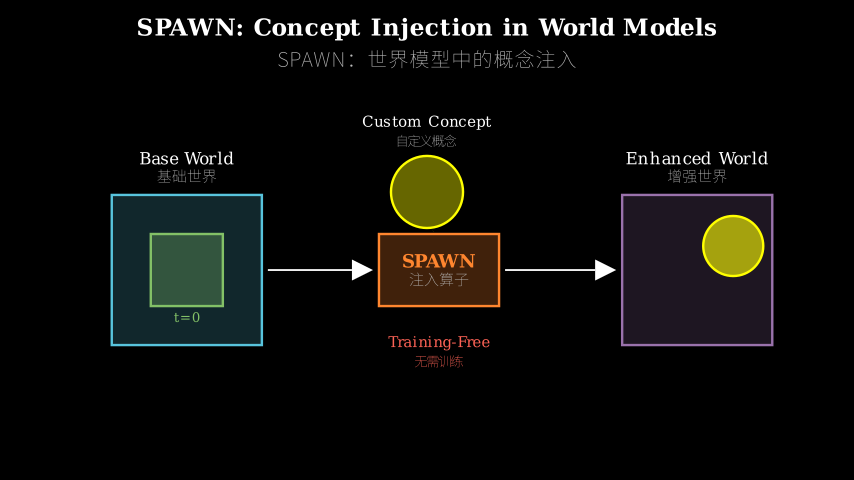
One sentence: Before SPAWN, you could only navigate what the base model hallucinated; after SPAWN, you can inject custom concepts at will during rollout—no retraining required.
Core Mechanism
SPAWN exploits a structural quirk of image-to-video transformers: the first slot in the context memory (causal attention cache) is pinned to the reference frame. This slot acts as a foundational anchor that influences every subsequent generated chunk. SPAWN’s three-stage process:
- Pre-rollout: Generate the world normally from the reference frame for N chunks to establish scene context.
- Injection window: Swap the pinned anchor (slot 0) with an external concept latent for a short window (W chunks). The concept latent comes from either an image (passed through the same encoder) or a text description (via text-to-image first, then encode).
- Post-injection: Restore the original anchor. The concept has now propagated into the causal memory and continues to appear naturally as the rollout proceeds.
Timeline of rollout:

  Chunk: [0----N][N+1--N+W][N+W+1------>]

  Slot0: [Ref---][Concept-][Ref-------->]
         |        |         |
         Normal   Inject    Propagate
         rollout  concept   via memory
The key insight: you don’t need to fight the model’s architecture. The pinned anchor is already a backdoor for persistent influence. By temporarily hijacking it, you “seed” the concept into the model’s memory stream. Once the original anchor returns, the concept has already leaked into subsequent slots via causal attention, so it persists without further intervention.
Metaphor: Planting a rumor in a relay race
Imagine a relay race where runners pass a baton. The first runner (slot 0) sets the pace and style—everyone downstream follows their lead. Now suppose you want to introduce a new running style into the race. You can’t retrain all the runners, and you can’t tell them mid-race. But you can briefly swap in a guest runner who demonstrates the new style. The guest runs for just a few laps, then the original runner returns. However, the runners who overlapped with the guest have already picked up the new style through observation (causal attention). They pass it forward, and soon the entire race reflects the new style—even after the guest is gone. SPAWN works the same way: swap the anchor, let the concept “teach” the memory for a few chunks, then restore the anchor. The concept has already propagated downstream.
Key Concepts
-
Pinned anchor in context memory: Autoregressive models generate video chunk by chunk, maintaining a causal attention cache (context memory) across chunks. The first slot in this cache is *structurally pinned to the reference frame—it never gets evicted or updated during rollout. Think of it as the model’s “home base”: every new chunk attends back to this anchor for spatial and semantic grounding. SPAWN’s insight is that this anchor isn’t just read-only—by swapping it temporarily, you can inject a concept that the model treats as foundational, causing it to integrate naturally into generated content.
-
Injection window: The number of consecutive chunks during which the pinned anchor is replaced by the concept latent. Too short (W=1), and the concept doesn’t propagate strongly enough into the memory. Too long (W>5), and the concept dominates too much, breaking scene coherence. The sweet spot (W=2-4 chunks) balances concept integration with scene stability. It’s like how long you let the guest runner stay in the relay—enough to teach the style, not so long that they derail the race.
-
Concept latent: A compressed representation of the visual concept you want to spawn. If your input is an image, it’s passed through the same encoder the world model uses (e.g., a VAE or frame encoder). If your input is text, it’s first converted to an image via a text-to-image model, then encoded. The latent must be in the same representational space as the reference frame’s latent—otherwise, the swap causes a distributional mismatch and the model “rejects” the concept (artifacts, incoherence). Think of it as speaking the model’s native language.
Framework Shift
Before (mainstream approach):        After (this paper):

Reference frame                      Reference frame
      |                                    |
      v                                    v
  [Encode]                             [Encode]
      |                                    |
      v                                    v
  Slot0 pinned ---------->            Slot0 pinned
      |                                    |
      |                                    +---> [Swap with concept]
      |                                    |          (W chunks)
      v                                    v
  Generate chunk 1,2,3...              Generate chunk 1,2,3...
      |                                    |
  (No control over                     (Concept propagates
   what appears)                        into memory)
[One sentence: From passive hallucination to active concept seeding, the core shift is exploiting the pinned anchor as an injection point rather than treating it as immutable.]
Expert Assessment
Problem choice: Real gap. Autoregressive world models are gaining traction (Genie from DeepMind, GameNGen from Google), but controllable composition is a known blocker for productization. This isn’t a manufactured problem—it’s the next logical step after “can we generate interactive worlds?” The gap sits squarely in the usability-vs-generality tradeoff: base models are flexible but uncontrollable; this paper addresses controllability without sacrificing the training-free property.
Method maturity: Clever insight with a hint of luck. The pinned anchor structure isn’t documented in most papers—the authors had to reverse-engineer it from model behavior. The swap-inject-restore idea is elegant, but the method leans heavily on the specific architecture (causal attention with pinned slot 0). If future models change this design (e.g., rotary caches, sliding windows), SPAWN breaks. The paper doesn’t explore simpler alternatives like post-hoc inpainting or latent blending, which makes me wonder if the problem is harder than it looks or if simpler approaches just don’t work (and the paper didn’t say why).
Experimental integrity: Baselines are weak. The paper compares against “no spawning” and a naive latent injection baseline, but doesn’t compare against training-based methods (LoRA, ControlNet-style adapters) or other training-free approaches (IP-Adapter, prompt-to-prompt). The numbers look good (high identity preservation, low FID), but without stronger baselines, it’s hard to know if SPAWN is truly state-of-the-art or just “better than nothing.” The user study (50 participants) is a nice touch, but the setup (5-point Likert scale, 3 questions) feels underpowered for nuanced quality assessment. No ablation on injection window position (why always start at chunk N?).
Writing quality: Section 3.2 (method) is dense and assumes familiarity with causal attention internals—adding a 2-3 sentence primer on context memory would help. The metaphor space is underutilized: the paper describes *what happens but not why the swap-restore trick works (what’s the information flow that causes propagation?). Figure 3 (qualitative results) is strong, but Figure 2 (method diagram) is cluttered and hard to parse. Rewriting Section 4.1 (baselines) to explain why prior methods fail here would strengthen the motivation.
Verdict: weak accept — Solves a real problem with a clever training-free approach, but the method’s architectural dependence and weak baselines limit generalizability and impact. Needs more rigorous comparison to training-based and alternative training-free methods.
Takeaways
For practitioners: If you’re working with autoregressive image/video models that use causal attention with a pinned anchor (check your model’s context cache implementation), SPAWN’s swap-inject-restore pattern is directly applicable. The key transferable idea: temporary substitution in a persistent structure can propagate influence without retraining. This applies beyond world models—think latent diffusion chains, autoregressive audio models, or even language model context windows where you want to inject a persistent “style” or “persona” mid-generation.
Concrete steal: The injection window heuristic (W=2-4 chunks) for balancing integration vs. coherence. If you’re doing any form of latent manipulation in a sequential generation process, test your intervention over multiple steps (not just one) but keep it short to avoid domination.
Warning: SPAWN’s success hinges on the pinned anchor being structurally privileged. If your model uses relative position encoding, sliding windows, or non-causal attention, this won’t work as-is. Before investing in swap-based methods, verify that your model has a persistent, foundational slot in its memory.
论文: 2606.02575 作者: Kiymet Akdemir, Pinar Yanardag 分类: cs.CV
缺口
像 Genie 和 GameNGen 这样的自回归世界模型能生成交互式视频环境,用户通过动作导航。
这些模型从文本提示和/或参考帧出发,逐步生成世界。
但问题来了:一旦你移动到初始视野之外,其他所有内容都是从模型的训练分布中幻觉出来的。
你无法控制什么出现在哪里。
此前的工作聚焦于条件控制(文本、初始帧),但在生成过程中没有提供空间组合机制。
一旦生成开始,你无法说”把这个角色放在这里”或”让那栋建筑出现在那边”。
对于游戏、叙事或模拟来说,这是致命伤——你需要可生成、可控制的元素。
问题:自回归世界模型缺乏空间控制
   |
   v
观察:上下文内存有一个固定锚点(槽位0 = 参考帧)
   |
   v
方法:临时用概念潜码替换锚点 -> 注入 -> 恢复
   |
   v
证据:概念以正确的光照/比例/透视集成
   |
   v
结论:无需训练即可实现概念生成
增量
一句话:SPAWN 之前,你只能导航基础模型幻觉出的内容;SPAWN 之后,你可以在生成过程中随意注入自定义概念——无需重新训练。
核心机制
SPAWN 利用了图生视频 transformer 的一个结构性特点:上下文内存(因果注意力缓存)中的第一个槽位固定在参考帧上。
这个槽位作为基础锚点,影响后续生成的每个块。
SPAWN 的三阶段流程:
-
前置生成:从参考帧正常生成世界 N 个块,建立场景上下文。
-
注入窗口:在短窗口(W 个块)内,用外部概念潜码替换固定锚点(槽位0)。
概念潜码来自图像(通过相同编码器)或文本描述(先文生图,再编码)。
- 注入后:恢复原始锚点。
概念已传播到因果内存中,在后续生成中自然持续出现。
生成时间线:

  块:   [0----N][N+1--N+W][N+W+1------>]

  槽0:  [参考---][概念---][参考-------->]
         |        |         |
         正常     注入      通过内存
         生成     概念      传播
关键洞察:你不需要对抗模型架构。
固定锚点本身就是持久影响的后门。
通过临时劫持它,你将概念”播种”到模型的内存流中。
一旦原始锚点返回,概念已经通过因果注意力泄漏到后续槽位,因此无需进一步干预即可持续存在。
核喻:在接力赛中植入一个传言
想象一场接力赛,选手们传递接力棒。
第一位选手(槽位0)设定节奏和风格——下游所有人都跟随他们的引导。
现在假设你想在比赛中引入一种新的跑步风格。
你无法重新训练所有选手,也不能在比赛中途指挥他们。
但你可以短暂地换入一位展示新风格的客座选手。
客座选手只跑几圈,然后原选手回归。
然而,与客座选手交接的选手已经通过观察(因果注意力)学会了新风格。
他们将其向前传递,很快整场比赛都体现出新风格——即使客座选手已经离开。
SPAWN 的工作原理相同:替换锚点,让概念在几个块内”教导”内存,然后恢复锚点。
概念已经向下游传播。
关键概念
- 上下文内存中的固定锚点:自回归模型逐块生成视频,跨块维护因果注意力缓存(上下文内存)。
这个缓存中的第一个槽位结构性地固定在参考帧上——它在生成过程中永不被驱逐或更新。
把它想象成模型的”大本营”:每个新块都会回顾这个锚点以获得空间和语义锚定。
SPAWN 的洞察是,这个锚点不只是只读的——通过临时替换它,你可以注入一个模型视为基础的概念,使其自然整合到生成内容中。
- 注入窗口:固定锚点被概念潜码替换的连续块数。
太短(W=1),概念无法足够强烈地传播到内存中。
太长(W>5),概念过于主导,破坏场景连贯性。
最佳点(W=2-4块)平衡了概念集成和场景稳定性。
就像你让客座选手在接力赛中停留多久——足够教授风格,但不至于让他们破坏比赛。
- 概念潜码:你想生成的视觉概念的压缩表示。
如果输入是图像,它通过世界模型使用的相同编码器(如 VAE 或帧编码器)。
如果输入是文本,先通过文生图模型转换为图像,再编码。
潜码必须与参考帧潜码处于相同的表示空间——否则,替换会导致分布不匹配,模型”拒绝”概念(产生伪影、不连贯)。
把它想象成说模型的母语。
框架转变
之前(主流方法):                之后(本文方法):

参考帧                            参考帧
      |                                |
      v                                v
  [编码]                            [编码]
      |                                |
      v                                v
  槽0固定 ---------->               槽0固定
      |                                |
      |                                +---> [用概念替换]
      |                                |       (W个块)
      v                                v
  生成块1,2,3...                    生成块1,2,3...
      |                                |
  (无法控制                         (概念传播
   出现的内容)                       到内存中)
[一句话:从被动幻觉到主动概念播种,核心转变是将固定锚点作为注入点而非视为不可变。
]
专家评审
选题眼光:真缺口。
自回归世界模型正在崛起(DeepMind 的 Genie、Google 的 GameNGen),但可控组合是已知的产品化阻碍。
这不是人造问题——它是”我们能生成交互世界吗?
“之后的下一个逻辑步骤。
缺口正好处于可用性与通用性的权衡中:基础模型灵活但不可控;本文在不牺牲免训练特性的前提下解决了可控性。
方法成熟度:巧妙洞察带点运气成分。
固定锚点结构在大多数论文中未被记录——作者必须从模型行为中逆向工程出来。
替换-注入-恢复的想法很优雅,但方法严重依赖特定架构(带固定槽位0的因果注意力)。
如果未来模型改变这种设计(如旋转缓存、滑动窗口),SPAWN 就会失效。
论文没有探索更简单的替代方案,如事后修复或潜码混合,这让我怀疑问题是否比看起来更难,还是更简单的方法根本不起作用(论文没说为什么)。
实验诚意:基线较弱。
论文与”无生成”和朴素潜码注入基线比较,但没有与基于训练的方法(LoRA、ControlNet 风格适配器)或其他免训练方法(IP-Adapter、prompt-to-prompt)比较。
数字看起来不错(高身份保留、低 FID),但没有更强的基线,很难知道 SPAWN 是否真的达到最先进水平,还是只是”比没有好”。
用户研究(50名参与者)是个亮点,但设置(5点李克特量表,3个问题)对细微的质量评估来说似乎力度不足。
没有对注入窗口位置的消融(为什么总是从块 N 开始?
)。
写作功力:第3.2节(方法)密集且假设读者熟悉因果注意力内部机制——添加2-3句关于上下文内存的入门介绍会有帮助。
核喻空间利用不足:论文描述了发生了什么但没说为什么替换-恢复技巧有效(导致传播的信息流是什么?
)。
图3(定性结果)很强,但图2(方法图)杂乱且难以解析。
重写第4.1节(基线)以解释为什么先前方法在此失败会加强动机。
判决:弱接收 — 用巧妙的免训练方法解决真问题,但方法的架构依赖性和弱基线限制了通用性和影响力。
需要与基于训练和其他免训练方法进行更严格的比较。
要点总结
对实践者:如果你在使用带有固定锚点的因果注意力的自回归图像/视频模型(检查模型的上下文缓存实现),SPAWN 的替换-注入-恢复模式可以直接应用。
关键的可迁移想法:在持久结构中的临时替换可以在不重新训练的情况下传播影响。
这适用于世界模型之外——想想潜扩散链、自回归音频模型,甚至是语言模型上下文窗口,你想在生成过程中注入持久的”风格”或”人格”。
具体窃取:注入窗口启发式(W=2-4块)用于平衡集成与连贯性。
如果你在顺序生成过程中进行任何形式的潜码操作,在多个步骤上测试你的干预(不仅仅是一个),但保持简短以避免主导。
警告:SPAWN 的成功取决于固定锚点在结构上具有特权。
如果你的模型使用相对位置编码、滑动窗口或非因果注意力,这种方法无法直接使用。
在投资基于替换的方法之前,验证你的模型在其内存中有一个持久的、基础性的槽位。