
Paper: 2604.14090 Authors: Simon Ostermann, Daniil Gurgurov, Tanja Baeumel, Michael A. Hedderich, Sebastian Lapuschkin, Wojciech Samek, Vera Schmitt Categories: cs.CL
The Gap
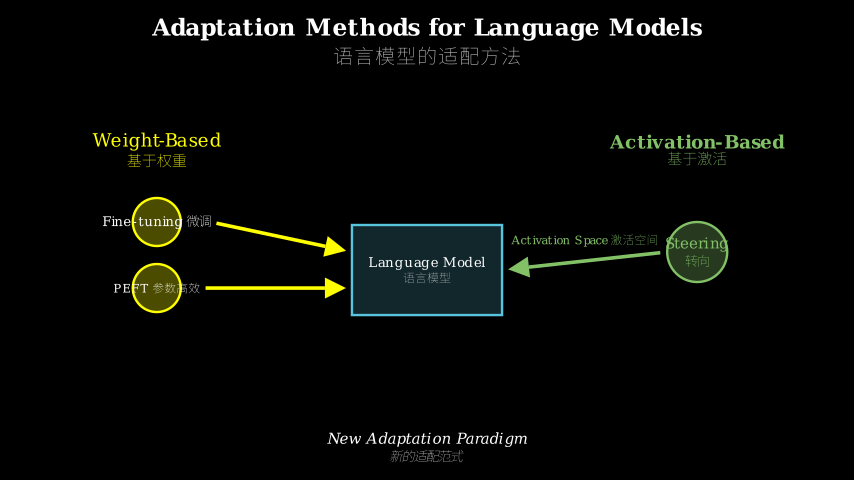
The field has three established ways to adapt language models: fine-tuning (update weights), parameter-efficient methods like LoRA (update subset of weights), and prompting (modify inputs). Meanwhile, a parallel research thread has been modifying activations at inference time—adding vectors to hidden states, scaling attention patterns—to steer model behavior. These “steering” methods work, sometimes impressively well, but they’ve been treated as a separate curiosity rather than a legitimate adaptation approach. No one has systematically asked: what makes steering different from or similar to fine-tuning? When should you use one versus the other? The conceptual framework for comparing adaptation methods doesn’t include steering at all.
Problem: Steering methods exist but lack conceptual grounding
   |
   v
Assumption: Adaptation methods share functional properties
   |
   v
Method: Define criteria (scope, reversibility, cost, etc.)
        Compare steering vs classical methods on these axes
   |
   v
Evidence: Steering occupies unique position in design space
          (local, reversible, zero-parameter-cost)
   |
   v
Conclusion: Steering = distinct adaptation paradigm
            Deserves unified taxonomy with fine-tuning/prompting
The Increment
One sentence: Before this paper, steering was a bag of tricks; after, it’s a recognized adaptation paradigm with clear trade-offs against fine-tuning and prompting.
Core Mechanism
The paper doesn’t introduce a new steering algorithm. Instead, it builds a conceptual framework for comparing adaptation methods. The authors define functional criteria: where does the intervention happen (input, parameters, activations)? Is it reversible? What’s the computational cost? How localized is the effect? They then map existing methods—fine-tuning, LoRA, prompting, various steering techniques—onto this multi-dimensional space.
The analysis reveals steering’s unique position: it operates in activation space (not weights or inputs), requires zero parameter updates, and can be applied/removed instantly at inference time. Unlike prompting, which affects all downstream tokens equally, steering can target specific layers or attention heads. Unlike fine-tuning, it doesn’t risk catastrophic forgetting because the base model stays intact.
Adaptation Method Comparison:

                    Fine-tuning    Prompting    Steering
                         |             |            |
Intervention site:   Weights       Input      Activations
                         |             |            |
Reversibility:        Hard         Easy         Easy
                         |             |            |
Parameter cost:       High         Zero         Zero
                         |             |            |
Scope control:        Global      Global       Local
                         |             |            |
                         v             v            v
                    [Permanent]   [Ephemeral]  [Surgical]
Think of a language model as a city’s water system. Fine-tuning is like replacing pipes—permanent, expensive, affects everything downstream. Prompting is like adding dye at the reservoir—cheap, temporary, but colors all the water uniformly. Steering is like installing valves at specific junctions—you can redirect flow in targeted neighborhoods without touching the infrastructure, and you can open or close valves instantly. The pipes (parameters) stay the same, but you control where the water (information) goes at runtime.
Key Concepts
-
Activation Space Intervention: Instead of changing what the model “knows” (parameters) or what it “sees” (input), steering changes what it “thinks” mid-computation. Imagine a calculator that always adds 5 to intermediate results before the final output—you haven’t changed its addition algorithm or the numbers you typed, but you’ve altered its internal processing. In language models, this means adding vectors to hidden states or scaling attention weights as tokens flow through layers. The model’s knowledge stays frozen, but its reasoning path shifts.
-
Reversibility vs Permanence: Fine-tuning is like carving into stone—once you update weights, the old model is gone unless you kept a backup. Steering is like using a transparency overlay—place it on the image to change what you see, remove it to see the original. This matters because you might want different behaviors for different tasks without maintaining multiple model copies. Steering lets one base model serve many purposes by swapping intervention vectors.
-
Localized Behavioral Change: Prompting affects the entire generation process uniformly—if you prompt “be formal,” every token gets that signal. Steering can target specific layers (early layers for style, late layers for factuality) or specific attention heads (those responsible for pronoun resolution, for example). It’s the difference between adjusting room temperature with a central thermostat versus space heaters in individual rooms.
Framework Shift
Before (mainstream view):              After (this paper):

Adaptation = Parameter Change          Adaptation = Behavioral Change

Fine-tuning ----+                      Fine-tuning ----+
LoRA -----------+---> Update weights   LoRA -----------+---> Weight space
Prompting ------+---> Modify input     Prompting ------+---> Input space
                                       Steering -------+---> Activation space
Steering? (orphaned technique)                |
                                              v
                                       Three complementary
                                       intervention points
From “steering is a weird trick” to “steering is a third axis of adaptation,” the core shift is recognizing that where you intervene (weights/input/activations) defines fundamentally different trade-offs, not just implementation details.
Expert Assessment
Problem choice: This is real conceptual debt. The field has been accumulating steering methods (representation engineering, activation addition, contrastive activation addition) without a unifying framework. The gap isn’t manufactured—practitioners genuinely don’t know when to use steering versus fine-tuning, and papers rarely compare them head-to-head. This sits at a meta-level: not solving a task better, but organizing how we think about solving tasks.
Method maturity: The contribution is taxonomic, not algorithmic. The functional criteria (reversibility, scope, cost) are sensible but not groundbreaking—any experienced researcher could have proposed similar axes. The value is in doing the work: systematically comparing methods and arguing for steering’s legitimacy. It’s more curation than innovation, which is fine—the field needs this. However, the paper could have gone further by proposing quantitative metrics for each criterion rather than qualitative descriptions.
Experimental integrity: This is primarily a position paper, not an empirical study. The authors cite existing work to support their framework but don’t run new experiments comparing steering to baselines. That’s appropriate for the paper’s goals, but it means the claims rest on synthesis rather than novel evidence. The risk: if the cited steering papers used weak baselines or cherry-picked tasks, those flaws propagate here.
Writing quality: The introduction clearly motivates the problem, but the middle sections get repetitive—the same points about reversibility and localization appear multiple times without adding depth. The paper would benefit from cutting 20% and using that space for concrete case studies: “Here’s a scenario where steering wins” and “Here’s where fine-tuning is still necessary.” The taxonomy tables are useful but dense; a decision tree (“If you need X, use Y”) would be more actionable.
Verdict: weak accept — Fills a real conceptual gap and will help organize future work, but the contribution is more framing than substance; the field will cite this for the taxonomy, not for new insights about how steering works.
Takeaways
For practitioners: If you need to change model behavior temporarily or for specific contexts (e.g., different tones for different users), steering is cheaper than maintaining multiple fine-tuned models. The catch: you need to know which layers/heads to target, which requires interpretability work upfront.
For researchers: The functional criteria framework (intervention site, reversibility, scope, cost) is a reusable lens for evaluating any new adaptation method. When proposing a technique, explicitly position it on these axes relative to existing approaches—it clarifies your contribution and helps readers assess trade-offs.
Transferable idea: The “three intervention points” framing (weights, inputs, activations) applies beyond language models. In any learned system, you can adapt by retraining (expensive, permanent), by changing inputs (cheap, limited control), or by modifying intermediate computations (middle ground). Computer vision, RL, and recommender systems all have analogs—this paper’s taxonomy could structure those fields too.
论文: 2604.14090 作者: Simon Ostermann, Daniil Gurgurov, Tanja Baeumel, Michael A. Hedderich, Sebastian Lapuschkin, Wojciech Samek, Vera Schmitt 分类: cs.CL
缺口
该领域有三种成熟的语言模型适配方法:微调(更新权重)、参数高效方法如LoRA(更新权重子集)、提示(修改输入)。
与此同时,另一条研究线索一直在推理时修改激活——向隐藏状态添加向量、缩放注意力模式——以转向模型行为。
这些”转向”方法有效,有时效果惊人,但它们被当作独立的奇技淫巧,而非正统的适配手段。
没人系统地问过:转向与微调有何异同?
何时该用这个而非那个?
比较适配方法的概念框架根本不包含转向。
问题:转向方法存在但缺乏概念基础
   |
   v
假设:适配方法共享功能属性
   |
   v
方法:定义标准(范围、可逆性、成本等)
      在这些维度上比较转向与经典方法
   |
   v
证据:转向在设计空间中占据独特位置
      (局部、可逆、零参数成本)
   |
   v
结论:转向 = 独特的适配范式
      应与微调/提示纳入统一分类
增量
一句话: 这篇论文之前,转向是一堆技巧;之后,它是一个公认的适配范式,与微调和提示有明确的权衡关系。
核心机制
本文没有提出新的转向算法。
相反,它构建了一个比较适配方法的概念框架。
作者定义了功能标准:干预发生在哪里(输入、参数、激活)?
可逆吗?
计算成本如何?
效果有多局部?
然后他们将现有方法——微调、LoRA、提示、各种转向技术——映射到这个多维空间。
分析揭示了转向的独特位置:它在激活空间操作(而非权重或输入),不需要参数更新,可以在推理时即时应用/移除。
与提示不同,提示对所有下游token影响相同,转向可以针对特定层或注意力头。
与微调不同,它不会造成灾难性遗忘,因为基础模型保持完整。
适配方法比较:

                    微调         提示         转向
                     |            |            |
干预位置:         权重         输入         激活
                     |            |            |
可逆性:           困难         容易         容易
                     |            |            |
参数成本:          高          零           零
                     |            |            |
范围控制:         全局         全局         局部
                     |            |            |
                     v            v            v
                 [永久性]     [短暂性]     [精准性]
把语言模型想象成城市供水系统。
微调像是更换管道——永久性的、昂贵的、影响下游所有区域。
提示像是在水库加染料——便宜、临时,但所有水都被均匀染色。
转向像是在特定节点安装阀门——你可以在目标街区重定向水流而不动基础设施,而且可以即时开关阀门。
管道(参数)保持不变,但你在运行时控制水(信息)的流向。
关键概念
- 激活空间干预: 不改变模型”知道”什么(参数)或”看到”什么(输入),转向改变它在计算中途”思考”什么。
想象一个计算器总是在最终输出前给中间结果加5——你没改它的加法算法或你输入的数字,但你改变了它的内部处理。
在语言模型中,这意味着向隐藏状态添加向量或在token流经层时缩放注意力权重。
模型的知识保持冻结,但它的推理路径发生偏移。
- 可逆性与永久性: 微调像在石头上雕刻——一旦更新权重,旧模型就消失了,除非你留了备份。
转向像使用透明覆盖层——放在图像上改变你看到的内容,移除它就看到原图。
这很重要,因为你可能想为不同任务使用不同行为,而不维护多个模型副本。
转向让一个基础模型通过交换干预向量服务多种用途。
- 局部行为改变: 提示对整个生成过程影响均匀——如果你提示”要正式”,每个token都收到这个信号。
转向可以针对特定层(早期层控制风格,后期层控制事实性)或特定注意力头(例如负责代词消解的那些)。
这是用中央恒温器调节室温与在各个房间用电暖器的区别。
框架转变
之前(主流观点):                之后(本文观点):

适配 = 参数改变                   适配 = 行为改变

微调 ------+                      微调 ------+
LoRA ------+---> 更新权重         LoRA ------+---> 权重空间
提示 ------+---> 修改输入         提示 ------+---> 输入空间
                                  转向 ------+---> 激活空间
转向?(孤立技术)                         |
                                          v
                                   三个互补的
                                   干预点
从”转向是个怪招”到”转向是适配的第三轴”,核心转变是认识到你在哪里干预(权重/输入/激活)定义了根本不同的权衡,而非仅仅是实现细节。
专家评审
选题眼光: 这是真实的概念债务。
该领域一直在积累转向方法(表征工程、激活加法、对比激活加法),却没有统一框架。
缺口不是人造的——实践者真的不知道何时用转向而非微调,论文也很少正面比较它们。
这处于元层面:不是把任务做得更好,而是组织我们思考如何做任务的方式。
方法成熟度: 贡献是分类学的,而非算法的。
功能标准(可逆性、范围、成本)合理但不突破——任何有经验的研究者都能提出类似维度。
价值在于做了这项工作:系统地比较方法并论证转向的合法性。
这更像策展而非创新,这没问题——该领域需要这个。
然而,论文本可以更进一步,为每个标准提出定量指标而非定性描述。
实验诚意: 这主要是立场论文,而非实证研究。
作者引用现有工作支持其框架,但没有运行新实验比较转向与基线。
这对论文目标是合适的,但意味着主张基于综合而非新证据。
风险在于:如果被引用的转向论文使用了弱基线或挑选了任务,这些缺陷会在此传播。
写作功力: 引言清晰地阐明了问题,但中间部分有重复——关于可逆性和局部化的相同观点出现多次而未增加深度。
论文可以删减20%,用这些空间提供具体案例研究:“这是转向获胜的场景”和”这是仍需微调的场景”。
分类表有用但密集;决策树(“如果你需要X,用Y”)会更可操作。
判决: 弱接收 — 填补了真实的概念缺口,将帮助组织未来工作,但贡献更多是框架而非实质;该领域会引用这篇论文的分类法,而非关于转向如何工作的新洞见。
要点总结
对实践者: 如果你需要临时或针对特定上下文改变模型行为(例如为不同用户使用不同语气),转向比维护多个微调模型更便宜。
陷阱:你需要知道针对哪些层/头,这需要预先做可解释性工作。
对研究者: 功能标准框架(干预位置、可逆性、范围、成本)是评估任何新适配方法的可复用透镜。
提出技术时,在这些维度上明确相对于现有方法的定位——这能澄清你的贡献并帮助读者评估权衡。
可迁移想法: “三个干预点”框架(权重、输入、激活)适用于语言模型之外。
在任何学习系统中,你可以通过重训练(昂贵、永久)、改变输入(便宜、控制有限)或修改中间计算(中间地带)来适配。
计算机视觉、强化学习、推荐系统都有类似物——本文的分类法也能构建那些领域。