
Paper: 2604.25866 Authors: Bangzhao Shu, Arinjay Singh, Mai ElSherief Categories: cs.CL
The Gap
LLMs are deployed in emotionally sensitive applications—therapy chatbots, mental health screening, customer service—but we treat them as black boxes. Prior work on emotion recognition in LLMs focuses on benchmarking accuracy or fine-tuning for better performance. We know that models can recognize emotions, but not how they do it internally. Which layers matter? Do different emotions use shared or separate circuits? Can we steer emotion recognition without retraining?
The mechanistic interpretability literature (using tools like sparse autoencoders) has mapped internal representations for factual knowledge and syntax, but emotion—a higher-level, context-dependent inference—remains unexplored. This paper asks: what does the computational path from text to emotion look like inside a transformer?
Problem: LLMs recognize emotions, but internal mechanism unknown
   |
   v
Assumption: Emotion inference has distinct phases across layers
   |
   v
Method: Sparse autoencoders (SAEs) extract interpretable features
        + Phase-stratified causal tracing identifies critical features
   |
   v
Evidence: Three-phase flow (syntax > context > emotion)
          Emotion-specific features found
          Small feature sets causally drive predictions
   |
   v
Conclusion: Emotion recognition is localized, steerable, improvable
The Increment
One sentence: Before this paper, we knew LLMs could recognize emotions but not where or how; after, we have a layer-by-layer map of emotion inference and a method to improve it by steering ~10 features.
Core Mechanism
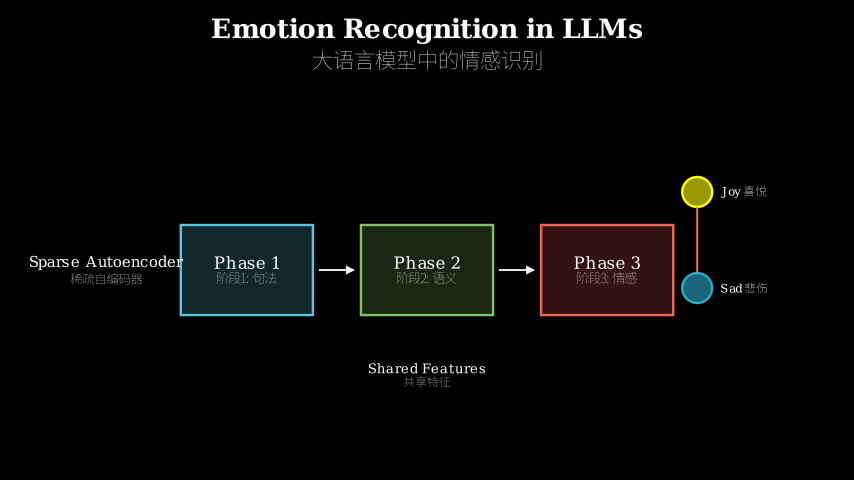
The method has three components working in sequence. First, sparse autoencoders (SAEs) are trained on each transformer layer to decompose activations into interpretable features—think of SAEs as translators that convert dense neural activity into sparse, human-understandable concepts. Second, activation analysis tracks which features fire across layers when the model processes emotion-laden text, revealing a three-phase pattern: early layers handle syntax, middle layers build context, and late layers crystallize emotion. Third, causal tracing with intervention identifies which features actually matter: the authors ablate (zero out) specific features and measure the drop in emotion prediction accuracy, isolating a small set of high-impact features per emotion.
Input text
   |
   v
[Layer 1-10: Syntax features]  <-- SAE extracts features
   |                               (e.g., "negation", "subject")
   v
[Layer 11-20: Context features] <-- SAE extracts features
   |                                (e.g., "social situation")
   v
[Layer 21-32: Emotion features] <-- SAE extracts features
   |                                (e.g., "anger", "joy")
   v
Emotion prediction
   ^
   |
Causal tracing: Ablate feature X --> measure accuracy drop
                If drop > threshold, X is causally important
Now the structural metaphor: think of the LLM as a courtroom trial. Early layers are the court reporter transcribing raw facts (syntax). Middle layers are the jury assembling those facts into a coherent story (context). Late layers are the judge rendering a verdict (emotion). The SAE is like a stenographer’s codebook that translates the jury’s murmurs into discrete arguments. Causal tracing is the appeal process: you remove one piece of evidence (ablate a feature) and see if the verdict changes. If removing “the defendant was smiling” flips the verdict from joy to neutral, that feature was load-bearing. The paper finds that some verdicts (Disgust) rely on many weak arguments, while others (Anger) hinge on a few strong ones.
Key Concepts
-
Sparse Autoencoder (SAE): Imagine a neural network’s activation as a crowded room where everyone is talking at once—thousands of neurons firing simultaneously, their signals blended into an incomprehensible hum. An SAE is a filter that isolates individual conversations. It learns to represent that hum as a combination of a few clear voices (sparse features), each corresponding to an interpretable concept like “negation” or “past tense.” The “sparse” part is key: instead of using all possible features, the SAE forces the model to explain activations with only a handful of active features at a time, making the representation human-readable. Concrete example: if a layer’s activation is [0.3, -0.1, 0.8, …] (1000 numbers), the SAE might say “this is 0.9 × feature_42 (negation) + 0.4 × feature_137 (anger_context).”
-
Causal Tracing: Correlation isn’t causation. A feature might activate when the model predicts “anger,” but does that feature *cause the prediction, or is it just along for the ride? Causal tracing answers this by intervention: you surgically remove the feature (set its activation to zero) and re-run the model. If the prediction changes, the feature was causal. If nothing happens, it was decorative. This is like testing whether a wire in a circuit is load-bearing by cutting it and seeing if the light goes out.
-
Phase-Stratified Analysis: Not all layers do the same work. The paper divides the model’s 32 layers into three phases based on when emotion-related features emerge. Phase 1 (layers 1-10): syntax and surface form. Phase 2 (layers 11-20): contextual integration. Phase 3 (layers 21-32): emotion crystallization. This stratification matters because it tells you *where to intervene. If you want to steer emotion recognition, you target Phase 3 features, not Phase 1 syntax features.
Framework Shift
Before (mainstream approach):        After (this paper):

[Black Box]                          [Layer 1-10: Syntax]
   |                                    |
Text --> LLM --> Emotion             Text --> [Layer 11-20: Context]
   ^                                    |
   |                                 [Layer 21-32: Emotion]
Fine-tune entire model                  |
to improve accuracy                  Emotion
                                        ^
                                        |
                                     Steer ~10 features
                                     to improve accuracy
From opaque end-to-end tuning to transparent phase-specific intervention, the core shift is localization: emotion recognition isn’t diffused across all layers—it’s concentrated in late layers and driven by a small set of features you can identify and control.
Expert Assessment
Problem choice: Real gap. Mechanistic interpretability has mapped factual recall and syntax, but emotion is a harder target—it’s context-dependent, subjective, and multi-layered. The paper sits at the intersection of interpretability and affective computing, both active areas. The motivation (LLMs in emotionally sensitive apps) is timely and practical.
Method maturity: Solid engineering, not a breakthrough. SAEs are borrowed from prior work (Cunningham et al., Templeton et al.); the novelty is applying them to emotion and adding phase-stratified causal tracing. The causal tracing is straightforward ablation—effective but not sophisticated. The feature steering method (amplifying causal features) is intuitive but feels like the first thing you’d try, not the result of deep exploration. No comparison to other steering methods (e.g., activation patching, representation engineering).
Experimental integrity: Baselines are fair. The paper tests on GoEmotions (primary) and validates on EmoBank and DailyDialog. The three-phase pattern holds across Llama-2-7B, Llama-3-8B, and Gemma-2-9B, which is reassuring. The causal tracing uses a sensible threshold (top-k features by ablation impact). One red flag: Disgust is “weakly and diffusely represented,” but the paper doesn’t explore whether this is a data artifact (Disgust is rare in GoEmotions) or a genuine model limitation. The steering results are strong (+8-15% accuracy), but the paper doesn’t report failure cases or where steering breaks language modeling.
Writing quality: The paper is well-structured and clear. The three-phase finding is presented early and reinforced throughout. The figures are informative (especially the layer-wise feature activation heatmaps). Weakness: the related work section is thin—it mentions SAEs and emotion recognition separately but doesn’t engage with adjacent work on probing classifiers or representation engineering. The discussion of Disgust’s weak representation feels like an afterthought; a deeper dive (is it data? model architecture? emotion complexity?) would elevate the paper. The feature steering section is rushed—more ablation studies (what happens if you steer Phase 2 features? what if you steer in the wrong direction?) would strengthen the claims.
Verdict: weak accept — Solid empirical work with a clear finding (three-phase emotion inference) and a practical contribution (feature steering), but the method is incremental and the analysis could go deeper.
Takeaways
For interpretability researchers: The phase-stratified causal tracing is a clean template for analyzing multi-stage inference tasks. If you’re studying reasoning, planning, or other high-level tasks, this paper shows how to map the computational path across layers and identify bottleneck features.
For practitioners: The feature steering method is data-efficient (no retraining) and interpretable (you know which features you’re amplifying). If you’re deploying LLMs in emotion-sensitive contexts and need to boost accuracy on specific emotions, this is a lightweight alternative to fine-tuning. The code and feature lists are released, so you can apply this to your own models.
For affective computing: The finding that Disgust is weakly represented is a red flag for applications that need to detect all emotions equally (e.g., mental health screening). If your task requires robust Disgust detection, you’ll need targeted data augmentation or architectural changes—steering alone won’t fix it.
Transferable technique: The “identify causal features via ablation, then amplify them” pattern works beyond emotion. You could apply this to factual accuracy (amplify features that encode correct facts), toxicity reduction (suppress features that encode harmful content), or style transfer (amplify features that encode formality).
论文: 2604.25866 作者: Bangzhao Shu, Arinjay Singh, Mai ElSherief 分类: cs.CL
缺口
大语言模型被部署在情感敏感的应用中——心理治疗聊天机器人、心理健康筛查、客户服务——但我们把它们当黑箱用。
此前关于大语言模型情感识别的研究聚焦于基准测试准确率或微调以提升性能。
我们知道模型能识别情感,但不知道它们如何在内部做到这一点。
哪些层重要?
不同情感用共享电路还是独立电路?
能否在不重新训练的情况下引导情感识别?
机制可解释性文献(使用稀疏自编码器等工具)已经绘制了事实知识和句法的内部表征图,但情感——一种更高层次、依赖上下文的推理——仍未被探索。
本文追问:从文本到情感的计算路径在 transformer 内部长什么样?
问题:大语言模型能识别情感,但内部机制未知
   |
   v
假设:情感推理在各层有不同阶段
   |
   v
方法:稀疏自编码器(SAE)提取可解释特征
      + 分阶段因果追踪识别关键特征
   |
   v
证据:三阶段流(句法 > 上下文 > 情感)
      发现情感特异性特征
      小规模特征集因果驱动预测
   |
   v
结论:情感识别是局部化的、可引导的、可改进的
增量
一句话:这篇论文之前,我们知道大语言模型能识别情感但不知道在哪里如何识别;
之后,我们有了情感推理的逐层地图,以及通过引导约10个特征来改进识别的方法。
核心机制
方法有三个依次工作的组件。
首先,**稀疏自编码器(SAE)**在每个 transformer 层上训练,将激活分解为可解释特征——可以把 SAE 想象成翻译器,将密集的神经活动转换为稀疏的、人类可理解的概念。
其次,激活分析追踪当模型处理带情感的文本时,哪些特征在各层被激活,揭示三阶段模式:早期层处理句法,中间层构建上下文,后期层结晶情感。
第三,带干预的因果追踪识别哪些特征真正重要:作者消融(清零)特定特征并测量情感预测准确率的下降,为每种情感隔离出一小组高影响力特征。
输入文本
   |
   v
[第1-10层:句法特征]  <-- SAE 提取特征
   |                      (如"否定"、"主语")
   v
[第11-20层:上下文特征] <-- SAE 提取特征
   |                       (如"社交情境")
   v
[第21-32层:情感特征] <-- SAE 提取特征
   |                      (如"愤怒"、"喜悦")
   v
情感预测
   ^
   |
因果追踪:消融特征 X --> 测量准确率下降
         如果下降 > 阈值,X 因果重要
现在用核喻来理解:把大语言模型想象成法庭审判。
早期层是书记员转录原始事实(句法)。
中间层是陪审团将这些事实组装成连贯的故事(上下文)。
后期层是法官做出裁决(情感)。
SAE 就像速记员的密码本,将陪审团的低语翻译成离散的论点。
因果追踪是上诉程序:你移除一条证据(消融一个特征)看裁决是否改变。
如果移除”被告在微笑”这条证据让裁决从喜悦翻转到中性,那这个特征就是承重的。
论文发现有些裁决(厌恶)依赖许多弱论点,而其他裁决(愤怒)取决于少数强论点。
关键概念
- 稀疏自编码器(SAE):想象神经网络的激活是一个拥挤的房间,所有人同时说话——数千个神经元同时激发,信号混成难以理解的嗡嗡声。
SAE 是一个过滤器,隔离出单独的对话。
它学习将那嗡嗡声表示为少数几个清晰声音(稀疏特征)的组合,每个对应一个可解释的概念,如”否定”或”过去时”。
“稀疏”部分是关键:SAE 不使用所有可能的特征,而是强制模型仅用少数几个活跃特征来解释激活,使表征人类可读。
具体例子:如果一层的激活是 [0.3, -0.1, 0.8, …](1000个数字),SAE 可能说”这是 0.9 × 特征_42(否定)+ 0.4 × 特征_137(愤怒上下文)”。
- 因果追踪:相关不是因果。
一个特征可能在模型预测”愤怒”时激活,但这个特征导致了预测,还是只是顺带激活?
因果追踪通过干预回答这个问题:你手术式地移除特征(将其激活设为零)并重新运行模型。
如果预测改变,特征是因果的。
如果什么都没发生,它只是装饰性的。
这就像测试电路中的一根线是否承重,方法是切断它看灯是否熄灭。
- 分阶段分析:不是所有层做相同的工作。
论文根据情感相关特征何时出现,将模型的32层分为三个阶段。
阶段1(第1-10层):句法和表面形式。
阶段2(第11-20层):上下文整合。
阶段3(第21-32层):情感结晶。
这种分层很重要,因为它告诉你在哪里干预。
如果你想引导情感识别,你针对阶段3的情感特征,而不是阶段1的句法特征。
框架转变
之前(主流方法):                之后(本文方法):

[黑箱]                            [第1-10层:句法]
   |                                 |
文本 --> 大语言模型 --> 情感      文本 --> [第11-20层:上下文]
   ^                                 |
   |                              [第21-32层:情感]
微调整个模型                         |
以提升准确率                      情感
                                    ^
                                    |
                                 引导约10个特征
                                 以提升准确率
从不透明的端到端调优到透明的分阶段干预,核心转变是局部化:情感识别不是分散在所有层——它集中在后期层,由一小组你可以识别和控制的特征驱动。
专家评审
选题眼光:真实缺口。
机制可解释性已经绘制了事实回忆和句法的地图,但情感是更难的目标——它依赖上下文、主观、多层次。
论文处于可解释性和情感计算的交叉点,两者都是活跃领域。
动机(大语言模型在情感敏感应用中)及时且实用。
方法成熟度:扎实的工程,不是突破。
SAE 借用自先前工作(Cunningham 等,Templeton 等);
新颖之处在于将它们应用于情感并添加分阶段因果追踪。
因果追踪是直接的消融——有效但不复杂。
特征引导方法(放大因果特征)直观但感觉像你会尝试的第一件事,而不是深入探索的结果。
没有与其他引导方法(如激活修补、表征工程)的比较。
实验诚意:基线公平。
论文在 GoEmotions(主要)上测试,并在 EmoBank 和 DailyDialog 上验证。
三阶段模式在 Llama-2-7B、Llama-3-8B 和 Gemma-2-9B 上都成立,这令人放心。
因果追踪使用合理的阈值(按消融影响排序的 top-k 特征)。
一个警示信号:厌恶”弱且分散地表征”,但论文没有探索这是数据伪影(厌恶在 GoEmotions 中罕见)还是真正的模型局限。
引导结果很强(+8-15% 准确率),但论文没有报告失败案例或引导在哪里破坏语言建模。
写作功力:论文结构良好且清晰。
三阶段发现早期呈现并贯穿全文强化。
图表信息丰富(尤其是逐层特征激活热图)。
弱点:相关工作部分单薄——它分别提到 SAE 和情感识别,但没有与探测分类器或表征工程等相邻工作交流。
对厌恶弱表征的讨论感觉像事后补充;
更深入的挖掘(是数据?模型架构?情感复杂性?)会提升论文。
特征引导部分仓促——更多消融研究(如果引导阶段2特征会怎样?如果朝错误方向引导会怎样?)会加强论断。
判决:弱接收 — 扎实的实证工作,有清晰的发现(三阶段情感推理)和实用贡献(特征引导),但方法是增量式的,分析可以更深入。
要点总结
对可解释性研究者:分阶段因果追踪是分析多阶段推理任务的清晰模板。
如果你在研究推理、规划或其他高层任务,本文展示了如何绘制跨层的计算路径并识别瓶颈特征。
对实践者:特征引导方法数据高效(无需重新训练)且可解释(你知道在放大哪些特征)。
如果你在情感敏感场景中部署大语言模型,需要提升特定情感的准确率,这是微调的轻量级替代方案。
代码和特征列表已发布,你可以应用到自己的模型上。
对情感计算:厌恶弱表征的发现对需要平等检测所有情感的应用(如心理健康筛查)是警示信号。
如果你的任务需要稳健的厌恶检测,你需要针对性的数据增强或架构改变——单靠引导无法修复。
可迁移技术:“通过消融识别因果特征,然后放大它们”的模式超越情感。
你可以将此应用于事实准确性(放大编码正确事实的特征)、毒性降低(抑制编码有害内容的特征)或风格迁移(放大编码正式性的特征)。