
Paper: 2605.20177 Authors: Juncheng Wu, Hardy Chen, Haoqin Tu, Xianfeng Tang, Freda Shi, Hui Liu, Hanqing Lu, Cihang Xie, Yuyin Zhou Categories: cs.CL, cs.CV
The Gap
Current VLMs like GPT-4V and Gemini emphasize long chain-of-thought reasoning for visual tasks. The field assumes that longer reasoning traces lead to better performance. But when these models fail on visual math or perception tasks, researchers have been throwing more reasoning data at the problem—more steps, more explanations, more tokens.
This paper challenges that assumption. The authors find that VLMs aren’t failing because they can’t reason—they’re failing because they can’t see properly in the first place. Existing post-training methods merge perception and reasoning data together, treating them as a single capability. This conflates two fundamentally different skills: extracting information from pixels versus manipulating symbolic representations.
Problem: VLMs underperform on visual tasks
         |
         v
Mainstream assumption: Need better reasoning
         |
         v
Current approach: Merge all training data
         |                (perception + reasoning mixed)
         v
Result: Long reasoning chains, mediocre accuracy
         |
         v
This paper's insight: Perception is the bottleneck
         |
         v
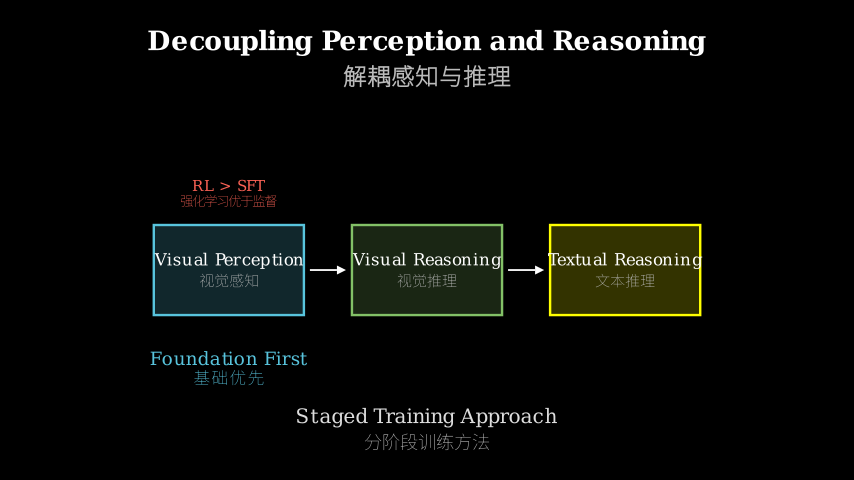
Method: Stage training by capability type
         |        (perception -> visual reasoning -> textual reasoning)
         v
Evidence: +5.2% WeMath, 20.8% shorter reasoning traces
         |
         v
Conclusion: Fix perception first, reasoning becomes easier
The Increment
One sentence: Before this paper, VLM training mixed perception and reasoning data together; after, we know to train perception first with RL, then layer reasoning on top—getting better results with less reasoning.
Core Mechanism
The method decomposes VLM training into three sequential stages, each targeting a specific capability with specialized data. Stage 1 focuses on visual perception—teaching the model to accurately extract information from images (counting objects, reading text, identifying spatial relationships). Stage 2 adds visual reasoning—connecting perceptual observations through logical steps. Stage 3 introduces textual reasoning—pure symbolic manipulation without visual grounding.
Each stage uses different training techniques. Perception benefits most from reinforcement learning (RL) with outcome-based rewards, because caption-style supervision doesn’t provide clear signals for “did you count correctly?” Visual and textual reasoning use supervised fine-tuning (SFT) on chain-of-thought data. The key architectural insight: perception must solidify before reasoning, because reasoning chains built on faulty perception just amplify errors.
Input Image
    |
    v
[Stage 1: Visual Perception]
    |  RL training on:
    |  - Object counting
    |  - OCR tasks
    |  - Spatial relationships
    |  Reward: Correct/Incorrect
    v
Solid perceptual foundation
    |
    v
[Stage 2: Visual Reasoning]
    |  SFT on:
    |  - Multi-hop visual logic
    |  - Diagram interpretation
    v
Visual reasoning capability
    |
    v
[Stage 3: Textual Reasoning]
    |  SFT on:
    |  - Pure math problems
    |  - Symbolic manipulation
    v
Final VLM with decoupled capabilities
Think of it like learning to play chess. You can’t develop opening theory (reasoning) if you can’t reliably distinguish a knight from a bishop (perception). Traditional VLM training is like teaching someone chess notation, tactical patterns, and piece identification all at once—they end up with elaborate plans based on misread positions. This paper says: first drill piece recognition until it’s automatic, then teach tactics, then strategy. Each layer builds on the previous one being solid.
The staged approach also reveals something subtle: when perception improves, models need less reasoning. The paper shows 20.8% shorter reasoning traces with higher accuracy. It’s like how expert chess players “see” moves instantly that novices must calculate—better perception compresses the reasoning required.
Key Concepts
-
Capability-based staging: Traditional curriculum learning orders examples by difficulty (easy problems first, hard problems later). This paper introduces a perpendicular dimension: ordering by capability type. Perception must precede reasoning regardless of problem difficulty, because reasoning on bad perception is worse than useless—it’s confidently wrong. The insight is that some capabilities are foundational scaffolds for others, and this dependency structure should guide training order, not just task difficulty.
-
RL for perception vs SFT for reasoning: Why does perception benefit from RL while reasoning prefers SFT? Perception tasks have clear ground truth (did you count 7 objects correctly?) but the path to that answer is flexible—the model can attend to different image regions in different orders. RL’s outcome-based rewards let the model discover its own perceptual strategies. Reasoning tasks, by contrast, benefit from explicit step-by-step demonstrations because the logical structure itself is what we want to teach. It’s the difference between “get the right answer however you want” (perception) versus “follow this logical pattern” (reasoning).
-
Additive curriculum dimensions: The paper shows that capability-based staging (perception → reasoning) and difficulty-based staging (easy → hard) are orthogonal—you can combine both for additive gains. This suggests training curricula have multiple independent dimensions, like a coordinate system. Most prior work explored one axis (difficulty); this paper adds a second axis (capability type). Future work might discover additional axes (domain, modality, abstraction level) that similarly compose.
Framework Shift
Before (mainstream approach):        After (this paper):

All training data mixed              Stage 1: Perception only
    |                                    |  (RL on visual tasks)
    v                                    v
Single training phase                Stage 2: Visual reasoning
    |                                    |  (SFT on visual CoT)
    v                                    v
VLM with entangled                   Stage 3: Textual reasoning
capabilities                             |  (SFT on math CoT)
    |                                    v
    v                                VLM with decoupled
Long reasoning chains,               capabilities
mediocre accuracy                        |
                                         v
                                     Short reasoning chains,
                                     high accuracy
From treating perception and reasoning as a single monolithic capability to recognizing them as distinct, sequentially-dependent skills—the core shift is architectural: build the foundation before the structure.
Expert Assessment
Problem choice: This is a real gap, not manufactured. The field’s obsession with longer reasoning chains has been a visible trend since GPT-4V, and this paper provides empirical evidence that we’ve been optimizing the wrong bottleneck. The problem sits at a critical juncture—VLMs are being deployed for visual tasks, but their failure modes aren’t well understood. Identifying perception as the limiting factor redirects research effort productively.
Method maturity: The staged training approach is conceptually simple, which is a strength. The authors aren’t proposing exotic architectures or loss functions—they’re reorganizing existing techniques (RL, SFT) based on a clear hypothesis about capability dependencies. However, the paper doesn’t deeply explore why RL specifically helps perception beyond “outcome-based rewards work better.” A more mechanistic understanding of what RL does differently to the model’s visual encoder would strengthen the contribution. The comparison between staged and merged training is thorough, but I’d want to see ablations on stage ordering (what if reasoning comes before perception?) to confirm the dependency claim.
Experimental integrity: Baselines are fair—they compare against merged training with the same total data budget. The results are consistent across multiple VLM architectures (LLaVA, Qwen-VL), which suggests the findings generalize. The 20.8% shorter reasoning traces with higher accuracy is a strong signal that something fundamental changed, not just overfitting to benchmarks. One concern: the paper doesn’t report variance across training runs, so we don’t know if the gains are robust or sensitive to initialization. The benchmark selection (WeMath, RealWorldQA) is appropriate for testing perception, though more diverse visual domains (medical imaging, satellite imagery) would strengthen claims of generality.
Writing quality: The abstract and introduction are clear, but Section 3 (method) buries the key insight—that perception is the bottleneck—under implementation details. The paper would benefit from leading with the diagnostic experiments (showing perception limits performance) before describing the staged training solution. The related work section is thorough but reads like a literature review rather than positioning this work’s unique angle. Figure 2 (the staged training diagram) should appear earlier and be larger—it’s the paper’s conceptual core.
Verdict: weak accept — The core insight (perception bottlenecks VLM performance, stage training by capability type) is valuable and well-demonstrated, but the paper doesn’t fully explain why staged training works mechanistically, limiting its scientific depth.
Takeaways
For practitioners building VLMs: Don’t mix perception and reasoning data in a single training phase. If your model hallucinates visual details, more reasoning data won’t fix it—you need targeted perception training first, and RL works better than caption-based SFT for this.
For curriculum learning researchers: Capability type (perception vs reasoning) is an orthogonal curriculum dimension to difficulty. Check if your domain has similar dependency structures—maybe syntax before semantics in NLP, or motor control before strategy in robotics.
For anyone debugging model failures: When a model fails at a complex task, decompose the failure into capability types (perception, reasoning, memory, etc.) and test each separately. The bottleneck might not be where you think—this paper’s key lesson is that elaborate reasoning on bad perception is worse than simple reasoning on good perception.
Transferable technique: The “stage by capability, not just difficulty” principle applies beyond VLMs. Any system with hierarchical capabilities (where skill B depends on skill A) should consider staged training. The paper’s experimental protocol—comparing staged vs merged training with equal data budgets—is a clean template for testing this in other domains.
论文: 2605.20177 作者: Juncheng Wu, Hardy Chen, Haoqin Tu, Xianfeng Tang, Freda Shi, Hui Liu, Hanqing Lu, Cihang Xie, Yuyin Zhou 分类: cs.CL, cs.CV
缺口
当前的视觉语言模型(VLM)如 GPT-4V 和 Gemini 强调用长链式思维推理来处理视觉任务。
领域内的主流假设是:更长的推理链条能带来更好的性能。
但当这些模型在视觉数学或感知任务上失败时,研究者们一直在往问题里扔更多推理数据——更多步骤、更多解释、更多token。
本文挑战了这个假设。
作者发现 VLM 失败不是因为不会推理,而是因为它们一开始就没”看清楚”。
现有的后训练方法把感知和推理数据混在一起,当作单一能力来训练。
这混淆了两种根本不同的技能:从像素中提取信息 vs 操纵符号表示。
问题:VLM 在视觉任务上表现不佳
         |
         v
主流假设:需要更好的推理能力
         |
         v
当前方法:混合所有训练数据
         |        (感知+推理混在一起)
         v
结果:推理链很长,准确率平平
         |
         v
本文洞察:感知才是瓶颈
         |
         v
方法:按能力类型分阶段训练
         |        (感知 -> 视觉推理 -> 文本推理)
         v
证据:WeMath +5.2%,推理链缩短 20.8%
         |
         v
结论:先修好感知,推理就变简单了
增量
一句话:这篇论文之前,VLM 训练把感知和推理数据混在一起;之后,我们知道要先用强化学习训练感知,再在上面叠加推理——用更少的推理获得更好的结果。
核心机制
该方法将 VLM 训练分解为三个连续阶段,每个阶段针对特定能力使用专门数据。
第一阶段聚焦视觉感知——教模型准确从图像中提取信息(数物体、读文字、识别空间关系)。
第二阶段加入视觉推理——通过逻辑步骤连接感知观察。
第三阶段引入文本推理——纯符号操作,不依赖视觉基础。
每个阶段使用不同的训练技术。
感知最受益于基于结果奖励的强化学习(RL),因为字幕式监督无法提供”你数对了吗?“这样清晰的信号。
视觉和文本推理使用链式思维数据的监督微调(SFT)。
关键的架构洞察:感知必须在推理之前固化,因为建立在错误感知上的推理链只会放大错误。
输入图像
    |
    v
[阶段1:视觉感知]
    |  RL 训练:
    |  - 物体计数
    |  - OCR 任务
    |  - 空间关系
    |  奖励:正确/错误
    v
坚实的感知基础
    |
    v
[阶段2:视觉推理]
    |  SFT 训练:
    |  - 多跳视觉逻辑
    |  - 图表解读
    v
视觉推理能力
    |
    v
[阶段3:文本推理]
    |  SFT 训练:
    |  - 纯数学问题
    |  - 符号操作
    v
能力解耦的最终 VLM
把它想象成学下棋。
如果你连马和象都分不清(感知),就无法发展开局理论(推理)。
传统 VLM 训练就像同时教某人棋谱记号、战术模式和棋子识别——他们最终会基于看错的局面制定精巧计划。
本文说:先反复练习棋子识别直到成为自动反应,再教战术,然后教策略。
每一层都建立在前一层稳固的基础上。
分阶段方法还揭示了一个微妙之处:当感知改善时,模型需要的推理更少。
论文显示推理链缩短 20.8% 但准确率更高。
这就像象棋高手能”看到”新手必须计算的走法——更好的感知压缩了所需的推理。
关键概念
- 基于能力的分阶段:传统课程学习按难度排序样本(先简单问题,后困难问题)。
本文引入了一个垂直维度:按能力类型排序。
无论问题难度如何,感知必须先于推理,因为基于错误感知的推理比没用更糟——它会自信地犯错。
洞察在于:某些能力是其他能力的基础脚手架,这种依赖结构应该指导训练顺序,而不仅仅是任务难度。
- 感知用 RL vs 推理用 SFT:为什么感知受益于 RL 而推理偏好 SFT?感知任务有明确的真值(你数对了7个物体吗?)但达到答案的路径是灵活的——模型可以按不同顺序关注不同图像区域。
RL 的基于结果的奖励让模型发现自己的感知策略。
相比之下,推理任务受益于明确的逐步演示,因为逻辑结构本身就是我们想教的东西。
这是”用你想要的方式得到正确答案”(感知)与”遵循这个逻辑模式”(推理)之间的区别。
- 可叠加的课程维度:论文显示基于能力的分阶段(感知→推理)和基于难度的分阶段(易→难)是正交的——你可以组合两者获得叠加收益。
这表明训练课程有多个独立维度,像坐标系一样。
大多数先前工作探索一个轴(难度);本文添加了第二个轴(能力类型)。
未来工作可能发现额外的轴(领域、模态、抽象层次)同样可以组合。
框架转变
之前(主流方法):              之后(本文方法):

所有训练数据混合              阶段1:仅感知
    |                              |  (视觉任务的 RL)
    v                              v
单一训练阶段                   阶段2:视觉推理
    |                              |  (视觉 CoT 的 SFT)
    v                              v
能力纠缠的 VLM                 阶段3:文本推理
    |                              |  (数学 CoT 的 SFT)
    v                              v
推理链长,                     能力解耦的 VLM
准确率平平                         |
                                   v
                               推理链短,
                               准确率高
从把感知和推理当作单一整体能力,到认识到它们是不同的、顺序依赖的技能——核心转变是架构性的:先建地基再建结构。
专家评审
选题眼光:这是真缺口,不是人造的。
自 GPT-4V 以来,领域对更长推理链的痴迷一直是明显趋势,本文提供了实证证据表明我们一直在优化错误的瓶颈。
问题处于关键节点——VLM 正被部署用于视觉任务,但它们的失败模式尚未被充分理解。
识别感知为限制因素能有效重定向研究努力。
方法成熟度:分阶段训练方法概念上简单,这是优点。
作者没有提出奇异的架构或损失函数——他们基于能力依赖性的清晰假设重组现有技术(RL、SFT)。
然而,论文没有深入探索为什么 RL 特别帮助感知,除了”基于结果的奖励效果更好”。
对 RL 如何不同地作用于模型视觉编码器的更机制性理解会加强贡献。
分阶段与混合训练的比较很彻底,但我想看到阶段顺序的消融实验(如果推理在感知之前会怎样?)来确认依赖性主张。
实验诚意:基线公平——他们与相同总数据预算的混合训练比较。
结果在多个 VLM 架构(LLaVA、Qwen-VL)上一致,表明发现具有泛化性。
推理链缩短 20.8% 但准确率更高是强信号,表明发生了根本性变化,而不仅仅是对基准过拟合。
一个担忧:论文没有报告训练运行间的方差,所以我们不知道收益是否稳健或对初始化敏感。
基准选择(WeMath、RealWorldQA)适合测试感知,但更多样化的视觉领域(医学影像、卫星图像)会加强泛化性主张。
写作功力:摘要和引言清晰,但第3节(方法)把关键洞察——感知是瓶颈——埋在实现细节下。
论文应该先展示诊断实验(显示感知限制性能),再描述分阶段训练解决方案。
相关工作部分很彻底但读起来像文献综述而非定位本工作的独特角度。
图2(分阶段训练图)应该更早出现且更大——它是论文的概念核心。
判决:弱接收 — 核心洞察(感知是 VLM 性能瓶颈,按能力类型分阶段训练)有价值且得到充分证明,但论文没有完全解释分阶段训练为何在机制上有效,限制了其科学深度。
要点总结
对于构建 VLM 的实践者:不要在单一训练阶段混合感知和推理数据。
如果你的模型幻觉视觉细节,更多推理数据修不好它——你需要先进行针对性的感知训练,而且 RL 比基于字幕的 SFT 效果更好。
对于课程学习研究者:能力类型(感知 vs 推理)是与难度正交的课程维度。
检查你的领域是否有类似依赖结构——也许 NLP 中的句法先于语义,或机器人中的运动控制先于策略。
对于调试模型失败的任何人:当模型在复杂任务上失败时,将失败分解为能力类型(感知、推理、记忆等)并分别测试。
瓶颈可能不在你认为的地方——本文的关键教训是:基于错误感知的精巧推理比基于良好感知的简单推理更糟。
可迁移技术:“按能力分阶段,不仅按难度”原则适用于 VLM 之外。
任何具有层次化能力的系统(技能 B 依赖技能 A)都应考虑分阶段训练。
论文的实验协议——在相等数据预算下比较分阶段与混合训练——是在其他领域测试这一点的简洁模板。