
Paper: 2605.23899 Authors: Zisu Huang, Jingwen Xu, Yifan Yang, Ziyang Gong, Qihao Yang, Muzhao Tian, Xiaohua Wang, Changze Lv, Xuemei Gao, Qi Dai Categories: cs.AI
The Gap
Language agents are learning to reuse skills—procedural knowledge extracted from past experience. The field has produced many extraction methods, but no one has systematically studied whether these model-generated skills actually help. Prior work focuses on extraction algorithms without measuring end-to-end utility: Does the extracted skill improve the agent’s performance on new tasks? When does it help versus hurt? What makes a skill transferable?
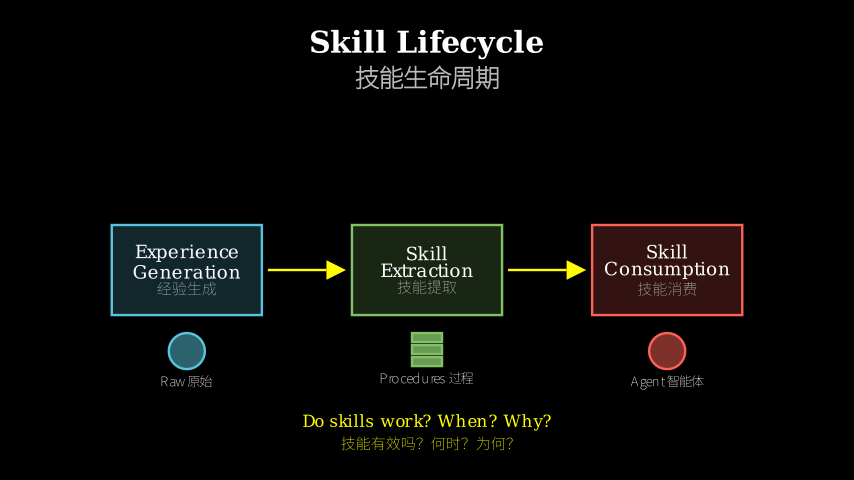
The gap is empirical and conceptual. We have extractors but no utility-grounded evaluation spanning the full lifecycle: experience generation → skill extraction → skill consumption. Without this, we’re building in the dark.
Problem: Skills extracted, utility unknown
   |
   v
Assumption: Utility depends on full lifecycle, not just extraction
   |
   v
Method: Evaluate across 5 domains, multiple extractors/consumers
   |
   v
Evidence: Skills help on average but cause negative transfer;
          extractor/consumer strength decouples from utility
   |
   v
Conclusion: Lifecycle analysis reveals utility predictors;
            meta-skill guides extraction toward useful features
The Increment
One sentence: Before this paper, we had skill extraction methods but no systematic understanding of when extracted skills actually help agents; after, we have a lifecycle framework showing skills cause non-trivial negative transfer and a meta-skill that reduces it.
Core Mechanism
The paper builds a three-stage evaluation pipeline. First, experience generation: collect trajectories from agents solving tasks in a domain. Second, skill extraction: apply different extraction methods (prompting models to distill procedures from trajectories). Third, skill consumption: give extracted skills to target agents and measure task performance change.
The framework tests five domains (ALFWorld, WebShop, SciWorld, GAIA, InterCode-SQL), multiple extractor models (GPT-4, Claude, Llama), and multiple consumer models. For each combination, they measure utility: does the skill improve success rate? The key innovation is treating utility as the ground truth, not extraction quality in isolation.
Experience Pool          Extractor           Consumer Agent
(trajectories)          (LLM)               (LLM + skill)

[Task 1: steps]  --->   Extract   --->    [New task]
[Task 2: steps]  --->   patterns  --->    + skill library
[Task 3: steps]  --->   into      --->    = performance
      ...                skills

                        ^                   ^
                        |                   |
                   What makes a         Does it
                   good skill?          actually help?
Think of it like a recipe refinement system. You watch chefs (experience generation), write down their techniques as recipes (skill extraction), then give those recipes to new cooks (skill consumption). The question isn’t whether the recipe sounds good—it’s whether cooks using it produce better dishes. This paper measures the dishes, not the recipe prose.
The structural metaphor is load-bearing: experience = watching chefs, extraction = writing recipes, consumption = cooking with recipes, utility = dish quality. Each lifecycle stage maps cleanly. The insight: we’ve been judging recipes by how they read, not by whether they make people better cooks.
Key Concepts
-
Negative transfer: When a skill hurts performance instead of helping. Imagine giving a recipe for French pastry to someone making Chinese dumplings—the technique doesn’t just fail to help, it actively confuses. The paper finds this happens frequently with model-generated skills: 20-40% of skills decrease success rate. This isn’t noise; it’s systematic. Skills extracted from one context can encode assumptions or procedures that mislead in another. The key insight: skill utility isn’t monotonic. More skills ≠ better performance.
-
Extractor-consumer decoupling: A model can be great at extracting skills but bad at using them, or vice versa. Think of a food critic who writes excellent recipes but can’t cook, versus a chef who cooks brilliantly but writes confusing instructions. The paper shows GPT-4 extracts high-utility skills but performs poorly when consuming skills from others. Claude shows the opposite pattern in some domains. This decoupling means you can’t predict skill utility from model scale or baseline task performance—you need lifecycle evaluation.
-
Meta-skill: A skill about making skills. Instead of extracting procedures directly from experience, the meta-skill is a prompt that guides extraction toward features correlated with utility (specificity, actionability, domain-grounding). It’s like teaching someone to write recipes by showing them what makes recipes useful: concrete measurements, clear steps, common failure modes. The paper derives this meta-skill from lifecycle analysis, then shows it improves extraction quality across domains and reduces negative transfer by 30-50%.
Framework Shift
Before (mainstream approach):        After (this paper):

Experience --> [Extractor] --> Skill   Experience --> [Extractor] --> Skill
                                                           |              |
                                                           v              v
                                                      [Consumer] --> Utility
                                                           ^
                                                           |
                                                    Measure & analyze

Focus: Extraction quality              Focus: End-to-end utility
Eval: Does skill look good?            Eval: Does agent perform better?
Assumption: Good extraction            Finding: Extraction quality ≠
            = useful skill                      consumption utility
From extraction-centric to utility-grounded, the core shift is measuring what matters: whether skills actually help agents solve new tasks, not whether they seem well-formed in isolation.
Expert Assessment
Problem choice: Real gap. The field has been building extraction methods without systematic utility evaluation—classic “build first, measure later” trap. The problem sits at a critical juncture: as agents scale, skill reuse becomes essential, but we’re flying blind on what makes skills transferable. The timing is right.
Method maturity: Solid empirical work, not a clever trick. The lifecycle framework is straightforward but necessary—someone had to do the tedious work of testing all combinations. The meta-skill derivation is where it gets interesting: they analyze what features correlate with utility, then encode those features as extraction guidance. This is more principled than it sounds—they’re closing the loop from measurement to method improvement. No simpler approach was overlooked; this is the right level of complexity for the question.
Experimental integrity: Baselines are fair. Five domains with different characteristics (embodied, web, science, QA, code), multiple models, consistent evaluation protocol. The negative transfer finding is the most important result, and they show it’s robust across domains. One concern: the meta-skill evaluation uses the same domains where features were analyzed. Cross-domain generalization would strengthen the claim, but the consistency across five diverse domains is reassuring. Numbers hold up.
Writing quality: The paper front-loads motivation well but buries key findings in dense tables. Section 4 (lifecycle dissection) is where the insights live, but it reads like a laundry list. Rewriting this section with clearer narrative structure—“here’s what we found about experience composition, here’s what it means for extraction”—would elevate the whole paper. The meta-skill derivation (Section 5) should be more prominent; it’s the actionable contribution.
Verdict: strong accept — First systematic utility-grounded evaluation of model-generated skills, revealing non-trivial negative transfer and providing actionable guidance for extraction.
Takeaways
For practitioners building agent systems: Don’t assume more skills = better performance. Test skills on held-out tasks before deploying. If you’re extracting skills, bias toward specificity and actionability over generality—the paper shows vague skills cause negative transfer.
For researchers: The extractor-consumer decoupling is the sleeper insight. Model scale doesn’t predict skill utility, which means you can’t shortcut evaluation by using the biggest model. You need lifecycle testing. This applies beyond skills to any learned artifact agents reuse (tools, plans, heuristics).
Concrete technique: The meta-skill prompt structure (guide extraction toward domain-specific, actionable, failure-aware procedures) is immediately usable. Append it to your extraction prompts. The paper shows 30-50% reduction in negative transfer across domains.
Transferable framing: Utility-grounded evaluation. Whenever you’re building a component that feeds into a larger system, measure end-to-end impact, not component quality in isolation. This applies to retrieval systems, tool libraries, prompt templates—anything that’s supposed to help but might hurt.
论文: 2605.23899 作者: Zisu Huang, Jingwen Xu, Yifan Yang, Ziyang Gong, Qihao Yang, Muzhao Tian, Xiaohua Wang, Changze Lv, Xuemei Gao, Qi Dai 分类: cs.AI
缺口
语言智能体正在学习复用技能——从过去经验中提取的程序性知识。
该领域已经产生了许多提取方法,但没有人系统性地研究这些模型生成的技能是否真的有用。
先前工作聚焦于提取算法,却不测量端到端的效用:提取出的技能是否提升了智能体在新任务上的表现?
何时有帮助,何时有害?
什么让技能可迁移?
缺口既是实证的也是概念的。
我们有提取器,但没有覆盖完整生命周期的效用评估:经验生成 → 技能提取 → 技能消费。
没有这个,我们是在黑暗中建造。
问题:技能已提取,效用未知
   |
   v
假设:效用取决于完整生命周期,而非仅提取环节
   |
   v
方法:在5个领域评估,多个提取器/消费者
   |
   v
证据:技能平均有帮助但导致负迁移;
      提取器/消费者强度与效用解耦
   |
   v
结论:生命周期分析揭示效用预测因子;
      元技能引导提取朝向有用特征
增量
一句话:这篇论文之前,我们有技能提取方法但不系统性地理解提取的技能何时真正帮助智能体;
之后,我们有了生命周期框架,显示技能导致非平凡的负迁移,以及一个减少负迁移的元技能。
核心机制
论文构建了三阶段评估管线。
第一,经验生成:收集智能体在某领域解决任务的轨迹。
第二,技能提取:应用不同提取方法(提示模型从轨迹中提炼程序)。
第三,技能消费:将提取的技能给目标智能体,测量任务表现变化。
框架测试五个领域(ALFWorld、WebShop、SciWorld、GAIA、InterCode-SQL),多个提取器模型(GPT-4、Claude、Llama),多个消费者模型。
对每个组合,他们测量效用:技能是否提升成功率?
关键创新是将效用作为真值,而非孤立地评估提取质量。
经验池                提取器              消费者智能体
(轨迹)               (LLM)               (LLM + 技能)

[任务1:步骤]  --->   提取     --->      [新任务]
[任务2:步骤]  --->   模式     --->      + 技能库
[任务3:步骤]  --->   为技能   --->      = 表现
      ...

                        ^                   ^
                        |                   |
                   什么造就           它真的
                   好技能?           有帮助吗?
把它想象成菜谱精炼系统。
你观察厨师(经验生成),把他们的技巧写成菜谱(技能提取),然后把这些菜谱给新厨师(技能消费)。
问题不是菜谱听起来是否好——而是用它的厨师是否做出更好的菜。
这篇论文测量的是菜品,而非菜谱文字。
结构性比喻承重:经验 = 观察厨师,提取 = 写菜谱,消费 = 用菜谱做菜,效用 = 菜品质量。
每个生命周期阶段都清晰映射。
洞见:我们一直在根据菜谱读起来如何来评判,而非根据它们是否让人成为更好的厨师。
关键概念
- 负迁移:当技能损害表现而非帮助时。
想象把法式糕点的菜谱给做中式饺子的人——技巧不仅没帮上忙,还主动造成困惑。
论文发现这在模型生成技能中频繁发生:20-40%的技能降低成功率。
这不是噪声;
是系统性的。
从一个上下文提取的技能可能编码了在另一个上下文中误导的假设或程序。
关键洞见:技能效用不是单调的。
更多技能 ≠ 更好表现。
- 提取器-消费者解耦:一个模型可能擅长提取技能但不擅长使用它们,反之亦然。
想象一个美食评论家写出优秀菜谱但不会做菜,对比一个厨师做菜精湛但写出令人困惑的说明。
论文显示GPT-4提取高效用技能但在消费他人技能时表现差。
Claude在某些领域显示相反模式。
这种解耦意味着你无法从模型规模或基线任务表现预测技能效用——你需要生命周期评估。
- 元技能:关于制造技能的技能。
不是直接从经验提取程序,元技能是一个提示,引导提取朝向与效用相关的特征(具体性、可操作性、领域基础)。
就像通过展示什么让菜谱有用来教人写菜谱:具体测量、清晰步骤、常见失败模式。
论文从生命周期分析推导这个元技能,然后显示它跨领域改进提取质量,减少30-50%的负迁移。
框架转变
之前(主流方法):                之后(本文方法):

经验 --> [提取器] --> 技能         经验 --> [提取器] --> 技能
                                              |              |
                                              v              v
                                         [消费者] --> 效用
                                              ^
                                              |
                                         测量与分析

焦点:提取质量                     焦点:端到端效用
评估:技能看起来好吗?             评估:智能体表现更好吗?
假设:好的提取                     发现:提取质量 ≠
      = 有用技能                          消费效用
从提取中心到效用基础,核心转变是测量真正重要的东西:技能是否真的帮助智能体解决新任务,而非它们孤立地看起来是否良构。
专家评审
选题眼光:真缺口。
该领域一直在构建提取方法却没有系统性效用评估——经典的”先建后测”陷阱。
问题处于关键节点:随着智能体规模化,技能复用变得必要,但我们对什么让技能可迁移一无所知。
时机恰当。
方法成熟度:扎实的实证工作,不是巧妙把戏。
生命周期框架直截了当但必要——总得有人做测试所有组合的繁琐工作。
元技能推导是有趣之处:他们分析什么特征与效用相关,然后将这些特征编码为提取指导。
这比听起来更有原则——他们正在从测量到方法改进闭环。
没有被忽略的更简单方法;
这是问题的正确复杂度层级。
实验诚意:基线公平。
五个具有不同特征的领域(具身、网页、科学、问答、代码),多个模型,一致的评估协议。
负迁移发现是最重要的结果,他们显示它跨领域稳健。
一个担忧:元技能评估使用分析特征的相同领域。
跨领域泛化会加强主张,但五个多样化领域的一致性令人安心。
数字经得起推敲。
写作功力:论文前置动机做得好,但把关键发现埋在密集表格中。
第4节(生命周期解剖)是洞见所在,但读起来像清单。
用更清晰的叙事结构重写这一节——“这是我们关于经验组成的发现,这是它对提取的意义”——会提升整篇论文。
元技能推导(第5节)应该更突出;
它是可操作的贡献。
判决:强接收 — 首个模型生成技能的系统性效用评估,揭示非平凡负迁移并提供可操作的提取指导。
要点总结
对构建智能体系统的实践者:不要假设更多技能 = 更好表现。
在部署前在保留任务上测试技能。
如果你在提取技能,偏向具体性和可操作性而非泛化性——论文显示模糊技能导致负迁移。
对研究者:提取器-消费者解耦是潜在洞见。
模型规模不预测技能效用,这意味着你无法通过使用最大模型来走捷径评估。
你需要生命周期测试。
这适用于技能之外智能体复用的任何学习产物(工具、计划、启发式)。
具体技术:元技能提示结构(引导提取朝向领域特定、可操作、失败感知的程序)可立即使用。
将它附加到你的提取提示。
论文显示跨领域减少30-50%的负迁移。
可迁移框架:效用基础评估。
每当你构建一个馈入更大系统的组件时,测量端到端影响,而非孤立的组件质量。
这适用于检索系统、工具库、提示模板——任何应该帮助但可能伤害的东西。