Paper: 2605.15181 Authors: Anirudh Sundara Rajan, Krishna Kumar Singh, Yong Jae Lee Categories: cs.CV
The Gap
Modern image editing models like Stable Diffusion or DALL-E handle concrete instructions well (“make the sky blue”), but collapse on abstract, multi-step requests (“make this advertisement more vegetarian-friendly”). Prior agent-based approaches (LLM-based decomposition, tool-use pipelines) either hardcode the decomposition logic or imitate teacher demonstrations, creating two problems: (1) planning is decoupled from actual editing outcomes—a plan that sounds good might produce terrible results, and (2) the system can’t learn from its mistakes because success is defined by matching teacher behavior, not by whether the edit actually worked.
Problem: Abstract instructions need multi-step reasoning
   |
   v
Assumption: Decomposition + tool selection can be learned from outcomes
   |
   v
Method: Planner generates atomic steps -> Orchestrator executes with tools
        -> Judge scores results -> Rewards refine both components
   |
   v
Evidence: Outperforms single-step and rule-based baselines on coherence
   |
   v
Conclusion: Coupling planning with reward-driven execution improves reliability
The Increment
One sentence: Before this paper, multi-step image editing relied on handcrafted pipelines or teacher imitation; after, both planning and execution can be learned end-to-end from outcome-based rewards.
Core Mechanism
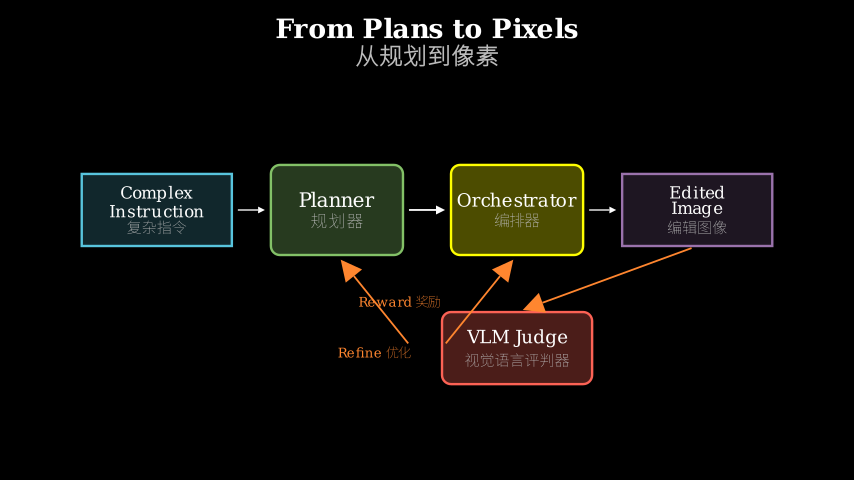
The system has three components. A planner (fine-tuned LLM) takes an abstract instruction and generates a sequence of atomic editing steps in natural language. An orchestrator (trained policy network) reads each step, selects which editing tool to use (inpainting, style transfer, object removal, etc.), and determines which image region to apply it to. A vision-language judge (VLM-based reward model) evaluates the final result against the original instruction, scoring both instruction adherence and visual quality.
The orchestrator is trained via reinforcement learning to maximize judge rewards. Successful editing trajectories (high-reward sequences of tool selections and region masks) are collected and used to fine-tune the planner, teaching it to generate decompositions that lead to executable, high-quality edits. This creates a feedback loop: better plans enable better execution, and better execution data improves planning.
Instruction: "Make ad vegetarian-friendly"
   |
   v
[Planner (LLM)]
   |
   +---> Step 1: "Remove meat from plate"
   +---> Step 2: "Add vegetables to plate"
   +---> Step 3: "Change text to 'Plant-Based'"
   |
   v
[Orchestrator (Policy)]
   |
   +---> Step 1: Tool=Inpaint, Region=<plate area>
   +---> Step 2: Tool=ObjectAdd, Region=<plate area>
   +---> Step 3: Tool=TextEdit, Region=<text box>
   |
   v
[Judge (VLM)] --> Reward: 0.87
   |
   v
Update Orchestrator (RL) + Refine Planner (successful trajectory)
Think of this like a kitchen brigade learning a new recipe. The head chef (planner) writes down the cooking steps. The line cooks (orchestrator) execute each step, choosing which tools (knife, pan, oven) and ingredients (regions) to use. The food critic (judge) tastes the final dish and gives a score. The line cooks adjust their technique based on the score (RL training). When a dish scores well, the head chef studies what steps led to success and updates the recipe book (planner refinement). Over time, the recipe becomes more executable, and the cooks become better at following it. The key insight: the recipe and the execution technique co-evolve based on whether the dish actually tastes good, not whether it matches some textbook procedure.
Key Concepts
-
Atomic decomposition: Breaking a complex instruction into the smallest meaningful editing operations. “Make this vegetarian-friendly” becomes three atomic steps: remove meat, add vegetables, change text. Each atomic step should be simple enough that a single tool can handle it. The challenge is that “atomic” depends on what tools you have—if you only have an inpainting tool, “add vegetables” might need further decomposition into “generate vegetable image” + “composite onto plate.” This paper assumes a fixed tool library, so atomicity is defined relative to those tools.
-
Outcome-based rewards: Instead of judging whether the agent followed the right process (imitation learning), judge whether the final image satisfies the instruction. The judge is a vision-language model that scores two things: (1) does the edited image match the instruction? (2) does it look realistic? This shifts the optimization target from “do what the teacher did” to “produce results that work.” The risk is that the judge itself might be miscalibrated, rewarding superficial changes over meaningful edits.
-
Experiential refinement: The planner improves by studying its own successful executions, not by imitating a teacher. When the orchestrator achieves a high reward, that trajectory (instruction → decomposition → tool sequence → final image) is added to the planner’s training data. This is different from standard imitation learning because the “teacher” is the agent’s own past successes, filtered by outcome quality. It’s a form of self-play where the planner learns what kinds of decompositions actually lead to good edits.
Framework Shift
Before (rule-based or imitation):        After (this paper):

Instruction                              Instruction
    |                                        |
    v                                        v
[Handcrafted Rules]                      [Planner (learnable)]
    |                                        |
    v                                        v
Fixed Decomposition                      Atomic Steps
    |                                        |
    v                                        v
[Tool Pipeline]                          [Orchestrator (RL)]
    |                                        |
    v                                        v
Execute All Steps                        Execute + Get Reward
    |                                        |
    v                                        v
Output (no feedback)                     [Judge] --> Reward
                                             |
                                             v
                                         Refine Both Components
From fixed pipelines to adaptive co-evolution, the core shift is closing the loop between planning and execution through outcome-based learning.
Expert Assessment
Problem choice: Real gap. Abstract instructions are where current models visibly fail, and it’s a natural next frontier after single-step editing matured. The problem sits at the intersection of tool use, planning, and vision-language grounding—all active areas. Not manufactured.
Method maturity: Clever architecture but relies heavily on the judge’s quality. If the VLM judge is biased or shallow (e.g., rewards superficial changes), the whole system optimizes for the wrong thing. The paper doesn’t deeply interrogate judge failure modes. The RL component is standard policy gradient—no novel algorithmic contribution there. The experiential refinement loop is the genuinely interesting idea, but it’s underexplored: how many iterations does it take to converge? Does the planner overfit to the orchestrator’s quirks?
Experimental integrity: Baselines are reasonable (single-step models, rule-based decomposition, imitation learning). The human evaluation is small-scale but appropriate for this task. One red flag: no ablation on judge quality. What happens if you swap in a weaker VLM? The results suggest the method works, but the error bars are wide, and some qualitative examples show the system still struggles with spatial reasoning (e.g., “move object to the left” sometimes fails).
Writing quality: The abstract and intro are strong. The method section is dense—too much notation for what’s conceptually a simple feedback loop. Figure 2 (the system diagram) does most of the explanatory work; the text should lean on it more. The related work section is thorough but could be trimmed. The biggest missed opportunity: no discussion of failure modes or limitations until the appendix. A paragraph in the main text acknowledging where the judge breaks down would strengthen credibility.
Verdict: weak accept — Solid contribution to an important problem, but the reliance on judge quality is underexplored, and the experimental scale is modest.
Takeaways
Steal the feedback loop structure: The idea of training a planner by filtering its own successful executions (not imitating a teacher) transfers to any multi-step decision problem. If you’re building an agent that decomposes tasks, don’t just imitate demonstrations—run the decompositions, measure outcomes, and retrain on what worked.
Judge design matters more than you think: The quality ceiling of this entire approach is set by the judge. If you’re building a similar system, invest heavily in judge robustness. Test it adversarially: can it detect superficial edits that technically satisfy the instruction but miss the intent?
Atomic decomposition is tool-dependent: Don’t treat “atomic” as an absolute property. A step is atomic relative to your tool library. If you add more powerful tools, you can make the decomposition coarser. If your tools are weaker, you need finer steps. Design the planner and tool library together, not separately.
论文: 2605.15181 作者: Anirudh Sundara Rajan, Krishna Kumar Singh, Yong Jae Lee 分类: cs.CV
缺口
现代图像编辑模型(如 Stable Diffusion 或 DALL-E)能很好地处理具体指令(“把天空变蓝”),但在抽象的多步骤请求(“让这个广告更适合素食主义者”)上会崩溃。
先前基于智能体的方法(基于 LLM 的分解、工具使用管道)要么硬编码分解逻辑,要么模仿教师演示,造成两个问题:(1)规划与实际编辑结果脱钩——听起来不错的计划可能产生糟糕的结果;(2)系统无法从错误中学习,因为成功被定义为匹配教师行为,而非编辑是否真正有效。
问题:抽象指令需要多步推理
   |
   v
假设:分解 + 工具选择可以从结果中学习
   |
   v
方法:规划器生成原子步骤 -> 编排器用工具执行
      -> 评判器打分 -> 奖励优化两个组件
   |
   v
证据:在连贯性上优于单步和基于规则的基线
   |
   v
结论:将规划与奖励驱动的执行耦合提高可靠性
增量
一句话:这篇论文之前,多步图像编辑依赖手工管道或教师模仿;之后,规划和执行都能从基于结果的奖励中端到端学习。
核心机制
系统有三个组件。
规划器(微调的 LLM)接收抽象指令,生成一系列自然语言描述的原子编辑步骤。
编排器(训练的策略网络)读取每个步骤,选择使用哪个编辑工具(修复、风格迁移、物体移除等),并确定应用到哪个图像区域。
视觉-语言评判器(基于 VLM 的奖励模型)根据原始指令评估最终结果,对指令遵循度和视觉质量打分。
编排器通过强化学习训练以最大化评判器奖励。
成功的编辑轨迹(高奖励的工具选择和区域掩码序列)被收集并用于微调规划器,教它生成可执行、高质量的分解。
这创建了一个反馈循环:更好的计划带来更好的执行,更好的执行数据改进规划。
指令:"让广告更适合素食主义者"
   |
   v
[规划器 (LLM)]
   |
   +---> 步骤1:"从盘子里移除肉类"
   +---> 步骤2:"在盘子里添加蔬菜"
   +---> 步骤3:"将文字改为'植物基'"
   |
   v
[编排器 (策略)]
   |
   +---> 步骤1:工具=修复,区域=<盘子区域>
   +---> 步骤2:工具=添加物体,区域=<盘子区域>
   +---> 步骤3:工具=文字编辑,区域=<文本框>
   |
   v
[评判器 (VLM)] --> 奖励:0.87
   |
   v
更新编排器 (RL) + 优化规划器(成功轨迹)
把这想象成厨房团队学习新菜谱。
主厨(规划器)写下烹饪步骤。
厨师(编排器)执行每个步骤,选择使用哪些工具(刀、锅、烤箱)和食材(区域)。
美食评论家(评判器)品尝最终菜品并打分。
厨师根据分数调整技术(RL 训练)。
当一道菜得分高时,主厨研究哪些步骤带来了成功,并更新菜谱(规划器优化)。
随着时间推移,菜谱变得更可执行,厨师也更擅长遵循它。
关键洞察:菜谱和执行技术基于菜品是否真的好吃而共同演化,而非是否匹配某个教科书程序。
关键概念
- 原子分解:将复杂指令分解为最小的有意义编辑操作。
“让这个适合素食主义者”变成三个原子步骤:移除肉类、添加蔬菜、更改文字。
每个原子步骤应该简单到单个工具能处理。
挑战在于”原子”取决于你有什么工具——如果只有修复工具,“添加蔬菜”可能需要进一步分解为”生成蔬菜图像”+“合成到盘子上”。
本文假设固定的工具库,所以原子性是相对于这些工具定义的。
- 基于结果的奖励:不是判断智能体是否遵循了正确的过程(模仿学习),而是判断最终图像是否满足指令。
评判器是一个视觉-语言模型,对两件事打分:(1)编辑后的图像是否匹配指令?(2)看起来是否真实?这将优化目标从”做教师做的事”转变为”产生有效的结果”。
风险是评判器本身可能校准不当,奖励表面变化而非有意义的编辑。
- 经验优化:规划器通过研究自己的成功执行来改进,而非模仿教师。
当编排器获得高奖励时,该轨迹(指令 → 分解 → 工具序列 → 最终图像)被添加到规划器的训练数据中。
这与标准模仿学习不同,因为”教师”是智能体自己过去的成功,由结果质量过滤。
这是一种自我对弈形式,规划器学习什么样的分解实际上会导致好的编辑。
框架转变
之前(基于规则或模仿):              之后(本文方法):

指令                                  指令
    |                                     |
    v                                     v
[手工规则]                            [规划器(可学习)]
    |                                     |
    v                                     v
固定分解                              原子步骤
    |                                     |
    v                                     v
[工具管道]                            [编排器 (RL)]
    |                                     |
    v                                     v
执行所有步骤                          执行 + 获得奖励
    |                                     |
    v                                     v
输出(无反馈)                        [评判器] --> 奖励
                                          |
                                          v
                                      优化两个组件
从固定管道到自适应共同演化,核心转变是通过基于结果的学习闭合规划与执行之间的循环。
专家评审
选题眼光:真实缺口。
抽象指令是当前模型明显失败的地方,是单步编辑成熟后的自然下一个前沿。
问题位于工具使用、规划和视觉-语言基础的交叉点——都是活跃领域。
不是人造的。
方法成熟度:巧妙的架构,但严重依赖评判器的质量。
如果 VLM 评判器有偏见或肤浅(例如,奖励表面变化),整个系统会优化错误的东西。
论文没有深入探讨评判器的失败模式。
RL 组件是标准策略梯度——那里没有新颖的算法贡献。
经验优化循环是真正有趣的想法,但探索不足:需要多少次迭代才能收敛?规划器会过拟合到编排器的怪癖吗?
实验诚意:基线合理(单步模型、基于规则的分解、模仿学习)。
人类评估规模较小,但适合这个任务。
一个危险信号:没有关于评判器质量的消融实验。
如果换成更弱的 VLM 会怎样?结果表明方法有效,但误差条很宽,一些定性例子显示系统在空间推理上仍有困难(例如,“将物体移到左边”有时会失败)。
写作功力:摘要和引言很强。
方法部分很密集——对于概念上简单的反馈循环来说符号太多。
图 2(系统图)完成了大部分解释工作;文本应该更多地依赖它。
相关工作部分很全面但可以精简。
最大的错失机会:直到附录才讨论失败模式或局限性。
主文本中承认评判器在哪里崩溃的一段话会增强可信度。
判决:弱接收 — 对重要问题的扎实贡献,但对评判器质量的依赖探索不足,实验规模适中。
要点总结
偷走反馈循环结构:通过过滤自己的成功执行(而非模仿教师)来训练规划器的想法可以迁移到任何多步决策问题。
如果你在构建分解任务的智能体,不要只是模仿演示——运行分解,测量结果,并在有效的内容上重新训练。
评判器设计比你想象的更重要:这整个方法的质量上限由评判器设定。
如果你在构建类似系统,大力投资于评判器的鲁棒性。
对抗性测试:它能检测到技术上满足指令但错过意图的表面编辑吗?
原子分解依赖于工具:不要将”原子”视为绝对属性。
一个步骤相对于你的工具库是原子的。
如果你添加更强大的工具,可以使分解更粗。
如果你的工具更弱,你需要更细的步骤。
一起设计规划器和工具库,而非分开设计。