
Paper: 2603.13191 Authors: Haonan Huang Categories: physics.comp-ph, cond-mat.mtrl-sci, cs.AI
The Gap
LLMs have become capable executors in computational materials science—they can run quantum simulations, parse outputs, and chain together workflows. But there’s a difference between running a hundred simulations and being a researcher. Real researchers learn: they remember which parameter choices failed, recognize patterns across different materials, and apply hard-won insights to new problems. Current AI agents treat each execution as a fresh start, discarding everything they learned the moment the task completes.
Problem: Stateless execution
   |
   v
Assumption: Research = accumulation of knowledge over time
   |
   v
Method: Record findings + Retrieve before new runs + Reflect periodically
   |
   v
Evidence: 67% less reasoning overhead, 47%->3% error, 1% on transfer
   |
   v
Conclusion: Memory + reflection transforms executors into learners
The Increment
One sentence: Before this paper, LLM agents executed computational workflows but forgot everything between runs; after, they accumulate knowledge with provenance tracking and reflection, behaving more like researchers than calculators.
Core Mechanism
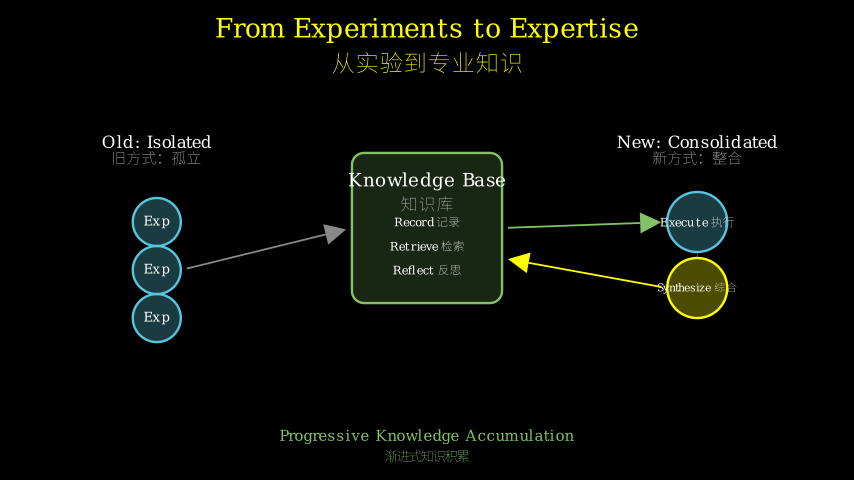
QMatSuite has three interlocking components. First, a recording system captures every finding with full provenance—not just “this parameter worked” but the entire context of why it was tried, what happened, and what was learned. Second, a retrieval system that queries this knowledge base before starting new calculations, pulling relevant past experiences into the agent’s context. Third, dedicated reflection sessions where the agent reviews accumulated findings, corrects errors, and synthesizes cross-compound patterns.
The data flow is cyclical: execute a simulation, record the outcome with context, then before the next simulation retrieve relevant past experiences. Periodically, the agent pauses execution to reflect—reviewing its knowledge base to spot contradictions, generalize patterns, and consolidate understanding. This reflection isn’t just summarization; it’s active error correction and pattern synthesis.
Think of it like a lab notebook that talks back. A traditional notebook is passive—you write things down, but you have to remember to look back at the right pages. QMatSuite’s notebook is active: when you’re about to try a new experiment, it taps you on the shoulder and says “hey, remember when you tried something similar with that other compound? Here’s what happened.” And every Friday afternoon, you sit down with the notebook for a reflection session—it shows you contradictions (“you wrote X here but Y there”), helps you spot patterns (“these three compounds all needed higher cutoff energies”), and consolidates scattered observations into principles you can apply to new materials.
Key Concepts
-
Provenance tracking: When you record “increasing the k-point mesh improved convergence,” that’s a fact. But without context—which material, what starting mesh, what convergence criterion—it’s nearly useless for future decisions. Provenance means capturing the full causal chain: the problem you were solving, the hypothesis you were testing, the parameters you changed, and the outcome. It’s the difference between “this worked” and “this worked because…” The former is a data point; the latter is transferable knowledge.
-
Reflection sessions: Most AI systems learn by gradient descent during training, then stay frozen during deployment. Reflection is different—it’s deliberate, periodic self-examination during deployment. The agent reviews its accumulated knowledge looking for three things: contradictions that need resolution (did I record conflicting findings?), patterns that can be generalized (do these five cases share a common structure?), and scattered observations that can be synthesized into principles. It’s metacognition: thinking about what you’ve learned, not just applying what you know.
Framework Shift
Before (mainstream approach):        After (this paper):

  Task -> LLM -> Execute               Task -> Retrieve past knowledge
           |                                      |
           v                                      v
        Output                            LLM -> Execute with context
                                                  |
    (memory cleared)                              v
                                           Record with provenance
                                                  |
                                                  v
                                           Periodic reflection
                                                  |
                                                  v
                                           Synthesized knowledge base
From stateless execution to stateful learning, the core shift is treating the agent’s experience as a first-class asset that compounds over time rather than ephemeral context that evaporates after each run.
Expert Assessment
Problem choice: This is a real gap, not manufactured. The field has made impressive progress on getting LLMs to execute computational workflows, but the stateless nature is a genuine bottleneck. The framing—“performing a hundred simulations does not make a researcher”—cuts to the heart of what’s missing. It sits at the natural next step in the trajectory: we’ve solved execution, now we need learning.
Method maturity: Straightforward but well-executed. The three components (record, retrieve, reflect) are conceptually simple, which is a strength—no exotic architectures or clever tricks, just disciplined engineering of what researchers actually do. The reflection mechanism is the most interesting piece, but the paper (based on the abstract) likely needs more detail on how it works internally. Are there simpler approaches? Maybe—you could imagine pure retrieval without reflection—but the combination feels right.
Experimental integrity: The numbers are strong and specific: 67% reduction in reasoning overhead, 47% to 3% error reduction, and crucially, 1% deviation on transfer to unfamiliar materials with zero pipeline failures. That transfer test is the real validation—it’s easy to overfit to your benchmark, but maintaining accuracy on new materials suggests the knowledge is genuinely generalizable. The baselines appear fair (comparing against the same agent without memory), though I’d want to see ablations separating retrieval from reflection.
Writing quality: The abstract is excellent—clear problem statement, concrete numbers, and the opening line (“performing a hundred simulations does not make a researcher”) is memorable. The weakness is likely in the method section: how exactly does reflection work? What’s the algorithm for spotting contradictions and synthesizing patterns? That’s where the paper probably needs more detail to be reproducible.
Verdict: weak accept — Solid contribution addressing a real gap with strong empirical results, but method details likely need strengthening for full reproducibility.
Takeaways
The core idea—treating agent experience as a compounding asset—transfers directly to any domain where AI systems perform repeated tasks. If you’re building agents for software development, data analysis, or experimental design, steal this pattern: (1) record outcomes with full context, not just results, (2) retrieve relevant past experiences before new tasks, (3) schedule periodic reflection to consolidate learning. The specific technique of reflection sessions is particularly portable: pause execution periodically to review accumulated knowledge for contradictions, patterns, and synthesis opportunities. It’s a simple architectural change that transforms stateless executors into stateful learners.
论文: 2603.13191 作者: Haonan Huang 分类: physics.comp-ph, cond-mat.mtrl-sci, cs.AI
缺口
大语言模型已经成为计算材料科学中称职的执行者——它们能运行量子模拟、解析输出、串联工作流。
但执行一百次模拟和成为研究者是两回事。
真正的研究者会学习:他们记得哪些参数选择失败了,识别不同材料间的模式,将艰难获得的洞见应用到新问题上。
当前的AI智能体把每次执行都当作全新开始,任务完成的瞬间就丢弃了所有学到的东西。
问题:无状态执行
   |
   v
假设:研究 = 随时间积累知识
   |
   v
方法:记录发现 + 新运行前检索 + 定期反思
   |
   v
证据:推理开销减少67%,误差从47%降至3%,迁移时1%误差
   |
   v
结论:记忆 + 反思将执行者转变为学习者
增量
一句话: 这篇论文之前,大语言模型智能体执行计算工作流但运行之间忘记一切;
之后,它们通过溯源追踪和反思积累知识,表现得更像研究者而非计算器。
核心机制
QMatSuite有三个互锁的组件。
首先是记录系统,捕获每个发现及其完整溯源——不只是”这个参数有效”,而是为什么尝试它、发生了什么、学到了什么的全部上下文。
其次是检索系统,在开始新计算前查询知识库,将相关的过往经验拉入智能体的上下文。
第三是专门的反思会话,智能体回顾积累的发现,纠正错误,将观察综合为跨化合物的模式。
数据流是循环的:执行模拟,带上下文记录结果,然后在下次模拟前检索相关的过往经验。
定期地,智能体暂停执行进行反思——审查知识库以发现矛盾、泛化模式、巩固理解。
这种反思不只是总结;
它是主动的错误纠正和模式综合。
把它想象成一本会说话的实验笔记本。
传统笔记本是被动的——你写下东西,但得记得翻回正确的页面。
QMatSuite的笔记本是主动的:当你要尝试新实验时,它拍拍你肩膀说”嘿,记得你用另一个化合物试过类似的吗?
结果是这样的。
“每周五下午,你和笔记本坐下来反思——它展示矛盾之处(“你这里写了X但那里写了Y”),帮你发现模式(“这三个化合物都需要更高的截断能”),将零散观察巩固为可应用于新材料的原则。
关键概念
- 溯源追踪: 当你记录”增加k点网格改善了收敛性”,这是个事实。
但没有上下文——哪种材料、什么起始网格、什么收敛标准——它对未来决策几乎无用。
溯源意味着捕获完整的因果链:你在解决的问题、你在测试的假设、你改变的参数、以及结果。
这是”这个有效”和”这个有效因为…”的区别。
前者是数据点;
后者是可迁移的知识。
- 反思会话: 大多数AI系统通过训练时的梯度下降学习,然后在部署时保持冻结。
反思不同——它是部署期间有意的、定期的自我审查。
智能体审查积累的知识,寻找三样东西:需要解决的矛盾(我记录了冲突的发现吗?
),可以泛化的模式(这五个案例有共同结构吗?
),以及可以综合为原则的零散观察。
这是元认知:思考你学到了什么,而不只是应用你知道的。
框架转变
之前(主流方法):                之后(本文方法):

  任务 -> LLM -> 执行               任务 -> 检索过往知识
           |                                |
           v                                v
         输出                        LLM -> 带上下文执行
                                            |
    (内存清空)                              v
                                     带溯源记录
                                            |
                                            v
                                     定期反思
                                            |
                                            v
                                     综合知识库
从无状态执行到有状态学习,核心转变是将智能体的经验视为随时间复利的一等资产,而非每次运行后蒸发的临时上下文。
专家评审
选题眼光: 这是真缺口,不是人造的。
该领域在让大语言模型执行计算工作流方面取得了令人印象深刻的进展,但无状态特性是真正的瓶颈。
这个框架——“执行一百次模拟不能造就研究者”——切中了缺失的核心。
它处于发展轨迹的自然下一步:我们解决了执行,现在需要学习。
方法成熟度: 直接但执行良好。
三个组件(记录、检索、反思)在概念上很简单,这是优势——没有奇特的架构或巧妙的技巧,只是对研究者实际所做的严谨工程化。
反思机制是最有趣的部分,但论文(基于摘要)可能需要更多关于其内部运作的细节。
有更简单的方法吗?
也许——你可以想象没有反思的纯检索——但这个组合感觉对。
实验诚意: 数字强劲且具体:推理开销减少67%,误差从47%降至3%,关键是在不熟悉材料上迁移时1%偏差且零管道失败。
那个迁移测试是真正的验证——过拟合基准很容易,但在新材料上保持准确性表明知识是真正可泛化的。
基线看起来公平(与没有记忆的同一智能体比较),尽管我想看到分离检索和反思的消融实验。
写作功力: 摘要很出色——清晰的问题陈述、具体的数字,开头那句(“执行一百次模拟不能造就研究者”)令人难忘。
弱点可能在方法部分:反思到底如何工作?
发现矛盾和综合模式的算法是什么?
那是论文可能需要更多细节以实现完全可复现的地方。
判决: 弱接收 — 解决真实缺口的扎实贡献,实验结果强劲,但方法细节可能需要加强以实现完全可复现性。
要点总结
核心思想——将智能体经验视为复利资产——直接迁移到AI系统执行重复任务的任何领域。
如果你在构建软件开发、数据分析或实验设计的智能体,偷走这个模式:(1)带完整上下文记录结果,不只是结果本身,(2)新任务前检索相关过往经验,(3)安排定期反思以巩固学习。
反思会话的具体技术特别可移植:定期暂停执行以审查积累的知识,寻找矛盾、模式和综合机会。
这是一个简单的架构改变,将无状态执行器转变为有状态学习者。