Paper: 2603.09972 Authors: Lucas Prieto, Edward Stevinson, Melih Barsbey, Tolga Birdal, Pedro A. M. Mediano Categories: cs.LG, cs.AI, cs.CV
The Gap
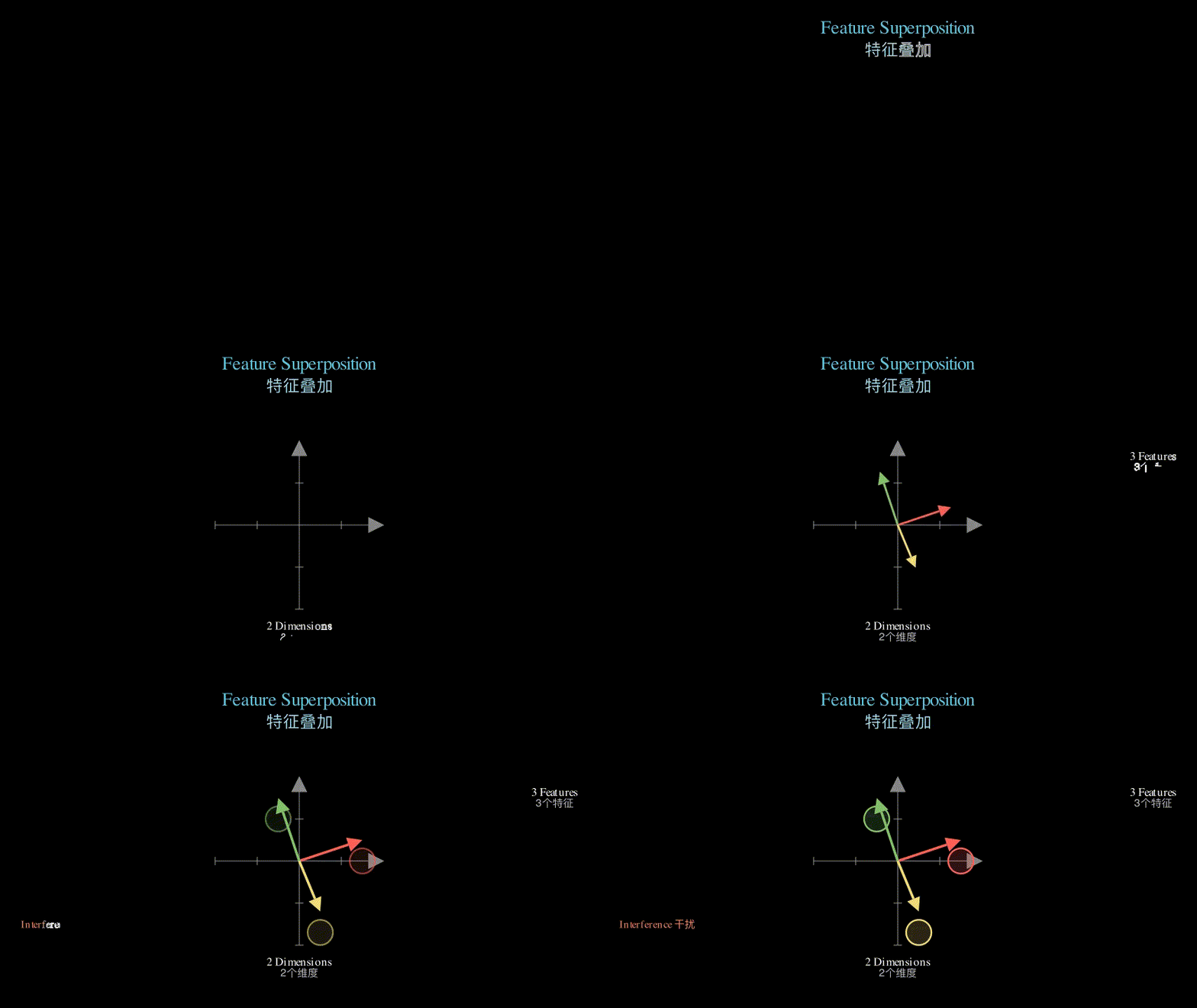
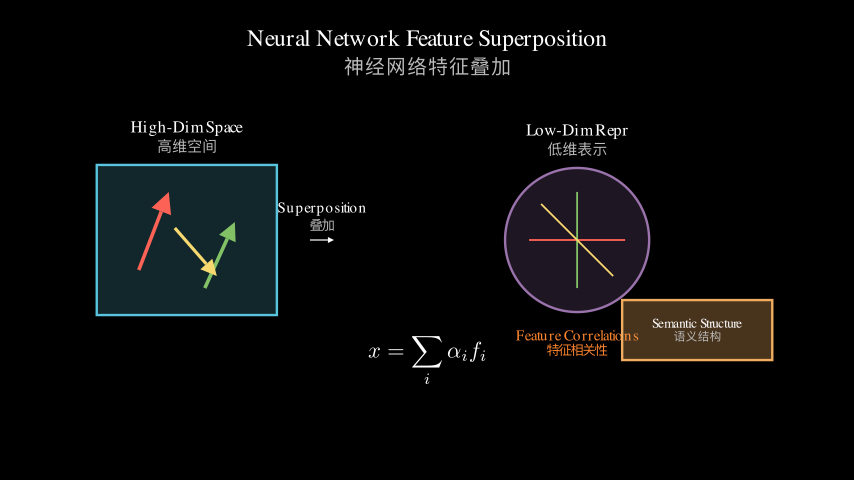
Mechanistic interpretability research has established that neural networks pack more features than dimensions through superposition. The dominant framework, pioneered by Anthropic and others, treats this as a geometric packing problem: sparse, independent features arranged to minimize interference, filtered by ReLUs, forming regular polytopes. This works beautifully in toy settings.
But real data has correlations. Words co-occur. Features activate together. The standard theory says nothing about this — it assumes features are independent and treats all interference as noise to be minimized. Yet language models show semantic clusters and cyclical structures that the polytope story doesn’t predict.
The gap: How does superposition work when features are correlated?
Problem: Real features correlate
   |
   v
Assumption: Standard theory assumes independence
   |                    (treats interference as pure noise)
   v
Method: BOWS - controlled correlated features
   |              (bag-of-words from real text)
   v
Evidence: Interference becomes constructive
   |           (semantic clusters emerge)
   v
Conclusion: Correlations reshape geometry fundamentally
The Increment
One sentence: Before this paper, superposition was understood as minimizing interference between independent features; after, we see that correlated features can arrange themselves to make interference constructive, explaining semantic structure in real models.
Core Mechanism
The authors introduce Bag-of-Words Superposition (BOWS): train a small autoencoder to compress binary bag-of-words vectors from internet text into a lower-dimensional bottleneck. The input is which words appear in a document (not their order or frequency), and the model must reconstruct this from fewer dimensions than there are words.
The key insight: when words co-occur frequently (like “neural” and “network”), the model can place their feature directions close together in the embedding space. When both activate, their interference is constructive — the combined signal is stronger and easier to decode. ReLUs still filter out false positives from inactive features, but now interference between active features helps rather than hurts.
They vary the correlation structure by controlling which text domains to sample from, and they vary the regularization (weight decay) to see how it affects the learned geometry. The result: with realistic correlations and weight decay, features cluster by semantic similarity and form cyclical structures — exactly what’s observed in real language models but unexplained by the standard polytope picture.
Input: Binary word vector (10k dims)
   |
   v
[Encoder: compress to bottleneck]
   |
   v
Bottleneck (512 dims) <-- Superposition happens here
   |                      Features arranged by co-activation
   v
[Decoder: reconstruct]
   |
   v
Output: Reconstructed word vector

Key: Correlated features (e.g., "neural"+"network")
     placed nearby -> interference adds up constructively
Think of it like a crowded subway car. The standard superposition story says: pack people in to minimize contact, everyone stands rigid, any bump is bad. But real commuters who travel together (correlations) can lean on each other — the contact becomes support. The model learns: if these two features usually activate together, place them so their signals reinforce rather than cancel. Weight decay acts like a gentle pressure pushing related features closer, while ReLUs are the doors that keep non-passengers out.
Key Concepts
-
Constructive vs Destructive Interference: In the standard view, when two feature directions overlap in the embedding space, their simultaneous activation creates interference that corrupts both signals — this is destructive. But if those features frequently co-activate (like “neural” and “network”), the model can orient them so their combined signal is stronger and more distinct than either alone — this is constructive. The decoder learns to expect this combined pattern. It’s like two radio signals: if they’re random, they create static; if they’re synchronized, they amplify each other.
-
Semantic Clustering: When features that co-occur are placed nearby in the embedding space, you get clusters of related concepts. For example, all medical terms might cluster together because they appear in similar documents. This isn’t just dimensionality reduction — it’s the model discovering that interference within a cluster is constructive (these features help each other) while interference across clusters is destructive (these features confuse each other). The geometry encodes the correlation structure of the data.
-
Weight Decay as Geometry Shaper: Weight decay penalizes large weights, which pushes the model toward simpler solutions. In superposition, this means: instead of using orthogonal directions for every feature (which requires large decoder weights to separate them), the model prefers to place correlated features close together (smaller weights, since the decoder can use the correlation structure). Weight decay doesn’t just prevent overfitting — it actively shapes the feature geometry to match the data’s correlation structure.
Framework Shift
Before (standard superposition):        After (this paper):

Features = independent                  Features = correlated
    |                                       |
    v                                       v
Minimize all interference              Constructive interference
    |                                   for co-active features
    v                                       |
Regular polytopes                           v
(geometric packing)                    Semantic clusters
                                       (correlation-driven)
    |                                       |
    v                                       v
ReLU filters noise                     ReLU filters false positives
                                       (but preserves constructive signal)
From geometric packing to correlation encoding, the core shift is: interference changes from enemy to ally when features co-activate.
Expert Assessment
Problem choice: This is a real gap. The mechanistic interpretability community has been puzzled by semantic clusters and cyclical structures in language models for a while. The standard polytope story is elegant but clearly incomplete — it’s a spherical cow model. Addressing correlations is the obvious next step, and the authors are right to tackle it.
Method maturity: BOWS is clever and controlled. Using bag-of-words gives you natural correlations from real text while keeping the setup simple enough to analyze. The ablations (varying correlation structure, weight decay) are well-designed. However, the leap from BOWS to “this explains language models” is a bit fast — bag-of-words is still quite different from contextualized embeddings. The mechanism is plausible but needs validation on actual LLM internals.
Experimental integrity: The baselines are fair (comparing to standard sparse coding and the Anthropic toy models). The visualizations are compelling — you can see the clusters form. But I’d want to see more quantitative metrics: how much does constructive interference actually help reconstruction? What’s the trade-off curve between correlation exploitation and false positive rate? The paper leans heavily on qualitative geometry observations.
Writing quality: The introduction is excellent — it clearly motivates the gap. The related work section is thorough. But the results section gets a bit hand-wavy: lots of “we observe” without enough “we measure.” The discussion of cyclical structures feels tacked on — it’s mentioned but not deeply analyzed. Rewriting Section 4 with more quantitative analysis would elevate the whole paper.
Verdict: weak accept — Addresses a real gap with a clever method, but the evidence is more suggestive than conclusive. Needs stronger quantitative validation and clearer connection to real LLMs.
Takeaways
If you’re training sparse autoencoders or doing dictionary learning on neural network activations, consider: your regularization choice shapes the feature geometry based on correlation structure. Weight decay isn’t just preventing overfitting — it’s pushing correlated features together. If your data has strong correlations (like language does), this might be a feature, not a bug.
For interpretability work: look for semantic clusters, not just individual feature directions. If features co-activate, their combined geometry might be more meaningful than either alone. The “one feature = one direction” framing might be too simplistic.
For anyone building compressed representations: interference can be constructive if you know the correlation structure. Instead of fighting to make everything orthogonal, lean into the correlations. Place related features nearby and let them reinforce each other. The decoder can learn to expect these patterns.
论文: 2603.09972 作者: Lucas Prieto, Edward Stevinson, Melih Barsbey, Tolga Birdal, Pedro A. M. Mediano 分类: cs.LG, cs.AI, cs.CV
缺口
机制可解释性研究已经确立:神经网络通过叠加态(superposition)将更多特征塞进更少维度。
主流框架由 Anthropic 等机构开创,将此视为几何打包问题:稀疏、独立的特征排列以最小化干扰,由 ReLU 过滤,形成规则多面体。
这在玩具设定中效果很好。
但真实数据有相关性。
词会共现。
特征会一起激活。
标准理论对此只字未提——它假设特征独立,将所有干扰都视为需要最小化的噪声。
然而语言模型展现出语义聚类和循环结构,而多面体故事无法预测这些。
缺口在于:当特征相关时,叠加态如何运作?
问题:真实特征存在相关性
   |
   v
假设:标准理论假定独立性
   |              (将干扰视为纯噪声)
   v
方法:BOWS - 受控的相关特征
   |          (来自真实文本的词袋)
   v
证据:干扰变得建设性
   |        (语义聚类涌现)
   v
结论:相关性从根本上重塑几何结构
增量
一句话: 这篇论文之前,叠加态被理解为最小化独立特征间的干扰;之后,我们看到相关特征可以自我排列使干扰具有建设性,从而解释真实模型中的语义结构。
核心机制
作者引入词袋叠加态(BOWS):训练一个小型自编码器,将互联网文本的二值词袋向量压缩到更低维的瓶颈层。
输入是文档中出现了哪些词(不考虑顺序或频率),模型必须从比词汇量更少的维度中重建这个信息。
关键洞察:当词频繁共现(如”神经”和”网络”),模型可以在嵌入空间中将它们的特征方向放得很近。
当两者都激活时,它们的干扰是建设性的——组合信号更强,更易解码。
ReLU 仍然过滤掉未激活特征的假阳性,但现在激活特征间的干扰是有益的而非有害的。
他们通过控制采样的文本领域来改变相关性结构,通过改变正则化(权重衰减)来观察其如何影响学到的几何结构。
结果:在真实相关性和权重衰减下,特征按语义相似性聚类并形成循环结构——正是在真实语言模型中观察到但标准多面体图景无法解释的现象。
输入:二值词向量(1万维)
   |
   v
[编码器:压缩到瓶颈]
   |
   v
瓶颈层(512维)<-- 叠加态发生在这里
   |                特征按共激活模式排列
   v
[解码器:重建]
   |
   v
输出:重建的词向量

关键:相关特征(如"神经"+"网络")
     放置在附近 -> 干扰建设性叠加
把它想象成拥挤的地铁车厢。
标准叠加态故事说:把人塞进去以最小化接触,每个人都站得笔直,任何碰撞都是坏事。
但一起通勤的真实乘客(相关性)可以相互依靠——接触变成了支撑。
模型学到:如果这两个特征通常一起激活,就把它们放置得让信号相互增强而非抵消。
权重衰减像是温和的压力,推动相关特征靠近,而 ReLU 是门,把非乘客挡在外面。
关键概念
- 建设性干扰 vs 破坏性干扰: 在标准观点中,当两个特征方向在嵌入空间中重叠,它们的同时激活会产生破坏两个信号的干扰——这是破坏性的。
但如果这些特征频繁共激活(如”神经”和”网络”),模型可以调整它们的方向,使组合信号比单独任何一个都更强、更独特——这是建设性的。
解码器学会期待这种组合模式。
就像两个无线电信号:如果它们随机,会产生静电;如果它们同步,会相互放大。
- 语义聚类: 当共现的特征在嵌入空间中被放置在附近,你会得到相关概念的聚类。
例如,所有医学术语可能聚在一起,因为它们出现在相似的文档中。
这不仅仅是降维——而是模型发现聚类内的干扰是建设性的(这些特征相互帮助),而跨聚类的干扰是破坏性的(这些特征相互混淆)。
几何结构编码了数据的相关性结构。
- 权重衰减作为几何塑造者: 权重衰减惩罚大权重,这推动模型走向更简单的解。
在叠加态中,这意味着:与其为每个特征使用正交方向(需要大的解码器权重来分离它们),模型更倾向于将相关特征放在一起(更小的权重,因为解码器可以利用相关性结构)。
权重衰减不仅仅防止过拟合——它主动塑造特征几何以匹配数据的相关性结构。
框架转变
之前(标准叠加态):              之后(本文方法):

特征 = 独立                       特征 = 相关
    |                                 |
    v                                 v
最小化所有干扰                    共激活特征的
    |                             建设性干扰
    v                                 |
规则多面体                            v
(几何打包)                      语义聚类
                                 (相关性驱动)
    |                                 |
    v                                 v
ReLU 过滤噪声                     ReLU 过滤假阳性
                                 (但保留建设性信号)
从几何打包到相关性编码,核心转变是:当特征共激活时,干扰从敌人变成盟友。
专家评审
选题眼光: 这是真缺口。
机制可解释性社区对语言模型中的语义聚类和循环结构困惑已久。
标准多面体故事优雅但明显不完整——它是球形奶牛模型。
处理相关性是显而易见的下一步,作者选对了方向。
方法成熟度: BOWS 巧妙且可控。
使用词袋给你来自真实文本的自然相关性,同时保持设定足够简单以便分析。
消融实验(改变相关性结构、权重衰减)设计得当。
然而,从 BOWS 跳到”这解释了语言模型”有点快——词袋与上下文化嵌入还是很不同的。
机制是合理的,但需要在实际 LLM 内部进行验证。
实验诚意: 基线公平(与标准稀疏编码和 Anthropic 玩具模型比较)。
可视化令人信服——你能看到聚类形成。
但我想看更多定量指标:建设性干扰实际上对重建帮助有多大?相关性利用与假阳性率之间的权衡曲线是什么?论文过度依赖定性几何观察。
写作功力: 引言出色——清晰地阐明了缺口。
相关工作部分详尽。
但结果部分有点含糊:大量”我们观察到”而没有足够的”我们测量到”。
对循环结构的讨论感觉是硬加上去的——提到了但没有深入分析。
用更多定量分析重写第4节会提升整篇论文。
判决: 弱接收 — 用巧妙方法解决真实缺口,但证据更多是暗示性而非决定性的。
需要更强的定量验证和与真实 LLM 的更清晰联系。
要点总结
如果你在训练稀疏自编码器或对神经网络激活做字典学习,考虑:你的正则化选择基于相关性结构塑造特征几何。
权重衰减不仅仅是防止过拟合——它在推动相关特征靠拢。
如果你的数据有强相关性(如语言),这可能是特性而非缺陷。
对于可解释性工作:寻找语义聚类,而不仅仅是单个特征方向。
如果特征共激活,它们的组合几何可能比单独任何一个都更有意义。
“一个特征=一个方向”的框架可能过于简化。
对于任何构建压缩表示的人:如果你知道相关性结构,干扰可以是建设性的。
与其努力让一切正交,不如顺应相关性。
将相关特征放在附近,让它们相互增强。
解码器可以学会期待这些模式。