
Paper: 2605.02815 Authors: Quang Hieu Pham, Yang He, Ping Nie, Canwen Xu, Davood Rafiei, Yuepeng Wang, Xi Ye, Jocelyn Qiaochu Chen Categories: cs.CL
The Gap
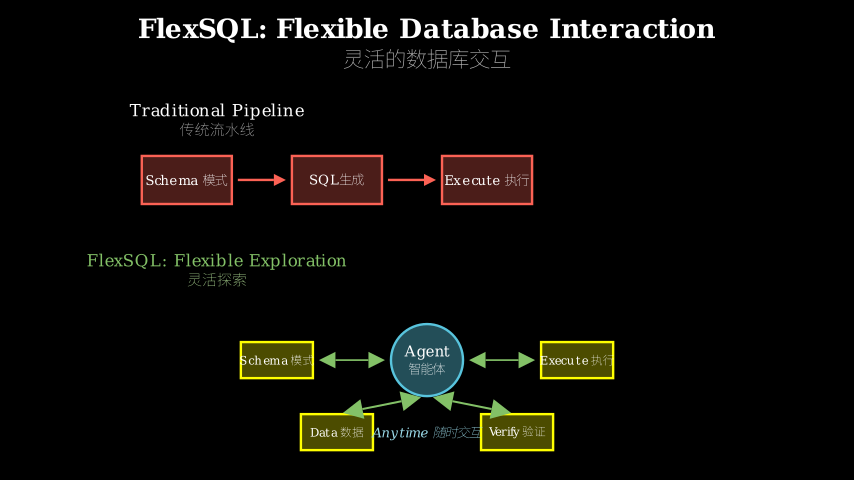
Current text-to-SQL systems follow a rigid pipeline: retrieve schema elements once at the start, generate SQL, execute, and maybe repair if it breaks. This “retrieve-once-then-commit” design creates a recovery ceiling—if the initial schema retrieval misses key tables or the query interpretation is wrong, the system has no way to backtrack and reconsider. Over large analytical databases with hundreds of tables and ambiguous natural language queries, this brittleness compounds: early mistakes propagate through the pipeline with no mechanism for mid-flight correction.
Problem: Complex schemas + ambiguous queries
    |
    v
Assumption: Database interaction is expensive,
            do it once upfront
    |
    v
Method: Flexible exploration + diverse plans +
        two-tier repair (code-level + plan-level)
    |
    v
Evidence: 65.4% on Spider2-Snow (gpt-oss-120b),
          beats stronger models with fixed pipelines
    |
    v
Conclusion: Flexibility in when/how to query DB
            > one-shot retrieval + post-hoc repair
The Increment
One sentence: Before FlexSQL, text-to-SQL agents retrieved schema once and repaired SQL syntax errors; after FlexSQL, agents explore the database continuously during reasoning and can revise their interpretation of the query itself, not just the code.
Core Mechanism
FlexSQL has three interlocking components. First, flexible exploration: at any reasoning step, the agent can inspect schema metadata (table names, column types, foreign keys) or sample actual data values to ground its understanding. This isn’t a one-time retrieval—it’s an ongoing dialogue with the database. Second, diverse execution plans: instead of committing to a single SQL query, the agent generates multiple interpretations of the user’s question, each as a structured plan (which tables to join, what filters to apply). It then implements each plan in either SQL or Python, choosing the language that fits the task. Third, two-tier repair: if execution fails, the system first tries code-level fixes (syntax errors, type mismatches). If that doesn’t work, it backtracks to the plan level and revises the query interpretation itself—maybe the user meant a different table, or the join condition was wrong.
User Question
    |
    v
[Flexible Exploration]
    |
    +---> Schema Inspector ----+
    |                          |
    +---> Data Sampler --------+
    |                          |
    v                          v
[Plan Generator] ---------> Multiple Plans
    |                          |
    +---> Plan A (SQL)         |
    +---> Plan B (Python)      |
    +---> Plan C (SQL)         |
    |                          |
    v                          v
[Execution] <------------- [Two-Tier Repair]
    |                          ^
    |                          |
    +---> Code-level fix ------+
    |                          |
    +---> Plan-level revision -+
    |
    v
Results
Think of FlexSQL as a detective investigating a crime scene. Traditional systems are like detectives who read the case file once, form a theory, write a report, and only revise typos if the report has grammatical errors. FlexSQL is the detective who keeps returning to the scene: checking alibis (schema structure), interviewing witnesses (sampling data), considering multiple suspects (diverse plans), and willing to revisit the entire theory (plan-level repair) if new evidence contradicts it. The case file isn’t a static document—it’s an active resource the detective consults throughout the investigation. The key insight: flexibility in when and how you interact with evidence (the database) lets you recover from wrong turns that a one-shot approach would lock you into.
Key Concepts
-
Flexible Exploration: Imagine you’re assembling IKEA furniture. A fixed pipeline is like reading the entire manual once, then building without looking back—if you misunderstood step 3, you’re stuck. Flexible exploration is checking the manual whenever you’re unsure: “Wait, does this screw go here or there?” You can inspect the diagram (schema metadata) or compare your half-built shelf to the picture (sample data) at any point. In FlexSQL, the agent doesn’t commit to a schema subset upfront. It queries the database’s metadata tables and samples rows as needed during reasoning, treating the database as a reference it can consult anytime, not a document it reads once.
-
Plan-Level Repair: Most text-to-SQL systems repair syntax errors—missing commas, wrong function names. Plan-level repair goes deeper: it revises the semantic interpretation of the query. If the user asks “show me sales by region” and the agent initially joins the
salesandregionstables but gets no results, plan-level repair might realize the user actually meant theterritoriestable, notregions. It’s the difference between fixing a typo in your essay versus realizing your thesis statement is wrong and rewriting the argument. FlexSQL maintains a backtracking mechanism: if code-level fixes fail, it returns to the plan generation step and tries a different interpretation of the user’s intent. -
Diverse Execution Plans: Instead of betting everything on one query interpretation, FlexSQL generates multiple plans that cover different readings of the ambiguous question. If the user asks “average price,” does that mean average across all products, or grouped by category? The agent creates plans for both, implements them (some in SQL, some in Python if the logic is complex), and evaluates which results make sense. It’s like a chess player considering multiple opening moves before committing. The diversity isn’t random—it’s structured exploration of the ambiguity space in natural language queries.
Framework Shift
Before (fixed pipeline):              After (FlexSQL):

User Query                            User Query
    |                                     |
    v                                     v
Schema Retrieval (once)               Reasoning Loop:
    |                                     |
    v                                     +---> Explore schema
SQL Generation                            |     (anytime)
    |                                     |
    v                                     +---> Sample data
Execution                                 |     (anytime)
    |                                     |
    v                                     +---> Generate plans
Syntax Repair (if error)                  |     (multiple)
    |                                     |
    v                                     +---> Execute & verify
Done                                      |
                                          +---> Repair (code or plan)
                                          |
                                          v
                                      Done (when verified)
From a linear pipeline with one database touchpoint to a feedback loop where database interaction is woven throughout reasoning, the core shift is treating the database as a continuous resource rather than a one-time input.
Expert Assessment
Problem choice: Real gap. Large analytical databases (hundreds of tables, ambiguous column names) are where text-to-SQL breaks in practice, and the “retrieve once, repair syntax” paradigm genuinely hits a ceiling. This isn’t a manufactured problem—it’s where industry deployments fail. The paper positions itself well in the trajectory from small-schema benchmarks (Spider) to realistic enterprise scenarios (Spider2-Snow).
Method maturity: The core insight—flexible database interaction—is elegant and underexplored. However, the implementation leans on LLM reasoning rather than principled search or planning algorithms. The “generate diverse plans” step is essentially sampling from the LLM with different prompts, not a structured exploration of the query space. This works but feels like a transitional solution. A tighter integration with database query optimizers or symbolic planners could make this more robust. The two-tier repair is clever but the boundary between code-level and plan-level errors is heuristic, not principled.
Experimental integrity: Baselines are fair—they compare against strong open-source systems and even show their method integrated into Claude Code. The Spider2-Snow benchmark is appropriate (real Snowflake databases, complex schemas). One concern: the 65.4% score uses gpt-oss-120b, but the comparison to “stronger models like gpt-o3” is vague—no head-to-head with the same model across methods. The ablation studies (flexible exploration vs. flexible execution) are solid and show both components contribute. No obvious red flags, but I’d want to see error analysis: what types of queries still fail?
Writing quality: The abstract and introduction are crisp. The method section is dense—Figure 2 (the system diagram) does heavy lifting but isn’t self-explanatory. The paper would benefit from a worked example walking through one query end-to-end, showing exactly when the agent explores schema, generates plans, and repairs. The related work section is thorough but reads like a checklist. The conclusion oversells slightly (“key design principle”) without discussing failure modes or when flexibility might hurt (e.g., exploration cost on simple queries).
Verdict: weak accept — Solid contribution with a clear insight (flexible DB interaction) and strong empirical results, but the method feels like an LLM-era hack rather than a durable architectural principle. The paper advances the state of the art but doesn’t fully explore the design space it opens.
Takeaways
For practitioners building text-to-SQL systems: Don’t lock yourself into upfront schema retrieval. Instrument your database so the agent can cheaply query metadata and sample data during reasoning. The cost of a few extra metadata queries is negligible compared to the cost of generating and repairing a wrong SQL query.
For agent builders in any domain: The two-tier repair pattern (surface-level fix → deep revision) transfers. If your agent writes code, tries it, and fails, don’t just patch syntax—consider whether the plan itself is wrong. Build backtracking into your agent loop.
For researchers: The “diverse plans” approach is undertheorized. There’s a paper waiting to be written on how to systematically explore the ambiguity space in natural language queries, rather than relying on LLM sampling. The connection to query optimization and database theory is underdeveloped—text-to-SQL could borrow more from decades of work on query planning.
Steal this: The idea of treating external resources (databases, APIs, file systems) as continuous dialogue partners rather than one-shot inputs. Most agent architectures retrieve context once and then reason in isolation. FlexSQL shows that interleaving retrieval and reasoning can break through brittleness ceilings.
论文: 2605.02815 作者: Quang Hieu Pham, Yang He, Ping Nie, Canwen Xu, Davood Rafiei, Yuepeng Wang, Xi Ye, Jocelyn Qiaochu Chen 分类: cs.CL
缺口
当前的文本转SQL系统遵循刚性流水线:开始时一次性检索模式元素,生成SQL,执行,如果出错可能修复。
这种”检索一次然后提交”的设计造成了恢复上限——如果初始模式检索遗漏了关键表,或者查询解释错了,系统没有办法回溯重新考虑。
在拥有数百张表和模糊自然语言查询的大型分析数据库上,这种脆弱性会复合:早期错误在流水线中传播,没有中途纠正的机制。
问题:复杂模式 + 模糊查询
    |
    v
假设:数据库交互成本高,
      前期做一次就够了
    |
    v
方法:灵活探索 + 多样化计划 +
      双层修复(代码级 + 计划级)
    |
    v
证据:Spider2-Snow上65.4%(gpt-oss-120b),
      击败使用固定流水线的更强模型
    |
    v
结论:何时/如何查询数据库的灵活性
      > 一次性检索 + 事后修复
增量
一句话:FlexSQL之前,文本转SQL智能体检索模式一次并修复SQL语法错误;FlexSQL之后,智能体在推理过程中持续探索数据库,并且能修正对查询本身的理解,而不仅仅是代码。
核心机制
FlexSQL有三个互锁的组件。
首先,灵活探索:在任何推理步骤,智能体都可以检查模式元数据(表名、列类型、外键)或采样实际数据值来确立理解。
这不是一次性检索——而是与数据库的持续对话。
其次,多样化执行计划:智能体不会承诺单一SQL查询,而是生成用户问题的多种解释,每种都是结构化计划(连接哪些表,应用什么过滤器)。
然后用SQL或Python实现每个计划,选择适合任务的语言。
第三,双层修复:如果执行失败,系统首先尝试代码级修复(语法错误、类型不匹配)。
如果不行,它回溯到计划层面并修正查询解释本身——也许用户指的是另一张表,或者连接条件错了。
用户问题
    |
    v
[灵活探索]
    |
    +---> 模式检查器 ----+
    |                   |
    +---> 数据采样器 ----+
    |                   |
    v                   v
[计划生成器] -------> 多个计划
    |                   |
    +---> 计划A (SQL)   |
    +---> 计划B (Python)|
    +---> 计划C (SQL)   |
    |                   |
    v                   v
[执行] <----------- [双层修复]
    |                   ^
    |                   |
    +---> 代码级修复 ----+
    |                   |
    +---> 计划级修正 ----+
    |
    v
结果
把FlexSQL想象成调查犯罪现场的侦探。
传统系统像是读一遍案卷、形成理论、写报告,只在报告有语法错误时修改错别字的侦探。
FlexSQL是不断返回现场的侦探:核对不在场证明(模式结构),询问证人(采样数据),考虑多个嫌疑人(多样化计划),并且愿意在新证据矛盾时重新审视整个理论(计划级修复)。
案卷不是静态文档——而是侦探在整个调查过程中咨询的活跃资源。
关键洞察:何时以及如何与证据(数据库)交互的灵活性,让你能从一次性方法会锁定你的错误转向中恢复。
关键概念
- 灵活探索:想象你在组装宜家家具。
固定流水线就像把整本说明书读一遍,然后不再回看地组装——如果你误解了第3步,你就卡住了。
灵活探索是在不确定时随时查看说明书:“等等,这个螺丝是拧这里还是那里?“你可以在任何时候检查图示(模式元数据)或把你半成品的架子和图片对比(采样数据)。
在FlexSQL中,智能体不会预先承诺一个模式子集。
它在推理过程中根据需要查询数据库的元数据表和采样行,把数据库当作可以随时咨询的参考,而不是读一次的文档。
- 计划级修复:大多数文本转SQL系统修复语法错误——缺少逗号、错误的函数名。
计划级修复更深入:它修正对查询的语义解释。
如果用户问”显示各地区销售额”,智能体最初连接了sales和regions表但没有结果,计划级修复可能意识到用户实际指的是territories表,而不是regions。
这是修改论文中的错别字与意识到论点本身错了并重写论证之间的区别。
FlexSQL维护一个回溯机制:如果代码级修复失败,它返回计划生成步骤并尝试对用户意图的不同解释。
- 多样化执行计划:FlexSQL不把所有赌注押在一个查询解释上,而是生成多个计划,覆盖模糊问题的不同理解。
如果用户问”平均价格”,这是指所有产品的平均值,还是按类别分组?智能体为两者都创建计划,实现它们(有些用SQL,有些用Python如果逻辑复杂),并评估哪个结果有意义。
这就像棋手在承诺之前考虑多个开局走法。
多样性不是随机的——而是对自然语言查询中歧义空间的结构化探索。
框架转变
之前(固定流水线):              之后(FlexSQL):

用户查询                          用户查询
    |                                 |
    v                                 v
模式检索(一次)                  推理循环:
    |                                 |
    v                                 +---> 探索模式
SQL生成                               |     (任何时候)
    |                                 |
    v                                 +---> 采样数据
执行                                  |     (任何时候)
    |                                 |
    v                                 +---> 生成计划
语法修复(如果出错)                  |     (多个)
    |                                 |
    v                                 +---> 执行并验证
完成                                  |
                                      +---> 修复(代码或计划)
                                      |
                                      v
                                  完成(验证后)
从只有一个数据库接触点的线性流水线到将数据库交互贯穿整个推理的反馈循环,核心转变是将数据库视为持续资源而非一次性输入。
专家评审
选题眼光:真实缺口。
大型分析数据库(数百张表、模糊的列名)是文本转SQL在实践中失败的地方,“检索一次,修复语法”范式确实触及了天花板。
这不是人造问题——这是工业部署失败的地方。
论文在从小模式基准(Spider)到现实企业场景(Spider2-Snow)的轨迹中定位得很好。
方法成熟度:核心洞察——灵活的数据库交互——优雅且未被充分探索。
然而,实现依赖LLM推理而非原则性搜索或规划算法。
“生成多样化计划”步骤本质上是用不同提示从LLM采样,而不是对查询空间的结构化探索。
这有效但感觉像过渡性解决方案。
与数据库查询优化器或符号规划器的更紧密集成可以使其更稳健。
双层修复很巧妙,但代码级和计划级错误之间的边界是启发式的,不是原则性的。
实验诚意:基线公平——他们与强大的开源系统比较,甚至展示了他们的方法集成到Claude Code中。
Spider2-Snow基准合适(真实Snowflake数据库,复杂模式)。
一个担忧:65.4%的分数使用gpt-oss-120b,但与”像gpt-o3这样的更强模型”的比较很模糊——没有跨方法使用相同模型的正面对比。
消融研究(灵活探索vs灵活执行)扎实,显示两个组件都有贡献。
没有明显的危险信号,但我想看错误分析:哪些类型的查询仍然失败?
写作功力:摘要和引言简洁。
方法部分密集——图2(系统图)承担重任但不能自我解释。
论文将受益于一个完整示例,逐步展示一个查询,准确显示智能体何时探索模式、生成计划和修复。
相关工作部分全面但读起来像清单。
结论略微夸大(“关键设计原则”),没有讨论失败模式或灵活性何时可能有害(例如,简单查询上的探索成本)。
判决:弱接收 — 扎实的贡献,有清晰的洞察(灵活的数据库交互)和强大的实证结果,但方法感觉像LLM时代的技巧而非持久的架构原则。
论文推进了技术水平,但没有充分探索它打开的设计空间。
要点总结
对于构建文本转SQL系统的实践者:不要把自己锁定在前期模式检索中。
给你的数据库加装仪表,让智能体能在推理过程中廉价地查询元数据和采样数据。
几次额外元数据查询的成本与生成和修复错误SQL查询的成本相比微不足道。
对于任何领域的智能体构建者:双层修复模式(表面修复 → 深度修正)可迁移。
如果你的智能体写代码、尝试、失败,不要只修补语法——考虑计划本身是否错了。
在你的智能体循环中构建回溯。
对于研究者:“多样化计划”方法理论不足。
有一篇论文等待被写,关于如何系统地探索自然语言查询中的歧义空间,而不是依赖LLM采样。
与查询优化和数据库理论的联系未充分发展——文本转SQL可以从几十年的查询规划工作中借鉴更多。
偷走这个:将外部资源(数据库、API、文件系统)视为持续对话伙伴而非一次性输入的想法。
大多数智能体架构检索上下文一次,然后孤立推理。
FlexSQL表明,交错检索和推理可以突破脆弱性天花板。