Paper: 2603.14938 Authors: Yaoru Li, Federico Landi, Marco Godi, Xin Jin, Ruiju Fu, Yufei Ma, Muyang Sun, Heyu Si, Qi Guo Categories: cs.CV
The Gap
Autonomous driving systems need realistic simulation environments for training and testing, but we’re stuck between two unsatisfying options. Traditional graphics-based simulators (like CARLA) give you interaction but look fake and require massive manual asset creation. Recent generative video models (like Sora, Runway) produce stunning visuals but operate in open-loop mode—they generate a video sequence independently, with no way for a driving agent to steer, brake, or otherwise affect what happens next frame.
The few attempts at closed-loop learning-based simulators hit three walls: (1) multiple camera views drift out of sync over time, (2) feeding generated frames back as input causes quality to degrade rapidly (autoregressive error accumulation), and (3) generating frames fast enough for real-time interaction is computationally prohibitive.
Problem: Need interactive + realistic driving simulation
   |
   v
Constraint 1: Multi-camera consistency over long horizons
Constraint 2: Autoregressive degradation under self-conditioning
Constraint 3: Sub-second latency for real-time interaction
   |
   v
Method: Frame-autoregressive diffusion with structured control
        + Two-stage training (adaptive reference + blend-forcing)
        + System-level efficiency optimizations
   |
   v
Evidence: State-of-the-art on nuScenes, <1s latency on single GPU
   |
   v
Conclusion: Closed-loop learning-based simulation is now viable
The Increment
One sentence: Before FAR-Drive, you chose between beautiful non-interactive videos or interactive low-fidelity graphics; after, you get photorealistic simulation that responds to driving actions in real-time.
Core Mechanism
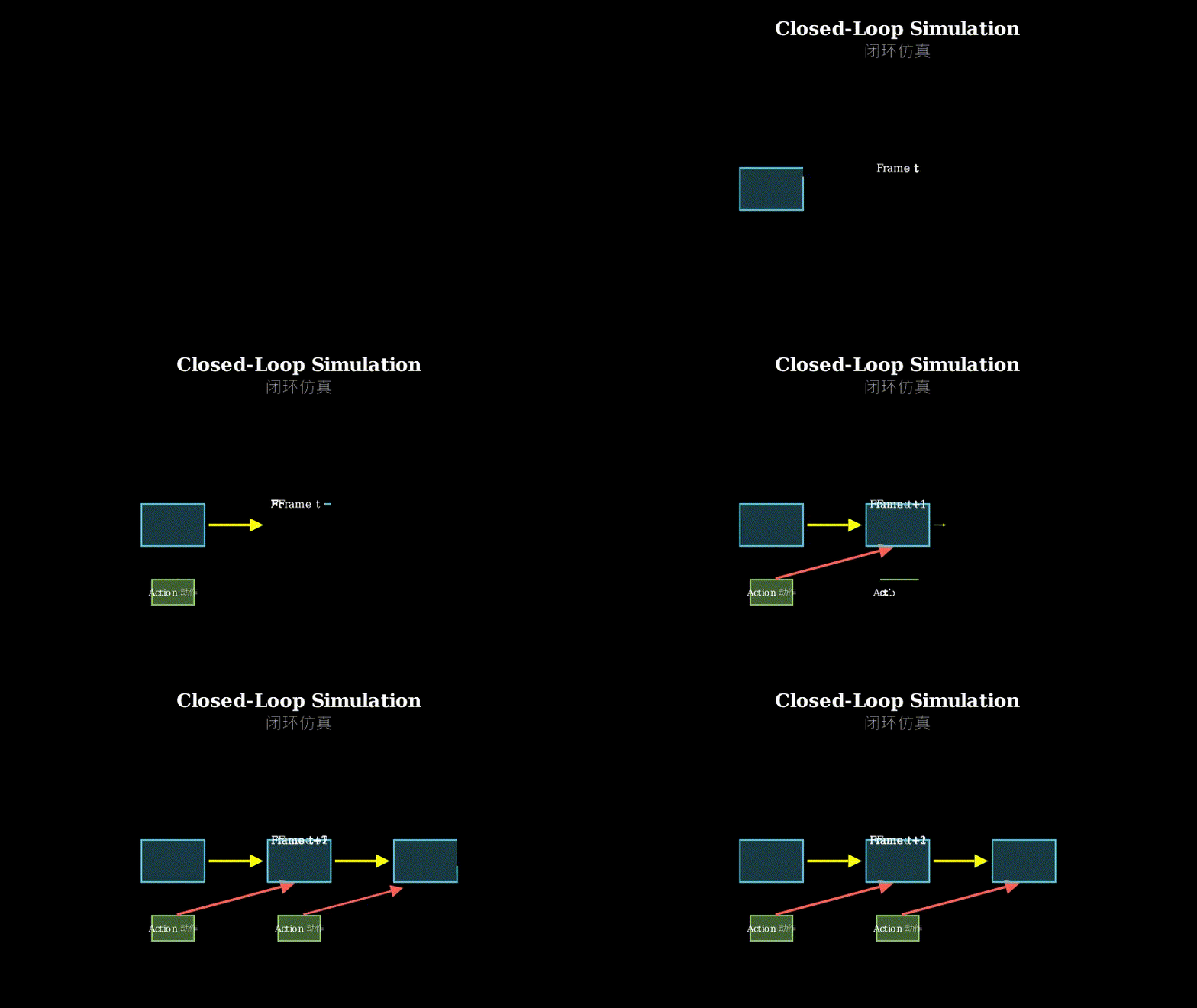
FAR-Drive generates driving videos one frame at a time, with each frame conditioned on the previous frames and the agent’s control inputs (steering, acceleration). The core is a multi-view diffusion transformer that simultaneously generates images from multiple camera angles while maintaining geometric consistency—if the front camera shows a car 10 meters ahead, the side camera better show that same car at the correct relative position.
The training happens in two stages. First, adaptive reference horizon conditioning: the model learns to look back at previous frames for context, with the lookback window gradually increasing during training. This builds long-term temporal consistency. Second, blend-forcing autoregressive training: instead of always feeding back the model’s own generated frames (which compounds errors), they randomly mix in ground truth frames during training. This teaches the model to recover from its own mistakes rather than spiraling into degradation.
For deployment, they add system-level optimizations—model quantization, kernel fusion, memory management—to hit sub-second generation times on a single GPU, making real-time interaction feasible.
Control Input (steering, throttle, brake)
   |
   v
[Multi-view Diffusion Transformer]
   |
   +---> Camera 1 frame_t
   +---> Camera 2 frame_t  <--- Geometric consistency enforced
   +---> Camera 3 frame_t
   |
   v
Frames fed back as input for frame_t+1 (autoregressive loop)
   ^
   |
[Blend-forcing: Mix generated + ground truth during training]
Think of it like an assembly line producing multi-angle photographs of a moving car. Each workstation (camera view) must photograph the same car simultaneously, so the images align geometrically—if station 1 shows the car turning left, station 2 can’t show it going straight. The line runs continuously, with each batch of photos depending on the previous batch (autoregressive).
The problem: if any station makes a mistake (blurry photo, wrong angle), that error gets passed down the line and amplified. Traditional training is like running the line with only its own output—mistakes compound until everything’s garbage. Blend-forcing is like quality control randomly swapping in perfect reference photos from a master set during production runs. The stations learn to correct course when they receive a good input, so when deployed with only their own outputs, they’ve practiced recovering from errors.
Key Concepts
-
Closed-loop vs Open-loop Simulation: Imagine you’re training a pilot. Open-loop is showing them a pre-recorded video of a flight—they can watch but not touch the controls. Closed-loop is a flight simulator where their stick movements actually change what happens next. For autonomous driving, open-loop means generating a pretty video of a car driving; closed-loop means the AI driver’s decisions (turn left, brake) determine what the next frame shows. The latter is vastly harder because you can’t pre-generate everything—you must respond to arbitrary action sequences in real-time.
-
Autoregressive Degradation: When you photocopy a photocopy, quality degrades. When you record a recording, noise accumulates. Autoregressive video generation has the same problem: frame 1 is generated from real data (perfect), frame 2 is generated from frame 1 (slight errors), frame 3 from frame 2 (errors compound), and by frame 50 you’re looking at visual soup. The model was trained on clean data but deployed on its own imperfect outputs—a distribution mismatch that spirals out of control.
-
Blend-forcing Training: Instead of training the model only on perfect ground truth sequences (which doesn’t prepare it for its own mistakes), or only on its own generated sequences (which teaches it to amplify errors), blend-forcing randomly mixes both. During training, some frames come from the dataset, others from the model’s own generation. This forces the model to learn: “When I receive a slightly corrupted input, how do I generate a good next frame?” It’s like practicing recovery, not just perfect execution.
Framework Shift
Before (open-loop generation):        After (closed-loop simulation):

[Video Model]                         [Agent] --action--> [FAR-Drive]
      |                                                         |
   generate                                                  generate
   full video                                               next frame
      |                                                         |
      v                                                         v
[Complete sequence]                   [Single frame] --feedback-->
(no interaction)                      (continuous interaction)
Structural difference:
One-shot generation                   Iterative generation with
of entire sequence                    action-conditioned feedback loop
From batch production to real-time manufacturing, the core shift is replacing pre-rendered sequences with frame-by-frame generation that responds to control inputs.
Expert Assessment
Problem choice: This is a genuine gap. Autonomous driving companies spend millions on simulation infrastructure, and the visual realism gap between simulators and reality causes sim-to-real transfer failures. The problem sits at the intersection of two hot areas (generative video + autonomous driving), which is both opportunistic and pragmatic.
Method maturity: This is competent engineering more than conceptual breakthrough. Multi-view diffusion transformers exist. Blend-forcing is a known technique from robotics (teacher forcing variants). The contribution is showing these pieces can be assembled into a working closed-loop system. Nothing wrong with that—most progress is integration—but don’t expect novel algorithmic insights.
Experimental integrity: Red flag: only evaluated on nuScenes, which has relatively short sequences and limited diversity. The “state-of-the-art” claim needs scrutiny—what are the baselines? Are they comparing against other learning-based closed-loop methods, or against open-loop models unfairly? The latency numbers (sub-second on single GPU) are impressive but need hardware specs and batch size details. I’d want to see failure cases and degradation curves over longer horizons.
Writing quality: The abstract is buzzword-heavy (“fine-grained structured control,” “geometrically consistent multi-camera generation”). The method section likely drowns in architectural details without enough intuition about why each component matters. If I were reviewing, I’d ask them to rewrite the introduction with a concrete example: “Here’s a driving scenario, here’s what existing methods do wrong, here’s what we do differently.”
Verdict: Weak accept—addresses a real problem with a working solution, but the novelty is in integration rather than innovation, and the evaluation needs more depth to be convincing.
Takeaways
Blend-forcing for autoregressive models: If you’re building any system that feeds its outputs back as inputs (video generation, trajectory prediction, language models with self-correction), don’t just train on perfect sequences. Randomly inject the model’s own imperfect outputs during training so it learns to recover from mistakes. This is directly transferable to any autoregressive domain.
Two-stage curriculum for temporal consistency: Start with short-horizon dependencies, gradually increase the temporal window. This “adaptive reference horizon” strategy could apply to any sequence modeling task where long-range consistency matters—music generation, long-form text, animation.
System-level optimization matters: The paper spends significant effort on inference acceleration (quantization, kernel fusion). For interactive applications, algorithmic improvements mean nothing if you can’t hit latency targets. This is a reminder that deployment engineering is part of the research contribution, not an afterthought.
论文: 2603.14938 作者: Yaoru Li, Federico Landi, Marco Godi, Xin Jin, Ruiju Fu, Yufei Ma, Muyang Sun, Heyu Si, Qi Guo 分类: cs.CV
缺口
自动驾驶系统需要逼真的模拟环境来训练和测试,但我们困在两个都不理想的选项之间。
传统的图形模拟器(如CARLA)能交互但看起来假,还需要大量手工制作资产。
最近的生成式视频模型(如Sora、Runway)视觉效果惊艳,但只能开环运行——它们独立生成视频序列,驾驶智能体无法通过转向、刹车等操作影响下一帧会发生什么。
少数尝试闭环学习式模拟器的工作碰到三堵墙:(1)多个摄像头视角随时间失去同步,(2)将生成的帧反馈作为输入导致质量快速退化(自回归误差累积),(3)生成帧的速度不够快,无法实现实时交互。
问题:需要交互式 + 逼真的驾驶模拟
   |
   v
约束1:多摄像头长时程一致性
约束2:自条件下的自回归退化
约束3:实时交互需要亚秒级延迟
   |
   v
方法:帧级自回归扩散 + 结构化控制
     + 两阶段训练(自适应参考 + 混合强制)
     + 系统级效率优化
   |
   v
证据:nuScenes数据集上达到最优,单GPU延迟<1秒
   |
   v
结论:闭环学习式模拟现在可行了
增量
一句话:FAR-Drive之前,你在漂亮但不可交互的视频和可交互但低保真的图形之间二选一;
之后,你能得到响应驾驶动作的实时照片级模拟。
核心机制
FAR-Drive逐帧生成驾驶视频,每一帧都以前面的帧和智能体的控制输入(转向、加速)为条件。
核心是一个多视角扩散变换器,同时生成多个摄像头角度的图像,同时保持几何一致性——如果前置摄像头显示前方10米有辆车,侧面摄像头必须在正确的相对位置显示同一辆车。
训练分两个阶段。
第一阶段,自适应参考视野调节:模型学习回看之前的帧获取上下文,回看窗口在训练期间逐渐增大。
这建立了长期时间一致性。
第二阶段,混合强制自回归训练:不是总是反馈模型自己生成的帧(会累积误差),而是在训练时随机混入真实帧。
这教会模型从自己的错误中恢复,而不是螺旋式退化。
部署时,他们添加系统级优化——模型量化、内核融合、内存管理——在单GPU上达到亚秒级生成时间,使实时交互成为可能。
控制输入(转向、油门、刹车)
   |
   v
[多视角扩散变换器]
   |
   +---> 摄像头1 第t帧
   +---> 摄像头2 第t帧  <--- 强制几何一致性
   +---> 摄像头3 第t帧
   |
   v
帧反馈作为第t+1帧的输入(自回归循环)
   ^
   |
[混合强制:训练时混合生成帧 + 真实帧]
把它想象成一条生产线,为移动的汽车拍摄多角度照片。
每个工位(摄像头视角)必须同时拍摄同一辆车,所以图像在几何上对齐——如果工位1显示车在左转,工位2不能显示它在直行。
生产线持续运转,每批照片依赖前一批(自回归)。
问题是:如果任何工位出错(模糊照片、错误角度),错误会沿着生产线传递并放大。
传统训练就像只用生产线自己的输出运行——错误累积直到一切都是垃圾。
混合强制就像质量控制在生产运行期间随机从主样本集中换入完美参考照片。
工位学会在收到好输入时纠正路线,所以部署时只用自己的输出,它们已经练习过从错误中恢复。
关键概念
- 闭环vs开环模拟:想象你在训练飞行员。
开环是给他们看一段预录的飞行视频——他们能看但不能碰控制杆。
闭环是飞行模拟器,他们的操纵杆动作真的会改变接下来发生的事。
对于自动驾驶,开环意味着生成一段汽车行驶的漂亮视频;
闭环意味着AI驾驶员的决策(左转、刹车)决定下一帧显示什么。
后者难得多,因为你不能预生成所有东西——你必须实时响应任意动作序列。
- 自回归退化:当你复印一份复印件,质量会退化。
当你录制一段录音,噪声会累积。
自回归视频生成有同样的问题:第1帧从真实数据生成(完美),第2帧从第1帧生成(轻微误差),第3帧从第2帧生成(误差累积),到第50帧你看到的是视觉糊糊。
模型在干净数据上训练,但部署在自己不完美的输出上——分布不匹配螺旋失控。
- 混合强制训练:不是只在完美真实序列上训练模型(这不能让它为自己的错误做准备),也不是只在自己生成的序列上训练(这教它放大错误),混合强制随机混合两者。
训练期间,一些帧来自数据集,另一些来自模型自己的生成。
这迫使模型学习:“当我收到一个轻微损坏的输入,我如何生成一个好的下一帧?“这像是练习恢复,而不只是完美执行。
框架转变
之前(开环生成):                之后(闭环模拟):

[视频模型]                        [智能体] --动作--> [FAR-Drive]
      |                                                    |
   生成完整                                             生成下一帧
     视频                                                   |
      |                                                     v
      v                                          [单帧] --反馈-->
[完整序列]                                      (持续交互)
(无交互)
结构差异:
一次性生成                        迭代生成,带有
整个序列                          动作条件的反馈循环
从批量生产到实时制造,核心转变是用响应控制输入的逐帧生成替代预渲染序列。
专家评审
选题眼光:这是真实的缺口。
自动驾驶公司在模拟基础设施上花费数百万,模拟器和现实之间的视觉真实感差距导致仿真到现实的迁移失败。
问题位于两个热门领域(生成式视频+自动驾驶)的交叉点,既投机又务实。
方法成熟度:这是称职的工程多于概念突破。
多视角扩散变换器已经存在。
混合强制是机器人学中的已知技术(教师强制的变体)。
贡献在于展示这些部件可以组装成一个工作的闭环系统。
这没什么问题——大多数进步都是集成——但别期待新颖的算法洞见。
实验诚意:危险信号:只在nuScenes上评估,该数据集序列相对较短且多样性有限。
“最先进”的声明需要审查——基线是什么?他们是在与其他基于学习的闭环方法比较,还是不公平地与开环模型比较?延迟数字(单GPU亚秒级)令人印象深刻,但需要硬件规格和批量大小细节。
我想看失败案例和更长时程的退化曲线。
写作功力:摘要充斥术语(“细粒度结构化控制”、“几何一致的多摄像头生成”)。
方法部分可能淹没在架构细节中,没有足够的直觉说明每个组件为什么重要。
如果我在审稿,我会要求他们用具体例子重写引言:“这是一个驾驶场景,现有方法哪里做错了,我们做了什么不同的事。”
判决:弱接收——用可行的解决方案解决真实问题,但新颖性在于集成而非创新,评估需要更多深度才有说服力。
要点总结
自回归模型的混合强制:如果你在构建任何将输出反馈作为输入的系统(视频生成、轨迹预测、带自我纠正的语言模型),不要只在完美序列上训练。
随机注入模型自己的不完美输出,让它学会从错误中恢复。
这可以直接迁移到任何自回归领域。
时间一致性的两阶段课程:从短时程依赖开始,逐渐增加时间窗口。
这种”自适应参考视野”策略可以应用于任何长程一致性重要的序列建模任务——音乐生成、长文本、动画。
系统级优化很重要:论文在推理加速(量化、内核融合)上花了大量精力。
对于交互式应用,如果达不到延迟目标,算法改进毫无意义。
这提醒我们部署工程是研究贡献的一部分,不是事后想法。