
Paper: 2604.08535 Authors: Simon Gerstenecker, Andreas Geiger, Katrin Renz Categories: cs.RO, cs.CV
The Gap
Existing closed-loop driving benchmarks in CARLA test models on the same scenarios used during training. This creates a fundamental measurement problem: when a model succeeds, we can’t tell if it learned to drive or just memorized the test routes. Prior work (CARLA Leaderboard, NoCrash, etc.) reports high success rates, but these numbers conflate generalization with memorization. The field lacks a way to isolate and quantify how models degrade under distribution shifts—the very shifts that matter in real-world deployment.
Problem: Test = Train scenarios
    |
    v
Assumption: Success rates measure memorization + generalization (confounded)
    |
    v
Method: Paired routes (shifted vs in-distribution)
    |
    v
Evidence: 22.8% average success drop on shifted routes
    |
    v
Conclusion: SOTA models memorize, don't generalize
The Increment
One sentence: Before this paper, we had high benchmark scores masking memorization; after, we have a diagnostic tool that isolates generalization failure and quantifies it route-by-route.
Core Mechanism
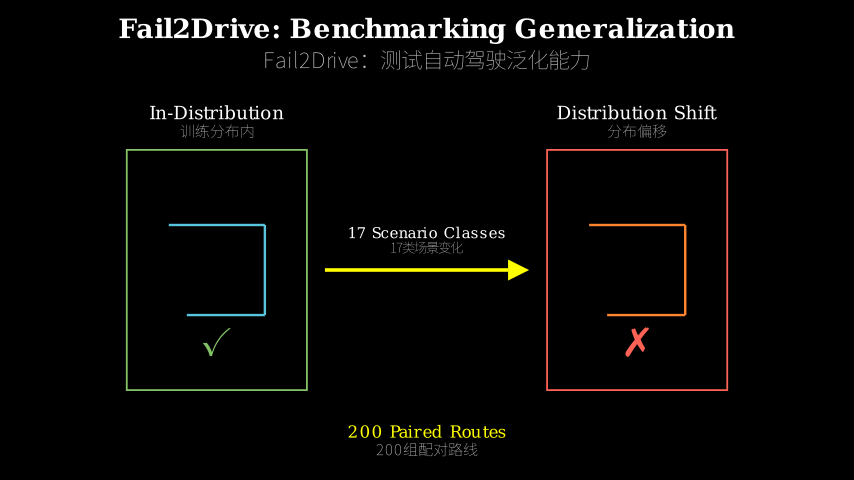
Fail2Drive constructs 200 route pairs in CARLA. Each pair has an in-distribution route (similar to training) and a shifted route (same start/end, different challenge). The shifts span four categories: appearance (weather, lighting), layout (new intersections, road structures), behavioral (aggressive pedestrians, unpredictable vehicles), and robustness (sensor noise, actuator lag).
The pairing is the key structural innovation. By matching routes on everything except the shift variable, the benchmark turns qualitative failure (“the model crashed”) into quantitative diagnosis (“the model’s success rate drops 35% under fog”). Each route also comes with a privileged expert policy that validates solvability—if the expert can’t solve it, the route is discarded.
The toolbox automates scenario creation using CARLA’s scenario runner. Researchers define shift parameters (e.g., “add jaywalking pedestrian at intersection”), and the system generates routes, validates them with the expert, and packages them for evaluation. This makes the benchmark extensible: new shift types can be added without redesigning the entire framework.
Structural metaphor: Think of Fail2Drive as a medical stress test for driving models. The in-distribution route is the baseline EKG—the patient at rest. The shifted route is the treadmill test—same patient, elevated heart rate. The pairing isolates the effect of stress. If the EKG flatlines under load, you know the heart (model) has a specific weakness. The expert policy is the cardiologist who confirms the test is medically valid before you run it. The toolbox is the protocol manual that lets other hospitals (researchers) replicate the test with new stress conditions.
Key Concepts
-
Paired-route isolation: Traditional benchmarks mix many variables (route geometry, traffic density, weather) in each test. When a model fails, you can’t pinpoint why. Fail2Drive pairs each shifted route with an in-distribution twin that differs only in the shift variable. If the model succeeds on Route A (sunny, normal traffic) but fails on Route A’ (foggy, same traffic), the failure is attributable to fog. This turns debugging from guesswork into differential diagnosis. Imagine testing a bridge: you don’t just load it until it breaks; you load it incrementally and measure deflection at each step to find the weak joint.
-
Privileged expert policy: A common benchmark pitfall is including unsolvable scenarios. If a route requires clairvoyance (e.g., predicting a hidden pedestrian), models fail for the wrong reason. Fail2Drive uses a privileged expert with access to ground-truth future states. If the expert can’t solve a route, it’s removed. This ensures failures reflect model limitations, not task impossibility. Think of it as a control group in drug trials: the expert is the healthy patient who proves the treatment (route) is survivable before testing it on the sick (models).
-
Closed-loop generalization: Open-loop evaluation (predict next action given a recorded trajectory) is cheap but misleading—models never face their own mistakes. Closed-loop evaluation runs the model in the simulator, where errors compound. A small steering mistake at t=0 puts the car in the wrong lane at t=5, triggering a cascade. Fail2Drive measures closed-loop performance under distribution shift, the hardest test. It’s the difference between a pilot practicing in a flight simulator (closed-loop, mistakes matter) versus watching cockpit videos (open-loop, no consequences).
Framework Shift
Before (mainstream approach):        After (this paper):

Train scenarios                      Train scenarios
    |                                    |
    v                                    v
Test on same scenarios               Test on paired routes:
    |                                    |
    v                                    +---> In-distribution route
High success rate                        |         |
    |                                    |         v
    v                                    |     Success rate A
"Model works!"                           |
(memorization + generalization)          +---> Shifted route
                                              |         |
                                              |         v
                                              |     Success rate B
                                              |
                                              v
                                          Delta = A - B
                                              |
                                              v
                                      Isolated shift effect
One sentence: From opaque aggregate scores to paired differential measurements, the core shift is making generalization failure observable and attributable.
Expert Assessment
Problem choice: This is a real gap. The field has been celebrating 90%+ success rates on benchmarks that recycle training data. Fail2Drive doesn’t invent a new problem—it exposes an existing measurement flaw. The timing is right: as models scale up, the cost of deploying a memorizer (versus a generalizer) grows catastrophic. The problem sits at the intersection of benchmarking rigor and safety-critical deployment, which is exactly where autonomous driving research needs scrutiny.
Method maturity: The paired-route design is elegant and underutilized in robotics benchmarks. The privileged expert is a smart safeguard against unsolvable scenarios. However, the method is more curation than algorithmic innovation—it’s a benchmark, not a model. The 17 scenario classes are hand-designed, which limits coverage. A stronger version would include a generative process for shift discovery (e.g., adversarial scenario synthesis). The toolbox is a nice touch, but the real test is whether the community adopts it.
Experimental integrity: The baselines are fair—they evaluate multiple SOTA models (TransFuser, InterFuser, TCP) under identical conditions. The 22.8% average drop is stark and consistent across models, which strengthens the claim. One concern: the paper doesn’t report variance across route pairs. If a few hard routes dominate the drop, the average is misleading. The privileged expert validation is a strength, but the paper doesn’t discuss expert failure rates (how many routes were discarded?). This omission makes it hard to assess scenario difficulty calibration.
Writing quality: The paper is well-structured, but the results section is dense with tables. A single figure showing per-model degradation across shift types would clarify the narrative. The related work section undersells the novelty—it reads like a literature review, not a positioning statement. Rewriting it to emphasize “why existing benchmarks can’t measure what we measure” would sharpen the contribution. The failure mode analysis (models ignoring LiDAR objects) is buried in the appendix; promoting it to the main text would make the paper more memorable.
Verdict: Weak accept — The benchmark addresses a real gap and the paired-route design is sound, but the contribution is incremental (better measurement, not new methods). The experimental integrity is solid, though variance reporting is missing. The paper will be useful to the community, but it’s not a paradigm shift.
Takeaways
For benchmark designers: The paired-route pattern is generalizable. If you’re evaluating any system under distribution shift (vision models, NLP, robotics), pair each test case with an in-distribution control. This isolates the shift effect and turns qualitative failure into quantitative diagnosis. The privileged expert pattern is also portable—use a ground-truth oracle to validate that your test cases are solvable before blaming the model.
For model developers: The failure modes are instructive. Models ignore LiDAR objects and fail to learn free/occupied space—these are not edge cases, they’re fundamental concept gaps. If your model succeeds on standard benchmarks but fails here, you’re overfitting to scenario structure, not learning driving. The 22.8% drop is a calibration point: if your model doesn’t degrade this much, you’re either more robust or your training data already covers these shifts.
For practitioners: Don’t trust aggregate success rates on benchmarks where test scenarios resemble training. Demand paired evaluations or at least held-out scenario classes. The paper’s toolbox (open-sourced) lets you create custom shift scenarios—use it to stress-test your models before deployment. The lesson generalizes: memorization looks like generalization until you measure them separately.
论文: 2604.08535 作者: Simon Gerstenecker, Andreas Geiger, Katrin Renz 分类: cs.RO, cs.CV
缺口
现有的 CARLA 闭环驾驶基准在测试时重用训练场景。
这造成了一个根本性的测量问题:当模型成功时,我们无法判断它是学会了驾驶还是只是记住了测试路线。
先前工作(CARLA Leaderboard、NoCrash 等)报告了很高的成功率,但这些数字混淆了泛化能力和记忆能力。
该领域缺乏一种方法来隔离和量化模型在分布偏移下的退化程度——而这些偏移正是真实世界部署中最重要的。
问题:测试场景 = 训练场景
    |
    v
假设:成功率测量的是记忆 + 泛化(混淆)
    |
    v
方法:配对路线(偏移 vs 分布内)
    |
    v
证据:偏移路线上平均成功率下降 22.8%
    |
    v
结论:SOTA 模型在记忆,而非泛化
增量
一句话: 这篇论文之前,我们有掩盖记忆能力的高基准分数;之后,我们有了一个诊断工具,能逐条路线地隔离泛化失败并量化它。
核心机制
Fail2Drive 在 CARLA 中构建了 200 对路线。
每对路线包含一条分布内路线(类似训练数据)和一条偏移路线(相同起点/终点,不同挑战)。
偏移涵盖四类:外观(天气、光照)、布局(新交叉口、道路结构)、行为(激进行人、不可预测车辆)和鲁棒性(传感器噪声、执行器延迟)。
配对是关键的结构创新。
通过在除偏移变量外的所有方面匹配路线,基准将定性失败(“模型撞车了”)转化为定量诊断(“模型在雾天成功率下降 35%”)。
每条路线还配有一个特权专家策略来验证可解性——如果专家无法解决,该路线就被丢弃。
工具箱使用 CARLA 的场景运行器自动化场景创建。
研究者定义偏移参数(例如”在交叉口添加乱穿马路的行人”),系统生成路线,用专家验证它们,并打包供评估使用。
这使基准具有可扩展性:可以添加新的偏移类型而无需重新设计整个框架。
核喻:把 Fail2Drive 想象成驾驶模型的医学压力测试。
分布内路线是基线心电图——病人静息状态。
偏移路线是跑步机测试——同一个病人,心率升高。
配对隔离了压力的效果。
如果心电图在负荷下变平,你就知道心脏(模型)有特定的弱点。
专家策略是心脏病专家,在你运行测试前确认测试在医学上是有效的。
工具箱是协议手册,让其他医院(研究者)能用新的压力条件复制测试。
关键概念
- 配对路线隔离:传统基准在每个测试中混合许多变量(路线几何、交通密度、天气)。
当模型失败时,你无法精确定位原因。
Fail2Drive 将每条偏移路线与一条仅在偏移变量上不同的分布内孪生路线配对。
如果模型在路线 A(晴天,正常交通)上成功但在路线 A’(雾天,相同交通)上失败,失败可归因于雾。
这将调试从猜测变成差异诊断。
想象测试一座桥:你不只是加载它直到它断裂;你逐步加载并在每一步测量挠度,以找到薄弱的接头。
- 特权专家策略:基准的一个常见陷阱是包含无法解决的场景。
如果一条路线需要预知能力(例如预测隐藏的行人),模型会因错误的原因失败。
Fail2Drive 使用一个可访问真实未来状态的特权专家。
如果专家无法解决一条路线,它就被移除。
这确保失败反映模型局限性,而非任务不可能性。
把它想象成药物试验中的对照组:专家是健康的病人,在对病人(模型)测试之前证明治疗(路线)是可存活的。
- 闭环泛化:开环评估(给定记录的轨迹预测下一个动作)便宜但误导——模型永远不会面对自己的错误。
闭环评估在模拟器中运行模型,错误会复合。
t=0 时的小转向错误会让汽车在 t=5 时进入错误的车道,触发级联反应。
Fail2Drive 测量分布偏移下的闭环性能,这是最难的测试。
这就像飞行员在飞行模拟器中练习(闭环,错误有影响)与观看驾驶舱视频(开环,无后果)之间的区别。
框架转变
之前(主流方法):                之后(本文方法):

训练场景                          训练场景
    |                                 |
    v                                 v
在相同场景上测试                   在配对路线上测试:
    |                                 |
    v                                 +---> 分布内路线
高成功率                              |         |
    |                                 |         v
    v                                 |     成功率 A
"模型有效!"                          |
(记忆 + 泛化)                       +---> 偏移路线
                                           |         |
                                           |         v
                                           |     成功率 B
                                           |
                                           v
                                       Delta = A - B
                                           |
                                           v
                                   隔离的偏移效应
一句话:从不透明的聚合分数到配对差异测量,核心转变是使泛化失败可观察且可归因。
专家评审
选题眼光:这是一个真实的缺口。
该领域一直在庆祝基准上 90%+ 的成功率,而这些基准回收训练数据。
Fail2Drive 没有发明新问题——它暴露了现有的测量缺陷。
时机恰当:随着模型规模扩大,部署一个记忆器(而非泛化器)的成本变得灾难性。
该问题位于基准严谨性和安全关键部署的交叉点,这正是自动驾驶研究需要审查的地方。
方法成熟度:配对路线设计优雅且在机器人基准中未被充分利用。
特权专家是防止无法解决场景的聪明保障。
然而,该方法更多是策展而非算法创新——它是一个基准,而非模型。
17 个场景类别是手工设计的,这限制了覆盖范围。
更强的版本会包含偏移发现的生成过程(例如对抗性场景合成)。
工具箱是一个不错的补充,但真正的考验是社区是否采用它。
实验诚意:基线是公平的——它们在相同条件下评估多个 SOTA 模型(TransFuser、InterFuser、TCP)。
22.8% 的平均下降是显著的,并且在模型间一致,这加强了主张。
一个担忧:论文没有报告路线对之间的方差。
如果少数困难路线主导了下降,平均值就会产生误导。
特权专家验证是一个优势,但论文没有讨论专家失败率(有多少路线被丢弃?)。
这一遗漏使得难以评估场景难度校准。
写作功力:论文结构良好,但结果部分充满表格。
一张显示每个模型在偏移类型上退化的单一图表会澄清叙述。
相关工作部分低估了新颖性——它读起来像文献综述,而非定位声明。
重写它以强调”为什么现有基准无法测量我们测量的东西”会使贡献更清晰。
失败模式分析(模型忽略 LiDAR 对象)被埋在附录中;将其提升到正文会使论文更令人难忘。
判决:弱接收 — 基准解决了一个真实的缺口,配对路线设计是合理的,但贡献是增量的(更好的测量,而非新方法)。
实验诚意是可靠的,尽管缺少方差报告。
论文对社区有用,但不是范式转变。
要点总结
对基准设计者:配对路线模式是可泛化的。
如果你在分布偏移下评估任何系统(视觉模型、NLP、机器人),将每个测试用例与分布内对照配对。
这隔离了偏移效应,并将定性失败转化为定量诊断。
特权专家模式也是可移植的——使用真实值预言机在责怪模型之前验证你的测试用例是可解的。
对模型开发者:失败模式是有启发性的。
模型忽略 LiDAR 对象并且无法学习自由/占用空间——这些不是边缘情况,它们是基本概念缺口。
如果你的模型在标准基准上成功但在这里失败,你过拟合了场景结构,而非学习驾驶。
22.8% 的下降是一个校准点:如果你的模型没有退化这么多,你要么更鲁棒,要么你的训练数据已经覆盖了这些偏移。
对实践者:不要相信测试场景类似训练的基准上的聚合成功率。
要求配对评估或至少保留的场景类别。
论文的工具箱(开源)让你创建自定义偏移场景——在部署前用它对你的模型进行压力测试。
教训是可泛化的:记忆看起来像泛化,直到你分别测量它们。