Paper: 2603.05506 Authors: Weijie Lyu, Ming-Hsuan Yang, Zhixin Shu Categories: cs.CV
The Gap
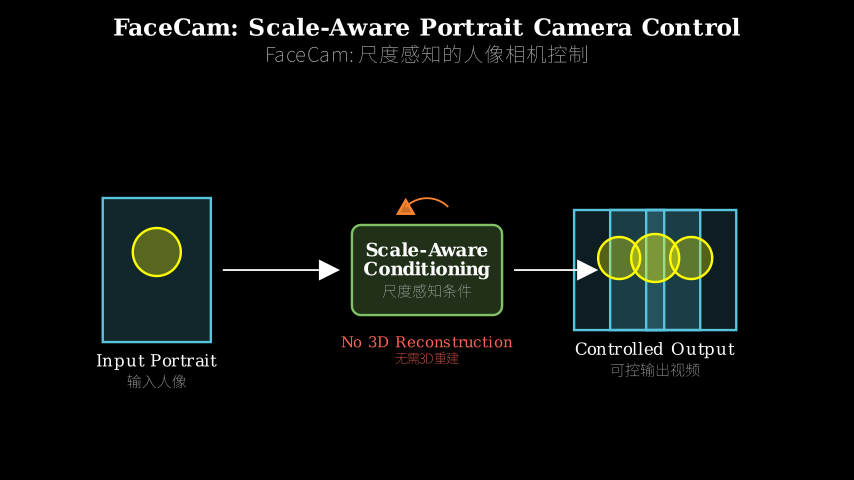
Video generation models like Runway and Pika can now take camera control inputs — you tell them “dolly forward” or “pan left” and they try to comply. But when you apply these to portrait videos, faces warp, stretch, and break. The problem isn’t the generation quality per se; it’s that existing camera representations are scale-ambiguous. A “move forward 2 meters” instruction means nothing without knowing how far away the subject is. Prior work either uses generic 3D camera parameters (which don’t account for face-specific geometry) or reconstructs 3D meshes first (which introduces errors that propagate through generation). Both approaches treat portraits like any other scene, ignoring that faces have predictable structure we can exploit.
Problem: Camera control on portraits creates distortions
   |
   v
Assumption: Face geometry is predictable, unlike generic scenes
   |
   v
Method: Scale-aware conditioning using face landmarks (no 3D reconstruction)
   |
   v
Evidence: Ava-256 + in-the-wild videos show better geometry preservation
   |
   v
Conclusion: Domain-specific representations beat generic 3D priors for faces
The Increment
One sentence: Before FaceCam, controlling camera motion in portrait video generation meant choosing between scale-ambiguous parameters or error-prone 3D reconstruction; after, you get deterministic control using 2D face landmarks that inherently encode scale.
Core Mechanism
FaceCam has three components working in sequence. First, a scale-aware camera encoder takes your desired camera trajectory and converts it into a representation grounded in face geometry — specifically, it uses 2D facial landmarks to define camera motion relative to the face itself, not abstract 3D space. This sidesteps the “how far is 2 meters?” problem entirely because motion is expressed as changes in landmark positions and scales.
Second, a video generation backbone (built on diffusion models) takes your input portrait video and the encoded camera trajectory, then generates new frames. The key is that camera conditioning happens at multiple scales through cross-attention layers, so both coarse motion (head turning) and fine details (eye gaze) respect the camera instruction.
Third, training data comes from two sources: multi-view studio captures (where you have ground truth camera positions) and in-the-wild monocular videos (where you synthesize camera motion or stitch multiple shots). The synthetic motion strategy generates plausible camera trajectories by interpolating between static frames. The multi-shot stitching takes videos with cuts and creates smooth camera transitions between them, effectively teaching the model continuous motion from discontinuous data.
Input Portrait Video
        |
        v
   [Face Landmark]  <--- Desired Camera Trajectory
    Detection              |
        |                  v
        |            [Scale-Aware]
        |             Encoder
        |                  |
        +------------------+
                 |
                 v
          [Video Diffusion]
           Model (U-Net)
                 |
                 v
          Output Video
       (new camera view)
Think of FaceCam like a puppeteer controlling a marionette. Traditional camera control is like shouting directions from the audience — “move left!” — but the puppeteer doesn’t know if you mean stage left or their left, or how far. FaceCam instead attaches strings directly to the puppet’s joints (face landmarks). When you want the camera to move closer, you pull the strings to make the puppet’s face appear larger in frame. The strings (landmark positions) encode both direction and scale simultaneously. The puppeteer (video model) just follows the string tension, no guessing required. The training regime is like practicing with both a professional puppet (studio multi-view data) and a hand-me-down puppet with some strings missing (in-the-wild monocular data), so the puppeteer learns to work with whatever strings are available.
Key Concepts
-
Scale-Aware Conditioning: Imagine you’re directing a cinematographer to frame a portrait shot. If you say “move the camera 1 meter forward,” they’ll ask “from where?” But if you say “frame the face so the eyes are 30% of frame width,” that’s unambiguous. Scale-aware conditioning does the latter — it describes camera position relative to observable face features (landmark distances, face bounding box size) rather than abstract 3D coordinates. A close-up has landmarks spread wide across the frame; a distant shot has them clustered small. The model learns this mapping, so “make landmarks 2x bigger” deterministically means “move camera closer by a specific amount” without ever computing depth.
-
Synthetic Camera Motion: You have a static video of someone talking. How do you teach a model to move the camera around them? Synthetic motion generates plausible trajectories by treating the static video as a keyframe and interpolating camera positions between it and hypothetical other views. It’s like having a photo of a building and imagining what it looks like from 10 degrees to the left — you don’t have that photo, but you can infer constraints (windows stay rectangular, walls stay parallel). For faces, the constraints are stronger: eyes stay symmetric, nose stays centered. The model learns these invariants and generates intermediate frames that respect them.
-
Multi-Shot Stitching: Movie scenes often have cuts — close-up, then wide shot, then over-the-shoulder. Each shot is static, but the sequence implies camera motion. Multi-shot stitching takes these discontinuous clips and trains the model to generate smooth transitions between them. It’s teaching the model to “fill in” the camera movement that would connect shot A to shot B. The clever bit: this turns abundant static footage into training data for continuous camera control, without needing actual moving cameras during capture.
Framework Shift
Before (mainstream approach):        After (this paper):

Input Video                          Input Video
     |                                    |
     v                                    v
[3D Reconstruction]                 [2D Face Landmarks]
  (mesh/depth)                        (direct observation)
     |                                    |
     | (errors propagate)                 | (no reconstruction)
     v                                    v
[Generic Camera Params]             [Scale-Aware Encoding]
  (x,y,z,roll,pitch,yaw)              (landmark deltas + scale)
     |                                    |
     v                                    v
[Video Generation]                  [Video Generation]
  (distortions)                       (geometry preserved)
From “reconstruct 3D then apply generic camera math” to “use 2D face structure as the camera reference frame itself,” the core shift is eliminating the reconstruction bottleneck by making the conditioning domain-specific.
Expert Assessment
Problem choice: This is a real gap, not manufactured. Portrait video generation is commercially valuable (content creation, virtual production), and camera control is the obvious next frontier after basic generation quality. The failure mode — geometric distortions on faces — is highly visible and breaks immersion. The problem sits at the intersection of video generation (hot) and 3D-aware synthesis (established), making it timely.
Method maturity: The scale-aware representation is genuinely clever — it’s not obvious that 2D landmarks contain enough information to replace 3D camera parameters, but faces are constrained enough that it works. However, the training data strategies (synthetic motion, multi-shot stitching) feel like workarounds for not having real moving-camera portrait datasets. They’re practical, but I’d want to see ablations showing how much performance degrades compared to true multi-view training data.
Experimental integrity: Baselines are reasonable (CameraCtrl, MotionCtrl), though I’d like to see comparisons against 3D-aware methods like EG3D adapted for video. The Ava-256 dataset is standard, and in-the-wild results are convincing. One red flag: no user study quantifying “geometric distortion” — the paper relies on visual inspection and identity preservation metrics, which are proxies. Distortion is subjective; you need human raters.
Writing quality: The abstract and intro are crisp, but the method section buries the key insight (why landmarks encode scale) under implementation details. Figure 2 should come earlier. The related work section is thorough but reads like a literature review, not a positioning statement. Rewriting it to emphasize “why existing camera representations fail for faces” would sharpen the narrative.
Verdict: weak accept — solves a real problem with a clever domain-specific insight, but the evaluation could be more rigorous and the writing could better highlight the core contribution.
Takeaways
The big transferable idea: when your domain has strong structural priors (faces, hands, rigid objects), don’t force it through generic 3D representations. Design conditioning signals that exploit domain structure directly. For faces, 2D landmarks work because facial geometry is constrained. For hands, bone lengths are fixed. For cars, wheels stay circular. The pattern is: find the invariants, encode them in your conditioning, skip the reconstruction step.
Concretely, practitioners working on controllable generation for specific object categories should ask: “What 2D observations uniquely determine 3D configuration in my domain?” For faces, it’s landmark positions and scales. For your domain, it might be silhouette curvature, part symmetries, or texture gradients. Build your conditioning around those, not generic camera matrices.
The training data strategies are also worth stealing. If you have static multi-view captures, synthetic motion generation lets you create continuous trajectories. If you have monocular videos with cuts, multi-shot stitching turns them into motion training data. Both are ways to bootstrap dynamic control from static or discontinuous data.
论文: 2603.05506 作者: Weijie Lyu, Ming-Hsuan Yang, Zhixin Shu 分类: cs.CV
缺口
像Runway和Pika这样的视频生成模型现在能接受镜头控制指令了——你告诉它”推轨前进”或”左摇”,它会尝试照做。
但把这些用在人像视频上时,脸会扭曲、拉伸、变形。
问题不在生成质量本身,而在于现有的镜头表示方法有尺度歧义。
一个”向前移动2米”的指令如果不知道拍摄对象有多远就毫无意义。
之前的工作要么用通用的3D镜头参数(不考虑人脸特有的几何结构),要么先重建3D网格(引入的误差会传播到生成过程)。
两种方法都把人像当成普通场景处理,忽略了人脸有可预测的结构可以利用。
问题: 人像视频的镜头控制产生变形
   |
   v
假设: 人脸几何可预测,不像通用场景
   |
   v
方法: 用人脸关键点做尺度感知条件(无需3D重建)
   |
   v
证据: Ava-256和野外视频显示更好的几何保持
   |
   v
结论: 针对人脸的专用表示胜过通用3D先验
增量
一句话: FaceCam之前,控制人像视频生成的镜头运动意味着在尺度模糊的参数和易错的3D重建之间二选一; 之后,你用本身就编码了尺度的2D人脸关键点获得确定性控制。
核心机制
FaceCam有三个依次工作的组件。
首先,尺度感知镜头编码器接收你想要的镜头轨迹,把它转换成基于人脸几何的表示——具体来说,它用2D面部关键点来定义相对于人脸本身的镜头运动,而非抽象的3D空间。
这完全绕过了”2米是多远?”的问题,因为运动被表达为关键点位置和尺度的变化。
其次,视频生成主干(基于扩散模型)接收你的输入人像视频和编码后的镜头轨迹,然后生成新帧。
关键在于镜头条件通过交叉注意力层在多个尺度上起作用,所以粗略运动(头部转动)和精细细节(眼神)都遵从镜头指令。
第三,训练数据来自两个源:多视角棚拍(有真实镜头位置)和野外单目视频(合成镜头运动或拼接多个镜头)。
合成运动策略通过在静态帧之间插值生成合理的镜头轨迹。
多镜头拼接把有剪辑的视频变成它们之间的平滑镜头过渡,实际上是从不连续数据教模型学连续运动。
输入人像视频
        |
        v
   [人脸关键点]  <--- 期望的镜头轨迹
      检测              |
        |               v
        |          [尺度感知]
        |            编码器
        |               |
        +---------------+
                |
                v
         [视频扩散]
          模型(U-Net)
                |
                v
          输出视频
        (新镜头视角)
把FaceCam想象成控制提线木偶的人。
传统镜头控制像从观众席喊指令——“往左移!”——但操纵者不知道你说的是舞台左还是他们的左,也不知道移多远。
FaceCam则是把线直接系在木偶的关节上(人脸关键点)。
当你想让镜头靠近,你拉线让木偶的脸在画面里显得更大。
线(关键点位置)同时编码了方向和尺度。
操纵者(视频模型)只需跟着线的张力走,无需猜测。
训练机制就像既用专业木偶(棚拍多视角数据)又用缺了几根线的旧木偶(野外单目数据)练习,所以操纵者学会用任何可用的线工作。
关键概念
- 尺度感知条件: 想象你在指导摄影师拍人像。
如果你说”把镜头向前移1米”,他们会问”从哪儿开始?”但如果你说”把脸框成眼睛占画面宽度30%“,这就没有歧义。
尺度感知条件做的是后者——它用可观察的人脸特征(关键点距离、人脸框大小)而非抽象3D坐标来描述镜头位置。
特写时关键点在画面里铺得很开; 远景时它们聚成一小团。
模型学会这个映射,所以”让关键点变大2倍”确定性地意味着”把镜头拉近特定距离”,完全不用计算深度。
- 合成镜头运动: 你有一段某人说话的静态视频。
怎么教模型围着他们移动镜头?合成运动把静态视频当关键帧,在它和假想的其他视角之间插值镜头位置,生成合理的轨迹。
就像你有一张建筑的照片,想象它从左边10度看是什么样——你没有那张照片,但能推断约束(窗户保持矩形,墙保持平行)。
对人脸,约束更强:眼睛保持对称,鼻子保持居中。
模型学会这些不变量,生成尊重它们的中间帧。
- 多镜头拼接: 电影场景常有剪辑——特写,然后全景,然后过肩镜头。
每个镜头是静态的,但序列暗示了镜头运动。
多镜头拼接把这些不连续片段拿来,训练模型生成它们之间的平滑过渡。
这是在教模型”填充”连接镜头A到镜头B的镜头运动。
巧妙之处:这把大量静态素材变成连续镜头控制的训练数据,拍摄时不需要真的移动镜头。
框架转变
之前(主流方法):                  之后(本文方法):

输入视频                          输入视频
     |                                |
     v                                v
[3D重建]                         [2D人脸关键点]
(网格/深度)                       (直接观察)
     |                                |
     | (误差传播)                      | (无需重建)
     v                                v
[通用镜头参数]                    [尺度感知编码]
(x,y,z,横滚,俯仰,偏航)            (关键点增量+尺度)
     |                                |
     v                                v
[视频生成]                        [视频生成]
  (变形)                           (几何保持)
从”重建3D然后应用通用镜头数学”到”用2D人脸结构本身作为镜头参考系”,核心转变是通过让条件针对特定领域来消除重建瓶颈。
专家评审
选题眼光: 这是真缺口,不是人造的。
人像视频生成有商业价值(内容创作、虚拟制片),镜头控制是基础生成质量之后的明显下一步。
失效模式——人脸几何变形——非常显眼,破坏沉浸感。
问题处在视频生成(热门)和3D感知合成(成熟)的交叉点,时机恰当。
方法成熟度: 尺度感知表示确实巧妙——2D关键点包含足够信息来替代3D镜头参数并不显而易见,但人脸约束足够强使它可行。
不过,训练数据策略(合成运动、多镜头拼接)感觉像是没有真实移动镜头人像数据集的变通办法。
它们实用,但我想看消融实验显示相比真实多视角训练数据性能下降多少。
实验诚意: 基线合理(CameraCtrl、MotionCtrl),虽然我想看与适配视频的3D感知方法如EG3D的比较。
Ava-256数据集是标准的,野外结果有说服力。
一个警示:没有用户研究量化”几何变形”——论文依赖视觉检查和身份保持指标,这些是代理指标。
变形是主观的; 需要人类评分者。
写作功力: 摘要和引言简洁,但方法部分把关键洞见(为什么关键点编码尺度)埋在实现细节下。
图2应该更早出现。
相关工作部分详尽但读起来像文献综述,不是定位陈述。
重写成强调”为什么现有镜头表示对人脸失效”会让叙事更锐利。
判决: 弱接收——用巧妙的领域专用洞见解决真实问题,但评估可以更严格,写作可以更好地突出核心贡献。
要点总结
可迁移的大想法:当你的领域有强结构先验(人脸、手、刚体),不要强行通过通用3D表示。
设计直接利用领域结构的条件信号。
对人脸,2D关键点有效因为面部几何受约束。
对手,骨长固定。
对车,轮子保持圆形。
模式是:找到不变量,在条件中编码它们,跳过重建步骤。
具体来说,做特定物体类别可控生成的实践者应该问:“在我的领域,什么2D观察唯一确定3D配置?”对人脸,是关键点位置和尺度。
对你的领域,可能是轮廓曲率、部件对称性或纹理梯度。
围绕那些而非通用镜头矩阵构建你的条件。
训练数据策略也值得借鉴。
如果你有静态多视角捕捉,合成运动生成让你创建连续轨迹。
如果你有带剪辑的单目视频,多镜头拼接把它们变成运动训练数据。
两者都是从静态或不连续数据引导动态控制的方法。