Paper: 2605.15171 Authors: Chenyu Lian, Hong-Yu Zhou, Jing Qin Categories: cs.CV, cs.AI, cs.LG
The Gap
Current medical image screening models operate in isolation—they analyze each case independently without referencing historical knowledge. This creates two problems: (1) predictions lack interpretability because there’s no transparent reasoning path showing why a decision was made, and (2) performance suffers because the model can’t leverage patterns from similar past cases. Existing approaches either use post-hoc saliency maps (which don’t explain the decision process) or fail to incorporate historical evidence systematically.
Problem: Isolated screening          Assumption: Historical cases
         + poor interpretability  ->  contain reusable evidence
                                                |
                                                v
Method: Dual knowledge banks         Evidence: Higher specificity
        + retrieval + reasoning  ->  at clinical recall levels
                                                |
                                                v
                                      Conclusion: Evidence-based
                                      reasoning improves screening
The Increment
One sentence: Before this paper, disease screening models made isolated predictions with opaque reasoning; after, they retrieve region-level evidence from historical cases and show transparent reasoning paths.
Core Mechanism
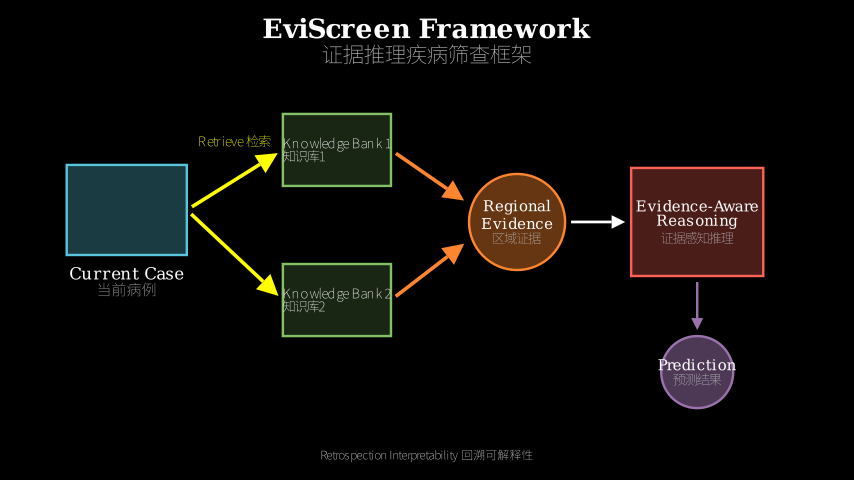
EviScreen consists of three components working in sequence. First, dual knowledge banks store historical cases—one bank holds image features, the other holds abnormality maps. When a new case arrives, the system performs contrastive retrieval: it compares the current case’s regional features against the banks to find similar historical regions, pulling both the visual features and the corresponding abnormality maps.
Second, the retrieved evidence flows into an evidence-aware reasoning module. This module doesn’t just look at the current case in isolation—it cross-references the current case’s features with the retrieved historical evidence. The reasoning happens at the region level: for each area of the current image, the module asks “what do similar regions in past cases tell us?” and weighs that evidence alongside the current observations.
Third, the abnormality maps from retrieval serve dual purposes. They provide localization interpretability (showing where abnormalities are) and guide the reasoning process. Unlike post-hoc saliency maps generated after prediction, these maps emerge naturally from the contrastive retrieval process—they’re part of the evidence itself, not an explanation tacked on afterward.
Current Case                Historical Knowledge Banks
    |                              |
    |                    +---------+---------+
    v                    |                   |
[Feature                 |  [Image Bank]    [Abnormality Bank]
Extraction]              |   (features)      (location maps)
    |                    |                   |
    +--------------------+-------------------+
                         |
                         v
                [Contrastive Retrieval]
                  (find similar regions)
                         |
            +------------+------------+
            |                         |
            v                         v
    [Retrieved Features]      [Retrieved Maps]
            |                         |
            +------------+------------+
                         |
                         v
              [Evidence-Aware Reasoning]
               (current + historical)
                         |
                         v
                  [Prediction + Maps]
Think of EviScreen as a medical resident consulting with senior doctors. When the resident sees a new X-ray, they don’t just stare at it alone—they pull up similar cases from the hospital archive. For each suspicious region, they find past cases with similar-looking areas and check: “What was the diagnosis there? Where exactly was the abnormality?” The resident then makes their diagnosis by weighing what they see now against what those historical cases revealed. The archive isn’t just a reference library—it’s structured evidence that directly shapes the reasoning. The abnormality maps are like annotations from previous radiologists, showing exactly where to look, and these annotations become part of the diagnostic reasoning rather than just post-hoc explanations.
Key Concepts
-
Contrastive Retrieval: Instead of retrieving entire similar cases, the system retrieves at the region level using contrastive learning. Imagine you’re diagnosing a lung X-ray with a suspicious spot in the upper right. Traditional retrieval would find “similar chest X-rays overall.” Contrastive retrieval zooms in: it finds historical cases where the upper-right region looked similar, even if the rest of the image was different. The “contrastive” part means the system learned to pull features closer for similar regions and push them apart for dissimilar ones. This gives you targeted evidence: “In 15 past cases with upper-right regions like this, 12 were malignant nodules.” That’s far more useful than “here are some vaguely similar chest X-rays.”
-
Dual Knowledge Banks: The system maintains two parallel archives—one storing visual features, one storing abnormality maps. Why two? Because you need different types of evidence. The feature bank answers “what does this region look like?” while the abnormality bank answers “where were problems found in similar cases?” When you retrieve from both simultaneously, you get complete evidence: not just “this looks like case #47” but also “in case #47, the abnormality was in this exact location.” It’s like having both the X-ray images and the radiologist’s annotations in your archive—you need both to reason effectively.
-
Retrospection Interpretability: This is interpretability through evidence rather than through post-hoc explanation. Most models generate saliency maps after making a prediction—they’re reverse-engineering an explanation. EviScreen’s interpretability is forward: the retrieved historical cases and their abnormality maps are the evidence used during reasoning, not explanations generated afterward. When the model says “abnormality detected,” it can point to specific historical cases and say “because these similar regions in past cases were abnormal.” The reasoning path is transparent because the evidence is explicit, not because we’re trying to visualize what a black box learned.
Framework Shift
Before (mainstream approach):        After (this paper):

  New Case                             New Case
     |                                    |
     v                                    v
[CNN Feature                         [Feature
 Extraction]                          Extraction]
     |                                    |
     v                                    +---> [Contrastive
[Classification                                 Retrieval]
 Head]                                           |
     |                                           v
     v                                    [Historical
[Prediction]                              Evidence]
     |                                           |
     v                                           v
[Post-hoc                                [Evidence-Aware
 Saliency Map]                            Reasoning]
                                                 |
Isolated reasoning,                              v
explanation after fact                    [Prediction +
                                           Evidence Maps]

                                          Evidence-based reasoning,
                                          transparent from start
From isolated prediction to evidence-based reasoning, the core shift is making historical knowledge an explicit part of the decision process rather than an implicit pattern buried in weights.
Expert Assessment
Problem choice: Real gap. Medical screening genuinely suffers from lack of interpretability and inability to reference past cases systematically. This isn’t manufactured—radiologists actually do consult historical cases, and current models don’t capture that workflow. The problem sits at the intersection of interpretability and performance, which is where the field needs to move.
Method maturity: Solid engineering with one clever insight—using contrastive retrieval to get abnormality maps as a byproduct rather than training a separate localization module. The dual knowledge bank structure is straightforward but effective. However, the paper doesn’t deeply explore failure modes: what happens when retrieved evidence is misleading? How does the system handle distribution shift between historical and current cases? These are solvable but not addressed.
Experimental integrity: Benchmarks are carefully constructed for real-world screening scenarios, emphasizing specificity at clinical recall levels (which matters more than raw accuracy). Baselines include recent interpretable methods, not just vanilla CNNs. One concern: the paper doesn’t show what happens when the knowledge banks are small or when no good matches exist. Performance likely degrades gracefully, but we don’t see that analysis.
Writing quality: The abstract and introduction are clear. The method section gets dense—Figure 2 (presumably the architecture diagram) carries too much load without enough textual walkthrough. The ablation studies are thorough but buried. If the authors rewrote Section 3.2 to lead with intuition before diving into technical details, the paper would be significantly more accessible.
Verdict: weak accept — Solid contribution with real clinical relevance, but the novelty is more in the integration than in individual components. The evidence-based reasoning framework is valuable, though not groundbreaking. Experimental validation is strong within its scope but could be more comprehensive.
Takeaways
Retrieval as reasoning, not just augmentation: Most retrieval-augmented systems treat retrieved content as context to condition on. EviScreen makes retrieval part of the reasoning mechanism itself—the retrieved abnormality maps directly shape the prediction. This pattern transfers: in any domain where decisions should reference historical precedents (legal case analysis, financial fraud detection), make the retrieval evidence explicit in the reasoning path rather than just feeding it as additional input.
Dual-bank architecture for multi-modal evidence: Storing features and annotations separately, then retrieving from both, is a clean pattern for any task where you need both “what does this look like?” and “what was the outcome?” evidence. In code review, you’d store code embeddings in one bank and bug reports in another. In customer support, query embeddings in one bank and resolution notes in another.
Contrastive retrieval for localization: Using contrastive learning to retrieve region-level matches, then deriving localization maps from the retrieval process itself, is cheaper than training separate localization modules. This works when your task naturally involves comparing parts of inputs (medical images, documents, time series). The localization emerges from similarity rather than being explicitly supervised.
论文: 2605.15171 作者: Chenyu Lian, Hong-Yu Zhou, Jing Qin 分类: cs.CV, cs.AI, cs.LG
缺口
当前的医学影像筛查模型是孤立运作的——它们独立分析每个病例,不参考历史知识。
这造成两个问题:(1)预测缺乏可解释性,因为没有透明的推理路径展示决策依据;(2)性能受限,因为模型无法利用相似历史病例中的模式。
现有方法要么使用事后显著图(无法解释决策过程),要么未能系统性地整合历史证据。
问题:孤立筛查              假设:历史病例
     + 可解释性差  ->       包含可复用证据
                                  |
                                  v
方法:双知识库              证据:临床召回率下
     + 检索 + 推理  ->      特异性更高
                                  |
                                  v
                            结论:基于证据的
                            推理改善筛查
增量
一句话: 这篇论文之前,疾病筛查模型做孤立预测且推理不透明;之后,它们从历史病例中检索区域级证据并展示透明推理路径。
核心机制
EviScreen 由三个顺序工作的组件构成。
首先,双知识库存储历史病例——一个库存图像特征,另一个存异常图。
当新病例到来时,系统执行对比检索:将当前病例的区域特征与知识库对比,找到相似的历史区域,同时提取视觉特征和对应的异常图。
其次,检索到的证据流入证据感知推理模块。
该模块不只是孤立地看当前病例——它将当前病例的特征与检索到的历史证据交叉参照。
推理发生在区域层面:对当前图像的每个区域,模块询问”过去相似区域告诉我们什么?“并将该证据与当前观察一起权衡。
第三,检索得到的异常图有双重用途。
它们提供定位可解释性(显示异常位置)并指导推理过程。
与预测后生成的事后显著图不同,这些图自然地从对比检索过程中涌现——它们是证据本身的一部分,而非事后添加的解释。
当前病例                历史知识库
    |                        |
    |              +---------+---------+
    v              |                   |
[特征提取]         |  [图像库]        [异常库]
    |              |  (特征)          (位置图)
    |              |                   |
    +--------------+-------------------+
                   |
                   v
            [对比检索]
            (找相似区域)
                   |
        +----------+----------+
        |                     |
        v                     v
  [检索特征]            [检索图谱]
        |                     |
        +----------+----------+
                   |
                   v
          [证据感知推理]
          (当前 + 历史)
                   |
                   v
            [预测 + 图谱]
把 EviScreen 想象成一个向资深医生请教的住院医。
当住院医看到新的 X 光片时,他们不会只是孤立地盯着它——他们会从医院档案中调出相似病例。
对每个可疑区域,他们找到有相似外观区域的过往病例并检查:“那里的诊断是什么?异常的确切位置在哪?“住院医随后通过权衡当前所见与历史病例揭示的信息来做出诊断。
档案不只是参考资料库——它是直接塑造推理的结构化证据。
异常图就像之前放射科医生的标注,精确显示该看哪里,这些标注成为诊断推理的一部分,而非事后解释。
关键概念
- 对比检索: 系统不是检索整个相似病例,而是使用对比学习在区域层面检索。
想象你在诊断一张右上方有可疑斑点的肺部 X 光片。
传统检索会找”整体相似的胸部 X 光片”。
对比检索则放大:它找到右上区域看起来相似的历史病例,即使图像其余部分不同。
“对比”部分意味着系统学会了将相似区域的特征拉近,将不相似的推远。
这给你有针对性的证据:“在 15 个右上区域像这样的过往病例中,12 个是恶性结节。
“这比”这里有些模糊相似的胸部 X 光片”有用得多。
- 双知识库: 系统维护两个并行档案——一个存视觉特征,一个存异常图。
为什么要两个?因为你需要不同类型的证据。
特征库回答”这个区域看起来像什么?“而异常库回答”在相似病例中哪里发现了问题?“当你同时从两者检索时,你得到完整证据:不只是”这看起来像病例 #47”,还有”在病例 #47 中,异常在这个确切位置”。
这就像在档案中同时拥有 X 光图像和放射科医生的标注——你需要两者才能有效推理。
- 回溯可解释性: 这是通过证据而非事后解释实现的可解释性。
大多数模型在做出预测后生成显著图——它们在逆向工程一个解释。
EviScreen 的可解释性是正向的:检索到的历史病例及其异常图是推理期间使用的证据,而非事后生成的解释。
当模型说”检测到异常”时,它能指向具体的历史病例并说”因为过去这些相似区域是异常的”。
推理路径是透明的,因为证据是显式的,而非因为我们试图可视化黑盒学到了什么。
框架转变
之前(主流方法):              之后(本文方法):

  新病例                          新病例
     |                               |
     v                               v
[CNN 特征                        [特征提取]
 提取]                               |
     |                               +---> [对比检索]
     v                                        |
[分类头]                                      v
     |                                 [历史证据]
     v                                        |
[预测]                                        v
     |                                 [证据感知
     v                                  推理]
[事后显著图]                                  |
                                              v
                                       [预测 +
孤立推理,                              证据图]
事后解释
                                       基于证据推理,
                                       从始透明
从孤立预测到基于证据的推理,核心转变是让历史知识成为决策过程的显式部分,而非隐藏在权重中的隐式模式。
专家评审
选题眼光: 真实缺口。
医学筛查确实受困于缺乏可解释性和无法系统性参考过往病例。
这不是人造的——放射科医生实际上会查阅历史病例,而当前模型没有捕捉这种工作流程。
问题位于可解释性和性能的交叉点,这正是该领域需要前进的方向。
方法成熟度: 扎实的工程加一个巧妙洞见——使用对比检索将异常图作为副产品获得,而非训练单独的定位模块。
双知识库结构简单但有效。
然而,论文没有深入探讨失败模式:当检索到的证据误导时会怎样?系统如何处理历史和当前病例之间的分布偏移?这些可解决但未被讨论。
实验诚意: 基准针对真实世界筛查场景精心构建,强调临床召回率下的特异性(比原始准确率更重要)。
基线包括近期可解释方法,不只是普通 CNN。
一个担忧:论文没有展示知识库较小或无良好匹配时会发生什么。
性能可能平稳下降,但我们没看到这种分析。
写作功力: 摘要和引言清晰。
方法部分变得密集——图 2(推测是架构图)承载了太多负担而没有足够的文字引导。
消融研究很彻底但被埋没了。
如果作者重写 3.2 节,先给直觉再深入技术细节,论文会更易理解。
判决: 弱接收 — 有真实临床相关性的扎实贡献,但新颖性更多在整合而非单个组件。
基于证据的推理框架有价值,虽非突破性。
实验验证在其范围内很强,但可以更全面。
要点总结
检索作为推理,而非仅增强: 大多数检索增强系统将检索内容视为条件化的上下文。
EviScreen 让检索成为推理机制本身的一部分——检索到的异常图直接塑造预测。
这种模式可迁移:在任何决策应参考历史先例的领域(法律案例分析、金融欺诈检测),让检索证据在推理路径中显式化,而非只是作为额外输入喂入。
多模态证据的双库架构: 分别存储特征和标注,然后从两者检索,是任何需要”这看起来像什么?“和”结果是什么?“证据的任务的简洁模式。
在代码审查中,你会在一个库存代码嵌入,在另一个存 bug 报告。
在客户支持中,一个库存查询嵌入,另一个存解决方案笔记。
用于定位的对比检索: 使用对比学习检索区域级匹配,然后从检索过程本身导出定位图,比训练单独的定位模块更便宜。
这在任务自然涉及比较输入部分时有效(医学图像、文档、时间序列)。
定位从相似性中涌现,而非被显式监督。