
Paper: 2603.24350 Authors: Adidev Jhunjhunwala, Judah Goldfeder, Hod Lipson Categories: cs.RO, cs.AI, cs.LG
Abstract
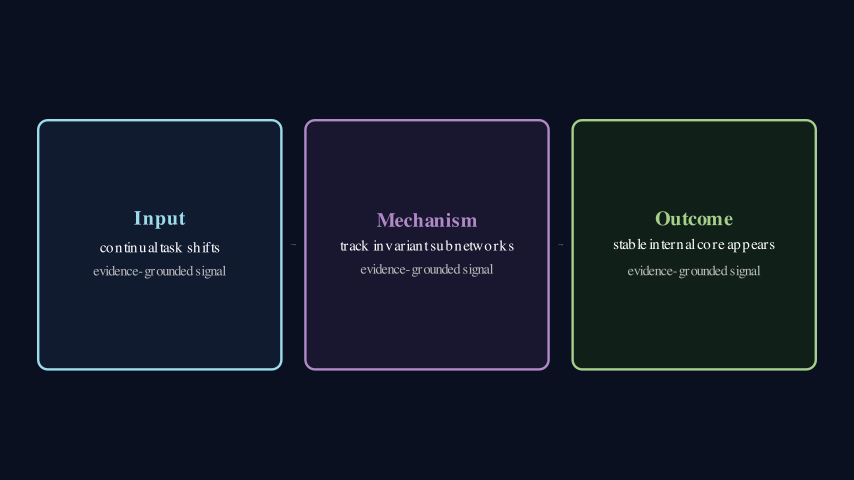
The paper treats the most persistent part of an intelligent system as a candidate for “self.” It compares a robot trained on one steady task with another trained across changing tasks. The continual-learning robot is reported to develop a more stable invariant subnetwork, with a statistically significant difference. The authors propose this as a way to study selfhood in AI systems.
Key Contributions
- Proposes a practical definition of self as the most stable part of cognition over time
- Compares fixed-task training with continual-learning training
- Reports a more invariant internal subnetwork in the continual-learning setting
- Finds a statistically significant difference between the two training regimes
- Frames the method as a way to study self-like structure in other AI systems
Methodology
The paper takes a structural view of selfhood: whatever remains most invariant while the rest of the system adapts may be a useful proxy for self. To test this idea, the authors train one robot on a single stable task and another on a sequence of changing tasks, then compare how much of each system stays the same internally.
That makes the study less about philosophy in the abstract and more about measurable network structure. The continual-learning setup is especially interesting because it forces the system to adapt while preserving useful competence, which should naturally reveal persistent internal components if they exist.
Results
The continual-learning robot develops a more stable invariant subnetwork than the fixed-task baseline. The difference is reported as statistically significant, suggesting this is not just noise from training dynamics.
The result does not prove consciousness or personhood. What it does show is that a system can develop a consistent internal core under continual change, and that this core can be measured. That is a useful empirical handle for future studies.
Takeaways
- Self can be operationalized as the most invariant part of an adaptive system
- Continual learning may reveal persistent internal structure that fixed-task training does not
- The result offers a measurable angle on self-like properties in AI
- The finding is statistical, not philosophical proof of consciousness
- Structural persistence could become a useful diagnostic for adaptive robot learning
论文: 2603.24350 作者: Adidev Jhunjhunwala, Judah Goldfeder, Hod Lipson 分类: cs.RO, cs.AI, cs.LG
摘要
本文将智能系统中最持久的部分视为“自我”的候选。作者比较了在单一稳定任务上训练的机器人与在不断变化任务上训练的机器人。结果显示,持续学习机器人会形成更稳定的不变子网络,且差异具有统计显著性。作者认为这为研究AI系统中的自我性提供了一种路径。
主要贡献
- 将自我定义为认知中随时间最稳定的部分
- 比较固定任务训练与持续学习训练
- 报告持续学习设置下存在更不变的内部子网络
- 发现两种训练机制之间具有统计显著差异
- 将该方法视为研究其他AI系统中自我样结构的途径
方法论
论文采用结构性的自我观:如果系统中有某部分在其余部分不断适应时仍保持最不变,那么这部分可以作为“自我”的一个有用近似。为检验这一观点,作者让一个机器人在单一稳定任务上训练,另一个机器人在一系列变化任务上训练,然后比较它们内部有多少部分保持不变。
这使得研究不再只是抽象哲学,而是可测量的网络结构分析。持续学习设置尤其有趣,因为它迫使系统在适应的同时保留有用能力,如果确实存在持久核心,它就更容易显现出来。
结果
持续学习机器人比固定任务基线表现出更稳定的不变子网络。论文报告该差异具有统计显著性,说明这并非训练动态中的随机噪声。
这个结果并不证明意识或人格。它真正表明的是:一个系统可以在持续变化中形成一致的内部核心,而且这个核心可以被测量。这为后续研究提供了有价值的实证抓手。
要点总结
- 可以将自我操作化为自适应系统中最不变的部分
- 持续学习可能揭示固定任务训练看不到的持久内部结构
- 这一结果为AI中的自我样性质提供了可测量角度
- 该发现是统计意义上的,不是意识的哲学证明
- 结构持久性可能成为自适应机器人学习中的有用诊断指标