
Paper: 2603.08704 Authors: Akshay Gulati, Kanha Singhania, Tushar Banga, Parth Arora, Anshul Verma, Vaibhav Kumar Singh, Agyapal Digra, Jayant Singh Bisht, Danish Sharma, Varun Singla Categories: cs.AI
The Gap
LLMs are being deployed for financial analysis—equity research, investment decisions, portfolio management—but we’re flying blind. Existing benchmarks test general reasoning (MMLU, BBH) or narrow financial knowledge (FinQA focuses on numerical reasoning over tables), but none systematically evaluate whether these models can actually do what analysts do: synthesize multi-source data, maintain consistency across related queries, distinguish facts from hallucinations, and work with current market information. The field has capability without measurement.
Problem: LLMs used in finance without domain-specific evaluation
    |
    v
Assumption: Financial intelligence is multi-dimensional
            (not just accuracy, but recency, consistency, completeness)
    |
    v
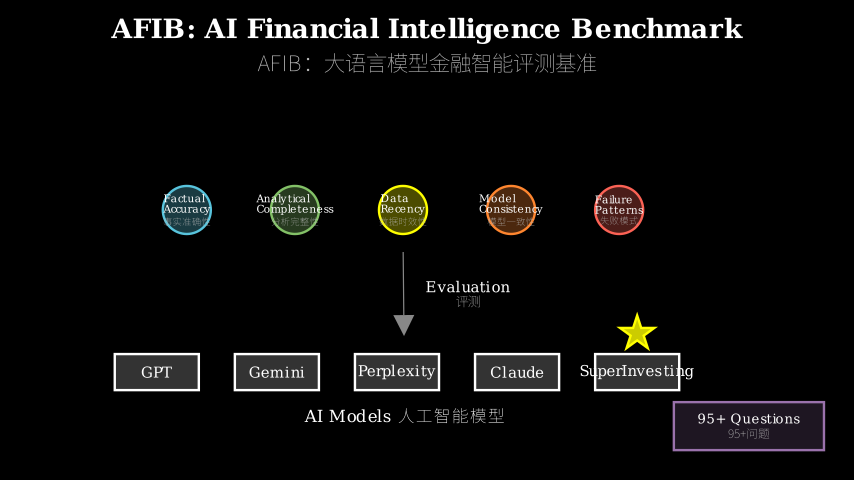
Method: AFIB benchmark with 5 evaluation dimensions
        + 95 structured questions from real equity research
    |
    v
Evidence: SuperInvesting (8.96/10 accuracy, 56.65/70 completeness)
          outperforms GPT, Gemini, Claude, Perplexity
    |
    v
Conclusion: Specialized systems with structured data access
            beat general-purpose LLMs for financial tasks
The Increment
One sentence: Before this paper, we had no systematic way to compare LLMs on real financial analysis workflows; after, we have a multi-dimensional benchmark showing that domain-specialized systems outperform general models.
Core Mechanism
AFIB evaluates five dimensions across 95 questions derived from actual equity research tasks. The dimensions are: (1) factual accuracy—can the model get basic financial facts right? (2) analytical completeness—does it cover all relevant aspects of a question? (3) data recency—is it working with current information? (4) model consistency—does it give the same answer to semantically identical questions? (5) failure patterns—what types of errors does it make?
Each question gets scored by domain experts using rubrics. Factual accuracy uses a 0-10 scale. Completeness breaks down into sub-components (for a company analysis question: business model, financials, competitive position, risks, etc.) with points allocated to each. Recency checks whether data is from the last quarter. Consistency tests involve asking the same question in different phrasings and measuring response similarity.
The benchmark tests five systems: GPT-4, Gemini, Claude, Perplexity, and SuperInvesting (a specialized financial AI). Questions span company analysis, sector comparisons, financial metric calculations, and market trend interpretation—the actual work of equity analysts.
Question Set (95 items)
    |
    +---> Dimension 1: Factual Accuracy (0-10 scale)
    |         |
    |         +---> Expert scoring against ground truth
    |
    +---> Dimension 2: Completeness (0-70 points)
    |         |
    |         +---> Rubric with sub-components
    |
    +---> Dimension 3: Data Recency (binary)
    |         |
    |         +---> Check if data < 1 quarter old
    |
    +---> Dimension 4: Consistency (similarity score)
    |         |
    |         +---> Rephrase question, measure response variance
    |
    +---> Dimension 5: Failure Patterns (categorization)
              |
              +---> Hallucination / Outdated / Incomplete / Refusal
Think of AFIB like a driving test for financial analysts. A written exam (factual accuracy) isn’t enough—you need to test parallel parking (completeness), highway merging (recency), consistency across different road conditions (model consistency), and what happens when things go wrong (failure patterns). A general-purpose LLM is like someone who passed a generic driving test; SuperInvesting is like someone trained specifically for Formula 1 racing. The benchmark reveals that financial analysis isn’t just “answer questions correctly”—it’s a multi-skill performance where specialized training matters.
Key Concepts
-
Analytical Completeness: When an analyst evaluates a company, they don’t just state facts—they build a complete picture. If you ask “Should I invest in Tesla?”, a complete answer covers: business model (how they make money), financial health (margins, cash flow, debt), competitive position (vs BYD, legacy automakers), growth drivers (new models, energy storage), and risks (Musk dependency, regulatory changes). Completeness means hitting all the dimensions a professional would consider. A model scoring 30/70 might nail the financials but miss competitive dynamics entirely—dangerous for actual investment decisions.
-
Hallucination in Financial Context: In finance, hallucination isn’t just making up facts—it’s stating specific numbers, dates, or events that are verifiably false. If a model says “Apple’s Q3 2024 revenue was 85B, that’s a hallucination. If it claims “Tesla announced a $25K model in March 2024” when no such announcement happened, that’s a hallucination. The benchmark tracks these explicitly because in finance, a single wrong number can cascade into catastrophically bad decisions. It’s not about being approximately right—precision matters.
-
Data Recency: Financial markets move fast. A company analysis using 2023 data in mid-2024 is worthless—earnings have been reported, guidance has changed, new products launched. Recency measures whether the model accesses current information. Perplexity scores high here because it searches the live web. Base LLMs with training cutoffs fail. This dimension captures a fundamental limitation: no matter how smart your reasoning, if you’re working with stale data, your conclusions are wrong.
Framework Shift
Before (general LLM evaluation):        After (AFIB):

Single metric (accuracy)                Five dimensions
      |                                       |
      v                                       +---> Accuracy
[Question] --> [Answer] --> [Score]           +---> Completeness
                                              +---> Recency
Generic questions                             +---> Consistency
                                              +---> Failure modes

                                        Domain-specific questions
                                        (real equity research tasks)
From “can it answer correctly?” to “can it do the job?”, the core shift is evaluating capability as a multi-dimensional performance profile rather than a single accuracy number.
Expert Assessment
Problem choice: Real gap. Finance is a high-stakes LLM deployment area, and existing benchmarks genuinely don’t capture what matters. The field needed this. However, the paper has a massive conflict of interest—the authors are affiliated with SuperInvesting, which conveniently wins their benchmark. This doesn’t invalidate the benchmark design, but it raises questions about evaluation rigor.
Method maturity: The five-dimensional framework is solid and well-motivated. But the execution is basic—95 questions is small, expert scoring introduces subjectivity, and there’s no inter-rater reliability reported. The consistency testing (rephrasing questions) is clever but underexplored. A more mature version would have 500+ questions, multiple expert raters with agreement metrics, and deeper analysis of failure modes.
Experimental integrity: Red flag: SuperInvesting wins on every dimension. That’s suspicious. Either it’s genuinely better (possible—specialized systems should outperform general models), or the benchmark is tuned to its strengths. The paper doesn’t provide enough detail on question selection or scoring procedures to judge. Baselines are reasonable (GPT-4, Claude, Gemini are the right comparisons), but I’d want to see the raw data and scoring rubrics to trust these results.
Writing quality: The paper reads like a product announcement disguised as research. The related work section is thin—no serious engagement with financial NLP literature or existing benchmarks. The results section is mostly tables without deep analysis of why systems differ. If they rewrote Section 4 (Results) to include error analysis, case studies of specific failures, and honest discussion of SuperInvesting’s limitations, this would be a much stronger contribution.
Verdict: weak accept — The benchmark design addresses a real need and the multi-dimensional framework is valuable, but the execution is preliminary and the conflict of interest undermines trust in the results.
Takeaways
The five-dimensional evaluation framework is immediately useful for anyone building domain-specific LLM applications. Don’t just measure accuracy—measure completeness (did it cover all relevant aspects?), consistency (does it give the same answer to equivalent questions?), recency (is it using current data?), and failure modes (how does it break?). This framework transfers directly to legal, medical, or technical domains.
The finding that specialized systems outperform general LLMs is important but not surprising—the real insight is quantifying how much specialization matters across different dimensions. Perplexity wins on recency but loses on analytical depth; GPT-4 is consistent but often outdated. This suggests a design principle: for high-stakes domains, you need both current data access and domain-specific reasoning, not just one or the other.
The consistency testing approach (rephrasing questions and measuring response variance) is a simple but powerful technique for evaluating reliability. Steal this for any application where users might ask the same thing in different ways—if your model gives contradictory answers, that’s a trust problem.
论文: 2603.08704 作者: Akshay Gulati, Kanha Singhania, Tushar Banga, Parth Arora, Anshul Verma, Vaibhav Kumar Singh, Agyapal Digra, Jayant Singh Bisht, Danish Sharma, Varun Singla 分类: cs.AI
缺口
大语言模型正被用于金融分析——股票研究、投资决策、投资组合管理——但我们在盲飞。
现有基准测试通用推理能力(MMLU、BBH)或狭窄的金融知识(FinQA 专注于表格数值推理),但没有一个系统性评估这些模型能否真正做分析师的工作:综合多源数据、在相关查询间保持一致性、区分事实与幻觉、使用当前市场信息。
领域有能力但无测量。
问题:大语言模型用于金融但缺乏领域专用评测
    |
    v
假设:金融智能是多维的
      (不只是准确性,还有时效性、一致性、完整性)
    |
    v
方法:AFIB 基准,5个评测维度
      + 95个来自真实股票研究的结构化问题
    |
    v
证据:SuperInvesting (8.96/10准确率, 56.65/70完整度)
      优于 GPT、Gemini、Claude、Perplexity
    |
    v
结论:带结构化数据访问的专用系统
      在金融任务上击败通用大语言模型
增量
一句话: 这篇论文之前,我们没有系统方法比较大语言模型在真实金融分析工作流上的表现;
之后,我们有了多维基准,显示领域专用系统优于通用模型。
核心机制
AFIB 在95个源自真实股票研究任务的问题上评测五个维度。
维度包括:(1) 事实准确性——模型能否答对基本金融事实?
(2) 分析完整性——是否覆盖问题的所有相关方面?
(3) 数据时效性——是否使用当前信息?
(4) 模型一致性——对语义相同的问题是否给出相同答案?
(5) 失败模式——会犯什么类型的错误?
每个问题由领域专家用评分标准打分。
事实准确性用0-10分制。
完整性分解为子组件(对公司分析问题:商业模式、财务状况、竞争地位、风险等),每个分配分数。
时效性检查数据是否来自最近一个季度。
一致性测试包括用不同措辞问同一问题,测量响应相似度。
基准测试五个系统:GPT-4、Gemini、Claude、Perplexity 和 SuperInvesting(专用金融AI)。
问题涵盖公司分析、行业比较、财务指标计算、市场趋势解读——股票分析师的实际工作。
问题集 (95项)
    |
    +---> 维度1: 事实准确性 (0-10分)
    |         |
    |         +---> 专家对照真实情况打分
    |
    +---> 维度2: 完整性 (0-70分)
    |         |
    |         +---> 带子组件的评分标准
    |
    +---> 维度3: 数据时效性 (二元)
    |         |
    |         +---> 检查数据是否 < 1季度
    |
    +---> 维度4: 一致性 (相似度分数)
    |         |
    |         +---> 改写问题,测量响应差异
    |
    +---> 维度5: 失败模式 (分类)
              |
              +---> 幻觉 / 过时 / 不完整 / 拒答
把 AFIB 想象成金融分析师的驾照考试。
笔试(事实准确性)不够——你需要测试侧方停车(完整性)、高速并线(时效性)、不同路况下的一致性(模型一致性)、以及出问题时会怎样(失败模式)。
通用大语言模型像通过普通驾考的人;
SuperInvesting 像专门训练的 F1 赛车手。
基准揭示金融分析不只是”正确回答问题”——它是多技能表现,专业训练很重要。
关键概念
- 分析完整性: 分析师评估公司时,不只陈述事实——要构建完整图景。
如果你问”该投资特斯拉吗?
“,完整答案涵盖:商业模式(如何赚钱)、财务健康(利润率、现金流、债务)、竞争地位(对比比亚迪、传统车企)、增长驱动(新车型、储能)、风险(马斯克依赖、监管变化)。
完整性意味着触及专业人士会考虑的所有维度。
模型得分30/70可能财务数据准确但完全遗漏竞争动态——对实际投资决策很危险。
- 金融语境中的幻觉: 在金融领域,幻觉不只是编造事实——是陈述可验证为假的具体数字、日期或事件。
如果模型说”苹果2024年Q3营收950亿美元”而实际是850亿,这是幻觉。
如果声称”特斯拉2024年3月宣布2.5万美元车型”而无此公告,这是幻觉。
基准明确追踪这些,因为在金融领域,一个错误数字能级联成灾难性决策。
不是大致正确——精确性很重要。
- 数据时效性: 金融市场变化快。
2024年中用2023年数据做公司分析毫无价值——财报已发布、指引已变化、新产品已推出。
时效性测量模型是否访问当前信息。
Perplexity 在此得分高因为它搜索实时网络。
有训练截止日期的基础大语言模型失败。
这个维度捕捉根本局限:无论推理多聪明,如果用过时数据,结论就是错的。
框架转变
之前(通用大语言模型评测):        之后(AFIB):

单一指标(准确率)                  五个维度
      |                                   |
      v                                   +---> 准确性
[问题] --> [答案] --> [分数]              +---> 完整性
                                          +---> 时效性
通用问题                                  +---> 一致性
                                          +---> 失败模式

                                    领域专用问题
                                    (真实股票研究任务)
从”能否答对?
“到”能否胜任工作?
“,核心转变是将能力评估为多维表现画像而非单一准确率数字。
专家评审
选题眼光: 真实缺口。
金融是高风险的大语言模型部署领域,现有基准确实未捕捉关键要素。
领域需要这个。
但论文有巨大利益冲突——作者隶属于 SuperInvesting,而它恰好赢了他们的基准。
这不会使基准设计失效,但引发对评测严谨性的质疑。
方法成熟度: 五维框架扎实且动机充分。
但执行基础——95个问题太少,专家打分引入主观性,未报告评分者间信度。
一致性测试(改写问题)巧妙但探索不足。
更成熟版本应有500+问题、多个专家评分者及一致性指标、更深入的失败模式分析。
实验诚意: 红旗:SuperInvesting 在每个维度都赢。
可疑。
要么它确实更好(可能——专用系统应优于通用模型),要么基准调优到它的优势。
论文未提供足够的问题选择或打分程序细节供判断。
基线合理(GPT-4、Claude、Gemini 是正确对比),但我想看原始数据和评分标准才能信任这些结果。
写作功力: 论文读起来像伪装成研究的产品发布。
相关工作部分单薄——未认真讨论金融自然语言处理文献或现有基准。
结果部分主要是表格,缺乏对系统差异原因的深入分析。
如果重写第4节(结果)加入错误分析、具体失败案例研究、诚实讨论 SuperInvesting 的局限,这会是更强的贡献。
判决: 弱接收 — 基准设计解决真实需求,多维框架有价值,但执行初步,利益冲突削弱对结果的信任。
要点总结
五维评测框架对构建领域专用大语言模型应用的人立即有用。
不只测准确性——测完整性(是否覆盖所有相关方面?
)、一致性(对等价问题是否给相同答案?
)、时效性(是否用当前数据?
)、失败模式(如何崩溃?
)。
此框架直接迁移到法律、医疗或技术领域。
专用系统优于通用大语言模型的发现重要但不意外——真正洞见是量化专业化在不同维度上的重要程度。
Perplexity 在时效性上赢但在分析深度上输;
GPT-4 一致但常过时。
这提示设计原则:对高风险领域,需要当前数据访问和领域专用推理,不只其一。
一致性测试方法(改写问题并测量响应差异)是评估可靠性的简单但强大技术。
为任何用户可能用不同方式问同一件事的应用偷走这个——如果你的模型给出矛盾答案,那是信任问题。