
Paper: 2605.23897 Authors: Beichen Zhang, Yuhong Liu, Jinsong Li, Yuhang Zang, Jiaqi Wang, Dahua Lin Categories: cs.CV, cs.AI, cs.CL
The Gap
Multimodal LLMs struggle with visual reasoning tasks that require fine-grained focus or view transformations—think counting overlapping objects, reading rotated text, or understanding 3D spatial relationships. Pure text chains-of-thought hit a wall because they can’t manipulate what they see. The “think with images” paradigm emerged as a fix: generate intermediate images to simplify the problem. But existing approaches split into two dead ends. Fixed toolkit methods (like VisProg) can only crop, rotate, or filter—they lack the flexibility to handle novel transformations. Unified multimodal methods (like Chameleon) generate images end-to-end but produce noisy, unreliable edits that hurt downstream reasoning.
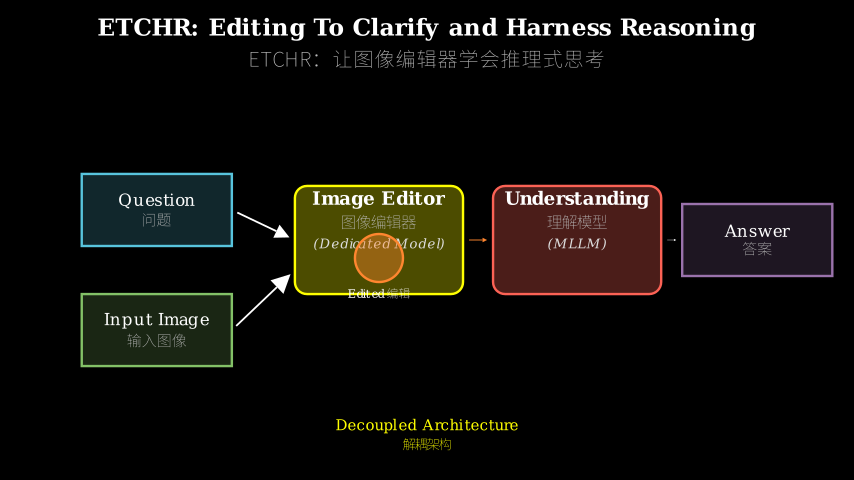
This paper pursues a third path: decouple a dedicated image editor from the understanding model. But off-the-shelf editors fail as reasoning assistants. They exhibit a language-side gap (trained as passive instruction-followers, they can’t map “Which number is larger?” to “zoom in on the y-axis labels”) and a generation-side gap (edit quality degrades as reasoning chains deepen, compounding errors).
Problem: Visual reasoning bottleneck in MLLMs
    |
    v
Observation: Text CoT can't transform views
    |
    +---> Prior fix 1: Fixed toolkits ---> Too rigid
    |
    +---> Prior fix 2: Unified generation ---> Noisy edits
    |
    v
This paper's bet: Decoupled editor + reasoning-aware training
    |
    v
Two-stage training targets two gaps:
    Stage 1 (Reasoning Imitation) ---> Fixes language-side gap
    Stage 2 (Reasoning Enhancement) ---> Fixes generation-side gap
    |
    v
Evidence: +4-5 points across 5 task families, 3 MLLMs
    |
    v
Conclusion: Question-conditioned editing > passive editing
The Increment
One sentence: Before ETCHR, image editors were passive tools that followed instructions; after ETCHR, they became reasoning-aware agents that infer what visual transformation will clarify a question.
Core Mechanism
ETCHR is a question-conditioned image editor built on InstructPix2Pix. It takes three inputs: the original image, the question being asked, and an edit instruction. It outputs an edited image designed to make the question easier to answer. The key innovation is training the editor to understand reasoning context, not just follow generic editing commands.
Training happens in two stages. Stage 1 (Reasoning Imitation) uses supervised fine-tuning on edit trajectories—sequences of edits that progressively simplify reasoning problems. These trajectories come from GPT-4V, which the authors prompt to generate step-by-step visual transformations for complex questions. The editor learns to map abstract questions to concrete visual operations. Stage 2 (Reasoning Enhancement) uses reinforcement learning with two reward signals: edit correctness (does the edit match the intended transformation?) and downstream accuracy (does the edited image help the MLLM answer correctly?). This stage sharpens the editor’s ability to produce edits that actually improve reasoning outcomes.
Input: [Image] + [Question] + [Edit instruction]
    |
    v
+----------------------------------+
| Question-Conditioned Editor      |
| (InstructPix2Pix backbone)       |
|                                  |
| Stage 1: Reasoning Imitation     |
|   Learn from GPT-4V trajectories |
|   Question ---> Edit mapping     |
|                                  |
| Stage 2: Reasoning Enhancement   |
|   RL with dual rewards:          |
|   - Edit correctness             |
|   - Downstream accuracy          |
+----------------------------------+
    |
    v
Output: [Edited image] ---> Downstream MLLM ---> Answer
Think of ETCHR as a sous chef preparing ingredients for a head chef. The head chef (the MLLM) is skilled but works faster with pre-prepped ingredients. A regular sous chef (off-the-shelf editor) follows recipes mechanically: “dice the onions” means dice the onions, regardless of whether you’re making soup or salad. ETCHR is a sous chef who understands the final dish. When the head chef says “I’m making French onion soup,” ETCHR knows to caramelize the onions, not just dice them. Stage 1 training is like apprenticing under a master chef (GPT-4V), learning which prep techniques suit which dishes. Stage 2 is like getting feedback from diners—if the soup tastes better with thinner slices, adjust the technique. The editor learns not just how to cut, but what cut serves the reasoning goal.
Key Concepts
-
Question-conditioned editing: Traditional image editors treat the edit instruction as the sole input—“rotate 90 degrees” or “increase contrast.” Question-conditioned editing adds the reasoning question as context. The editor learns that “rotate 90 degrees” serves different purposes depending on whether the question asks about text readability or spatial orientation. This conditioning allows the editor to infer implicit requirements. For example, given the question “What’s the trend in this chart?” and the instruction “zoom in,” the editor learns to zoom on the data region, not the legend. It’s the difference between a GPS that follows turn-by-turn directions and one that understands your destination and reroutes around traffic.
-
Reasoning trajectory: A sequence of edits that progressively simplifies a complex visual reasoning problem. For instance, answering “Which slice is largest in this pie chart?” might involve: (1) increase contrast to distinguish colors, (2) zoom in on the chart, (3) add grid lines for comparison. Each edit reduces cognitive load for the downstream model. The trajectory is not arbitrary—it follows a logical decomposition of the reasoning task. ETCHR learns these trajectories from GPT-4V demonstrations, then generalizes to new questions. Think of it like a math teacher showing work: you don’t jump straight to the answer, you show intermediate steps that make the solution obvious.
-
Decoupled architecture: The editor and the understanding model are separate components with no shared parameters. This contrasts with unified approaches where a single model generates both edits and answers. Decoupling has two advantages. First, the editor can be trained independently and plugged into any MLLM without retraining the MLLM. Second, it avoids the “jack of all trades, master of none” problem—the editor specializes in visual transformation, the MLLM specializes in reasoning. The cost is an extra inference pass (edit, then understand), but the gain is modularity and quality. It’s like having a dedicated camera operator and a director, rather than one person trying to do both jobs.
Framework Shift
Before (mainstream approach):          After (this paper):

Question ---> MLLM ---> Answer         Question ---> ETCHR Editor
                                              |
  (MLLM struggles with                        v
   fine-grained visual                   Edited Image
   reasoning)                                  |
                                              v
                                          MLLM ---> Answer
         OR
                                       Key difference:
Question ---> Unified Model            - Editor is reasoning-aware
              (generate edit +         - Trained with RL on downstream
               answer together)          accuracy, not just edit quality
              |                        - Decoupled: plug into any MLLM
              v
         Noisy edits hurt
         reasoning
One sentence: From passive instruction-following editors to reasoning-aware editors that infer what transformation clarifies the question, the core shift is treating editing as a reasoning subtask, not a generic image manipulation task.
Expert Assessment
Problem choice: Real gap. The “think with images” paradigm is gaining traction (see Chameleon, ViperGPT), but the execution is messy. Fixed toolkits are too brittle for open-ended reasoning, and unified models sacrifice edit quality for end-to-end convenience. Decoupling is the obvious middle ground, but no one had systematically addressed why off-the-shelf editors fail at reasoning tasks. The two-gap framing (language-side and generation-side) is clean and well-motivated.
Method maturity: Solid engineering with one clever insight. The insight is using downstream reasoning accuracy as a reward signal during RL training—this directly optimizes for what matters, rather than proxy metrics like CLIP similarity. The two-stage recipe (imitation then enhancement) is standard but well-executed. The reliance on GPT-4V for trajectory generation is a practical choice, though it limits reproducibility and introduces a dependency on a closed model. The method is not groundbreaking, but it’s thoughtfully designed.
Experimental integrity: Strong. Five task families (fine-grained perception, chart understanding, logic reasoning, jigsaw restoration, 3D understanding) cover diverse reasoning modes. Three MLLMs (Qwen3-VL-8B, Gemini-3.1-Flash-Lite, Kimi K2.5) span open and closed, small and large. Consistent gains (+4-5 points) across all settings suggest the method is robust, not overfit to one benchmark. Ablations isolate the contribution of each training stage. One weakness: no comparison to training the MLLM itself on edited images (i.e., does the MLLM need to be frozen?). Also, the paper doesn’t report inference cost—running an editor before every MLLM call adds latency.
Writing quality: Clear structure, but the related work section is bloated with taxonomy. The method section front-loads motivation (the two gaps) before diving into architecture, which helps. The results section could use more error analysis—when does ETCHR fail? The paper would benefit from a failure case gallery showing where question-conditioned editing still struggles. The appendix has good qualitative examples, but they’re buried.
Verdict: Weak accept — Addresses a real problem with a well-executed solution and strong empirical results, but the method is incremental (better training recipe for an existing architecture) rather than a conceptual leap. The decoupled design is practical and the RL reward formulation is smart, but the reliance on GPT-4V for data generation and the lack of inference cost analysis are notable gaps.
Takeaways
For practitioners: If you’re building multimodal reasoning systems, consider decoupling your editor from your understanding model. Train the editor with task-specific rewards (downstream accuracy, not just edit quality). The two-stage recipe (imitation on expert trajectories, then RL with task rewards) is a transferable pattern for any tool-use scenario where off-the-shelf tools underperform.
For researchers: Question-conditioned generation is underexplored. Most conditional generation work conditions on class labels or text descriptions, but conditioning on reasoning context (the question being answered) opens new design space. The dual-reward RL setup (edit correctness + downstream accuracy) is a template for training any intermediate reasoning step.
Steal this: The idea of using a strong model (GPT-4V) to generate reasoning trajectories, then distilling them into a smaller specialist model. This is cheaper than end-to-end RL and more flexible than fixed toolkits. Apply it to other reasoning bottlenecks—code generation, retrieval, planning.
论文: 2605.23897 作者: Beichen Zhang, Yuhong Liu, Jinsong Li, Yuhang Zang, Jiaqi Wang, Dahua Lin 分类: cs.CV, cs.AI, cs.CL
缺口
多模态大语言模型在需要细粒度聚焦或视角转换的视觉推理任务上表现吃力——比如数重叠物体、读旋转文字、理解3D空间关系。
纯文本思维链碰到了天花板,因为它们无法操纵所见之物。
“用图像思考”范式应运而生:生成中间图像来简化问题。
但现有方法走进了两条死胡同。
固定工具包方法(如VisProg)只能裁剪、旋转或滤镜——缺乏处理新颖变换的灵活性。
统一多模态方法(如Chameleon)端到端生成图像,但产生的编辑噪声大、不可靠,损害下游推理。
本文探索第三条路:将专用图像编辑器与理解模型解耦。
但现成的编辑器无法胜任推理助手的角色。
它们表现出语言侧缺口(训练为被动指令执行者,无法将”哪个数字更大?“映射为”放大y轴标签”)和生成侧缺口(随着推理链加深,编辑质量下降,误差累积)。
问题:多模态大模型的视觉推理瓶颈
    |
    v
观察:文本思维链无法转换视角
    |
    +---> 先前修复1:固定工具包 ---> 太僵化
    |
    +---> 先前修复2:统一生成 ---> 编辑噪声大
    |
    v
本文押注:解耦编辑器 + 推理感知训练
    |
    v
两阶段训练针对两个缺口:
    阶段1(推理模仿) ---> 修复语言侧缺口
    阶段2(推理增强) ---> 修复生成侧缺口
    |
    v
证据:5个任务族、3个多模态大模型上提升4-5个百分点
    |
    v
结论:问题驱动编辑 > 被动编辑
增量
一句话:ETCHR之前,图像编辑器是遵循指令的被动工具;ETCHR之后,它们成为推理感知的智能体,能推断出什么视觉变换会澄清问题。
核心机制
ETCHR是一个基于InstructPix2Pix构建的问题驱动图像编辑器。
它接收三个输入:原始图像、待回答的问题、编辑指令。
输出一张经过编辑的图像,旨在让问题更容易回答。
关键创新在于训练编辑器理解推理上下文,而非仅仅执行通用编辑命令。
训练分两个阶段。
**阶段1(推理模仿)**使用监督微调,基于编辑轨迹——逐步简化推理问题的编辑序列。
这些轨迹来自GPT-4V,作者提示它为复杂问题生成逐步的视觉变换。
编辑器学会将抽象问题映射到具体视觉操作。
**阶段2(推理增强)**使用强化学习,带有两个奖励信号:编辑正确性(编辑是否匹配预期变换?)和下游准确率(编辑后的图像是否帮助多模态大模型正确回答?)。
这一阶段锐化编辑器产生真正改善推理结果的编辑的能力。
输入:[图像] + [问题] + [编辑指令]
    |
    v
+----------------------------------+
| 问题驱动编辑器                    |
| (InstructPix2Pix 骨干)           |
|                                  |
| 阶段1:推理模仿                   |
|   从GPT-4V轨迹学习               |
|   问题 ---> 编辑映射              |
|                                  |
| 阶段2:推理增强                   |
|   强化学习双重奖励:              |
|   - 编辑正确性                    |
|   - 下游准确率                    |
+----------------------------------+
    |
    v
输出:[编辑后图像] ---> 下游多模态大模型 ---> 答案
把ETCHR想象成为主厨准备食材的副厨。
主厨(多模态大模型)技艺精湛,但用预处理好的食材工作更快。
普通副厨(现成编辑器)机械地遵循食谱:“切丁洋葱”就是切丁洋葱,不管你是做汤还是做沙拉。
ETCHR是理解最终菜品的副厨。
当主厨说”我在做法式洋葱汤”,ETCHR知道要焦糖化洋葱,而不只是切丁。
阶段1训练就像在大师厨师(GPT-4V)手下学徒,学习哪种预处理技术适合哪道菜。
阶段2就像从食客那里获得反馈——如果汤用更薄的切片味道更好,就调整技术。
编辑器学会的不只是如何切,而是什么切法服务于推理目标。
关键概念
- 问题驱动编辑:传统图像编辑器将编辑指令作为唯一输入——“旋转90度”或”增加对比度”。
问题驱动编辑将推理问题作为上下文添加进来。
编辑器学会”旋转90度”根据问题是关于文本可读性还是空间方向而服务于不同目的。
这种条件化允许编辑器推断隐含需求。
例如,给定问题”这张图表的趋势是什么?“和指令”放大”,编辑器学会放大数据区域,而非图例。
这是遵循逐向导航的GPS和理解你的目的地并绕开交通的GPS之间的区别。
- 推理轨迹:逐步简化复杂视觉推理问题的编辑序列。
例如,回答”这个饼图中哪个切片最大?“可能涉及:(1)增加对比度以区分颜色,(2)放大图表,(3)添加网格线以便比较。
每次编辑都为下游模型减少认知负荷。
轨迹不是任意的——它遵循推理任务的逻辑分解。
ETCHR从GPT-4V演示中学习这些轨迹,然后泛化到新问题。
想象成数学老师展示解题过程:你不会直接跳到答案,而是展示让解决方案显而易见的中间步骤。
- 解耦架构:编辑器和理解模型是独立组件,没有共享参数。
这与统一方法形成对比,后者用单一模型同时生成编辑和答案。
解耦有两个优势。
首先,编辑器可以独立训练并插入任何多模态大模型,无需重新训练多模态大模型。
其次,它避免了”样样通、样样松”的问题——编辑器专注于视觉变换,多模态大模型专注于推理。
代价是额外的推理过程(先编辑,再理解),但收益是模块化和质量。
这就像有专门的摄影师和导演,而不是一个人试图同时做两份工作。
框架转变
之前(主流方法):                之后(本文方法):

问题 ---> 多模态大模型 ---> 答案   问题 ---> ETCHR编辑器
                                        |
  (多模态大模型在细粒度                  v
   视觉推理上吃力)                   编辑后图像
                                        |
                                        v
         或                         多模态大模型 ---> 答案

问题 ---> 统一模型                 关键差异:
          (同时生成编辑 +           - 编辑器具有推理感知能力
           答案)                    - 用强化学习基于下游准确率训练,
          |                          不只是编辑质量
          v                        - 解耦:可插入任何多模态大模型
     噪声编辑损害推理
一句话:从被动遵循指令的编辑器到推理感知的编辑器(能推断出什么变换会澄清问题),核心转变是将编辑视为推理子任务,而非通用图像操作任务。
专家评审
选题眼光:真实缺口。
“用图像思考”范式正在获得关注(见Chameleon、ViperGPT),但执行混乱。
固定工具包对开放式推理太脆弱,统一模型为端到端便利牺牲编辑质量。
解耦是显而易见的中间地带,但没人系统地解决过为什么现成编辑器在推理任务上失败。
两缺口框架(语言侧和生成侧)清晰且动机充分。
方法成熟度:扎实的工程加一个巧妙洞见。
洞见是在强化学习训练期间使用下游推理准确率作为奖励信号——这直接优化重要的东西,而非CLIP相似度等代理指标。
两阶段配方(模仿然后增强)是标准做法但执行良好。
依赖GPT-4V生成轨迹是实用选择,但限制了可复现性并引入对闭源模型的依赖。
方法不算开创性,但设计周到。
实验诚意:强。
五个任务族(细粒度感知、图表理解、逻辑推理、拼图复原、3D理解)覆盖多样推理模式。
三个多模态大模型(Qwen3-VL-8B、Gemini-3.1-Flash-Lite、Kimi K2.5)跨越开源和闭源、小型和大型。
所有设置上的一致增益(+4-5个百分点)表明方法稳健,未过拟合单一基准。
消融实验隔离了每个训练阶段的贡献。
一个弱点:没有与在编辑图像上训练多模态大模型本身进行比较(即多模态大模型是否需要冻结?)。
此外,论文未报告推理成本——在每次多模态大模型调用前运行编辑器会增加延迟。
写作功力:结构清晰,但相关工作部分分类法臃肿。
方法部分在深入架构前先铺垫动机(两个缺口),这有帮助。
结果部分可以增加更多错误分析——ETCHR何时失败?论文会受益于失败案例画廊,展示问题驱动编辑仍然挣扎的地方。
附录有很好的定性示例,但被埋没了。
判决:弱接收 — 用执行良好的解决方案和强实证结果解决真实问题,但方法是渐进式的(对现有架构的更好训练配方)而非概念飞跃。
解耦设计实用,强化学习奖励公式巧妙,但依赖GPT-4V生成数据和缺乏推理成本分析是显著缺口。
要点总结
对实践者:如果你在构建多模态推理系统,考虑将编辑器与理解模型解耦。
用任务特定奖励(下游准确率,而非仅编辑质量)训练编辑器。
两阶段配方(在专家轨迹上模仿,然后用任务奖励强化学习)是可迁移模式,适用于任何现成工具表现不佳的工具使用场景。
对研究者:问题驱动生成探索不足。
大多数条件生成工作基于类别标签或文本描述进行条件化,但基于推理上下文(待回答的问题)进行条件化打开了新设计空间。
双重奖励强化学习设置(编辑正确性 + 下游准确率)是训练任何中间推理步骤的模板。
偷走这个:使用强模型(GPT-4V)生成推理轨迹,然后将其蒸馏到更小的专家模型的想法。
这比端到端强化学习更便宜,比固定工具包更灵活。
将其应用于其他推理瓶颈——代码生成、检索、规划。