
Paper: 2603.08681 Authors: Nanjun Li, Pinqi Cheng, Zean Liu, Minghe Tian, Xuanyin Wang Categories: cs.CV
The Gap
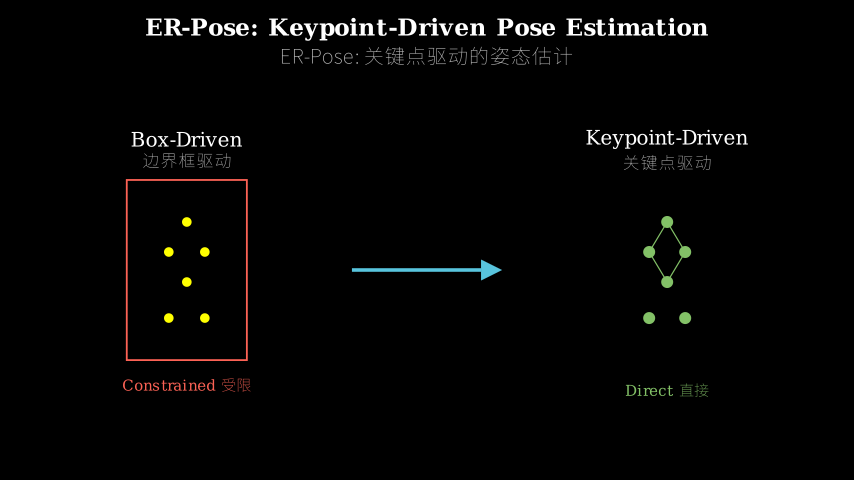
Single-stage pose estimation methods like YOLO-Pose inherit their architecture from object detection, treating pose as a secondary task constrained by bounding box prediction. This creates a fundamental misalignment: you’re training the model to find boxes, but evaluating it on keypoint accuracy (OKS metric). The box-driven paradigm forces the model to solve two parallel objectives—localize boxes AND predict keypoints—leading to semantic conflicts in sample assignment and feature representation. Prior work accepts this as necessary overhead for real-time performance.
Problem: Box-driven pose estimation
   |
   v
Observation: Training optimizes for boxes,
             evaluation measures keypoints
   |
   v
Hypothesis: Removing box prediction and
            redesigning for keypoints directly
            will reduce task misalignment
   |
   v
Method: Keypoint-driven architecture +
        dynamic sample assignment +
        smooth OKS loss
   |
   v
Evidence: +3.2 to +7.4 AP on COCO/CrowdPose
          with fewer parameters
   |
   v
Conclusion: Box prediction is unnecessary
            overhead for pose estimation
The Increment
One sentence: Before, real-time pose estimation borrowed object detection’s box-first architecture; after, ER-Pose shows you can skip boxes entirely and predict keypoints directly with better accuracy and efficiency.
Core Mechanism
ER-Pose restructures the prediction head to output keypoint coordinates and visibility scores directly, without intermediate bounding box predictions. The architecture uses a multi-scale feature pyramid (like YOLO) but replaces the detection head with a pose-specific head that produces dense keypoint predictions across spatial locations. Each spatial location can predict multiple person instances through a dynamic assignment strategy.
The keypoint-driven sample assignment is the critical innovation. During training, instead of assigning samples based on box IoU (intersection over union), ER-Pose uses a cost function that combines keypoint similarity (measured by OKS) with classification confidence. This creates a direct alignment between training supervision and the evaluation metric. The assignment is dynamic—it adapts per image based on which predictions best match ground truth poses.
For optimization, they introduce a smooth OKS-based loss that handles the discontinuities in standard OKS calculation. Traditional OKS has sharp transitions when keypoints move in/out of visibility, making gradients unstable. The smooth version uses continuous functions to approximate these transitions, stabilizing training for regression-based pose estimation.
Input Image
    |
    v
[Multi-scale Feature Pyramid]
    |
    +---> Scale 1 (large objects)
    +---> Scale 2 (medium objects)
    +---> Scale 3 (small objects)
          |
          v
    [Pose Head] (no box branch)
          |
          +---> Keypoint coords (17 x 2)
          +---> Visibility scores (17 x 1)
          +---> Person confidence (1)
          |
          v
    [Dynamic Assignment]
    (match predictions to GT using OKS cost)
          |
          v
    [Smooth OKS Loss]
    (stable gradients for regression)
Think of it like a restaurant switching from a two-step ordering system to direct service. The old way (box-driven): customers first get assigned to tables (bounding boxes), then order food (keypoints). The table assignment uses one set of rules (IoU), but you evaluate the restaurant on food quality (OKS). ER-Pose is like removing the table assignment entirely—customers directly tell the kitchen what they want, and the kitchen’s performance is measured on exactly what it’s optimizing for. The “dynamic assignment” is like a smart maître d’ who looks at each order and matches it to the chef who can best fulfill it, using the same criteria the food critic will use later.
Key Concepts
-
OKS (Object Keypoint Similarity): The standard metric for evaluating pose estimation, similar to IoU for boxes but for keypoints. It measures how well predicted keypoints match ground truth, accounting for person scale and keypoint visibility. Formula: OKS = Σ exp(-d²/2s²k²) δ(v>0) / Σ δ(v>0), where d is distance between predicted and ground truth keypoint, s is person scale, k is per-keypoint constant, and v is visibility. The problem: OKS has discontinuities (the δ function jumps), making it hard to use directly as a loss. ER-Pose’s smooth OKS replaces these jumps with continuous approximations, so gradients flow properly during backpropagation.
-
Sample Assignment Misalignment: In box-driven methods, you assign training samples (which predictions should learn from which ground truth) based on box IoU, but evaluate final performance using keypoint OKS. This is like training a basketball player by measuring how well they stand in the right court position (box), but judging them in games by shooting accuracy (keypoints). The mismatch means the model optimizes for the wrong objective. ER-Pose fixes this by using OKS directly in the assignment cost function, so training and evaluation use the same criteria.
-
Dense Supervision: Traditional methods assign each ground truth person to one or a few predictions (sparse). ER-Pose’s dynamic assignment can match multiple predictions to the same ground truth if they’re all good matches, providing more training signal. It’s like having multiple students learn from the same excellent example rather than forcing each student to learn from exactly one example. This increases gradient flow and helps the model learn faster, especially for crowded scenes.
Framework Shift
Before (box-driven):                After (keypoint-driven):

Input                               Input
  |                                   |
  v                                   v
Features                            Features
  |                                   |
  +---> [Box Head]                    +---> [Pose Head]
  |        |                                   |
  |        v                                   v
  |     Boxes (x,y,w,h)              Keypoints (x1,y1...x17,y17)
  |        |                          Visibility (v1...v17)
  |        v                          Confidence (c)
  +---> [Pose Head]                          |
         |                                   v
         v                          [Dynamic Assignment]
    Keypoints                       (cost = OKS + confidence)
         |                                   |
         v                                   v
  [Box-based Assignment]            [Smooth OKS Loss]
  (cost = IoU + class)
         |
         v
  [Box Loss + Pose Loss]

Parallel objectives                 Single unified objective
Task misalignment                   Direct alignment
From parallel multi-task learning to unified keypoint-centric learning, the core shift is eliminating the intermediate box representation that creates training-evaluation mismatch.
Expert Assessment
Problem choice: This is a real gap, not manufactured. The box-driven paradigm in pose estimation has been accepted as necessary for real-time performance, but the authors correctly identify it as inherited baggage from object detection rather than a fundamental requirement. The problem sits at a sweet spot—practical (affects real-time applications) and conceptually clean (clear misalignment between training and evaluation).
Method maturity: The core insight is elegant: if you’re not using boxes at inference, why predict them during training? The execution is solid but not groundbreaking—dynamic assignment and smooth losses are incremental refinements rather than novel techniques. The smooth OKS loss is clever but feels like engineering around a problem (non-differentiable OKS) rather than a fundamental rethinking. A simpler approach might be to use a differentiable approximation of OKS from the start, but the authors don’t explore alternatives.
Experimental integrity: Baselines are fair—they compare against YOLO-Pose, the direct box-driven counterpart. The improvements are substantial (+3.2 to +7.4 AP) and consistent across datasets. However, the paper lacks ablations on some design choices (why this specific smooth OKS formulation? how sensitive is performance to assignment cost weights?). The “fewer parameters” claim is mentioned but not thoroughly analyzed—where exactly do the parameter savings come from?
Writing quality: The abstract and introduction are clear, but the method section gets dense quickly. The smooth OKS loss formulation (Section 3.3) would benefit from more intuitive explanation before diving into equations. The paper also oversells the “paradigm shift”—removing box prediction is a simplification, not a revolution. The related work section could better position this against other NMS-free approaches.
Verdict: weak accept — Solid practical contribution with clear improvements, but the conceptual novelty is limited to “remove unnecessary components,” and some experimental details need strengthening.
Takeaways
Alignment principle: When your training objective differs from your evaluation metric, you’re fighting yourself. This applies beyond pose estimation—any multi-task learning setup should audit whether auxiliary tasks actually help or just add noise. If you’re not using a prediction at inference, question whether you need it during training.
Dynamic assignment as a pattern: The idea of matching predictions to ground truth using the same metric you’ll evaluate on is transferable. For any structured prediction task (segmentation, depth estimation, 3D reconstruction), consider whether your sample assignment strategy aligns with your final evaluation criteria.
Smooth loss design: When your metric has discontinuities (like OKS’s visibility function), you can’t backpropagate through it directly. The pattern here—replace discrete operations with continuous approximations—is a general technique for making non-differentiable metrics trainable. The specific smooth OKS formulation could be adapted to other keypoint-based tasks.
论文: 2603.08681 作者: Nanjun Li, Pinqi Cheng, Zean Liu, Minghe Tian, Xuanyin Wang 分类: cs.CV
缺口
像 YOLO-Pose 这样的单阶段姿态估计方法从目标检测继承了架构,把姿态当作受边界框预测约束的次要任务。
这造成了根本性的错位:你在训练模型找框,但用关键点精度(OKS 指标)评估它。
框驱动范式迫使模型解决两个并行目标——定位框并且预测关键点——导致样本分配和特征表示中的语义冲突。
先前工作接受这是实时性能的必要开销。
问题:框驱动的姿态估计
   |
   v
观察:训练优化框,
      评估测量关键点
   |
   v
假设:移除框预测并
      直接为关键点重新设计
      将减少任务错位
   |
   v
方法:关键点驱动架构 +
      动态样本分配 +
      平滑 OKS 损失
   |
   v
证据:在 COCO/CrowdPose 上
      +3.2 到 +7.4 AP
      且参数更少
   |
   v
结论:框预测是姿态估计的
      不必要开销
增量
一句话: 之前,实时姿态估计借用目标检测的框优先架构;
之后,ER-Pose 证明可以完全跳过框,直接预测关键点,精度和效率都更好。
核心机制
ER-Pose 重构预测头,直接输出关键点坐标和可见性分数,没有中间的边界框预测。
架构使用多尺度特征金字塔(像 YOLO),但用姿态专用头替换检测头,在空间位置上产生密集的关键点预测。
每个空间位置可以通过动态分配策略预测多个人体实例。
关键点驱动的样本分配是关键创新。
训练时,ER-Pose 不基于框 IoU(交并比)分配样本,而是使用结合关键点相似度(用 OKS 测量)和分类置信度的代价函数。
这在训练监督和评估指标之间创建了直接对齐。
分配是动态的——根据哪些预测最匹配真值姿态,每张图像自适应调整。
对于优化,他们引入平滑 OKS 损失,处理标准 OKS 计算中的不连续性。
传统 OKS 在关键点进出可见性时有尖锐转变,使梯度不稳定。
平滑版本用连续函数近似这些转变,稳定基于回归的姿态估计训练。
输入图像
    |
    v
[多尺度特征金字塔]
    |
    +---> 尺度 1(大物体)
    +---> 尺度 2(中物体)
    +---> 尺度 3(小物体)
          |
          v
    [姿态头](无框分支)
          |
          +---> 关键点坐标(17 x 2)
          +---> 可见性分数(17 x 1)
          +---> 人体置信度(1)
          |
          v
    [动态分配]
    (用 OKS 代价匹配预测到真值)
          |
          v
    [平滑 OKS 损失]
    (回归的稳定梯度)
把它想象成餐厅从两步点餐系统切换到直接服务。
旧方式(框驱动):顾客先被分配到桌子(边界框),然后点菜(关键点)。
桌子分配用一套规则(IoU),但你用菜品质量(OKS)评估餐厅。
ER-Pose 就像完全移除桌子分配——顾客直接告诉厨房想要什么,厨房的表现用它正在优化的东西来衡量。
“动态分配”就像聪明的领班,看每个订单并匹配给最能完成它的厨师,用的标准和美食评论家后来用的一样。
关键概念
- OKS(目标关键点相似度): 评估姿态估计的标准指标,类似框的 IoU 但用于关键点。
它测量预测关键点与真值的匹配程度,考虑人体尺度和关键点可见性。
公式:OKS = Σ exp(-d²/2s²k²) δ(v>0) / Σ δ(v>0),其中 d 是预测和真值关键点间距离,s 是人体尺度,k 是每个关键点的常数,v 是可见性。
问题:OKS 有不连续性(δ 函数跳跃),难以直接用作损失。
ER-Pose 的平滑 OKS 用连续近似替换这些跳跃,所以梯度在反向传播时正常流动。
- 样本分配错位: 在框驱动方法中,你基于框 IoU 分配训练样本(哪些预测应该从哪些真值学习),但用关键点 OKS 评估最终性能。
这就像训练篮球运动员时测量他们站在正确场地位置的能力(框),但在比赛中用投篮准确度(关键点)评判他们。
不匹配意味着模型为错误的目标优化。
ER-Pose 通过在分配代价函数中直接使用 OKS 来修复这个问题,所以训练和评估用相同标准。
- 密集监督: 传统方法将每个真值人体分配给一个或几个预测(稀疏)。
ER-Pose 的动态分配可以将多个预测匹配到同一个真值,如果它们都是好匹配,提供更多训练信号。
这就像让多个学生从同一个优秀例子学习,而不是强制每个学生恰好从一个例子学习。
这增加了梯度流,帮助模型更快学习,特别是对拥挤场景。
框架转变
之前(框驱动):                    之后(关键点驱动):

输入                                输入
  |                                   |
  v                                   v
特征                                特征
  |                                   |
  +---> [框头]                        +---> [姿态头]
  |        |                                   |
  |        v                                   v
  |     框 (x,y,w,h)                 关键点 (x1,y1...x17,y17)
  |        |                          可见性 (v1...v17)
  |        v                          置信度 (c)
  +---> [姿态头]                              |
         |                                   v
         v                          [动态分配]
    关键点                          (代价 = OKS + 置信度)
         |                                   |
         v                                   v
  [基于框的分配]                    [平滑 OKS 损失]
  (代价 = IoU + 类别)
         |
         v
  [框损失 + 姿态损失]

并行目标                            单一统一目标
任务错位                            直接对齐
从并行多任务学习到统一的关键点中心学习,核心转变是消除造成训练-评估不匹配的中间框表示。
专家评审
选题眼光: 这是真缺口,不是人造的。
姿态估计中的框驱动范式一直被接受为实时性能的必要条件,但作者正确识别出它是从目标检测继承的包袱,而非根本要求。
问题处于甜蜜点——实用(影响实时应用)且概念清晰(训练和评估间的明确错位)。
方法成熟度: 核心洞察优雅:如果推理时不用框,为什么训练时预测它们?
执行扎实但不突破——动态分配和平滑损失是渐进式改进而非新颖技术。
平滑 OKS 损失巧妙但感觉像在工程化绕过问题(不可微 OKS)而非根本性重新思考。
更简单的方法可能是从一开始就用 OKS 的可微近似,但作者没有探索替代方案。
实验诚意: 基线公平——他们与 YOLO-Pose 比较,直接的框驱动对应物。
改进显著(+3.2 到 +7.4 AP)且在数据集间一致。
然而,论文缺少一些设计选择的消融(为什么是这个特定的平滑 OKS 公式?
性能对分配代价权重有多敏感?
)。
“更少参数”的声明被提及但未彻底分析——参数节省究竟从哪里来?
写作功力: 摘要和引言清晰,但方法部分很快变得密集。
平滑 OKS 损失公式(3.3 节)在深入方程前需要更直观的解释。
论文也过度推销”范式转变”——移除框预测是简化,不是革命。
相关工作部分可以更好地将此与其他无 NMS 方法定位。
判决: 弱接收 — 扎实的实用贡献,改进明确,但概念新颖性局限于”移除不必要组件”,一些实验细节需要加强。
要点总结
对齐原则: 当训练目标与评估指标不同时,你在跟自己作对。
这超越姿态估计——任何多任务学习设置都应审查辅助任务是真的有帮助还是只是添加噪声。
如果推理时不用某个预测,质疑训练时是否需要它。
动态分配作为模式: 用你将评估的相同指标匹配预测到真值的想法是可迁移的。
对任何结构化预测任务(分割、深度估计、3D 重建),考虑样本分配策略是否与最终评估标准对齐。
平滑损失设计: 当指标有不连续性(像 OKS 的可见性函数)时,你不能直接通过它反向传播。
这里的模式——用连续近似替换离散操作——是使不可微指标可训练的通用技术。
特定的平滑 OKS 公式可以适配到其他基于关键点的任务。