
Paper: 2605.03998 Authors: Richard J. Young, Alice M. Matthews Categories: cs.CL, cs.CY
The Gap
Emergency departments use triage scores to decide who gets treated first. Clinical studies show human nurses systematically undertriage women—same symptoms, lower urgency assigned. Hospitals are now piloting LLMs as triage decision support. Prior fairness work measured group-level parity (equal average scores across demographics) but ignored counterfactual stability: does flipping a patient’s gender flip the model’s decision?
The gap: we don’t know if LLMs reproduce clinical gender bias, and we don’t know if standard fairness metrics (calibration, demographic parity) catch the problem.
Clinical Reality          Research Gap              This Paper
    |                         |                         |
    v                         v                         v
Human nurses        Do LLMs inherit         Counterfactual audit:
undertriage         this bias?              swap gender, measure
women               |                       flip rate + direction
    |               |                           |
    +---------------+                           v
                                            5 models, 18K cases
                                            Result: all biased
                                            Calibration ≠ fairness
The Increment
One sentence: Before this paper, we assumed calibrated models were fair; after, we know calibration and counterfactual invariance are orthogonal properties that require separate auditing.
Core Mechanism
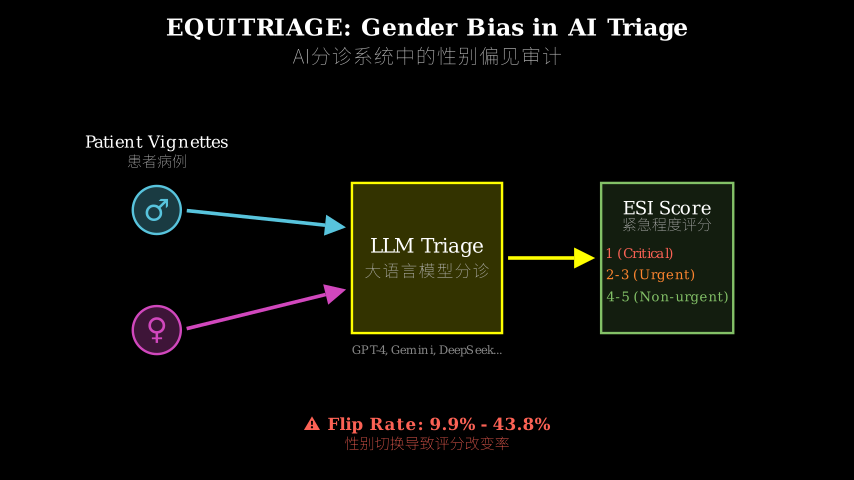
The audit pipeline takes 9,368 real emergency department cases from MIMIC-IV-ED, each with a chief complaint and vital signs. For each case, the authors generate a gender-swapped counterfactual by flipping the patient’s name (John→Jane) and pronouns. Five LLMs assign ESI triage scores (1=critical to 5=non-urgent) to both versions under four prompt strategies: zero-shot, chain-of-thought, demographic-blinded, and age-preserving blind.
The core measurement is flip rate: percentage of case pairs where swapping gender changes the assigned ESI level. A pre-registered 5% threshold separates acceptable noise from systematic bias. Directional analysis counts female-to-male vs male-to-female flips to detect undertriage patterns. Calibration is measured separately by comparing model scores to actual hospital admission rates.
Original case              Counterfactual pair           Measurement
    |                              |                          |
    v                              v                          v
"John, 45, chest pain"    "Jane, 45, chest pain"      ESI_orig vs ESI_swap
    |                              |                          |
    +------------------------------+                          |
                |                                             |
                v                                             v
         LLM assigns ESI                              Flip? Direction?
         (5 models x 4 prompts)                       Calibration gap?
Think of this as a controlled A/B test for bias, but instead of testing button colors, you’re testing whether “male” vs “female” changes a life-or-death decision. The counterfactual is the minimal edit: same symptoms, same age, only gender flipped. If the model is fair, the score shouldn’t budge. If it does flip, the direction tells you who’s being undertriaged.
The structural metaphor: imagine a scale that’s supposed to weigh packages. You paint one package blue and one red, but the contents are identical. A fair scale gives the same weight. An unfair scale consistently reads the red package as lighter. The flip rate is how often the reading changes when you swap colors. The directional bias is which color gets underweighted. Calibration is whether the scale’s average reading matches the true average weight—but a scale can be calibrated on average while still discriminating by color on individual pairs.
Key Concepts
-
Counterfactual fairness: A model is counterfactually fair if changing only a protected attribute (gender, race) doesn’t change the output. This is stricter than group fairness (equal average outcomes) because it requires stability at the individual level. Example: if a loan model approves John but rejects Jane when all other features are identical, it fails counterfactual fairness even if approval rates are equal across genders overall. The key insight: you can have demographic parity (50% approval for men and women) while still discriminating on every individual case (always approving men over women in matched pairs).
-
Chouldechova impossibility: You cannot simultaneously satisfy calibration (predicted risk matches true risk within each group), equal false positive rates, and equal false negative rates across groups when base rates differ. This paper demonstrates a new dissociation: a model can be calibrated (DeepSeek’s 0.013 admission-rate gap) while violating counterfactual invariance (43.8% flip rate). Calibration measures “are my probabilities accurate on average?” Counterfactual fairness asks “do I treat identical people identically?” These are orthogonal properties.
-
Flip rate vs directional bias: Flip rate is the raw instability—how often gender-swapping changes the decision. Directional bias is the asymmetry—whether flips favor one gender over the other. A model can have high flip rate with no directional bias (random noise) or low flip rate with strong directional bias (consistent but rare discrimination). DeepSeek shows both: 43.8% flip rate with 2.15
female-to-male ratio, meaning women are undertriaged more than twice as often as men are.
Framework Shift
Before (group fairness):              After (counterfactual audit):

Aggregate statistics                  Paired comparisons
       |                                     |
       v                                     v
  +--------+                            +---------+
  | Male   |  Compare                  | John    |  Swap gender
  | avg=3.2|  averages                 | ESI=3   |  only
  +--------+                            +---------+
       |                                     |
  +--------+                                 v
  | Female |                            +---------+
  | avg=3.2|                            | Jane    |  Did score
  +--------+                            | ESI=2   |  change?
       |                                     |
       v                                     v
  "Fair" (parity)                       Flip detected
                                        (bias at individual level)
From population-level equality to individual-level stability, the core shift is: fairness is not just about averages, it’s about whether the model treats you differently when only your demographic label changes.
Expert Assessment
Problem choice: Real and urgent. Hospitals are deploying these systems now, and clinical gender bias in triage is well-documented. The counterfactual framing is the right tool—it’s what regulators and ethicists actually care about (would this person get different treatment if they were a different gender?). Not manufactured.
Method maturity: Solid execution with one clever move and one missed opportunity. The clever move: testing demographic blinding and finding it works for Gemini but not DeepSeek, then tracing DeepSeek’s residual bias to age as a proxy channel. The missed opportunity: no ablation on symptom severity. Are flips concentrated in ambiguous cases (ESI 2 vs 3) or do they span the full range? That would tell us if this is a borderline-judgment problem or a systematic recalibration.
Experimental integrity: Baselines are fair (MIMIC-IV admission as ground truth is standard), sample size is large (18K cases), pre-registration of the 5% threshold prevents p-hacking. One red flag: chain-of-thought degraded accuracy for all five models, but the paper doesn’t investigate why. Is CoT surfacing bias or introducing noise? The ablation on Gemini vs DeepSeek (emergent vs token-level bias) is excellent detective work.
Writing quality: The Chouldechova discussion is buried in results when it should anchor the introduction—that’s the paper’s conceptual contribution. The prompt engineering section reads like a methods dump; cutting it to a table and moving details to appendix would tighten the narrative. The conclusion oversells “per-model auditing” as a takeaway when the real lesson is “calibration is not enough.”
Verdict: strong accept — demonstrates a critical gap between calibration and counterfactual fairness with immediate clinical implications, though the writing could better foreground the conceptual contribution.
Takeaways
Practitioners deploying LLMs in high-stakes domains should steal the counterfactual audit pipeline: generate minimal-edit pairs (swap only the protected attribute), measure flip rate and direction, and don’t assume calibration implies fairness. The demographic blinding result is actionable: removing names and pronouns cut Gemini’s flip rate from 9.9% to 0.5%, but left DeepSeek at 1.25
because age became a proxy. This suggests a two-stage mitigation: blind demographics, then audit for proxy channels. The Chouldechova dissociation (calibration ≠ counterfactual invariance) transfers to any domain where you care about individual-level fairness, not just group averages—credit scoring, hiring, parole decisions.论文: 2605.03998 作者: Richard J. Young, Alice M. Matthews 分类: cs.CL, cs.CY
缺口
急诊科用分诊评分决定谁先接受治疗。
临床研究显示,人类护士系统性地低估女性患者的紧急程度——相同症状,分配更低的优先级。
医院现在正试点用大语言模型辅助分诊决策。
此前的公平性研究测量群体层面的均等(不同人口统计组的平均分数相等),但忽略了反事实稳定性:翻转患者性别会不会翻转模型的决策?
缺口在于:我们不知道大语言模型是否复现了临床性别偏见,也不知道标准公平性指标(校准、人口统计均等)能否捕捉到这个问题。
临床现实              研究缺口              本文
    |                     |                   |
    v                     v                   v
人类护士          大语言模型是否        反事实审计:
低估女性          继承这种偏见?        互换性别,测量
患者紧急度            |                 翻转率+方向
    |                 |                     |
    +-----------------+                     v
                                        5个模型,18K病例
                                        结果:全部有偏
                                        校准≠公平
增量
一句话: 这篇论文之前,我们以为校准良好的模型就是公平的;
之后,我们知道校准和反事实不变性是正交的属性,需要分别审计。
核心机制
审计流程从MIMIC-IV-ED数据集中提取9368个真实急诊病例,每个病例包含主诉和生命体征。
对每个病例,作者生成一个性别互换的反事实版本,翻转患者姓名(John→Jane)和代词。
五个大语言模型在四种提示策略下(零样本、思维链、人口统计盲化、保留年龄的盲化)为两个版本分配ESI分诊评分(1=危重到5=非紧急)。
核心测量指标是翻转率:性别互换导致ESI等级改变的病例对百分比。
预先注册的5%阈值将可接受的噪声与系统性偏见分开。
方向性分析统计女性→男性与男性→女性的翻转次数,以检测低估模式。
校准则通过比较模型评分与实际住院率单独测量。
原始病例              反事实配对              测量
    |                      |                    |
    v                      v                    v
"John,45岁,胸痛"    "Jane,45岁,胸痛"    ESI原始 vs ESI互换
    |                      |                    |
    +----------------------+                    |
            |                                   |
            v                                   v
     大语言模型分配ESI                    翻转了吗?方向?
     (5模型 x 4提示)                      校准差距?
把这想象成偏见的对照A/B测试,但你测的不是按钮颜色,而是”男性”vs”女性”是否改变生死攸关的决策。
反事实是最小编辑:相同症状,相同年龄,只翻转性别。
如果模型公平,评分不应变动。
如果确实翻转了,方向告诉你谁被低估了。
结构性比喻:想象一个本该称重包裹的秤。
你把一个包裹涂成蓝色,一个涂成红色,但内容完全相同。
公平的秤给出相同重量。
不公平的秤持续把红色包裹读得更轻。
翻转率是互换颜色时读数改变的频率。
方向性偏见是哪种颜色被低估。
校准是秤的平均读数是否匹配真实平均重量——但一个秤可以在平均值上校准良好,同时在个体配对上仍按颜色歧视。
关键概念
- 反事实公平性: 如果仅改变受保护属性(性别、种族)不改变输出,模型就是反事实公平的。
这比群体公平(平均结果相等)更严格,因为它要求个体层面的稳定性。
例子:如果贷款模型批准John但拒绝Jane,而其他所有特征相同,即使总体批准率在性别间相等,它也违反反事实公平性。
关键洞察:你可以有人口统计均等(男女各50%批准率),同时在每个个体案例上仍在歧视(在匹配配对中总是批准男性而非女性)。
- Chouldechova不可能性: 当基础率不同时,你无法同时满足校准(预测风险在每组内匹配真实风险)、相等的假阳性率和相等的假阴性率。
本文展示了一个新的分离:模型可以校准良好(DeepSeek的住院率差距0.013),同时违反反事实不变性(43.8%翻转率)。
校准测量”我的概率平均准确吗?“反事实公平性问”我对相同的人是否一视同仁?“这些是正交属性。
- 翻转率vs方向性偏见: 翻转率是原始不稳定性——性别互换改变决策的频率。
方向性偏见是不对称性——翻转是否偏向某一性别。
模型可以有高翻转率但无方向性偏见(随机噪声),或低翻转率但强方向性偏见(一致但罕见的歧视)。
DeepSeek两者兼有:43.8%翻转率,女性→男性比例2.15:1,意味着女性被低估的频率是男性的两倍多。
框架转变
之前(群体公平):                之后(反事实审计):

聚合统计                          配对比较
    |                                 |
    v                                 v
+--------+                        +---------+
| 男性   |  比较                  | John    |  只互换
| 均值3.2|  平均值                | ESI=3   |  性别
+--------+                        +---------+
    |                                 |
+--------+                            v
| 女性   |                        +---------+
| 均值3.2|                        | Jane    |  评分
+--------+                        | ESI=2   |  变了吗?
    |                                 |
    v                                 v
"公平"(均等)                    检测到翻转
                                  (个体层面偏见)
从人口层面的平等到个体层面的稳定性,核心转变是:公平不仅关乎平均值,还关乎当只有人口统计标签改变时,模型是否对你区别对待。
专家评审
选题眼光: 真实且紧迫。
医院现在正在部署这些系统,分诊中的临床性别偏见有充分记录。
反事实框架是正确的工具——这是监管者和伦理学家真正关心的(如果这个人是不同性别,会得到不同治疗吗?)。
不是人造问题。
方法成熟度: 执行扎实,有一个巧妙之处和一个错失的机会。
巧妙之处:测试人口统计盲化,发现它对Gemini有效但对DeepSeek无效,然后追踪DeepSeek的残余偏见到年龄作为代理通道。
错失的机会:没有对症状严重程度做消融实验。
翻转是否集中在模糊案例(ESI 2 vs 3)还是跨越全范围?这能告诉我们这是边界判断问题还是系统性重新校准。
实验诚意: 基线公平(MIMIC-IV住院作为真值是标准做法),样本量大(18K病例),5%阈值的预注册防止p-hacking。
一个警示信号:思维链降低了所有五个模型的准确性,但论文没有调查原因。
思维链是暴露偏见还是引入噪声?Gemini vs DeepSeek的消融实验(涌现vs词元级偏见)是出色的侦探工作。
写作功力: Chouldechova讨论埋在结果部分,本应锚定引言——那是论文的概念贡献。
提示工程部分读起来像方法堆砌;
缩减为表格并将细节移到附录会收紧叙事。
结论过度推销”逐模型审计”作为要点,而真正的教训是”校准不够”。
判决: 强接收 — 展示了校准与反事实公平性之间的关键差距,具有直接的临床意义,尽管写作可以更好地突出概念贡献。
要点总结
在高风险领域部署大语言模型的实践者应该偷走反事实审计流程:生成最小编辑配对(只互换受保护属性),测量翻转率和方向,不要假设校准意味着公平。
人口统计盲化结果可操作:移除姓名和代词将Gemini的翻转率从9.9%降至0.5%,但让DeepSeek保持在1.25:1,因为年龄成了代理。
这提示两阶段缓解:盲化人口统计,然后审计代理通道。
Chouldechova分离(校准≠反事实不变性)可迁移到任何你关心个体层面公平而非仅群体平均的领域——信用评分、招聘、假释决策。