
Paper: 2605.15199 Authors: Ruozhen He, Meng Wei, Ziyan Yang, Vicente Ordonez Categories: cs.CV, cs.AI
The Gap
Single-shot video generation has matured, but extending it to multi-shot narratives hits a wall: characters change appearance, objects vanish and reappear differently, locations drift. Existing benchmarks use independently generated prompts with limited entity coverage, and metrics that blur intra-shot quality with cross-shot consistency. You can’t tell if a model fails because it can’t render a face, or because it forgot what that face looked like 20 shots ago.
Prior work treats consistency as a side effect of better generation. This paper argues it’s a distinct problem requiring explicit tracking.
Problem: Character in shot 1 =/= same character in shot 30
   |
   v
Assumption: Consistency needs explicit memory, not just better generation
   |
   v
Method: EntityBench (structured episodes) + EntityMem (per-entity memory bank)
   |
   v
Evidence: Consistency degrades with recurrence distance; explicit memory yields +2.33 Cohen's d
   |
   v
Conclusion: Cross-shot consistency is a separable problem needing dedicated mechanisms
The Increment
One sentence: Before this paper, multi-shot video generation was evaluated on ad-hoc prompts with conflated metrics; after, we have a structured benchmark that isolates cross-shot entity consistency from generation quality, plus a memory system that explicitly tracks entities across recurrence gaps.
Core Mechanism
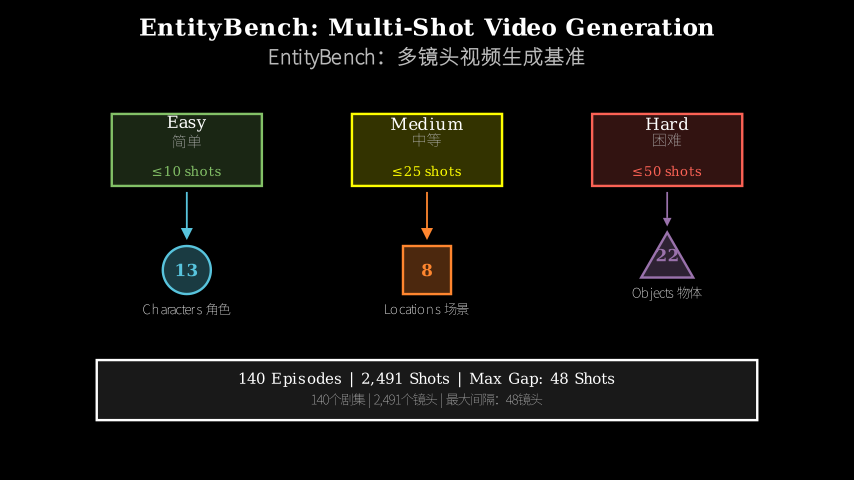
EntityBench is 140 episodes derived from real narrative media, with explicit entity schedules. Each episode specifies which characters, objects, and locations appear in which shots, with difficulty tiers based on sequence length (up to 50 shots), entity count (13 characters, 8 locations, 22 objects), and recurrence gaps (up to 48 shots between appearances).
The evaluation suite has three pillars: intra-shot quality (FVD, aesthetic score), prompt-following alignment (CLIP similarity), and cross-shot consistency. The consistency pillar uses a fidelity gate: only entity appearances that match the prompt are admitted into cross-shot scoring. This prevents rewarding a model that generates consistent faces that are consistently wrong.
EntityMem, the baseline system, works in two phases. First, it generates reference images for each entity in isolation and stores them in a memory bank. Second, during multi-shot generation, it retrieves relevant entity references and conditions the diffusion model on them via cross-attention. The memory is persistent across the entire episode, not just adjacent shots.
EntityBench Structure:
  Episode --> [Shot 1] [Shot 2] ... [Shot 50]
                 |        |            |
              Entity    Entity      Entity
              Schedule  Schedule    Schedule
                 |        |            |
              (Char A,  (Char B,    (Char A,
               Loc X)    Obj Y)      Loc Z)

EntityMem Flow:
  Phase 1: Generate & Store
    Prompt "Character A" --> Diffusion --> Image --> Memory Bank [A]
    Prompt "Location X"  --> Diffusion --> Image --> Memory Bank [X]

  Phase 2: Retrieve & Condition
    Shot N needs [A, X] --> Retrieve [A, X] from Memory
                        --> Cross-Attention Conditioning
                        --> Generate Shot N with consistent A, X
Think of EntityMem as a casting director’s reference book. Before filming starts, you photograph each actor, prop, and location in isolation—clean headshots, no context. When shooting a scene, the director flips to the relevant pages and says “make it look like this.” The book doesn’t change between scenes; it’s the single source of truth. If an actor appears in shot 1 and shot 40, you’re looking at the same headshot both times, not relying on the crew’s memory of what they shot 39 scenes ago.
The key insight: consistency is a retrieval problem, not a generation problem. You don’t ask the model to “remember” what it generated before; you show it what to match.
Key Concepts
-
Recurrence Gap: The number of shots between two appearances of the same entity. If Character A appears in shot 5 and shot 32, the recurrence gap is 27. This matters because existing models degrade sharply with distance—they might keep a character consistent across 3 shots but fail at 20. EntityBench explicitly tracks this to measure how consistency decays with gap length, revealing that most methods collapse beyond 10-shot gaps.
-
Fidelity Gate: A filtering mechanism that only admits entity appearances into cross-shot consistency scoring if they first pass a prompt-alignment check. Without this, a model could generate the same wrong face in every shot and score high on consistency. The gate uses CLIP similarity between the generated entity and the text prompt; only matches above a threshold proceed to cross-shot comparison. This disentangles “did you generate what I asked for?” from “did you keep it consistent?”
-
Per-Entity Memory Bank: A data structure that stores verified visual references for each entity (character, object, location) before generation begins. Unlike methods that condition on the previous shot or a sliding window, the memory bank is global and persistent. When generating shot N, the system retrieves all entities scheduled for that shot from the bank and uses them as conditioning signals. This decouples consistency from temporal proximity—an entity can reappear after 48 shots and still match its original reference.
Framework Shift
Before (mainstream approach):        After (this paper):

  Shot 1 --> Model --> Video 1         Entity Catalog:
     |                                   [A] [B] [C] [X] [Y]
     v                                    |   |   |   |   |
  Shot 2 --> Model --> Video 2           +---+---+---+---+
     |         ^                          |
     v         |                          v
  Shot 3 --> Model --> Video 3         Shot N Schedule: [A, X]
  (model tries to remember                |
   what it generated before)              v
                                        Retrieve [A, X] --> Model --> Video N
                                        (explicit reference, not memory)
From implicit temporal coherence to explicit entity retrieval, the core shift is treating consistency as a lookup problem rather than a generation constraint.
Expert Assessment
Problem choice: Real gap. Multi-shot video generation is moving from tech demos to narrative applications, and character drift is the obvious blocker. The paper doesn’t manufacture the problem—anyone who’s tried to generate a 10-shot sequence has hit this. The benchmark design (derived from real media, explicit entity schedules) is more rigorous than prior work’s ad-hoc prompt sets.
Method maturity: EntityMem is straightforward—almost too straightforward. The two-phase design (generate references, then retrieve) is conceptually clean but computationally expensive. You’re running inference twice: once for the memory bank, once for the actual shots. The paper doesn’t explore cheaper alternatives like learned entity embeddings or distilled references. That said, the simplicity is a feature for a baseline; it isolates the effect of explicit memory without confounding factors.
Experimental integrity: Baselines are fair (Mora, CogVideoX, Kling, Gen-3). The fidelity gate is a smart design choice that prevents gaming the consistency metric. The Cohen’s d = +2.33 for character fidelity is a large effect size, but the paper is honest about where EntityMem doesn’t win (object consistency is weaker). One concern: the memory bank references are generated in isolation, which might not match the visual style of the final shots. The paper doesn’t ablate this.
Writing quality: The benchmark description is dense but necessary. The related work section could be tighter—it lists methods without clearly positioning them relative to the paper’s contribution. The results section is thorough but repetitive; Figure 4’s recurrence gap analysis is the key insight and could be foregrounded earlier. The appendix has useful details (entity schedules, failure cases) that belong in the main text.
Verdict: weak accept — Solid benchmark contribution with a simple but effective baseline; the recurrence gap analysis is the paper’s strongest result, but the method itself is more proof-of-concept than production-ready.
Takeaways
Fidelity gate as a design pattern: When evaluating consistency, separate “did you generate the right thing?” from “did you keep it consistent?” This applies beyond video—any multi-step generation task (dialogue, code, design iterations) benefits from gating consistency metrics on correctness first.
Recurrence gap as a diagnostic: Measuring how performance degrades with distance between entity appearances is a transferable evaluation strategy. In code generation, how well does a model maintain variable naming conventions across 100 lines? In dialogue, does character voice drift over 50 turns? The gap metric makes degradation visible.
Explicit memory vs. implicit coherence: EntityMem’s two-phase design (build reference catalog, then retrieve) is overkill for video but the principle generalizes. When consistency matters more than novelty, decouple the “what to generate” (retrieval) from the “how to generate it” (model). This shows up in RAG systems, style transfer, and any task where you want controlled variation around a fixed reference.
论文: 2605.15199 作者: Ruozhen He, Meng Wei, Ziyan Yang, Vicente Ordonez 分类: cs.CV, cs.AI
缺口
单镜头视频生成已经成熟,但扩展到多镜头叙事时遇到瓶颈:角色外观变化,物体消失后再出现时不一致,场景漂移。
现有基准使用独立生成的提示词,实体覆盖有限,评估指标混淆了镜头内质量和跨镜头一致性。
你无法判断模型失败是因为渲染不出人脸,还是因为忘记了20个镜头前那张脸长什么样。
此前的工作把一致性当作更好生成的副产品。
本文认为这是一个需要显式跟踪的独立问题。
问题:第1个镜头的角色 =/= 第30个镜头的同一角色
   |
   v
假设:一致性需要显式记忆,而非仅靠更好的生成
   |
   v
方法:EntityBench(结构化剧集)+ EntityMem(按实体记忆库)
   |
   v
证据:一致性随重现距离退化;显式记忆产生 +2.33 Cohen's d
   |
   v
结论:跨镜头一致性是可分离问题,需要专门机制
增量
一句话:本文之前,多镜头视频生成在临时提示词和混杂指标上评估;本文之后,我们有了结构化基准,将跨镜头实体一致性从生成质量中分离,并提供显式跟踪实体跨重现间隙的记忆系统。
核心机制
EntityBench 包含140个剧集,源自真实叙事媒体,带有显式实体时间表。
每个剧集指定哪些角色、物体和场景出现在哪些镜头中,难度分级基于序列长度(最多50个镜头)、实体数量(13个角色、8个场景、22个物体)和重现间隙(两次出现之间最多48个镜头)。
评估套件有三个支柱:镜头内质量(FVD、美学评分)、提示词遵循对齐(CLIP相似度)和跨镜头一致性。
一致性支柱使用保真门:只有与提示词匹配的实体出现才被纳入跨镜头评分。
这防止奖励那些生成一致但一致错误的人脸的模型。
EntityMem 基线系统分两个阶段工作。
首先,它为每个实体单独生成参考图像并存储在记忆库中。
其次,在多镜头生成期间,它检索相关实体参考,并通过交叉注意力将扩散模型条件化在这些参考上。
记忆在整个剧集中持久存在,而非仅限相邻镜头。
EntityBench 结构:
  剧集 --> [镜头1] [镜头2] ... [镜头50]
             |        |            |
          实体      实体         实体
          时间表    时间表       时间表
             |        |            |
          (角色A,   (角色B,      (角色A,
           场景X)    物体Y)       场景Z)

EntityMem 流程:
  阶段1:生成与存储
    提示词"角色A" --> 扩散 --> 图像 --> 记忆库[A]
    提示词"场景X" --> 扩散 --> 图像 --> 记忆库[X]

  阶段2:检索与条件化
    镜头N需要[A, X] --> 从记忆库检索[A, X]
                    --> 交叉注意力条件化
                    --> 生成带一致A、X的镜头N
把 EntityMem 想象成选角导演的参考手册。
开拍前,你为每个演员、道具和场景单独拍照——干净的头像照,没有上下文。
拍摄场景时,导演翻到相关页面说”照这个样子拍”。
手册在场景之间不变;它是唯一的真实来源。
如果演员出现在第1个和第40个镜头,你两次看的是同一张头像照,而非依赖剧组对39个场景前拍摄内容的记忆。
关键洞见:一致性是检索问题,而非生成问题。
你不要求模型”记住”它之前生成了什么;你展示给它要匹配什么。
关键概念
- 重现间隙:同一实体两次出现之间的镜头数。
如果角色A出现在第5个和第32个镜头,重现间隙是27。
这很重要,因为现有模型随距离急剧退化——它们可能在3个镜头间保持角色一致,但在20个镜头时失败。
EntityBench 显式跟踪这一点以测量一致性如何随间隙长度衰减,揭示大多数方法在超过10个镜头间隙后崩溃。
- 保真门:一种过滤机制,只有在首先通过提示词对齐检查后,才将实体出现纳入跨镜头一致性评分。
没有这个,模型可能在每个镜头生成相同的错误人脸,并在一致性上得高分。
门使用生成实体与文本提示词之间的CLIP相似度;只有高于阈值的匹配才进入跨镜头比较。
这将”你生成了我要求的吗?“与”你保持一致了吗?“解耦。
- 按实体记忆库:一种数据结构,在生成开始前存储每个实体(角色、物体、场景)的验证视觉参考。
与条件化在前一个镜头或滑动窗口的方法不同,记忆库是全局且持久的。
生成镜头N时,系统从库中检索该镜头计划的所有实体,并将它们用作条件信号。
这将一致性与时间接近性解耦——实体可以在48个镜头后重现,仍然匹配其原始参考。
框架转变
之前(主流方法):                之后(本文方法):

  镜头1 --> 模型 --> 视频1         实体目录:
     |                              [A] [B] [C] [X] [Y]
     v                               |   |   |   |   |
  镜头2 --> 模型 --> 视频2           +---+---+---+---+
     |         ^                     |
     v         |                     v
  镜头3 --> 模型 --> 视频3         镜头N时间表:[A, X]
  (模型试图记住                      |
   它之前生成的内容)                 v
                                  检索[A, X] --> 模型 --> 视频N
                                  (显式参考,而非记忆)
从隐式时间连贯到显式实体检索,核心转变是将一致性视为查找问题而非生成约束。
专家评审
选题眼光:真实缺口。
多镜头视频生成正从技术演示转向叙事应用,角色漂移是明显的阻碍。
论文没有制造问题——任何尝试生成10个镜头序列的人都遇到过这个。
基准设计(源自真实媒体,显式实体时间表)比此前工作的临时提示词集更严格。
方法成熟度:EntityMem 很直接——几乎太直接了。
两阶段设计(生成参考,然后检索)概念上清晰但计算昂贵。
你运行推理两次:一次为记忆库,一次为实际镜头。
论文没有探索更便宜的替代方案,如学习的实体嵌入或蒸馏参考。
话虽如此,简单性对基线来说是优点;它隔离了显式记忆的效果,没有混淆因素。
实验诚意:基线公平(Mora、CogVideoX、Kling、Gen-3)。
保真门是防止操纵一致性指标的聪明设计选择。
角色保真度的 Cohen’s d = +2.33 是大效应量,但论文诚实地说明了 EntityMem 未获胜的地方(物体一致性较弱)。
一个担忧:记忆库参考是单独生成的,可能与最终镜头的视觉风格不匹配。
论文没有消融这一点。
写作功力:基准描述密集但必要。
相关工作部分可以更紧凑——它列出方法但没有清楚地将它们相对于论文贡献定位。
结果部分彻底但重复;图4的重现间隙分析是关键洞见,可以更早突出。
附录有有用的细节(实体时间表、失败案例),应该放在正文中。
判决:弱接收 — 扎实的基准贡献和简单但有效的基线;重现间隙分析是论文最强结果,但方法本身更像概念验证而非生产就绪。
要点总结
保真门作为设计模式:评估一致性时,将”你生成了正确的东西吗?“与”你保持一致了吗?“分离。
这超越视频——任何多步生成任务(对话、代码、设计迭代)都受益于首先在正确性上门控一致性指标。
重现间隙作为诊断:测量性能如何随实体出现之间的距离退化是可迁移的评估策略。
在代码生成中,模型在100行中保持变量命名约定的能力如何?在对话中,角色声音在50轮后是否漂移?间隙指标使退化可见。
显式记忆 vs. 隐式连贯:EntityMem 的两阶段设计(构建参考目录,然后检索)对视频来说过度,但原则可推广。
当一致性比新颖性更重要时,将”生成什么”(检索)与”如何生成”(模型)解耦。
这出现在RAG系统、风格迁移和任何你想要围绕固定参考进行受控变化的任务中。