
Paper: 2603.29997 Authors: Mohammadhossein Khojasteh, Yifan Jiang, Stefano De Giorgis, Frank van Harmelen, Filip Ilievski Categories: cs.CL, cs.AI
The Gap
Cognitive science has long studied structural mapping — the process of finding deep correspondences between two situations. Classic engines like SME (Structure-Mapping Engine) can align entities and relations beautifully, but they assume you’ve already extracted clean symbolic representations. Meanwhile, LLMs can process raw narratives but struggle with analogies when surface features differ. They’re brittle: change the prompt format or swap character names, and performance tanks.
The gap: We have symbolic reasoners that need pre-digested input, and neural models that drown in surface details. No one’s systematically explored whether LLM-generated abstractions can bridge this divide for narrative analogies.
Problem: Analogies fail when surface differs
    |
    v
Assumption: Abstraction separates structure from surface
    |
    v
Method: LLM decomposes -> abstracts -> symbolic mapper aligns
    |
    v
Evidence: Abstractions boost performance across similarity levels
    |
    v
Conclusion: Modular abstraction > end-to-end prompting
The Increment
One sentence: Before, you either pre-extracted symbols (limiting scope) or prompted LLMs end-to-end (fragile to surface variation); now, you can use LLMs to generate abstractions that feed symbolic mappers, getting robustness without manual annotation.
Core Mechanism
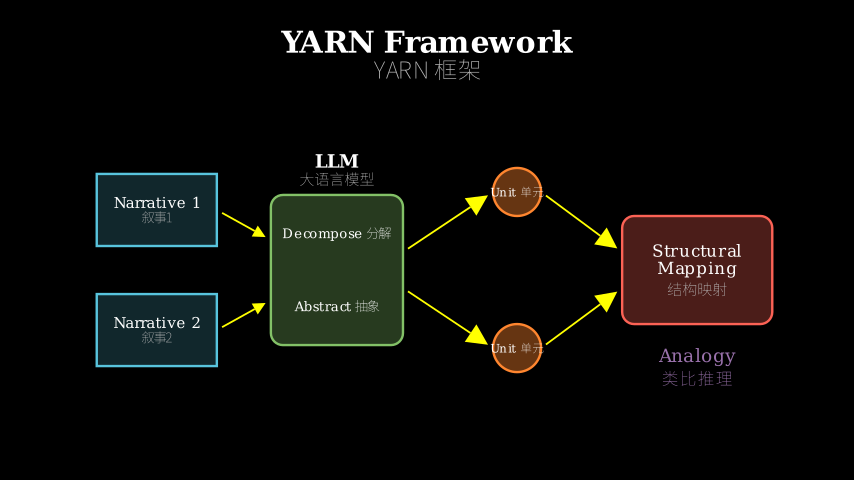
YARN has three stages. First, decomposition: an LLM breaks each narrative into semantic units (roughly, events or states). Second, abstraction: another LLM call lifts each unit to one of four levels — from concrete paraphrase to abstract role in the story arc. Third, mapping: a symbolic component (they use SMURF, a structure-mapping algorithm) aligns units across stories based on abstracted representations, then answers questions about the analogy.
The abstraction levels are grounded in frame semantics. Level 1 is surface paraphrase. Level 2 captures general meaning (e.g., “conflict arises”). Level 3 adds narrative role (e.g., “inciting incident”). Level 4 is maximally abstract (e.g., “disruption of equilibrium”). Each level strips away more surface detail while preserving relational structure.
Story A, Story B
    |
    v
[Decompose] -> Units: [u1, u2, ...], [v1, v2, ...]
    |
    v
[Abstract] -> Levels 1-4 for each unit
    |
    v
[Map] -> Align units via SMURF
    |
    v
Answer: Which elements correspond?
Think of YARN like a translation bureau for stories. Raw narratives come in speaking different “dialects” (different characters, settings, surface words). The decomposer is a clerk who segments each story into sentences. The abstractor is a linguist who rewrites each sentence at increasing levels of generality — first cleaning up grammar, then capturing the gist, then labeling its function in the narrative, finally distilling it to a universal story beat. The mapper is a pattern-matcher who, given these cleaned-up, labeled sentences, can now see which beats in Story A align with which beats in Story B, even if the original words were totally different. Without the linguist’s abstraction work, the pattern-matcher would be comparing apples to oranges.
Key Concepts
-
Structural Mapping: Imagine you’re comparing two recipes — one for bread, one for a software build process. Structural mapping ignores surface differences (flour vs. code) and finds deep parallels: mixing ingredients ↔ integrating modules, letting dough rise ↔ running tests, baking ↔ deploying. It’s about aligning *relations (X causes Y, A is part of B) rather than objects. In narratives, this means matching “hero faces obstacle” in one story to “protagonist encounters setback” in another, even if one’s a knight and the other’s a startup founder.
-
Abstraction Levels: Start with “The knight drew his sword and charged the dragon.” Level 1 (paraphrase): “The warrior attacked the beast with his blade.” Level 2 (general meaning): “A hero confronts a threat.” Level 3 (narrative role): “The protagonist initiates the climactic confrontation.” Level 4 (maximal abstraction): “Conflict escalation.” Each level trades specificity for generality. The key insight: higher levels make analogies easier to spot because they remove distracting details.
-
Modular vs. End-to-End: End-to-end is like asking a single person to read two novels and write an essay comparing them — they might get distracted by writing style or forget key plot points. Modular is like a team: one person outlines each book, another summarizes themes, a third compares the outlines. Each specialist does one thing well. YARN’s modularity lets you swap components (try a different mapper, test various abstraction prompts) and diagnose where failures happen, which a monolithic LLM call can’t offer.
Framework Shift
Before (end-to-end LLM):              After (YARN):

Story A ----\                         Story A -> [Decompose] -> Units
             \                                       |
              [LLM] -> Answer                        v
             /                                  [Abstract] -> Levels 1-4
Story B ----/                                        |
                                                     v
(Prompt-sensitive,                            [Map: SMURF] -> Alignment
 surface-distracted)                                 |
                                                     v
                                      Story B -> [Decompose] -> Units
                                                     |
                                                     v
                                                [Abstract] -> Levels 1-4
                                                     |
                                                     v
                                                  Answer

                                      (Modular, abstraction-robust)
From monolithic prompting to staged abstraction, the core shift is separating what to compare (abstracted units) from how to compare (symbolic alignment).
Expert Assessment
Problem choice: Real gap. Analogical reasoning is a known weak spot for LLMs, and the tension between symbolic and neural approaches is well-documented. This isn’t manufactured — it’s a natural next step after years of work on both structure-mapping and LLM reasoning.
Method maturity: Clever hybrid. Using LLMs for abstraction leverages their strength (semantic understanding) while offloading alignment to a symbolic engine (which handles relational structure better). The four-level abstraction scheme is theoretically grounded in frame semantics, not ad hoc. However, the reliance on SMURF means the approach inherits its limitations (e.g., struggles with implicit causality, as the authors note). A simpler baseline — just prompting for abstractions without the mapper — would strengthen claims.
Experimental integrity: Baselines are fair (GPT-4, Claude, Gemini in various prompting modes). The dataset (STORYANALOGY) is small but purpose-built. Numbers show consistent gains from abstraction, especially at higher levels and lower surface similarity. One red flag: no human evaluation of abstraction quality. We’re trusting the LLM’s abstractions are “correct” without ground truth. Error analysis is honest about failure modes (wrong abstraction level, missed implicit causality).
Writing quality: The paper front-loads motivation well but buries key details (like SMURF’s algorithm) in appendices. The abstraction level definitions could use concrete examples earlier. The results section is dense with tables — a single figure showing performance vs. abstraction level across similarity conditions would clarify the main finding faster.
Verdict: Weak accept — solid contribution with clear experimental wins, but limited by small-scale evaluation and lack of human validation for abstractions. The modular framework is the real contribution; the specific performance numbers are secondary.
Takeaways
Steal the abstraction ladder: The four-level scheme (paraphrase → general meaning → narrative role → maximal abstraction) is a reusable pattern. Apply it to any domain where you need to compare structured sequences — legal cases, scientific protocols, business processes. Prompt an LLM to generate multiple abstraction levels, then let a downstream system choose the right granularity.
Modularize for debuggability: When your end-to-end LLM fails, you can’t tell why. YARN’s decomposition → abstraction → mapping pipeline lets you inspect intermediate outputs. If analogies fail, check: Are units segmented wrong? Are abstractions too vague? Is the mapper misaligning? This diagnostic clarity is worth the engineering overhead.
Abstraction beats prompt engineering: The paper shows that structured abstraction outperforms clever prompting (chain-of-thought, few-shot examples). If you’re stuck tweaking prompts, consider whether you need a preprocessing step that transforms inputs into a more alignment-friendly representation. Sometimes the answer isn’t a better prompt — it’s better input.
论文: 2603.29997 作者: Mohammadhossein Khojasteh, Yifan Jiang, Stefano De Giorgis, Frank van Harmelen, Filip Ilievski 分类: cs.CL, cs.AI
缺口
认知科学长期研究结构映射——在两个情境之间找到深层对应关系的过程。
经典引擎如SME(结构映射引擎)能漂亮地对齐实体和关系,但它们假设你已经提取出干净的符号表示。
与此同时,大语言模型能处理原始叙事,但当表面特征不同时,类比推理就会失败。
它们很脆弱:改变提示格式或替换角色名字,性能就会暴跌。
缺口在于:我们有需要预处理输入的符号推理器,也有淹没在表面细节中的神经模型。
没人系统性地探索过大语言模型生成的抽象能否为叙事类比弥合这道鸿沟。
问题:表面不同时类比失败
    |
    v
假设:抽象能分离结构与表面
    |
    v
方法:LLM分解 -> 抽象 -> 符号映射器对齐
    |
    v
证据:抽象在各相似度水平上提升性能
    |
    v
结论:模块化抽象 > 端到端提示
增量
一句话:之前你要么预先提取符号(限制范围),要么端到端提示大语言模型(对表面变化脆弱);现在你可以用大语言模型生成抽象来喂给符号映射器,在无需人工标注的情况下获得鲁棒性。
核心机制
YARN有三个阶段。
第一,分解:大语言模型将每个叙事拆分为语义单元(大致是事件或状态)。
第二,抽象:另一次大语言模型调用将每个单元提升到四个层级之一——从具体释义到故事弧中的抽象角色。
第三,映射:符号组件(他们使用SMURF,一种结构映射算法)基于抽象表示对齐跨故事的单元,然后回答关于类比的问题。
抽象层级植根于框架语义学。
层级1是表面释义。
层级2捕获一般含义(如”冲突产生”)。
层级3添加叙事角色(如”触发事件”)。
层级4是最大抽象(如”平衡的破坏”)。
每个层级剥离更多表面细节,同时保留关系结构。
故事A,故事B
    |
    v
[分解] -> 单元:[u1, u2, ...], [v1, v2, ...]
    |
    v
[抽象] -> 每个单元的层级1-4
    |
    v
[映射] -> 通过SMURF对齐单元
    |
    v
答案:哪些元素对应?
把YARN想象成故事的翻译局。
原始叙事进来时说着不同的”方言”(不同角色、场景、表面词汇)。
分解器是个职员,把每个故事切分成句子。
抽象器是个语言学家,以递增的概括层级重写每个句子——先清理语法,然后捕获要点,再标注其在叙事中的功能,最后提炼为通用的故事节拍。
映射器是个模式匹配者,给定这些清理过、标注过的句子,现在能看出故事A中的哪些节拍与故事B中的哪些节拍对齐,即使原始词汇完全不同。
没有语言学家的抽象工作,模式匹配者就是在比较苹果和橙子。
关键概念
- 结构映射:想象你在比较两个配方——一个是做面包,一个是软件构建流程。
结构映射忽略表面差异(面粉vs代码),找到深层平行关系:混合配料↔集成模块,让面团发酵↔运行测试,烘烤↔部署。
这是关于对齐关系(X导致Y,A是B的一部分)而非对象。
在叙事中,这意味着将一个故事中的”英雄面对障碍”与另一个故事中的”主角遭遇挫折”匹配,即使一个是骑士,另一个是创业公司创始人。
- 抽象层级:从”骑士拔出剑冲向巨龙”开始。
层级1(释义):“战士用刀刃攻击野兽。“层级2(一般含义):“英雄对抗威胁。“层级3(叙事角色):“主角发起高潮对抗。“层级4(最大抽象):“冲突升级。“每个层级用特异性换取普遍性。
关键洞察:更高层级让类比更容易发现,因为它们移除了分散注意力的细节。
- 模块化vs端到端:端到端就像让一个人读两本小说然后写篇比较文章——他们可能被写作风格分心或忘记关键情节点。
模块化就像一个团队:一个人给每本书列提纲,另一个总结主题,第三个比较提纲。
每个专家做好一件事。
YARN的模块化让你能替换组件(尝试不同映射器,测试各种抽象提示)并诊断失败发生在哪里,这是单体大语言模型调用无法提供的。
框架转变
之前(端到端LLM):                之后(YARN):

故事A ----\                       故事A -> [分解] -> 单元
           \                                 |
            [LLM] -> 答案                    v
           /                            [抽象] -> 层级1-4
故事B ----/                                  |
                                             v
(对提示敏感,                        [映射:SMURF] -> 对齐
  被表面分心)                               |
                                             v
                                故事B -> [分解] -> 单元
                                             |
                                             v
                                        [抽象] -> 层级1-4
                                             |
                                             v
                                          答案

                                  (模块化,抽象鲁棒)
从单体提示到分阶段抽象,核心转变是分离比较什么(抽象单元)和如何比较(符号对齐)。
专家评审
选题眼光:真实缺口。
类比推理是大语言模型的已知弱点,符号与神经方法之间的张力有充分记录。
这不是人造的——这是多年结构映射和大语言模型推理工作后的自然下一步。
方法成熟度:巧妙的混合。
用大语言模型做抽象利用了它们的优势(语义理解),同时将对齐卸载给符号引擎(它更好地处理关系结构)。
四层级抽象方案在理论上植根于框架语义学,不是临时拼凑。
然而,对SMURF的依赖意味着该方法继承了它的局限(如作者指出的,难以处理隐式因果关系)。
一个更简单的基线——只提示抽象而不用映射器——会加强主张。
实验诚意:基线公平(GPT-4、Claude、Gemini的各种提示模式)。
数据集(STORYANALOGY)虽小但专门构建。
数字显示抽象带来一致增益,尤其在更高层级和更低表面相似度时。
一个警示信号:没有对抽象质量的人工评估。
我们在没有真实标准的情况下信任大语言模型的抽象是”正确的”。
错误分析诚实地指出失败模式(错误的抽象层级,遗漏的隐式因果关系)。
写作功力:论文前置动机做得好,但把关键细节(如SMURF的算法)埋在附录里。
抽象层级定义可以更早给出具体例子。
结果部分表格密集——一张显示性能vs抽象层级在各相似度条件下的图会更快澄清主要发现。
判决:弱接收——有明确实验胜利的扎实贡献,但受限于小规模评估和缺乏对抽象的人工验证。
模块化框架是真正的贡献;具体性能数字是次要的。
要点总结
偷走抽象阶梯:四层级方案(释义→一般含义→叙事角色→最大抽象)是可复用模式。
应用到任何需要比较结构化序列的领域——法律案例、科学协议、业务流程。
提示大语言模型生成多个抽象层级,然后让下游系统选择正确的粒度。
模块化以便调试:当端到端大语言模型失败时,你说不清为什么。
YARN的分解→抽象→映射管道让你检查中间输出。
如果类比失败,检查:单元分割错了吗?抽象太模糊吗?映射器对齐错了吗?这种诊断清晰度值得工程开销。
抽象胜过提示工程:论文显示结构化抽象优于巧妙提示(思维链、少样本示例)。
如果你困在调整提示上,考虑是否需要一个预处理步骤,将输入转换为更易对齐的表示。
有时答案不是更好的提示——而是更好的输入。