Paper: 2603.24577 Authors: Falong Fan, Yi Xie, Arnis Lektauers, Bo Liu, Jerzy Rozenblit Categories: cs.CV, cs.AI
The Gap
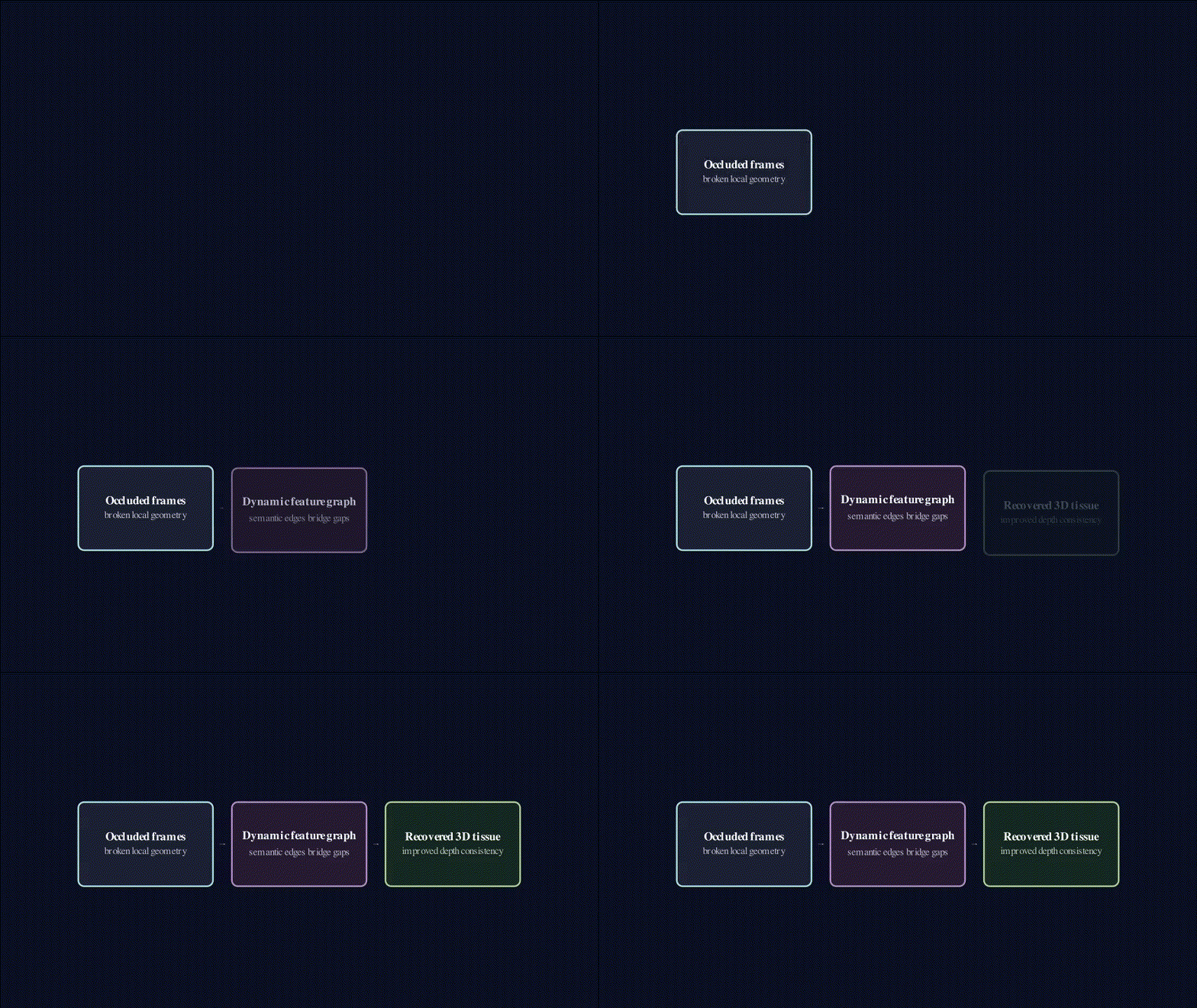
Surgical 3D reconstruction methods like SLAM and NeRF rely on local spatial neighborhoods to estimate depth. This works fine for textured, static scenes. But soft tissue in surgery is a nightmare: smooth surfaces with few features, specular reflections from wetness, and instruments constantly blocking the view. When an instrument occludes part of the tissue, traditional methods lose geometric continuity—they can’t “see through” the gap to understand that the tissue on both sides belongs to the same deforming surface. Prior work (EndoGaussian, EndoSurf) uses fixed spatial topology, so occluded regions become isolated islands with no way to propagate structural information across the gap.
Problem: Occlusion fragments tissue geometry
   |
   v
Assumption: Coherent tissue regions share semantic features
            even when spatially separated
   |
   v
Method: Build dynamic graphs in feature space (not spatial)
        to connect semantically similar regions
   |
   v
Evidence: 24.6% PSNR gain, zero-shot cross-dataset transfer
   |
   v
Conclusion: Feature-space graphs capture domain-agnostic
            geometric priors for non-rigid surfaces
The Increment
One sentence: Before, occluded tissue regions were geometrically isolated; now, they’re connected through learned feature similarity, enabling depth estimation to “see through” instruments.
Core Mechanism
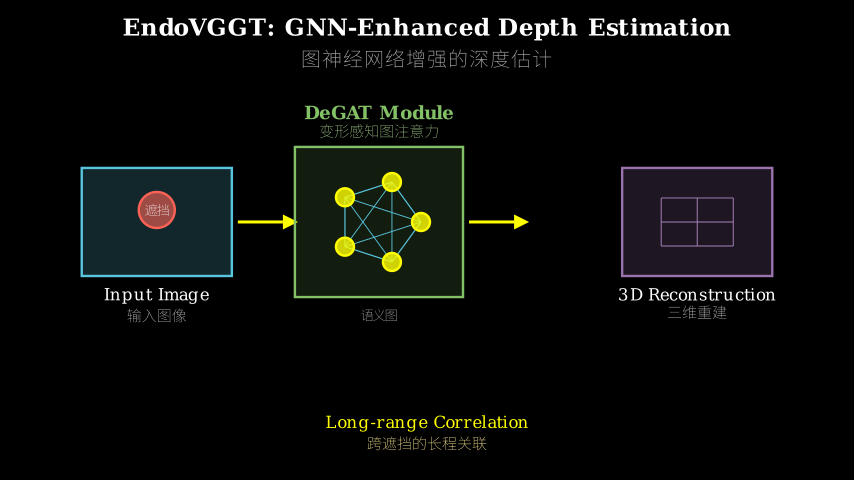
EndoVGGT has three stages. First, a standard encoder extracts multi-scale features from stereo images. Second, the Deformation-aware Graph Attention (DeGAT) module takes these features and builds a graph—but not based on pixel proximity. Instead, it computes feature similarity: pixels with similar appearance/texture get connected, even if they’re far apart spatially. This creates edges between tissue regions that “look alike” (same organ, same lighting, same deformation state). Third, graph attention propagates depth cues along these edges: if region A has confident depth estimates and region B looks similar but is occluded, B borrows geometric information from A through the graph connection.
Stereo Images --> Feature Encoder --> Feature Maps (F)
                                           |
                                           v
                    DeGAT: Compute similarity matrix S = F * F^T
                           Build graph: connect high-similarity pixels
                           Graph attention: aggregate features along edges
                                           |
                                           v
                                    Updated Features (F')
                                           |
                                           v
                              Depth Decoder --> Depth Map
Think of it like a city’s subway system during a street parade. Normally, you’d walk to nearby places (spatial neighbors). But when the parade blocks streets (occlusion), you take the subway to reach distant neighborhoods that “feel similar” (same vibe, same architecture). DeGAT is the subway map: it connects places not by distance, but by shared characteristics. When one station has good information (clear depth), it broadcasts to similar stations through the tunnels, even if they’re on opposite sides of the parade route. The graph edges are the tunnels, feature similarity is the ticket price (high similarity = cheap ticket = strong connection), and graph attention is the broadcast system.
Key Concepts
-
Feature-space graph: Traditional methods connect pixels if they’re close in the image (spatial graph). DeGAT connects pixels if their learned features are similar (feature-space graph). Why does this matter? Imagine two patches of liver tissue separated by a surgical tool. Spatially, they’re disconnected. But their CNN features—encoding texture, color, curvature—are nearly identical. A feature-space graph draws an edge between them, allowing depth information to flow across the occlusion. It’s like recognizing two puzzle pieces belong together not by their position, but by their pattern.
-
Graph attention: Not all connections are equally useful. Graph attention assigns weights to edges based on how relevant each neighbor is. Concretely: for pixel i, compute attention scores with all its feature-neighbors j, then take a weighted sum of their features. High attention = “this neighbor’s geometry is highly relevant to mine.” It’s adaptive: if pixel i is on a flat surface, it attends strongly to other flat regions; if it’s on a fold, it attends to other folds. This prevents smooth regions from being corrupted by irrelevant sharp edges.
-
Zero-shot generalization: The model is trained on SCARED dataset (porcine tissue), then tested on EndoNeRF (different organs, different camera setup) without retraining. It still works. Why? Because DeGAT learns geometric priors (how tissue deforms, how depth relates to shading) that aren’t dataset-specific. It’s not memorizing “this texture means depth=5cm”; it’s learning “regions with similar appearance likely have similar depth gradients.” That’s a structural rule, not a lookup table, so it transfers.
Framework Shift
Before (spatial topology):          After (feature-space topology):

Pixel grid:                         Pixel grid:
[A][B][C]                           [A][B][C]
[D][X][E]  X=occluded               [D][X][E]  X=occluded
[F][G][H]                           [F][G][H]

Connections:                        Connections:
A-B, B-C, D-X, X-E, ...             A-C (similar features)
(fixed spatial neighbors)           D-F (similar features)
                                    B-H (similar features)
X isolated, no info flow            (dynamic, similarity-based)
                                    X borrows from A,C,D,F via graph
One sentence: From fixed spatial grids that fragment under occlusion, to dynamic semantic graphs that maintain connectivity through learned feature similarity.
Expert Assessment
Problem choice: Real gap. Surgical reconstruction is commercially important (robotic surgery, AR guidance), and occlusion is the #1 failure mode for existing methods. Not manufactured—this is where SLAM and NeRF actually break in practice.
Method maturity: Clever but not novel in isolation. Graph attention on images has been explored (e.g., vision transformers are essentially fully-connected graphs). The insight here is applying it to the *depth estimation bottleneck specifically, and showing it helps with occlusion rather than just general feature learning. The DeGAT module itself is straightforward—compute similarity, build graph, apply attention. No exotic operations. The win comes from problem-method fit, not algorithmic innovation.
Experimental integrity: Baselines are fair (EndoGaussian, EndoSurf, Endo-Depth-and-Motion). The 24.6% PSNR gain is large, but SCARED is a controlled dataset—real surgery is messier. The zero-shot result on EndoNeRF is the strongest evidence: different tissue, different setup, still works. However, no ablation on graph construction strategy (why cosine similarity? what about learned metrics?). Also, no failure case analysis—when does DeGAT connect the wrong regions?
Writing quality: Abstract and intro are crisp. Method section is dense—Figure 2 (architecture diagram) does heavy lifting, but the text doesn’t walk through a concrete example. The “deformation-aware” framing is oversold: the method doesn’t explicitly model deformation, it just connects deforming regions via features. Section 4.3 (ablation) is thin—only 3 variants tested. If they’d rewritten Section 3.2 with a step-by-step example (input image → feature map → similarity matrix → graph → output), the paper would be much clearer.
Verdict: weak accept — Solid engineering solution to a real problem with convincing cross-dataset results, but limited algorithmic novelty and shallow analysis of when/why it works.
Takeaways
Steal the graph construction recipe: When your CNN features fragment under domain shift or occlusion, try building a k-NN graph in feature space (cosine similarity, top-k edges) and running a few rounds of graph attention. This is a plug-in module—works with any encoder. The key: don’t just connect spatial neighbors; connect *semantic neighbors.
Zero-shot as a design goal: The authors explicitly tested cross-dataset transfer. Most papers don’t. If your method learns domain-agnostic structure (geometric priors, physical constraints), zero-shot performance is a strong signal you’re not overfitting to dataset quirks. Build this into your eval protocol early.
Feature similarity is underused in dense prediction: Depth estimation, segmentation, optical flow—all treat pixels as independent or use fixed spatial windows. But if two pixels have similar features, they likely have similar labels. A simple similarity-weighted aggregation (like DeGAT) can propagate information across gaps. This is especially useful when ground truth is sparse or noisy.
论文: 2603.24577 作者: Falong Fan, Yi Xie, Arnis Lektauers, Bo Liu, Jerzy Rozenblit 分类: cs.CV, cs.AI
缺口
手术三维重建方法(如 SLAM 和 NeRF)依赖局部空间邻域来估计深度。
这对有纹理的静态场景没问题。
但手术中的软组织是噩梦:光滑表面特征少,湿润表面有镜面反射,器械不断遮挡视野。
当器械遮挡部分组织时,传统方法失去几何连续性——它们无法”透过”缺口理解两侧组织属于同一个变形表面。
先前工作(EndoGaussian、EndoSurf)使用固定空间拓扑,因此被遮挡区域变成孤岛,无法跨越缺口传播结构信息。
问题:遮挡打碎组织几何
   |
   v
假设:连贯的组织区域共享语义特征
      即使空间上分离
   |
   v
方法:在特征空间(非空间)构建动态图
      连接语义相似的区域
   |
   v
证据:PSNR 提升 24.6%,零样本跨数据集迁移
   |
   v
结论:特征空间图捕获领域无关的
      非刚性表面几何先验
增量
一句话: 之前被遮挡的组织区域在几何上孤立;现在通过学习到的特征相似性连接,使深度估计能”透过”器械。
核心机制
EndoVGGT 有三个阶段。
首先,标准编码器从立体图像提取多尺度特征。
其次,变形感知图注意力(DeGAT)模块接收这些特征并构建图——但不基于像素邻近性。
相反,它计算特征相似度:外观/纹理相似的像素被连接,即使它们在空间上相距很远。
这在”看起来相似”的组织区域间创建边(同一器官、同一光照、同一变形状态)。
第三,图注意力沿这些边传播深度线索:如果区域 A 有可信的深度估计,区域 B 看起来相似但被遮挡,B 通过图连接从 A 借用几何信息。
立体图像 --> 特征编码器 --> 特征图 (F)
                                |
                                v
         DeGAT: 计算相似度矩阵 S = F * F^T
                构建图:连接高相似度像素
                图注意力:沿边聚合特征
                                |
                                v
                         更新特征 (F')
                                |
                                v
                   深度解码器 --> 深度图
把它想象成游行期间城市的地铁系统。
正常情况下,你走到附近的地方(空间邻居)。
但当游行封锁街道(遮挡)时,你坐地铁到达”感觉相似”的远处街区(同样的氛围、同样的建筑)。
DeGAT 是地铁地图:它连接的地方不是按距离,而是按共同特征。
当一个站点有好信息(清晰深度)时,它通过隧道向相似站点广播,即使它们在游行路线的两侧。
图的边是隧道,特征相似度是票价(高相似度 = 便宜票 = 强连接),图注意力是广播系统。
关键概念
- 特征空间图: 传统方法在图像中距离近的像素间连接(空间图)。
DeGAT 在学习到的特征相似的像素间连接(特征空间图)。
为什么重要?想象两块被手术工具分隔的肝组织。
空间上,它们断开。
但它们的 CNN 特征——编码纹理、颜色、曲率——几乎相同。
特征空间图在它们之间画一条边,允许深度信息跨越遮挡流动。
就像识别两块拼图属于一起不是靠位置,而是靠图案。
- 图注意力: 不是所有连接都同样有用。
图注意力根据每个邻居的相关性为边分配权重。
具体来说:对于像素 i,计算与所有特征邻居 j 的注意力分数,然后对它们的特征进行加权求和。
高注意力 = “这个邻居的几何与我高度相关。
“它是自适应的:如果像素 i 在平坦表面上,它强烈关注其他平坦区域;如果在褶皱上,它关注其他褶皱。
这防止平滑区域被不相关的尖锐边缘破坏。
- 零样本泛化: 模型在 SCARED 数据集(猪组织)上训练,然后在 EndoNeRF(不同器官、不同相机设置)上测试,无需重新训练。
它仍然有效。
为什么?因为 DeGAT 学习的几何先验(组织如何变形、深度如何与阴影相关)不是数据集特定的。
它不是记忆”这个纹理意味着深度=5cm”;它在学习”外观相似的区域可能有相似的深度梯度。
“那是结构规则,不是查找表,所以它能迁移。
框架转变
之前(空间拓扑):              之后(特征空间拓扑):

像素网格:                      像素网格:
[A][B][C]                       [A][B][C]
[D][X][E]  X=遮挡               [D][X][E]  X=遮挡
[F][G][H]                       [F][G][H]

连接:                          连接:
A-B, B-C, D-X, X-E, ...         A-C (特征相似)
(固定空间邻居)                  D-F (特征相似)
                                B-H (特征相似)
X 孤立,无信息流                (动态,基于相似度)
                                X 通过图从 A,C,D,F 借用
一句话: 从遮挡下碎片化的固定空间网格,到通过学习到的特征相似性保持连通性的动态语义图。
专家评审
选题眼光: 真实缺口。
手术重建有商业重要性(机器人手术、AR 引导),遮挡是现有方法的头号失效模式。
不是人造的——这是 SLAM 和 NeRF 在实践中真正崩溃的地方。
方法成熟度: 巧妙但单独看不新颖。
图像上的图注意力已被探索(例如,视觉 Transformer 本质上是全连接图)。
这里的洞见是将其应用于深度估计瓶颈,并展示它帮助遮挡而不仅仅是一般特征学习。
DeGAT 模块本身很直接——计算相似度、构建图、应用注意力。
没有奇特操作。
胜利来自问题-方法匹配,而非算法创新。
实验诚意: 基线公平(EndoGaussian、EndoSurf、Endo-Depth-and-Motion)。
24.6% 的 PSNR 增益很大,但 SCARED 是受控数据集——真实手术更混乱。
EndoNeRF 上的零样本结果是最强证据:不同组织、不同设置,仍然有效。
然而,没有图构建策略的消融(为什么是余弦相似度?学习度量呢?)。
也没有失败案例分析——DeGAT 何时连接错误区域?
写作功力: 摘要和引言简洁。
方法部分密集——图 2(架构图)承担重任,但文本没有走过具体例子。
“变形感知”框架被夸大:方法没有显式建模变形,它只是通过特征连接变形区域。
第 4.3 节(消融)单薄——只测试了 3 个变体。
如果他们用逐步示例(输入图像 → 特征图 → 相似度矩阵 → 图 → 输出)重写第 3.2 节,论文会清晰得多。
判决: 弱接收 — 对真实问题的可靠工程解决方案,有令人信服的跨数据集结果,但算法新颖性有限,对何时/为何有效的分析浅薄。
要点总结
偷走图构建配方: 当你的 CNN 特征在领域迁移或遮挡下碎片化时,尝试在特征空间构建 k-NN 图(余弦相似度,top-k 边)并运行几轮图注意力。
这是一个插件模块——适用于任何编码器。
关键:不要只连接空间邻居;连接语义邻居。
零样本作为设计目标: 作者明确测试了跨数据集迁移。
大多数论文不这样做。
如果你的方法学习领域无关的结构(几何先验、物理约束),零样本性能是你没有过拟合数据集怪癖的强信号。
早期将其纳入评估协议。
特征相似度在密集预测中未被充分利用: 深度估计、分割、光流——都将像素视为独立或使用固定空间窗口。
但如果两个像素有相似特征,它们可能有相似标签。
简单的相似度加权聚合(如 DeGAT)可以跨越缺口传播信息。
当真值稀疏或有噪声时,这特别有用。