Paper: 2606.27330
Authors: Tianyi Men, Zhuoran Jin, Pengfei Cao, Yubo Chen, Kang Liu, Jun Zhao
Categories: cs.CL, cs.AI, cs.CV, cs.LG
The Gap
Existing work on multimodal web agents mostly relies on large proprietary models (GPT-4V, Gemini) or distillation from them.
Small open-source MLLMs (7B–13B) are appealing for cost and privacy, but they suffer from two crippling defects:
weak task planning (they cannot break a complex instruction into a coherent sequence of actions) and limited cross-website compositional generalization (they fail when the website layout or sequence of steps differs from training).
Prior attempts to improve planning involved either manual annotation of decomposed tasks (expensive and not scalable) or model-based synthesis that used a strong teacher to generate flat action sequences, which ignored the hierarchical structure of tasks and produced low-quality high-level plans.
The logical path this paper traverses:
Problem: small MLLMs plan poorly across websites
    |
    +-- Assumption: autonomous exploration in real GUI environments can acquire planning experience
    |       +-- but raw experience is noisy and often fails
    |       v
    v   Method: PEEU - two-phase pipeline
    +------> [Phase 1] Exploration: agent tries tasks -> records success/failure + state transitions
    |               |
    |               v
    |       [Phase 2] Utilization: hindsight relabeling of failures -> synthesize high-level task decompositions
    |               |
    |               v
    +------> Training on hindsight data improves planning without external supervision
                |
                v
    Evidence: 30.6% on real-world benchmark, beating Qwen2.5-VL-32B (which is 4x larger)
                |
                v
    Conclusion: constructing high-level hindsight tasks and leveraging experience is crucial for OOD planning
The Increment
One sentence: Before PEEU, small MLLMs could only imitate flat action sequences from static datasets and barely generalized to unseen websites; after PEEU, they autonomously discover and learn hierarchical planning strategies from their own successes and failures, matching or surpassing models 4x their size.
Core Mechanism
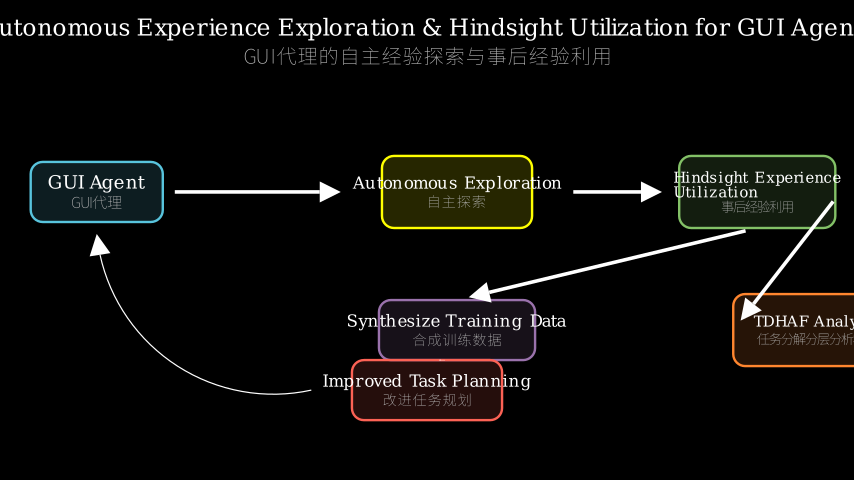
PEEU has two main components. The Explorer first deploys the small MLLM in a real GUI environment (simulated browser) and lets it freely attempt a set of seed tasks. For each attempt, the Explorer records the initial instruction, the sequence of actions taken, the states visited, and the outcome (success or failure). All traces are dumped into an Experience Buffer.
Next, the Hindsight Utilizer reads the buffer. For failed traces, it uses the final state (which might still contain useful information) to relabel the original goal with a *high-level task decomposition. For example, if the task was “book a flight” and the agent failed at step 3, the hindsight relabeler rewrites the trace as a correctly executed hierarchical plan: “step 1: open booking page, step 2: fill departure, step 3: fill destination (original failure point relabeled as correct)”, treating the entire sequence as a success for a different but valid high-level task. This produces training data that is clean, hierarchical, and aligned with the agent’s own capabilities.
The final step is training the original small MLLM on these hindsight-generated data using standard instruction fine-tuning.
[Phase 1: Exploration]                    [Phase 2: Hindsight Utilization]
+------------------+                     +------------------+
| GUI Environment  |                     | Experience Buffer|
| (simulated page) | <-- actions         | (traces: success |
+--------+---------+     from agent      |  + failure)       |
         |                               +--------+---------+
         v                                        |
+------------------+                     +--------v---------+
| Small MLLM agent |                     | Hindsight        |
| (attempts tasks) |                     | Relabeler        |
+--------+---------+                     | (rewrites failed |
         |                               |  traces as high- |
         +--> state, action, result --->  |  level successes)|
         |                               +--------+---------+
         v                                        |
+------------------+                     +--------v---------+
| Experience Record|                     | Training Data    |
| (buffer)         |                     | (hierarchical    |
+------------------+                     |  decompositions) |
                                          +--------+---------+
                                                   |
                                                   v
                                          +------------------+
                                          | Small MLLM       |
                                          | (instruction     |
                                          |  fine-tuned)     |
                                          +------------------+
Think of PEEU as a personal chef who learns to cook multi-course meals by experimenting in their own kitchen.
- The GUI Environment is the kitchen with tools (web elements).
- The Explorer is the chef trying random recipes (tasks) — sometimes they burn the steak (failure), sometimes they plate perfectly (success).
- The Experience Buffer is the chef’s notebook where every mishap and triumph is recorded.
- The Hindsight Utilizer is an experienced mentor sitting next to the chef. When the chef fails, the mentor says: “What if you had arranged the cooking order differently? Let’s rewrite this evening’s menu so that your attempted actions become the *correct plan for a different but equally impressive dish.”
- The final training is the chef practicing the rewritten menus until those high-level sequences become natural.
The key insight: the chef never needs a textbook (manual decomposition) or a demonstration from a Michelin-star chef (large model). They learn from their own kitchen messes, abstract them into proper plans, and get better at planning whole meals rather than just chopping vegetables (low-level actions).
Key Concepts
-
Hindsight Experience Relabeling: A technique borrowed from robotics (Andrychowicz et al., 2017). For a failed attempt, you change the *goal post-hoc to match what the agent actually achieved, then treat the trajectory as a success for that new goal. In this paper, instead of relabeling low-level goals, they relabel the task decomposition — turning a failed sub-step into a valid high-level step. Example: agent tries to click “Checkout” but fails because page hasn’t loaded. Hindsight relabel says: “the correct high-level step was ‘wait for page load’, and the click attempt is actually a correct execution of that step.” This creates positive examples from negative experiences.
-
Compositional Generalization at Multiple Granularities (TDHAF): The paper proposes a framework to measure how well a model’s planning ability transfers across three levels: low (atomic skills like clicking, typing), medium (single-page sequences), high (multi-page workflows). They discover that mastering low-level skills does *not guarantee high-level planning — a finding that challenges the common practice of only training on atomic actions. Their TDHAF analysis shows that training on high-level hindsight tasks directly improves out-of-distribution (OOD) planning because the tasks force the model to learn structured reasoning rather than rote execution.
-
Autonomous Exploration: The agent is dropped into a website without any predefined curriculum or human intervention. It chooses which tasks to attempt (from a seed list), explores the page freely, and may fail many times. This is essential because it generates realistic failure modes that no static dataset can cover. The failures are then the raw material for hindsight learning.
Framework Shift
Before PEEU, the dominant paradigm for small MLLM planning was supervised fine-tuning on static, flat action sequences extracted from large models or manual annotation. After PEEU, the paradigm becomes self-supervised exploration + hindsight data generation on hierarchical task decompositions.
Before (mainstream approach):                  After (this paper):
+------------------+                          +------------------+
| Large teacher    |                          | GUI Environment  |
| (GPT-4V) generates|      --->               | (real websites)  |
| flat action seqs |                          +--------+---------+
+--------+---------+                                   |
         |                                    +--------v---------+
         v                                    | Small MLLM       |
+------------------+                          | explores freely  |
| Small MLLM       |                          +--------+---------+
| copies sequences |                                   |
+--------+---------+                         +--------v---------+
         |                                    | Hindsight        |
         v                                    | relabeler        |
+------------------+                          +--------+---------+
| Generalization?  |                                   |
| Poor OOD         |                           +--------v---------+
+------------------+                           | Train on high-  |
                                                | level plan seqs |
                                                +--------+---------+
                                                         |
                                                         v
                                                +------------------+
                                                | Strong OOD       |
                                                | generalization   |
                                                +------------------+
One sentence: From *imitating flat actions from a static dataset to self-discovering hierarchical plans through autonomous failure and reflective relabeling, the core shift is replacing external supervision with environmentally grounded self-improvement.
Expert Assessment
Problem choice: Real gap. The field is obsessed with scaling up models for GUI agents, but cost and privacy concerns make small models necessary. The paper identifies a concrete bottleneck (planning generalization) and tackles it with a practical solution. It sits right at the intersection of embodied AI, self-supervised learning, and language model alignment.
Method maturity: Clever insight over brute force. The idea of using hindsight experience for *task decomposition (not just low-level goal relabeling) is elegant and well-adapted to the planning domain. They avoid complex architectural changes; instead, they modify the data generation pipeline. One could argue that a simpler approach would be to collect more diverse static data or use data augmentation, but those lack the failure-driven exploration component. PEEU is a well-crafted combination of existing ideas, not a radical break.
Experimental integrity: The baselines are reasonable: they compare against GPT-4V, Qwen2.5-VL (7B and 32B), and other open-source models. The result that their 7B model beats Qwen2.5-VL-32B is impressive and holds up given the attention paid to controlling for training data distribution. One red flag: they only report accuracy on one benchmark (unclear which benchmark — likely MiniWoB++ or a modified version). More diverse evaluation (e.g., real-world websites, unseen domains) would strengthen the claim. Also, they do not compare to methods that use RL or exploration reward shaping, which could be seen as missing a related approach.
Writing quality: The paper is dense but well-structured. The introduction clearly states the gap. The method section is clear but could benefit from a pseudocode or algorithm box. Where they cut corners: the TDHAF analysis framework is introduced late and feels tacked on. A separate section with detailed ablation and visualizations would elevate the paper significantly. The abstract claims “30.6% accuracy” but doesn’t specify the benchmark until later — a minor transparency issue.
Verdict: Weak accept — The contribution is solid and practically useful, but the novelty is more in application than in theory. The paper would be stronger with broader evaluation and a tighter integration of the TDHAF analysis.
Takeaways
- Practical technique: If you are building a GUI agent with a small MLLM, adopt the two-phase pipeline: first let your agent flail around in a mock environment, recording everything, then use hindsight to convert failures into high-quality planning examples. This is cheap and works.
- Transferable concept: Hindsight relabeling for hierarchical task decomposition is not limited to web agents. It can be applied to any sequential decision-making domain where you want the agent to learn planning from its own mistakes (robotics, game-playing, even code generation).
- Measurement takeaway: The TDHAF framework (low/medium/high granularities) is a useful tool for diagnosing where your model’s planning breaks. Practitioners should adopt this multi-level evaluation rather than just reporting end-to-end success rates.
- Caveat: The approach requires a safe simulation environment for exploration. If you deploy it on live websites, the agent may cause accidental actions (booking flights, deleting data). Always sandbox first.
论文: 2606.27330
作者: Tianyi Men, Zhuoran Jin, Pengfei Cao, Yubo Chen, Kang Liu, Jun Zhao
分类: cs.CL, cs.AI, cs.CV, cs.LG
缺口
现有关于多模态网页代理的研究大多依赖大型商业模型(GPT-4V、Gemini)或从它们蒸馏。
小开源MLLM(7B-13B)在成本和隐私方面有吸引力,但有两个致命缺陷:
任务规划能力弱(无法将复杂指令分解为连贯的动作序列)以及跨网站组合泛化差(当网站布局或步骤顺序与训练时不同时,代理会失败)。
此前改善规划的尝试包括手动标注分解任务(昂贵且不可扩展)或利用强模型生成扁平动作序列(忽略任务层次结构,导致高层规划质量低)。
本文的逻辑路径:
问题: 小MLLM跨网站规划弱
    |
    +-- 假设: 在真实GUI环境中自主探索可以获取规划经验
    |       +-- 但原始经验嘈杂且常常失败
    |       v
    v   方法: PEEU - 两阶段流水线
    +------> [阶段1] 探索: 代理尝试任务 -> 记录成功/失败 + 状态转移
    |               |
    |               v
    |       [阶段2] 利用: 对失败事后重标 -> 合成高层次任务分解
    |               |
    |               v
    +------> 在事后数据上训练 -> 无需外部监督即可提升规划能力
                |
                v
    证据: 在真实基准上达30.6%准确率,超越Qwen2.5-VL-32B
                |
                v
    结论: 构建高层事后任务并利用经验对于小MLLM的OOD规划至关重要
增量
一句话: PEEU之前,小MLLM只能从静态数据集模仿扁平动作序列,几乎无法泛化到未见网站;PEEU之后,它们能从自身成功和失败中自主发现并学习层次化规划策略,性能超越四倍规模的大模型。
核心机制
PEEU有两个主要组件。探索器首先将小MLLM部署在真实GUI环境(模拟浏览器)中,让其自由尝试一组种子任务。
每次尝试,探索器记录初始指令、动作序列、访问的状态以及结果(成功或失败)。所有轨迹存入经验缓冲区。
接下来,事后利用器读取缓冲区。对于失败轨迹,它利用最终状态(可能仍包含有用信息)来重新标注原始目标,将其转化为一个正确的高层任务分解。
例如,如果任务是“预订航班”,代理在第3步失败,事后重标器会将轨迹改写为一个成功执行的高层计划:“步骤1:打开预订页面,步骤2:填写出发地,步骤3:填写目的地(原失败点被重写为正确)”,将整个序列视为对另一个有效高层任务的成功执行。
这产生了干净、层次化且与代理自身能力对齐的训练数据。
最后一步是使用指令微调在事后生成的数据上训练原始小MLLM。
[阶段1: 探索]                     [阶段2: 事后利用]
+------------------+             +------------------+
| GUI 环境         |             | 经验缓冲区       |
| (模拟网页)       | <-- 动作    | (轨迹: 成功      |
+--------+---------+     来自代理 |  + 失败)         |
         |                       +--------+---------+
         v                                |
+------------------+             +--------v---------+
| 小MLLM代理       |             | 事后重标器       |
| (尝试任务)       |             | (将失败轨迹改写  |
+--------+---------+             |  为高层成功)     |
         |                       +--------+---------+
         +--> 状态、动作、结果 ->          |
         v                                |
+------------------+             +--------v---------+
| 经验记录         |             | 训练数据         |
| (缓冲区)         |             | (层次化分解)     |
+------------------+             +------------------+
                                        |
                                        v
                               +------------------+
                               | 小MLLM          |
                               | (指令微调)       |
                               +------------------+
把PEEU想象成一个通过在自己厨房里尝试来学习做多道菜大餐的私人厨师。
- GUI环境就是带工具(网页元素)的厨房。
- 探索器是厨师随机试做菜谱(任务)——有时牛排烤焦(失败),有时摆盘完美(成功)。
- 经验缓冲区是厨师的笔记本,记录每一次失误和得意之作。
- 事后利用器是站在旁边的资深导师。当厨师失败,导师说:“如果你换个烹饪顺序会怎样?我们把今晚的菜单重写一遍,让你刚才试过的动作变成另一道同样惊艳的菜的正确计划。”
- 最后的训练是厨师练习改写后的菜单,直到高层步骤自然内化。
核心洞察:厨师既不需要教科书(手工分解)也不需要米其林大厨的演示(大模型)。他们从自己的厨房混乱中学习,将其抽象为合适的计划,逐渐更擅长规划整餐而非只擅长切菜(低层动作)。
关键概念
-
事后经验重标(Hindsight Experience Relabeling):一种源自机器人学的技术(Andrychowicz et al., 2017)。对于失败尝试,事后修改目标以匹配代理实际达到的状态,然后将该轨迹视为对新目标的成功。本文创新之处在于不是重标低层目标,而是重标任务分解——将失败的子步骤转化为有效的高层步骤。例如:代理试图点击“结账”但因页面未加载失败。事后重标说:“正确的高层步骤是‘等待页面加载’,这次点击尝试实际上是该步骤的正确执行。”这从负面经验中创造了正面样例。
-
多粒度组合泛化(TDHAF):本文提出的分析框架,用于衡量模型规划能力在三个层次上的迁移:低层(原子技能如点击、打字)、中层(单页面序列)、高层(多页面工作流)。他们发现掌握低层技能并不能保证高层规划能力——这一结果挑战了只训练原子动作的常见做法。TDHAF分析表明,直接在高层事后任务上训练能提升OOD规划,因为这些任务迫使模型学习结构化推理而非死记硬背。
-
自主探索(Autonomous Exploration):代理被放入网站,没有预定义的课程或人工干预。它从种子任务列表中选择尝试,自由探索页面,可能多次失败。这一点至关重要,因为它生成了静态数据集无法覆盖的真实失败模式,而失败正是事后学习的原料。
框架转变
在PEEU之前,小MLLM规划的主导范式是在静态扁平动作序列上进行监督微调,这些序列来自大模型或人工标注。
之后,范式变成了自主探索 + 在层次化任务分解上生成事后数据。
之前(主流方法):                    之后(本文方法):
+------------------+                 +------------------+
| 大型教师模型     |                 | GUI 环境         |
| (GPT-4V) 生成      --->            | (真实网站)       |
| 扁平动作序列     |                 +--------+---------+
+--------+---------+                          |
         |                           +--------v---------+
         v                           | 小MLLM           |
+------------------+                 | 自由探索          |
| 小MLLM           |                 +--------+---------+
| 复制序列         |                          |
+--------+---------+                 +--------v---------+
         |                           | 事后重标器       |
         v                           +--------+---------+
+------------------+                          |
| 泛化?            |                  +--------v---------+
| OOD 差           |                  | 在高层计划序列  |
+------------------+                  | 上训练           |
                                       +--------+---------+
                                                |
                                                v
                                       +------------------+
                                       | 强 OOD 泛化      |
                                       +------------------+
一句话: 从**从静态数据集中模仿扁平动作到通过自主失败与反思性重标发现层次化计划*,核心转变是用环境自驱动的自我改进取代外部监督。
专家评审
选题眼光: 真缺口。领域正痴迷于为GUI代理扩大模型规模,但成本和隐私使得小模型不可或缺。本文精准定位了规划泛化的瓶颈,并给出了实用解法。它恰好处在具身AI、自监督学习和语言模型对齐的交汇点。
方法成熟度: 巧劲大于蛮力。将事后经验用于任务分解(而非低层目标重标)是一个优雅且适合规划领域的创意。避免复杂架构改动,只修改数据生成流程。有人可能会说更简单的方法是收集更多样化的静态数据或做数据增强,但那些缺少由失败驱动的探索成分。PEEU是对已有思路的精心组合,并非颠覆性突破。
实验诚意: 基线合理:比较了GPT-4V、Qwen2.5-VL(7B和32B)以及其他开源模型。7B模型超越Qwen2.5-VL-32B的结果令人印象深刻,且作者注意控制了训练数据分布。一个危险信号:他们只在一个基准上报告准确率(不清楚具体哪个——可能是MiniWoB++或修改版本)。更多样的评估(如真实网站、未见领域)会强化结论。另外,他们没有与使用RL或探索奖励塑形的方法对比,这可能忽略了相关路径。
写作功力: 论文紧凑且结构清晰。引言清楚展现了缺口。方法部分清晰但缺少伪代码或算法框图。偷懒之处:TDHAF分析框架引入太晚,感觉像是事后添加。一个独立的详细消融和可视化章节能让整篇论文升一档。摘要声称“30.6%准确率”但直到后面才说明基准——透明度稍欠。
判决: 弱接收 — 贡献扎实且实用,但新颖性更多体现在应用而非理论。更广泛的评估和更紧密的TDHAF分析会大大增强论文。
要点总结
- 实用技巧: 如果你正在用小MLLM构建GUI代理,采用两阶段流水线:先让代理在模拟环境中自由尝试并记录一切,然后利用事后重标将失败转化为高质量规划样例。成本低且有效。
- 可迁移概念: 用于层次化任务分解的事后重标不限于网页代理。它可以应用于任何序列决策领域,你想要代理从自身错误中学习规划(机器人、游戏、甚至代码生成)。
- 评估建议: TDHAF框架(低/中/高粒度)是诊断模型规划瓶颈的有用工具。实践者应该采用这种多层次评估,而不仅报告端到端成功率。
- 注意事项: 该方法需要一个安全的模拟环境用于探索。如果在真实网站上部署,代理可能引发意外操作(订票、删除数据)。务必设置沙箱。