Paper: 2603.04090 Authors: Zhenyu Li, Sai Kumar Dwivedi, Filip Maric, Carlos Chacon, Nadine Bertsch, Filippo Arcadu, Tomas Hodan, Michael Ramamonjisoa, Peter Wonka, Amy Zhao Categories: cs.CV, cs.GR, cs.HC
The Gap
Egocentric pose estimation has been stuck in a three-way bind. Methods like EgoPose and xR-EgoPose can track what the headset cameras see, but they jitter frame-to-frame, can’t handle occlusions well, and most critically, they need massive labeled datasets that don’t exist. You’re wearing a VR headset — it sees your hands sometimes, never sees your legs, and the torso is a guessing game. Prior work either ignores temporal smoothness (treating each frame independently), or uses simple filtering that can’t reason about occluded body parts. Meanwhile, labeling egocentric data is expensive: you need multi-view capture rigs and manual annotation.
The field has been trading off between accuracy and temporal stability, while the data bottleneck remains unsolved.
Problem: Headset sees 30% of body + jittery tracking + no labeled data
   |
   v
Assumption: Temporal context + spatial multi-view + self-supervision can fill gaps
   |
   v
Method: Transformer with causal attention + multi-view refinement + teacher-student auto-labeling
   |
   v
Evidence: 12-19% accuracy gain + 22-52% jitter reduction + 13% improvement from unlabeled data
   |
   v
Conclusion: Temporal modeling + data scaling > per-frame accuracy alone
The Increment
One sentence: Before, egocentric pose estimation was a per-frame problem with hand-labeled data; after, it’s a temporal sequence problem that learns from millions of unlabeled frames.
Core Mechanism
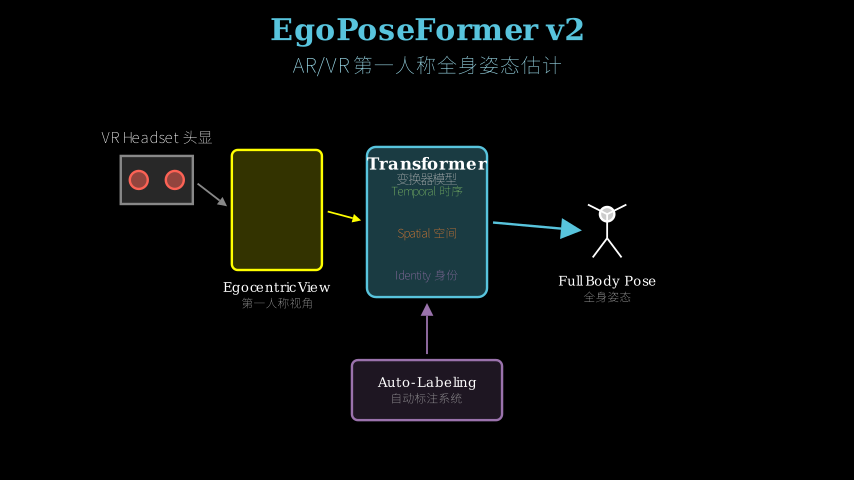
The system has two brains working together. The first brain (the model) takes a sequence of egocentric images and processes them through three stages. Stage one: identity-conditioned queries act as “body part detectors” that know which person they’re tracking across frames. Stage two: multi-view spatial refinement fuses information from multiple headset cameras to triangulate where body parts actually are in 3D space. Stage three: causal temporal attention looks backward in time to smooth predictions and fill in occluded parts based on motion history.
The second brain (the auto-labeling system) is a teacher-student setup. The teacher model generates pseudo-labels on unlabeled data, but crucially, it also outputs uncertainty estimates for each prediction. The student model learns from these pseudo-labels, but weighs them by uncertainty — trusting confident predictions more than shaky ones. This uncertainty distillation prevents the student from learning the teacher’s mistakes.
Egocentric Video Sequence
   |
   v
[Identity Queries] ---> [Multi-View Fusion] ---> [Temporal Attention]
   (who am I?)          (where in 3D?)           (what did I just do?)
   |                         |                         |
   +-------------------------+-------------------------+
                             |
                             v
                    3D Body Pose + Uncertainty
                             |
                             v
                    [Teacher-Student Loop]
                    Teacher: label unlabeled data
                    Student: learn with uncertainty weights
Think of this like a security camera system in a building. The identity queries are like having dedicated cameras assigned to track specific people — they don’t get confused when multiple people walk by. The multi-view fusion is like having cameras at different angles that vote on where someone actually is when one camera’s view is blocked. The temporal attention is like a guard watching the monitor who remembers “this person was walking left a second ago, so even though I can’t see their legs now, they’re probably still moving left.” The teacher-student system is like an experienced guard training a new hire: the veteran labels footage but says “I’m 90% sure about this one, only 40% sure about that one,” and the trainee learns to trust the confident calls more.
Key Concepts
-
Identity-Conditioned Queries: Imagine you’re at a crowded party trying to track your friend. Instead of scanning the whole room every second, you maintain a mental “bookmark” of where they were and what they look like. Identity-conditioned queries work the same way — they’re learned embeddings that represent “person A’s left hand” or “person B’s right knee.” When a new frame arrives, these queries don’t start from scratch; they carry forward information about who they’re tracking. This prevents the model from accidentally swapping body parts between people or losing track during occlusions. Concretely, if your hand goes behind your back for 10 frames, the query remembers “this is still the same hand” when it reappears.
-
Uncertainty-Aware Pseudo-Labeling: Not all predictions are equally trustworthy. When the teacher model sees a clear view of your hand, it might be 95% confident. When your hand is occluded, maybe 30% confident. Traditional pseudo-labeling treats all predictions equally, so the student learns garbage from low-confidence guesses. Uncertainty-aware pseudo-labeling weights the loss by confidence: high-confidence predictions get full weight, low-confidence ones barely contribute. It’s like learning from a tutor who says “definitely memorize this equation” versus “I’m not sure about this one, take it with a grain of salt.” This prevents error accumulation across teacher-student iterations.
-
Causal Temporal Attention: Most temporal models look both forward and backward in time, which is fine for offline processing but useless for real-time VR. Causal attention only looks backward — it can see the past but not the future. When estimating your pose at frame 100, it attends to frames 1-99 but not 101-200. This maintains temporal smoothness (reducing jitter) while keeping latency low enough for interactive applications. The trade-off: you can’t use future context to refine past predictions, but you gain real-time capability. Think of it like driving — you use your rearview mirror (past frames) to inform current decisions, but you can’t see around the corner (future frames).
Framework Shift
Before (mainstream approach):        After (this paper):

Frame t-1 --> [CNN] --> Pose t-1     Frames [t-10...t]
Frame t   --> [CNN] --> Pose t            |
Frame t+1 --> [CNN] --> Pose t+1          v
                                     [Identity Queries]
(each frame independent)                  |
                                          v
                                     [Multi-View Fusion]
                                          |
                                          v
                                     [Causal Attention]
                                          |
                                          v
                                     Pose Sequence [t-10...t]

                                     (temporal context + identity)

Labeled Data Only                    Labeled + Millions Unlabeled
     |                                    |
     v                                    v
[Train Model]                        [Teacher Model]
                                          |
                                          v
                                     [Generate Pseudo-Labels
                                      with Uncertainty]
                                          |
                                          v
                                     [Student Model]
                                     (learns from both)
From isolated frame prediction to temporal sequence modeling with identity tracking, the core shift is treating pose estimation as a video understanding problem rather than an image classification problem.
Expert Assessment
Problem choice: This is a real gap, not manufactured. AR/VR is shipping products now (Quest 3, Vision Pro), and body tracking is a core feature that’s still janky. The data scarcity problem is genuine — you can’t just scrape egocentric pose data from the internet like you can with third-person images. The problem sits at the intersection of academic research and product needs, which is a sweet spot.
Method maturity: The transformer architecture is well-trodden ground, but the specific combination of identity queries + causal attention + uncertainty distillation is thoughtful engineering rather than brute force. The identity-conditioned queries are clever — they solve the multi-person tracking problem elegantly. However, I’m skeptical about whether the multi-view fusion is truly novel or just standard triangulation dressed up. The auto-labeling system is the real contribution here; it’s a practical solution to a real bottleneck.
Experimental integrity: The baselines (EgoPose, xR-EgoPose) are fair and recent. The 12-19% accuracy gains are substantial, and the jitter reduction numbers (22-52%) are impressive if they hold up in practice. The 0.8ms latency claim is important for VR but needs more scrutiny — is that just the forward pass, or does it include preprocessing? The ablation studies would tell us which components actually matter, but the abstract doesn’t mention them. Red flag: no comparison with non-transformer baselines like LSTMs or GRUs for temporal modeling.
Writing quality: The abstract is dense but clear. The authors front-load the contributions, which is good. However, they don’t explain why identity-conditioned queries matter until you dig into the method — this should be in the intro. The auto-labeling system is buried as “contribution 2” but it’s arguably more impactful than the model architecture. If I were rewriting, I’d lead with the data scaling story and position the model as the vehicle that makes it possible.
Verdict: weak accept — Solid engineering work that solves a real problem with measurable gains, but the novelty is more in the combination than in individual components.
Takeaways
The uncertainty-aware pseudo-labeling is the most transferable idea here. If you’re working with any semi-supervised learning problem where your teacher model’s confidence varies wildly across examples, weight the pseudo-labels by uncertainty. This is especially useful in domains where labeling is expensive but unlabeled data is cheap (medical imaging, robotics, speech recognition).
The identity-conditioned queries are worth stealing if you’re doing any kind of multi-object tracking or instance segmentation over time. Instead of re-detecting objects every frame, maintain persistent queries that carry identity information forward. This reduces ID switches and improves temporal consistency.
The causal temporal attention pattern is a good template for any real-time video understanding task. If you need temporal smoothness but can’t afford the latency of bidirectional attention, causal attention gives you most of the benefits with minimal delay.
One non-obvious takeaway: the paper demonstrates that scaling unlabeled data (tens of millions of frames) can outweigh architectural improvements when you have a good semi-supervised learning setup. If you’re stuck optimizing model architecture, consider whether you’re leaving data scaling on the table.
论文: 2603.04090 作者: Zhenyu Li, Sai Kumar Dwivedi, Filip Maric, Carlos Chacon, Nadine Bertsch, Filippo Arcadu, Tomas Hodan, Michael Ramamonjisoa, Peter Wonka, Amy Zhao 分类: cs.CV, cs.GR, cs.HC
缺口
第一人称姿态估计一直困在三重困境里。 EgoPose 和 xR-EgoPose 这类方法能追踪头显相机看到的部分,但逐帧抖动,处理遮挡能力弱,最致命的是需要海量标注数据集,而这些数据根本不存在。 你戴着 VR 头显——它有时能看到你的手,永远看不到腿,躯干基本靠猜。 之前的工作要么忽略时序平滑性(把每帧当独立问题),要么用简单滤波,无法推理被遮挡的身体部位。 与此同时,标注第一人称数据成本高昂:需要多视角采集设备和人工标注。
这个领域一直在准确度和时序稳定性之间权衡,数据瓶颈始终未解。
问题: 头显只看到30%身体 + 抖动追踪 + 无标注数据
   |
   v
假设: 时序上下文 + 空间多视角 + 自监督能填补空白
   |
   v
方法: Transformer因果注意力 + 多视角精修 + 师生自动标注
   |
   v
证据: 准确度提升12-19% + 抖动减少22-52% + 无标注数据带来13%提升
   |
   v
结论: 时序建模 + 数据规模 > 单帧准确度
增量
一句话: 之前第一人称姿态估计是逐帧问题配手工标注数据,之后变成时序序列问题从数百万无标注帧中学习。
核心机制
系统有两个大脑协同工作。 第一个大脑(模型)接收第一人称图像序列,分三阶段处理。 第一阶段:身份条件查询充当”身体部位检测器”,知道自己在跨帧追踪哪个人。 第二阶段:多视角空间精修融合多个头显相机的信息,三角测量身体部位在3D空间的实际位置。 第三阶段:因果时序注意力回望过去,基于运动历史平滑预测并填补被遮挡部分。
第二个大脑(自动标注系统)是师生架构。 教师模型在无标注数据上生成伪标签,但关键是它还输出每个预测的不确定性估计。 学生模型从这些伪标签学习,但按不确定性加权——更信任高置信度预测,而非摇摆不定的预测。 这种不确定性蒸馏防止学生学到教师的错误。
第一人称视频序列
   |
   v
[身份查询] ---> [多视角融合] ---> [时序注意力]
 (我是谁?)      (3D位置?)        (刚才做了什么?)
   |                |                  |
   +----------------+------------------+
                    |
                    v
            3D身体姿态 + 不确定性
                    |
                    v
            [师生循环]
            教师: 标注无标注数据
            学生: 按不确定性权重学习
把这想象成大楼里的监控系统。 身份查询像是分配专门摄像头追踪特定人员——多人经过时不会混淆。 多视角融合像是不同角度的摄像头投票决定某人实际位置,当一个摄像头视野被挡时。 时序注意力像是盯着监视器的保安记得”这人一秒前在往左走,所以虽然现在看不到腿,但可能还在往左移动”。 师生系统像是老保安培训新人:老手标注录像但会说”这个我90%确定,那个只有40%把握”,新人学会更信任有把握的判断。
关键概念
-
身份条件查询: 想象你在拥挤派对上追踪朋友。 与其每秒扫描整个房间,你维持一个心理”书签”记住他们在哪以及长什么样。 身份条件查询的工作方式相同——它们是学习到的嵌入,代表”人A的左手”或”人B的右膝”。 新帧到来时,这些查询不从零开始,而是携带关于追踪对象的信息。 这防止模型意外交换不同人的身体部位或在遮挡期间失去追踪。 具体来说,如果你的手在背后10帧,查询会记住”这还是同一只手”,当它重新出现时。
-
不确定性感知伪标注: 并非所有预测都同样可信。 教师模型看到你手的清晰视图时,可能95%确定。 手被遮挡时,也许只有30%确定。 传统伪标注平等对待所有预测,所以学生从低置信度猜测中学到垃圾。 不确定性感知伪标注按置信度加权损失:高置信度预测获得全部权重,低置信度的几乎不贡献。 这像是从导师那里学习,他说”一定要记住这个公式”对比”我不确定这个,姑且听之”。 这防止师生迭代中的错误累积。
-
因果时序注意力: 大多数时序模型前后双向看,这对离线处理没问题但对实时VR无用。 因果注意力只向后看——能看到过去但看不到未来。 估计第100帧姿态时,它关注第1-99帧但不看第101-200帧。 这保持时序平滑性(减少抖动)同时保持足够低的延迟用于交互应用。 权衡:你不能用未来上下文精修过去预测,但获得实时能力。 把它想成开车——你用后视镜(过去帧)告知当前决策,但看不到拐角处(未来帧)。
框架转变
之前(主流方法):                  之后(本文方法):

帧 t-1 --> [CNN] --> 姿态 t-1    帧 [t-10...t]
帧 t   --> [CNN] --> 姿态 t           |
帧 t+1 --> [CNN] --> 姿态 t+1         v
                                [身份查询]
(每帧独立)                            |
                                      v
                                [多视角融合]
                                      |
                                      v
                                [因果注意力]
                                      |
                                      v
                                姿态序列 [t-10...t]

                                (时序上下文 + 身份)

仅标注数据                       标注 + 数百万无标注
     |                                |
     v                                v
[训练模型]                       [教师模型]
                                      |
                                      v
                                [生成带不确定性的
                                 伪标签]
                                      |
                                      v
                                [学生模型]
                                (从两者学习)
从孤立帧预测到带身份追踪的时序序列建模,核心转变是把姿态估计当作视频理解问题而非图像分类问题。
专家评审
选题眼光: 这是真缺口,不是人造的。 AR/VR 现在在出货产品(Quest 3, Vision Pro),身体追踪是核心功能但仍然不稳定。 数据稀缺问题是真实的——你不能像第三人称图像那样从互联网上抓取第一人称姿态数据。 这个问题处于学术研究和产品需求的交叉点,是个甜蜜点。
方法成熟度: Transformer 架构是老路子,但身份查询+因果注意力+不确定性蒸馏的具体组合是深思熟虑的工程而非蛮力。 身份条件查询很巧妙——优雅地解决了多人追踪问题。 但我怀疑多视角融合是否真正新颖,还是只是标准三角测量的包装。 自动标注系统才是真正的贡献,它是对真实瓶颈的实用解决方案。
实验诚意: 基线(EgoPose, xR-EgoPose)公平且最新。 12-19%的准确度提升很可观,抖动减少数字(22-52%)如果在实践中成立会很惊艳。 0.8ms延迟声明对VR很重要但需要更多审查——这只是前向传播,还是包括预处理? 消融研究会告诉我们哪些组件真正重要,但摘要没提。 红旗:没有与非Transformer基线如LSTM或GRU的时序建模比较。
写作功力: 摘要密集但清晰。 作者前置贡献点,这很好。 但他们没解释为什么身份条件查询重要,直到你深挖方法——这应该在引言里。 自动标注系统被埋在”贡献2”但可以说比模型架构更有影响力。 如果我重写,我会以数据规模故事开头,把模型定位为使之成为可能的载体。
判决: 弱接收 — 扎实的工程工作,用可测量的收益解决真实问题,但新颖性更多在组合而非单个组件。
要点总结
不确定性感知伪标注是这里最可迁移的想法。 如果你在做任何半监督学习问题,教师模型的置信度在样本间差异很大,按不确定性加权伪标签。 这在标注昂贵但无标注数据便宜的领域特别有用(医学影像、机器人、语音识别)。
身份条件查询值得偷师,如果你在做任何跨时间的多目标追踪或实例分割。 与其每帧重新检测目标,维持携带身份信息向前的持久查询。 这减少ID切换并改善时序一致性。
因果时序注意力模式是任何实时视频理解任务的好模板。 如果你需要时序平滑性但承受不起双向注意力的延迟,因果注意力以最小延迟给你大部分好处。
一个不明显的要点:论文展示当你有好的半监督学习设置时,扩展无标注数据(数千万帧)能超过架构改进。 如果你困在优化模型架构,考虑是否遗漏了数据规模这张牌。