Paper: 2605.30337 Authors: Alaa Khamis, Alaa Maalouf Categories: cs.LG
The Gap
Test-time finetuning (TTFT) adapts language models per query by retrieving related examples and updating weights before inference. Existing methods face a quality-speed dilemma: fast nearest-neighbor retrieval often grabs redundant examples (high overlap, low diversity), while diversity-aware selection methods like determinantal point processes are too slow for per-query use. The core tension is that retrieval happens in the critical path—every millisecond counts, but naive speed sacrifices adaptation quality.
Problem: TTFT needs both speed and diversity
   |
   v
Existing approaches split:
   |
   +---> Fast retrieval (k-NN)  ---> Redundant examples ---> Weak adaptation
   |
   +---> Diverse selection (DPP) ---> Slow per-query ---> Impractical
   |
   v
This paper's path:
   Geometric projection (Frank-Wolfe on convex hull)
   |
   v
   Sparse support set (relevant + diverse)
   |
   v
   Integer multiset via geometric rounding
   |
   v
   Gradient reuse across repeated examples
   |
   v
   Result: Better quality at lower total cost
The Increment
One sentence: Before HullFT, you chose between fast-but-redundant retrieval or slow-but-diverse selection; after HullFT, geometric projection gives you both by representing queries as sparse convex combinations of training points, with gradient caching turning repeated examples into a computational advantage.
Core Mechanism
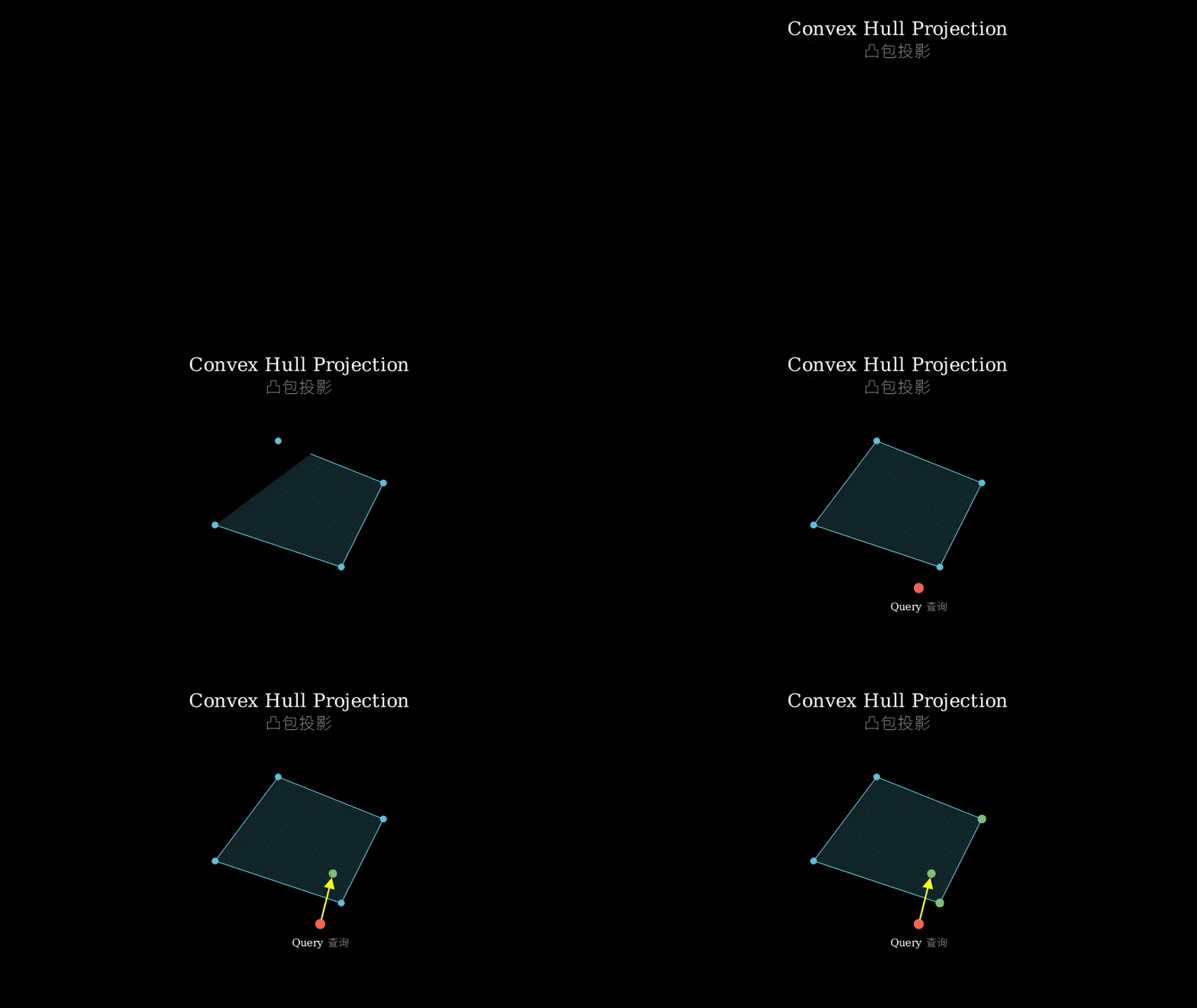
HullFT has three stages. First, given a query embedding, it finds a sparse convex combination of training embeddings that reconstructs the query—think of it as expressing the query as a weighted average of a few training points. This uses Frank-Wolfe optimization, which iteratively adds the training point with the highest inner product to the current mixture. The sparsity constraint ensures only a small support set is selected, and the convex hull geometry naturally enforces diversity (points far apart in embedding space contribute more to reconstruction).
Second, the fractional weights from the convex combination (e.g., 0.3, 0.5, 0.2) need to become integer counts for finetuning. HullFT uses a geometric integerization procedure that rounds these weights to integers while preserving the total budget and minimizing distortion. This produces a multiset—some examples appear multiple times.
Third, during finetuning, HullFT exploits the repeated examples. Instead of recomputing gradients for each occurrence, it caches the gradient from the first pass and reuses it for subsequent identical examples. This amortizes the forward-backward cost across repetitions, making the finetuning step faster without sacrificing quality.
Query embedding q
   |
   v
[Frank-Wolfe on convex hull]
   Find: q ~= w1*e1 + w2*e2 + ... + wk*ek
   where e_i are training embeddings, w_i >= 0, sum(w_i) = 1
   |
   v
Sparse support: \{(e1, w1), (e2, w2), ..., (ek, wk)\}
   |
   v
[Geometric integerization]
   Round weights to integers: \{(e1, n1), (e2, n2), ...\}
   |
   v
Multiset for finetuning: [e1, e1, ..., e2, e2, ..., ek, ...]
   |
   v
[Gradient caching]
   First pass on e1: compute gradient g1, cache it
   Subsequent passes on e1: reuse g1 (skip forward-backward)
   |
   v
Updated model -> Evaluate query
Think of HullFT as budget allocation in a portfolio. You have a query (your investment goal) and a universe of training examples (available assets). The convex hull projection is like finding the minimal set of assets whose weighted combination matches your goal—you want few assets (sparsity) that are complementary (diversity), not redundant. The fractional weights are your ideal allocation percentages, but you can only buy whole shares, so you round them to integers (integerization). Finally, when you execute the trades, if you’re buying multiple shares of the same asset, you don’t recalculate its value each time—you cache the first calculation and reuse it (gradient caching). The portfolio metaphor maps directly: query ↔ goal, training examples ↔ assets, convex weights ↔ allocation, integerization ↔ whole shares, gradient reuse ↔ cached valuation.
Key Concepts
-
Convex hull and sparse reconstruction: Imagine you’re standing in a room and want to describe your position using only a few landmarks. The convex hull is the smallest “tent” stretched over all landmarks—any point inside can be expressed as a weighted average of the tent’s corners. Sparse reconstruction means using as few landmarks as possible. In HullFT, the query embedding is your position, training embeddings are landmarks, and Frank-Wolfe finds the minimal set of landmarks (and their weights) that pinpoint your location. This is powerful because landmarks far apart naturally contribute more (diversity), while nearby redundant landmarks get zero weight (relevance without redundancy).
-
Frank-Wolfe optimization: Standard optimization methods (like gradient descent) take small steps in the direction that improves the objective. Frank-Wolfe is different: at each step, it solves a simpler linear problem (find the single best point to add) and moves toward that point. It’s “projection-free” because you never need to explicitly project onto the constraint set—you just pick from the vertices. For HullFT, this means each iteration adds one training example (the one with highest similarity to the current residual), making it naturally sparse and fast. Concrete example: if your query is “explain quantum entanglement,” and you’ve already selected a physics textbook excerpt, Frank-Wolfe next picks the example that best covers what’s still missing—maybe a simple analogy—rather than another physics textbook.
-
Gradient reuse: In standard finetuning, if you train on the same example twice, you compute its gradient twice—wasteful. Gradient reuse caches the gradient from the first pass and reuses it for subsequent identical examples. This works because the gradient depends only on the example and the current model state; if the example is the same and you’re in the same finetuning batch, the gradient is the same. Concrete example: if your multiset has “example A” three times, you do one forward-backward pass for A, cache the gradient, then apply it three times. You’ve turned three expensive operations into one expensive + two cheap operations.
Framework Shift
Before (mainstream TTFT):              After (HullFT):

Query q                                Query q
  |                                      |
  v                                      v
k-NN retrieval                         Convex hull projection
  |                                      |
  +---> Top-k similar examples          +---> Sparse support set
        (often redundant)                     (relevant + diverse)
  |                                      |
  v                                      v
Finetune on all k                      Integerize weights
  (each example once)                    |
  |                                      v
  v                                    Multiset with repetitions
Evaluate query                           |
                                         v
                                       Finetune with gradient reuse
                                         (amortize computation)
                                         |
                                         v
                                       Evaluate query
From similarity-based retrieval to geometry-based reconstruction, the core shift is treating selection as a sparse approximation problem in embedding space rather than a ranking problem.
Expert Assessment
Problem choice: Real gap. TTFT is gaining traction (see recent work on in-context learning and retrieval-augmented generation), and the speed-quality tradeoff is a genuine bottleneck for deployment. The problem sits at the intersection of efficient adaptation and geometric optimization—timely and well-motivated.
Method maturity: Clever insight, not brute force. The convex hull framing is elegant and theoretically grounded. However, the paper could explore simpler baselines more thoroughly—what about greedy diversity heuristics (e.g., maximal marginal relevance) that don’t require convex optimization? Frank-Wolfe is efficient, but the comparison against lightweight diversity methods feels incomplete.
Experimental integrity: Baselines are reasonable (k-NN, DPP-based selection), and the bits-per-byte metric is appropriate for language modeling. The runtime measurements are honest—they include both selection and finetuning time, which is critical. One red flag: the experiments are on relatively small models and datasets. Scaling behavior to billion-parameter models and web-scale retrieval corpora is unclear. The gradient reuse speedup is real but depends on having repeated examples—what happens when the support set is already diverse enough that integerization produces mostly unique examples?
Writing quality: The paper is dense and assumes familiarity with convex optimization. The Frank-Wolfe section could use a worked example with actual numbers. The integerization procedure is described algorithmically but lacks intuition—why this rounding scheme over simpler alternatives? The related work section is thorough but could better position HullFT relative to recent retrieval-augmented methods outside TTFT (e.g., RETRO, Atlas). Rewriting Section 3.2 (integerization) with a visual example would elevate clarity significantly.
Verdict: weak accept — Solid contribution with a novel geometric angle and practical speedups, but needs stronger evidence of scaling and clearer exposition of the integerization step.
Takeaways
Sparse convex reconstruction as a selection primitive: The idea of representing a query as a sparse convex combination of candidates is broadly applicable beyond TTFT. Anytime you need to select a small, diverse subset from a large pool (e.g., active learning, coreset construction, prompt selection for few-shot learning), framing it as sparse reconstruction over a convex hull gives you relevance and diversity in one shot. Frank-Wolfe makes it tractable.
Gradient caching for repeated data: If your training loop naturally produces repeated examples (data augmentation, oversampling, or multiset-based selection), caching gradients is a simple, high-impact optimization. This transfers directly to any scenario where you control the data distribution and can identify duplicates—think curriculum learning with repeated hard examples or federated learning with overlapping client data.
Integerization as a design pattern: The problem of converting fractional weights to integer counts while preserving structure appears in many contexts—sampling from distributions, resource allocation, rounding linear program solutions. The geometric integerization here (minimizing distortion in embedding space) is a specific instance, but the pattern is reusable: define a distortion metric in your domain, then round to integers while minimizing that metric.
论文: 2605.30337 作者: Alaa Khamis, Alaa Maalouf 分类: cs.LG
缺口
测试时微调(TTFT)通过检索相关样本并在推理前更新权重,为每个查询定制语言模型。
现有方法面临质量-速度困境:快速的最近邻检索常抓取冗余样本(高重叠、低多样性),而多样性感知的选择方法(如行列式点过程)对每次查询来说太慢。
核心矛盾在于检索处于关键路径——每毫秒都重要,但单纯追求速度会牺牲适应质量。
问题:TTFT 需要速度和多样性兼得
   |
   v
现有方法分裂为:
   |
   +---> 快速检索 (k-NN)  ---> 冗余样本 ---> 弱适应
   |
   +---> 多样化选择 (DPP) ---> 每次查询慢 ---> 不实用
   |
   v
本文路径:
   几何投影(凸包上的 Frank-Wolfe)
   |
   v
   稀疏支撑集(相关 + 多样)
   |
   v
   通过几何取整得到整数多重集
   |
   v
   跨重复样本复用梯度
   |
   v
   结果:更低总成本下的更高质量
增量
一句话: HullFT 之前,你在快速但冗余的检索和缓慢但多样的选择之间二选一;HullFT 之后,几何投影通过将查询表示为训练点的稀疏凸组合同时获得两者,梯度缓存将重复样本变成计算优势。
核心机制
HullFT 分三个阶段。
首先,给定查询嵌入,它找到训练嵌入的稀疏凸组合来重建查询——可以理解为将查询表达为少数几个训练点的加权平均。
这用 Frank-Wolfe 优化实现,迭代地将与当前混合内积最高的训练点加入。
稀疏性约束确保只选择小支撑集,凸包几何自然强制多样性(嵌入空间中相距较远的点对重建贡献更大)。
其次,凸组合的分数权重(如 0.3、0.5、0.2)需要变成微调用的整数计数。
HullFT 使用几何取整过程,将这些权重舍入为整数,同时保持总预算并最小化失真。
这产生一个多重集——某些样本出现多次。
第三,在微调期间,HullFT 利用重复样本。
它不为每次出现重新计算梯度,而是缓存第一次的梯度并在后续相同样本中复用。
这将前向-反向传播成本摊销到重复次数上,使微调步骤更快而不牺牲质量。
查询嵌入 q
   |
   v
[凸包上的 Frank-Wolfe]
   找到:q ~= w1*e1 + w2*e2 + ... + wk*ek
   其中 e_i 是训练嵌入,w_i >= 0,sum(w_i) = 1
   |
   v
稀疏支撑:\{(e1, w1), (e2, w2), ..., (ek, wk)\}
   |
   v
[几何取整]
   将权重舍入为整数:\{(e1, n1), (e2, n2), ...\}
   |
   v
微调用多重集:[e1, e1, ..., e2, e2, ..., ek, ...]
   |
   v
[梯度缓存]
   e1 首次:计算梯度 g1,缓存
   e1 后续:复用 g1(跳过前向-反向)
   |
   v
更新模型 -> 评估查询
把 HullFT 想象成投资组合的预算分配。
你有一个查询(投资目标)和一堆训练样本(可用资产)。
凸包投影就像找到最小资产集,其加权组合匹配你的目标——你想要少量资产(稀疏性)且互补(多样性),而非冗余。
分数权重是理想分配百分比,但你只能买整股,所以舍入为整数(取整)。
最后执行交易时,如果买同一资产的多股,你不会每次重算其价值——你缓存首次计算并复用(梯度缓存)。
投资组合比喻直接映射:查询 ↔ 目标,训练样本 ↔ 资产,凸权重 ↔ 分配,取整 ↔ 整股,梯度复用 ↔ 缓存估值。
关键概念
- 凸包与稀疏重建: 想象你站在房间里,想用尽可能少的地标描述你的位置。
凸包是覆盖所有地标的最小”帐篷”——内部任何点都能表达为帐篷角点的加权平均。
稀疏重建意味着用尽可能少的地标。
在 HullFT 中,查询嵌入是你的位置,训练嵌入是地标,Frank-Wolfe 找到定位你的最小地标集(及其权重)。
这很强大,因为相距较远的地标自然贡献更多(多样性),而附近冗余地标获得零权重(相关但不冗余)。
- Frank-Wolfe 优化: 标准优化方法(如梯度下降)朝改善目标的方向小步前进。
Frank-Wolfe 不同:每步求解一个更简单的线性问题(找到要添加的单个最佳点)并朝该点移动。
它是”无投影”的,因为你永远不需要显式投影到约束集——只需从顶点中挑选。
对 HullFT,这意味着每次迭代添加一个训练样本(与当前残差相似度最高的),使其自然稀疏且快速。
具体例子:如果你的查询是”解释量子纠缠”,你已选了物理教材摘录,Frank-Wolfe 接下来挑选最能覆盖缺失部分的样本——也许是简单类比——而非另一段物理教材。
- 梯度复用: 在标准微调中,如果你在同一样本上训练两次,你计算两次梯度——浪费。
梯度复用缓存首次的梯度并在后续相同样本中复用。
这有效是因为梯度只依赖样本和当前模型状态;如果样本相同且你在同一微调批次中,梯度就相同。
具体例子:如果你的多重集有三次”样本 A”,你对 A 做一次前向-反向传播,缓存梯度,然后应用三次。
你把三次昂贵操作变成一次昂贵 + 两次廉价操作。
框架转变
之前(主流 TTFT):                  之后(HullFT):

查询 q                                查询 q
  |                                      |
  v                                      v
k-NN 检索                              凸包投影
  |                                      |
  +---> 前 k 个相似样本                  +---> 稀疏支撑集
        (常冗余)                             (相关 + 多样)
  |                                      |
  v                                      v
在所有 k 上微调                        权重取整
  (每样本一次)                          |
  |                                      v
  v                                    带重复的多重集
评估查询                                  |
                                         v
                                       带梯度复用的微调
                                         (摊销计算)
                                         |
                                         v
                                       评估查询
从基于相似度的检索到基于几何的重建,核心转变是将选择视为嵌入空间中的稀疏逼近问题,而非排序问题。
专家评审
选题眼光: 真实缺口。
TTFT 正获得关注(见近期关于上下文学习和检索增强生成的工作),速度-质量权衡是部署的真实瓶颈。
问题位于高效适应和几何优化的交叉点——及时且动机充分。
方法成熟度: 巧劲,非蛮力。
凸包框架优雅且理论扎实。
但论文可以更彻底地探索更简单的基线——不需要凸优化的贪婪多样性启发式(如最大边际相关性)怎么样?Frank-Wolfe 高效,但与轻量级多样性方法的比较感觉不完整。
实验诚意: 基线合理(k-NN、基于 DPP 的选择),每字节比特数指标适合语言建模。
运行时测量诚实——包括选择和微调时间,这很关键。
一个警示:实验在相对小的模型和数据集上。
扩展到十亿参数模型和网络规模检索语料库的行为不清楚。
梯度复用加速是真实的,但依赖有重复样本——当支撑集已足够多样以至取整产生大多唯一样本时会怎样?
写作功力: 论文密集,假设熟悉凸优化。
Frank-Wolfe 部分可以用实际数字的例子。
取整过程用算法描述但缺乏直觉——为何用这个舍入方案而非更简单的替代?相关工作部分详尽,但可以更好地将 HullFT 定位于 TTFT 之外的近期检索增强方法(如 RETRO、Atlas)。
用视觉例子重写 3.2 节(取整)会显著提升清晰度。
判决: 弱接收 — 扎实贡献,新颖的几何角度和实用加速,但需要更强的扩展证据和更清晰的取整步骤阐述。
要点总结
稀疏凸重建作为选择原语: 将查询表示为候选的稀疏凸组合的想法广泛适用于 TTFT 之外。
任何时候你需要从大池中选择小而多样的子集(如主动学习、核心集构造、少样本学习的提示选择),将其框架为凸包上的稀疏重建一次性给你相关性和多样性。
Frank-Wolfe 使其可行。
重复数据的梯度缓存: 如果你的训练循环自然产生重复样本(数据增强、过采样或基于多重集的选择),缓存梯度是简单、高影响的优化。
这直接迁移到任何你控制数据分布并能识别重复的场景——想想带重复困难样本的课程学习或有重叠客户端数据的联邦学习。
取整作为设计模式: 将分数权重转换为整数计数同时保持结构的问题出现在许多上下文——从分布采样、资源分配、舍入线性规划解。
这里的几何取整(最小化嵌入空间中的失真)是特定实例,但模式可复用:在你的领域定义失真度量,然后舍入为整数同时最小化该度量。