Paper: 2603.04355 Authors: Geraldin Nanfack, Eugene Belilovsky, Elvis Dohmatob Categories: cs.LG, cs.AI
The Gap
Safety-aligned LLMs refuse harmful requests by encoding refusal behaviors in their internal representations. Recent jailbreaking methods (like representation engineering and refusal direction ablation) treat this as a simple geometry problem: find the “refusal direction” in activation space and project it away. These orthogonal projection approaches assume refusal is a one-dimensional phenomenon—a single arrow you can subtract.
But activations aren’t points on a line. They’re clouds of high-dimensional vectors with complex distributional structure. Removing a single direction is like trying to reshape a thundercloud by blowing in one direction—you’re ignoring the entire weather system.
Problem: Current jailbreaks treat refusal as 1D
    |
    v
Assumption: Refusal is distributional, not directional
    |
    v
Method: Use optimal transport to morph harmful → harmless distributions
    |
    v
Evidence: +11% attack success, localized to 1-2 layers at 40-60% depth
    |
    v
Conclusion: Safety mechanisms are vulnerable to distributional attacks
The Increment
One sentence: Before, we removed refusal by subtracting a direction; now, we reshape the entire activation distribution to match safe examples.
Core Mechanism
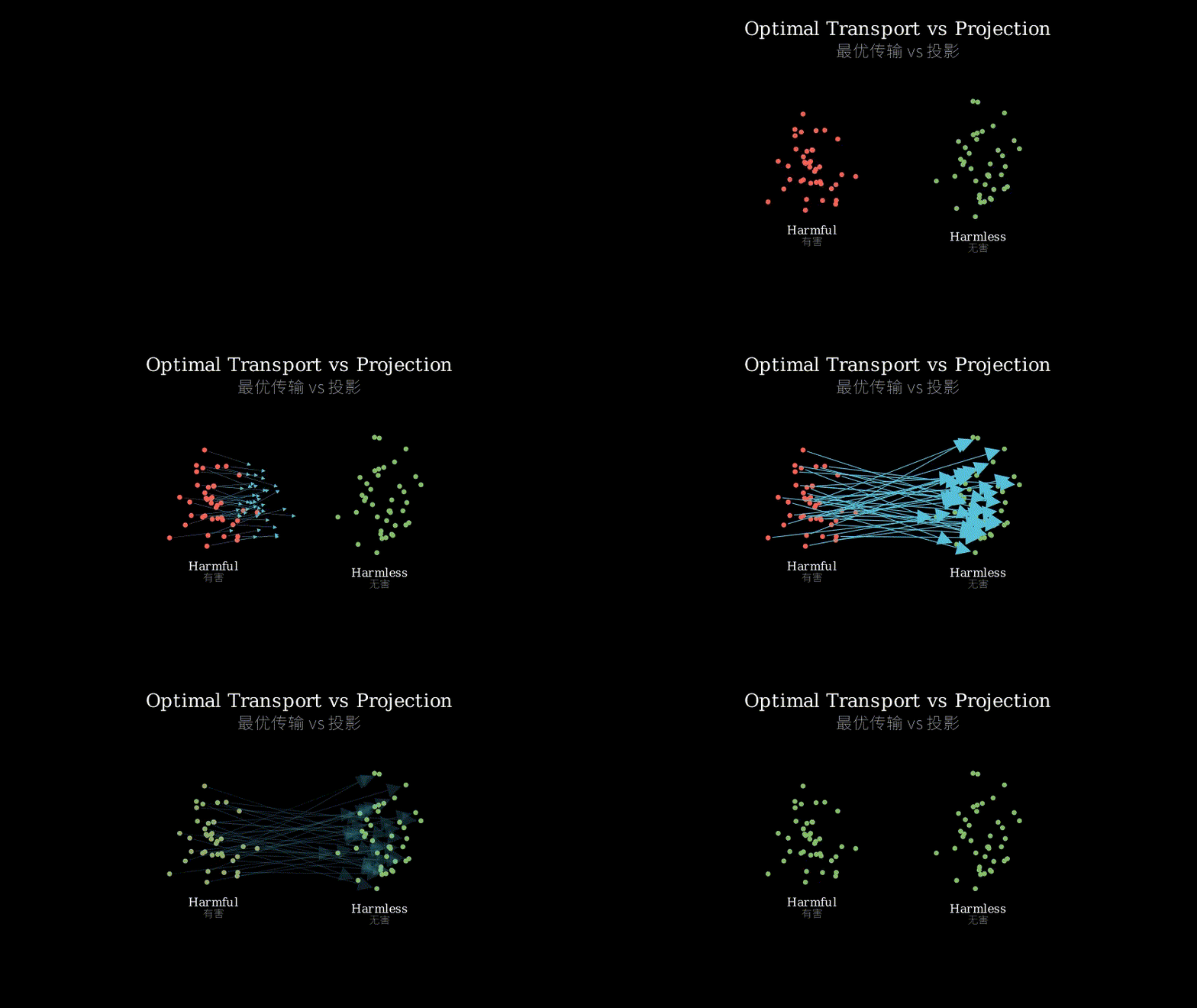
The method has three stages. First, collect activation distributions: run harmful prompts through the model and record activations at each layer, then do the same for harmless prompts. You now have two clouds of points in high-dimensional space for each layer.
Second, compress these clouds using PCA. High-dimensional optimal transport is computationally brutal, so project both distributions down to their top principal components (typically 10-50 dimensions). This preserves the essential shape while making the math tractable.
Third, apply Gaussian optimal transport. Model both compressed distributions as Gaussians (compute their means and covariances), then use the closed-form Wasserstein-2 solution to find the transformation matrix that morphs the harmful distribution into the harmless one. At inference time, apply this transformation to new harmful activations.
Harmful prompts  -->  [Layer activations]  -->  PCA compress
                                                      |
                                                      v
                                              [Gaussian fit]
                                                      |
                                                      v
Harmless prompts -->  [Layer activations]  -->  PCA compress
                                                      |
                                                      v
                                              [Gaussian fit]
                                                      |
                                                      v
                                          Compute OT transform T
                                                      |
                                                      v
New harmful input --> Apply T at target layer --> Bypass refusal
Think of it like accent coaching for the model’s internal voice. Current methods (orthogonal projection) are like telling someone “don’t use this one word.” But the model’s refusal isn’t a single word—it’s an entire accent, a pattern of pronunciation across many phonemes. Optimal transport is like a dialect coach who records how you speak (harmful distribution) and how native speakers talk (harmless distribution), then teaches you a transformation rule that shifts your entire speech pattern. The PCA step is like focusing on the most distinctive phonetic features instead of tracking every muscle movement in your mouth. And the layer-selective finding? It’s discovering that your accent is most obvious in just one or two specific sounds—fix those, and you pass as a native speaker.
Key Concepts
-
Optimal Transport (Wasserstein Distance): Imagine you have a pile of sand shaped like distribution A, and you want to reshape it into distribution B. Optimal transport finds the cheapest way to move sand grains from A to B, where “cost” is the distance each grain travels. The Wasserstein-2 distance is the total cost of this optimal rearrangement. For Gaussian distributions, there’s a beautiful closed-form solution: you can compute the exact transformation matrix without iterative optimization. This is why the method is efficient despite working in high dimensions—it’s not searching for the transformation, it’s calculating it directly from the covariance matrices.
-
Refusal Direction vs. Refusal Distribution: Previous work assumed refusal is encoded as a single vector direction in activation space—like a compass needle pointing toward “refuse.” But activations form clouds, not points. The “harmful” cloud and “harmless” cloud might have different shapes, spreads, and orientations. A single direction can’t capture this. It’s the difference between saying “move north” versus “reshape this entire weather system to match that one.” The distributional view acknowledges that safety alignment affects the entire statistical structure of activations, not just their mean direction.
-
Layer Localization: The paper finds that applying optimal transport to just 1-2 layers (around 40-60% network depth) works better than transforming all layers. This suggests refusal mechanisms aren’t uniformly distributed throughout the network—they’re concentrated in specific computational stages. Think of it like finding that a car’s speed limiter is in the fuel injection system, not spread across the entire engine. You don’t need to modify every component; just intervene at the critical bottleneck. This is both surprising (we thought safety was deeply integrated) and concerning (it’s easier to attack than expected).
Framework Shift
Before (orthogonal projection):     After (optimal transport):

Harmful activation (point)          Harmful distribution (cloud)
        |                                    /|\
        |                                   / | \
   Find refusal                           /  |  \
    direction v                          *   *   *
        |                                 \  |  /
        v                                  \ | /
  Project away v                            \|/
        |                           Compute transform T
        v                                    |
  Modified activation                        v
                                    Morphed distribution (cloud)
                                           /|\
                                          / | \
                                         *  *  *
                                    (matches harmless)
From removing a vector to reshaping a distribution, the core shift is treating safety as a statistical phenomenon rather than a geometric direction.
Expert Assessment
Problem choice: This is a real gap. The field has been stuck in the “refusal as direction” paradigm since representation engineering emerged. The distributional critique is obvious in hindsight but genuinely underexplored. It sits at a critical juncture—safety alignment is getting serious attention, and this exposes a fundamental vulnerability in how we think about it.
Method maturity: Clever insight with solid execution. Optimal transport is the right tool here—it’s principled, has closed-form solutions for Gaussians, and naturally handles distributional structure. The PCA compression is pragmatic, not lazy. However, the Gaussian assumption is a simplification that might miss multimodal or heavy-tailed structure. The authors don’t deeply investigate when this assumption breaks.
Experimental integrity: Baselines are fair (they compare against state-of-the-art refusal ablation methods). The 11% improvement is consistent across models, which is reassuring. Perplexity preservation is good but not perfect—there’s a slight degradation, suggesting the transformation isn’t perfectly structure-preserving. The layer localization finding is the most interesting result, but the paper doesn’t explain *why those layers matter. Is it where refusal is encoded, or just where the transformation happens to work best? This ambiguity weakens the mechanistic claims.
Writing quality: The paper front-loads theory and buries the layer localization insight. That finding should be in the abstract—it’s the most actionable and surprising result. The related work section is thorough but reads like a literature review, not a positioning argument. The method section is clear, but the experimental section could use more ablation studies (e.g., what happens with non-Gaussian distributions? How sensitive is layer selection?).
Verdict: weak accept — solid contribution with a genuinely new perspective, but the mechanistic understanding is shallow and the Gaussian assumption needs more scrutiny.
Takeaways
Layer-selective intervention is the steal here. If you’re doing any kind of activation editing (not just safety), test whether targeting 1-2 specific layers outperforms full-network interventions. The 40-60% depth range is a useful heuristic to start with.
The optimal transport framing is transferable. Anytime you’re trying to “remove” a concept from activations (bias, style, domain-specific features), ask: am I treating this as a direction or a distribution? If the latter, OT might be more effective than projection.
The PCA + closed-form Gaussian OT combo is a practical recipe for high-dimensional distribution matching. You can implement this in ~50 lines of code with standard libraries. It’s not just for jailbreaking—think style transfer, domain adaptation, or any task where you want to morph one activation distribution into another.
The vulnerability insight: current safety alignment might be more fragile than we thought. If refusal is localized and distributional attacks work this well, we need alignment methods that are robust to statistical transformations, not just directional perturbations.
论文: 2603.04355 作者: Geraldin Nanfack, Eugene Belilovsky, Elvis Dohmatob 分类: cs.LG, cs.AI
缺口
经过安全对齐的大语言模型通过在内部表征中编码拒绝行为来拒绝有害请求。
近期的越狱方法(如表征工程和拒绝方向消融)将此视为简单的几何问题:在激活空间中找到”拒绝方向”并将其投影掉。
这些正交投影方法假设拒绝是一维现象——一个可以减去的单一箭头。
但激活不是线上的点。
它们是具有复杂分布结构的高维向量云。
移除单一方向就像试图通过朝一个方向吹气来重塑雷雨云——你忽略了整个天气系统。
问题:当前越狱方法将拒绝视为一维
    |
    v
假设:拒绝是分布性的,而非方向性的
    |
    v
方法:用最优传输将有害分布变形为无害分布
    |
    v
证据:攻击成功率提升11%,局限于40-60%深度的1-2层
    |
    v
结论:安全机制易受分布式攻击
增量
一句话: 之前我们通过减去方向来移除拒绝;
现在我们重塑整个激活分布以匹配安全样本。
核心机制
方法分三个阶段。
首先,收集激活分布:让有害提示通过模型并记录每层的激活,然后对无害提示做同样的事。
现在你在每层都有两团高维空间中的点云。
其次,用PCA压缩这些点云。
高维最优传输计算量极大,所以将两个分布都投影到它们的主成分上(通常10-50维)。
这保留了本质形状同时让数学变得可行。
第三,应用高斯最优传输。
将两个压缩后的分布建模为高斯分布(计算它们的均值和协方差),然后用Wasserstein-2的闭式解找到将有害分布变形为无害分布的变换矩阵。
推理时,将此变换应用于新的有害激活。
有害提示  -->  [层激活]  -->  PCA压缩
                                  |
                                  v
                            [高斯拟合]
                                  |
                                  v
无害提示  -->  [层激活]  -->  PCA压缩
                                  |
                                  v
                            [高斯拟合]
                                  |
                                  v
                        计算最优传输变换T
                                  |
                                  v
新有害输入 --> 在目标层应用T --> 绕过拒绝
把它想象成给模型内部声音做口音训练。
当前方法(正交投影)就像告诉某人”别用这个词”。
但模型的拒绝不是单个词——它是整个口音,是跨越许多音素的发音模式。
最优传输就像方言教练,记录你的说话方式(有害分布)和母语者的说话方式(无害分布),然后教你一个转换规则来改变整个语音模式。
PCA步骤就像专注于最显著的语音特征,而不是追踪嘴里每块肌肉的运动。
而层选择性发现呢?
它发现你的口音在一两个特定音素中最明显——修正那些,你就能冒充母语者了。
关键概念
- 最优传输(Wasserstein距离): 想象你有一堆沙子堆成分布A的形状,你想把它重塑成分布B。
最优传输找到从A移动沙粒到B的最便宜方式,其中”成本”是每粒沙子移动的距离。
Wasserstein-2距离是这种最优重排的总成本。
对于高斯分布,有个漂亮的闭式解:你可以直接从协方差矩阵计算精确的变换矩阵,无需迭代优化。
这就是为什么该方法尽管在高维工作却很高效——它不是搜索变换,而是直接计算它。
- 拒绝方向 vs 拒绝分布: 之前的工作假设拒绝被编码为激活空间中的单个向量方向——就像指向”拒绝”的指南针。
但激活形成云,而非点。
“有害”云和”无害”云可能有不同的形状、扩散和方向。
单一方向无法捕捉这些。
这是”向北移动”和”重塑整个天气系统以匹配那个”之间的区别。
分布视角承认安全对齐影响激活的整个统计结构,而不仅仅是它们的平均方向。
- 层局部化: 论文发现仅对1-2层(约40-60%网络深度)应用最优传输比变换所有层效果更好。
这表明拒绝机制并非均匀分布在整个网络中——它们集中在特定的计算阶段。
想象成发现汽车的限速器在燃油喷射系统中,而不是分散在整个引擎。
你不需要修改每个组件;
只需在关键瓶颈处干预。
这既令人惊讶(我们以为安全是深度集成的)又令人担忧(它比预期更容易攻击)。
框架转变
之前(正交投影):              之后(最优传输):

有害激活(点)                  有害分布(云)
      |                            /|\
      |                           / | \
  找拒绝方向v                    /  |  \
      |                         *   *   *
      v                          \  |  /
  投影掉v                         \ | /
      |                            \|/
      v                     计算变换T
  修改后的激活                      |
                                   v
                          变形后的分布(云)
                                 /|\
                                / | \
                               *  *  *
                          (匹配无害分布)
从移除向量到重塑分布,核心转变是将安全视为统计现象而非几何方向。
专家评审
选题眼光: 这是真缺口。
自从表征工程出现以来,该领域一直困在”拒绝即方向”范式中。
分布式批判事后看来显而易见,但确实探索不足。
它处于关键节点——安全对齐正受到严肃关注,而这暴露了我们思考方式中的根本漏洞。
方法成熟度: 巧妙洞察加扎实执行。
最优传输是正确工具——它有原则,对高斯有闭式解,自然处理分布结构。
PCA压缩是务实的,不是偷懒。
然而,高斯假设是简化,可能错过多峰或重尾结构。
作者没有深入研究这个假设何时失效。
实验诚意: 基线公平(他们与最先进的拒绝消融方法比较)。
11%的提升在各模型间一致,这令人放心。
困惑度保持良好但不完美——有轻微退化,表明变换不是完全保结构的。
层局部化发现是最有趣的结果,但论文没解释为什么那些层重要。
是拒绝被编码的地方,还是只是变换恰好工作最好的地方?
这种模糊性削弱了机制性主张。
写作功力: 论文前置理论,埋藏层局部化洞察。
那个发现应该在摘要里——它是最可操作和最令人惊讶的结果。
相关工作部分很全面但读起来像文献综述,而非定位论证。
方法部分清晰,但实验部分需要更多消融研究(例如,非高斯分布会怎样?
层选择有多敏感?
)。
判决: 弱接收 — 扎实贡献,视角确实新颖,但机制理解浅薄,高斯假设需要更多审视。
要点总结
层选择性干预是这里的亮点。
如果你在做任何激活编辑(不仅是安全),测试针对1-2个特定层是否优于全网络干预。
40-60%深度范围是个有用的启发式起点。
最优传输框架可迁移。
任何时候你试图从激活中”移除”概念(偏见、风格、领域特定特征),问:我是将其视为方向还是分布?
如果是后者,最优传输可能比投影更有效。
PCA + 闭式高斯最优传输组合是高维分布匹配的实用配方。
你可以用标准库在约50行代码中实现它。
它不仅用于越狱——想想风格迁移、领域适应,或任何你想将一个激活分布变形为另一个的任务。
脆弱性洞察:当前安全对齐可能比我们想的更脆弱。
如果拒绝是局部化的且分布式攻击效果这么好,我们需要对统计变换鲁棒的对齐方法,而不仅仅是方向扰动。