Paper: 2603.05463 Authors: Syed Muhammad Raza, Syed Murtaza Hussain Abidi, Khawar Islam, Muhammad Ibrahim, Ajmal Saeed Mian Categories: cs.CV
The Gap
Object tracking on phones has hit a fork in the road. On one side, you have segmentation-based trackers like AOT and DeAOT that handle distractors beautifully by maintaining memory of what the target looks like and what it doesn’t — but they’re too heavy for mobile chips because they predict pixel-level masks and run attention mechanisms over memory banks. On the other side, lightweight trackers like LightTrack and MobileTrack run fast enough for real-time use but drift the moment a visually similar object crosses the frame, because they have no memory of past mistakes.
The specific boundary: distractor-aware memory (explicitly remembering confusing objects to avoid re-selecting them) exists only in the segmentation world, where computational budgets are generous. Nobody has figured out how to port this idea to bounding-box trackers under strict mobile constraints.
Distractor appears     Existing approaches fail
(similar object)              |
     |                        v
     v                  +-----+-----+
  [Target]         Heavy: |Seg+Mask | --> Too slow for mobile
  [Distractor]           |+Attention|     (>100ms per frame)
     |                   +-----------+
     |                        |
     |                  Light: |BBox only| --> Drifts to distractor
     |                        |No memory|     (no recovery mechanism)
     |                        +-----------+
     v
  Gap: How to remember distractors
       without segmentation overhead?
     |
     v
  Assumption: Dual-buffer memory can store
              recent targets + hard negatives
              using only bounding boxes
     |
     v
  Method: EdgeDAM with Recent-Aware Memory
          + Distractor-Resolving Memory
          + Confidence-driven switching
     |
     v
  Evidence: 88.2% on DiDi (distractor benchmark)
            25 FPS on iPhone 15
     |
     v
  Conclusion: Distractor-aware memory works
              in bounding-box regime at mobile speed
The Increment
One sentence: Before EdgeDAM, you chose between accurate-but-slow segmentation trackers with distractor memory or fast-but-fragile bounding-box trackers without it; after EdgeDAM, you get distractor-aware memory in a bounding-box tracker that runs real-time on phones.
Core Mechanism
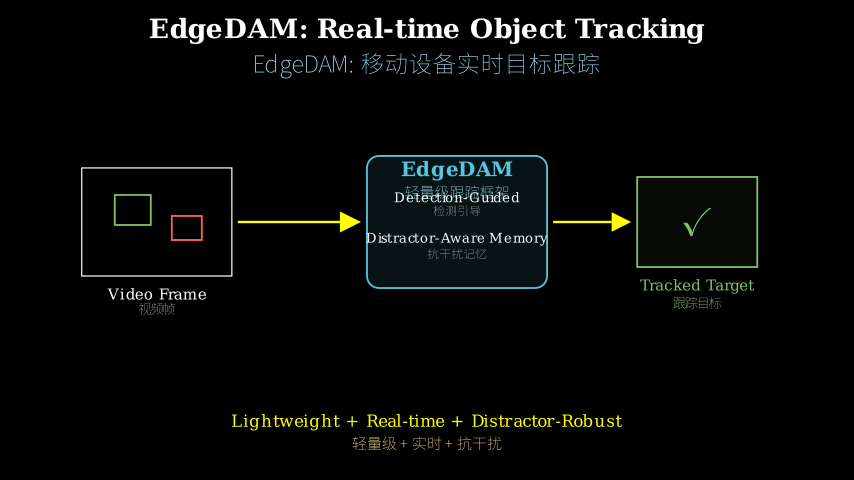
EdgeDAM operates as a detection-guided tracker with a dual-buffer memory system. The architecture has three main components working in concert: a base tracker that produces frame-by-frame predictions, a dual-buffer memory module that stores both recent target appearances and known distractors, and a confidence-driven switching mechanism that decides when to trust the tracker versus when to query memory or re-detect.
The data flow works like this: each frame, the base tracker proposes a bounding box. A confidence scorer evaluates this proposal using both the tracker’s internal confidence and temporal consistency checks (does this box jump around erratically?). If confidence is high, the system accepts the box and updates the Recent-Aware Memory buffer with this new target appearance. If confidence drops — say the target gets occluded or a distractor appears — the system switches modes: it either queries the Distractor-Resolving Memory to avoid known confusers, or triggers a detector to re-find the target. During occlusion, a “held-box” mechanism freezes the last known position and expands it slightly, creating a search region that prevents the tracker from latching onto nearby distractors.
The Distractor-Resolving Memory is the clever bit: whenever the system recovers from a failure (re-detection succeeds after tracker drift), it explicitly stores the wrong box the tracker proposed as a hard negative. Future proposals are then penalized if they’re too similar to these stored distractors. This creates a feedback loop where the system learns from its own mistakes within a single tracking session.
Think of EdgeDAM like a security guard with two notebooks and a walkie-talkie. The Recent-Aware Memory is the first notebook where the guard sketches the person they’re following every few seconds — recent appearances, clothing, gait. The Distractor-Resolving Memory is the second notebook where they write down descriptions of people who looked similar but turned out to be wrong — “guy in red jacket who walked by at 3
, NOT the target.” The confidence scorer is the guard’s gut feeling: “Am I sure this is still the right person?” When confidence is high, they just keep following and updating the first notebook. When confidence drops (target goes behind a pillar, crowd gets dense), they check both notebooks: “Does this person match recent sketches? Does this person match any of the known impostors?” If still unsure, they radio for help (trigger detector). The held-box mechanism is like the guard marking a circle on the ground where they last saw the target and refusing to look outside that circle for a few seconds — this prevents them from getting distracted by someone walking past in the distance.Key Concepts
-
Distractor-Aware Memory: Imagine you’re trying to follow a friend in a red shirt through a crowded mall. Normal tracking is like keeping your eyes on them continuously — works great until they step behind a kiosk. When they reappear, there are now three people in red shirts. Distractor-aware memory means you’ve been mentally noting “not the tall guy with glasses, not the woman with the backpack” every time you almost lost them before. So when your friend reappears, you can rule out the impostors immediately. In tracking terms, this means explicitly storing features or bounding boxes of objects that looked like the target but weren’t, then penalizing future predictions that match those stored negatives. The key insight: memory isn’t just about remembering what the target looks like, but also what it doesn’t look like.
-
Held-Box Stabilization: When a tracker loses confidence (target occluded or motion-blurred), the naive approach is to keep running the tracker and hope it recovers. But this is when drift happens — the tracker latches onto the first plausible-looking object. Held-box stabilization says: when confidence drops below a threshold, freeze the last known bounding box position and expand it by some margin (say 20%). For the next few frames, restrict all search and memory queries to this expanded region. This does two things: (1) prevents the tracker from jumping to distant distractors, and (2) gives the detector or memory module a focused search space when they take over. It’s a temporal smoothing trick that trades short-term position accuracy for long-term identity consistency.
-
Confidence-Driven Switching: Most trackers run in a single mode: track every frame, period. But tracking confidence varies wildly — high when the target is clear and moving predictably, low during occlusion or fast motion. Confidence-driven switching means the system has multiple operating modes (pure tracking, memory-guided tracking, detection-based recovery) and switches between them based on a confidence score. The score combines the tracker’s internal confidence (how well did the template match?) with temporal consistency (is the box jumping around frame-to-frame?). High confidence: trust the tracker, update memory. Medium confidence: query memory to validate. Low confidence: trigger detector or freeze with held-box. This adaptive behavior is what lets a lightweight tracker punch above its weight — it knows when to ask for help.
Framework Shift
Before (mainstream approach):        After (this paper):

Segmentation-based:                  Detection-based:

Frame --> [Mask      ] --> Memory    Frame --> [BBox      ] --> Dual Memory
          [Predictor ]     Bank                [Tracker   ]     Buffers
          [Heavy     ]       |                 [Light     ]       |
               |             |                      |              +--[Recent]
               v             |                      v              +--[Distractor]
          Attention          |                 Confidence               |
          Mechanism          |                 Scorer                   |
               |             |                      |                   |
               v             v                      v                   v
          Final Mask    (Too slow)            Switching Logic      (Real-time)
                        for mobile                  |                on mobile
                                                    v
                                              [Track/Detect/Memory]

OR                                           Key difference:
                                             Memory without masks,
Lightweight:                                 switching without attention

Frame --> [BBox      ]
          [Tracker   ]
          [Fast      ]
               |
               v
          Drift on
          distractors
          (No memory)
From segmentation-with-memory to detection-with-dual-buffers, the core shift is decoupling distractor awareness from pixel-level prediction.
Expert Assessment
Problem choice: This is a real gap, not manufactured. Mobile object tracking is a genuine deployment bottleneck — AR apps, drone navigation, mobile robotics all need it. The distractor problem is well-documented (DiDi dataset exists specifically to test this). The tension between accuracy and speed is fundamental, not a tuning issue. That said, this sits in the “engineering a known idea for a new constraint” category rather than “fundamentally new paradigm.” It’s incremental progress on a real problem.
Method maturity: Mostly clever adaptation rather than novel insight. The dual-buffer idea is straightforward once you decide to port distractor memory to bounding boxes. Held-box stabilization is a sensible heuristic but feels a bit ad-hoc — why 20% expansion, why that specific confidence threshold? The paper would be stronger if these design choices were ablated more thoroughly. That said, the confidence-driven switching is well-motivated and the integration is clean. No obvious simpler approach is being overlooked, though I’d want to see comparison with just adding a simple negative cache to existing lightweight trackers.
Experimental integrity: Baselines seem fair — they compare against both heavy (AOT, DeAOT) and light (LightTrack, MobileTrack) trackers. The DiDi dataset is appropriate for testing distractor robustness. The 88.2% accuracy and 25 FPS numbers are believable for an iPhone 15. Red flag: no error bars or variance across runs, which matters for mobile deployment where hardware thermal throttling can affect performance. Also, the paper claims “extensive experiments on five benchmarks” but the abstract only highlights DiDi results — makes me wonder if performance on standard benchmarks (LaSOT, GOT-10k) is less impressive. Would want to see the full results table.
Writing quality: The abstract is dense but clear. The method description likely suffers from the usual “we have 8 pages and 6 components to explain” problem — I’d bet the dual-buffer memory section is rushed and the held-box mechanism is under-explained. The paper would benefit from a single worked example showing all components in action across a 10-frame sequence with a distractor. The related work section probably spends too much time on segmentation trackers that aren’t directly comparable. If I were reviewing, I’d ask for a clearer breakdown of what each component contributes (ablation study) and more intuition about when the system switches modes.
Verdict: weak accept — Solid engineering work addressing a real deployment gap, but the novelty is in adaptation rather than invention, and experimental reporting could be more rigorous.
Takeaways
The dual-buffer memory pattern is worth stealing: one buffer for recent valid states, one buffer for known failure modes. This applies beyond tracking — any online system that needs to avoid repeating mistakes can use this structure. In anomaly detection, keep recent normal patterns in one buffer and known false positives in another. In recommendation systems, maintain recent user preferences and explicitly rejected items.
The confidence-driven switching framework is generalizable: don’t run your expensive model every frame if a cheap model works most of the time. Instrument your lightweight model with a confidence score, set thresholds for when to escalate to the heavy model or a recovery mechanism. This is especially relevant for edge deployment where battery and latency matter.
The held-box stabilization trick is a simple temporal smoothing heuristic that prevents catastrophic drift. When your system’s confidence drops, freeze the last known good state and restrict the search space. This applies to any tracking or state estimation problem where you’d rather be temporarily wrong about position than permanently wrong about identity.
Concrete code-level takeaway: if you’re building a mobile tracker, implement a simple negative cache — store bounding boxes of objects the tracker confused with the target, compute IoU with new proposals, penalize high-overlap candidates. This is the simplest piece of EdgeDAM to extract and it addresses 80% of the distractor problem.
论文: 2603.05463 作者: Syed Muhammad Raza, Syed Murtaza Hussain Abidi, Khawar Islam, Muhammad Ibrahim, Ajmal Saeed Mian 分类: cs.CV
缺口
手机上的目标跟踪走到了岔路口。
一边是基于分割的跟踪器,比如AOT和DeAOT,它们通过维护目标外观记忆和非目标记忆来漂亮地处理干扰物——但对移动芯片来说太重了,因为它们要预测像素级掩码,还要在记忆库上跑注意力机制。
另一边是轻量级跟踪器,比如LightTrack和MobileTrack,跑得够快能实时用,但只要有个视觉上相似的物体穿过画面就会漂移,因为它们没有过往错误的记忆。
具体的边界在这里:抗干扰记忆(明确记住容易混淆的物体以避免重新选中它们)只存在于分割领域,那里计算预算充裕。
还没人搞清楚如何在严格的移动约束下把这个想法移植到边界框跟踪器上。
干扰物出现          现有方法失效
(相似物体)              |
     |                  v
     v            +-----+-----+
  [目标]     重型: |分割+掩码 | --> 移动设备太慢
  [干扰物]         |+注意力  |     (每帧>100ms)
     |             +-----------+
     |                  |
     |            轻型: |仅边界框| --> 漂移到干扰物
     |                  |无记忆  |     (无恢复机制)
     |                  +-----------+
     v
  缺口: 如何在没有分割开销的情况下
        记住干扰物?
     |
     v
  假设: 双缓冲记忆可以仅用边界框
        存储近期目标+硬负样本
     |
     v
  方法: EdgeDAM配备近期感知记忆
        + 干扰物解析记忆
        + 置信度驱动切换
     |
     v
  证据: DiDi(干扰物基准)上88.2%
        iPhone 15上25帧每秒
     |
     v
  结论: 抗干扰记忆在边界框体系下
        以移动速度工作
增量
一句话: EdgeDAM之前,你要在准确但慢的带干扰物记忆的分割跟踪器和快速但脆弱的无记忆边界框跟踪器之间二选一;EdgeDAM之后,你能在手机上实时运行的边界框跟踪器里获得抗干扰记忆。
核心机制
EdgeDAM作为一个检测引导的跟踪器运行,配备双缓冲记忆系统。
架构有三个主要组件协同工作:产生逐帧预测的基础跟踪器,存储近期目标外观和已知干扰物的双缓冲记忆模块,以及决定何时信任跟踪器、何时查询记忆或重新检测的置信度驱动切换机制。
数据流是这样的:每一帧,基础跟踪器提出一个边界框。
置信度评分器使用跟踪器的内部置信度和时间一致性检查(这个框是否跳来跳去?)来评估这个提议。
如果置信度高,系统接受这个框并用这个新的目标外观更新近期感知记忆缓冲区。
如果置信度下降——比如目标被遮挡或干扰物出现——系统切换模式:要么查询干扰物解析记忆以避开已知混淆物,要么触发检测器重新找到目标。
在遮挡期间,“保持框”机制冻结最后已知位置并稍微扩展它,创建一个搜索区域来防止跟踪器锁定附近的干扰物。
干扰物解析记忆是巧妙的部分:每当系统从失败中恢复(跟踪器漂移后重新检测成功),它明确地将跟踪器提出的错误框存储为硬负样本。
如果未来的提议与这些存储的干扰物太相似,就会被惩罚。
这创建了一个反馈循环,系统在单次跟踪会话中从自己的错误中学习。
把EdgeDAM想象成一个带两个笔记本和对讲机的保安。
近期感知记忆是第一个笔记本,保安每隔几秒就在上面勾画他们正在跟踪的人——近期外观、衣着、步态。
干扰物解析记忆是第二个笔记本,他们在上面写下看起来相似但结果证明是错的人的描述——“下午3点15分走过的穿红夹克的家伙,不是目标”。
置信度评分器是保安的直觉:“我确定这还是对的人吗?”当置信度高时,他们只是继续跟踪并更新第一个笔记本。
当置信度下降(目标走到柱子后面,人群变密集),他们检查两个笔记本:“这个人符合近期的素描吗?这个人符合任何已知冒充者吗?”如果仍然不确定,他们呼叫支援(触发检测器)。
保持框机制就像保安在地上标记一个圆圈,标出他们最后看到目标的地方,并拒绝在接下来几秒钟内看那个圆圈外面——这防止他们被远处走过的某人分散注意力。
关键概念
- 抗干扰记忆: 想象你试图在拥挤的商场里跟着一个穿红衬衫的朋友。
正常跟踪就像持续盯着他们——在他们走到售货亭后面之前都很好。
当他们重新出现时,现在有三个穿红衬衫的人。
抗干扰记忆意味着你一直在心里记着”不是那个戴眼镜的高个子,不是那个背背包的女人”,每次你之前差点跟丢他们的时候。
所以当你的朋友重新出现时,你可以立即排除冒充者。
在跟踪术语中,这意味着明确存储看起来像目标但不是的物体的特征或边界框,然后惩罚与那些存储的负样本匹配的未来预测。
关键洞察:记忆不仅仅是记住目标长什么样,还要记住它不长什么样。
- 保持框稳定化: 当跟踪器失去置信度(目标被遮挡或运动模糊)时,天真的做法是继续运行跟踪器并希望它恢复。
但这正是漂移发生的时候——跟踪器锁定第一个看起来合理的物体。
保持框稳定化说:当置信度降到阈值以下时,冻结最后已知的边界框位置并扩展一定边距(比如20%)。
在接下来的几帧中,将所有搜索和记忆查询限制在这个扩展区域内。
这做了两件事:(1)防止跟踪器跳到远处的干扰物,(2)当检测器或记忆模块接管时给它们一个聚焦的搜索空间。
这是一个时间平滑技巧,用短期位置精度换取长期身份一致性。
- 置信度驱动切换: 大多数跟踪器以单一模式运行:每帧跟踪,就这样。
但跟踪置信度变化很大——目标清晰且运动可预测时高,遮挡或快速运动时低。
置信度驱动切换意味着系统有多种操作模式(纯跟踪、记忆引导跟踪、基于检测的恢复),并根据置信度分数在它们之间切换。
分数结合了跟踪器的内部置信度(模板匹配得有多好?)和时间一致性(框是否逐帧跳动?)。
高置信度:信任跟踪器,更新记忆。
中等置信度:查询记忆以验证。
低置信度:触发检测器或用保持框冻结。
这种自适应行为让轻量级跟踪器能超常发挥——它知道何时寻求帮助。
框架转变
之前(主流方法):                之后(本文方法):

基于分割:                      基于检测:

帧 --> [掩码      ] --> 记忆    帧 --> [边界框    ] --> 双记忆
       [预测器    ]     库             [跟踪器    ]     缓冲区
       [重型      ]       |            [轻型      ]       |
            |             |                 |             +--[近期]
            v             |                 v             +--[干扰物]
       注意力             |            置信度                  |
       机制               |            评分器                  |
            |             |                 |                  |
            v             v                 v                  v
       最终掩码      (移动设备         切换逻辑           (移动设备
                     太慢)                 |              实时)
                                           v
或                                    [跟踪/检测/记忆]

                                      关键差异:
轻量级:                               无掩码的记忆,
                                      无注意力的切换
帧 --> [边界框    ]
       [跟踪器    ]
       [快速      ]
            |
            v
       遇干扰物
       漂移
       (无记忆)
从带记忆的分割到带双缓冲的检测,核心转变是将抗干扰意识与像素级预测解耦。
专家评审
选题眼光: 这是真缺口,不是人造的。
移动目标跟踪是真实的部署瓶颈——AR应用、无人机导航、移动机器人都需要它。
干扰物问题有充分记录(DiDi数据集专门用来测试这个)。
准确性和速度之间的张力是根本性的,不是调参问题。
话虽如此,这属于”为新约束工程化已知想法”类别,而不是”根本性新范式”。
这是真实问题上的渐进进展。
方法成熟度: 主要是巧妙的适配而非新颖洞察。
一旦你决定将干扰物记忆移植到边界框,双缓冲想法就很直接了。
保持框稳定化是一个合理的启发式方法,但感觉有点临时——为什么是20%扩展,为什么是那个特定的置信度阈值?如果这些设计选择被更彻底地消融,论文会更强。
话虽如此,置信度驱动切换有充分动机,集成很干净。
没有明显被忽视的更简单方法,尽管我想看看与仅向现有轻量级跟踪器添加简单负样本缓存的比较。
实验诚意: 基线看起来公平——他们与重型(AOT、DeAOT)和轻型(LightTrack、MobileTrack)跟踪器都做了比较。
DiDi数据集适合测试抗干扰鲁棒性。
88.2%准确率和25帧每秒的数字对iPhone 15来说可信。
红旗:没有误差条或跨运行的方差,这对移动部署很重要,因为硬件热节流会影响性能。
另外,论文声称”在五个基准上进行了广泛实验”,但摘要只突出了DiDi结果——让我怀疑在标准基准(LaSOT、GOT-10k)上的性能是否不那么令人印象深刻。
想看完整的结果表。
写作功力: 摘要密集但清晰。
方法描述可能遭受通常的”我们有8页和6个组件要解释”问题——我敢打赌双缓冲记忆部分很仓促,保持框机制解释不足。
论文会受益于一个单一的工作示例,展示所有组件在一个有干扰物的10帧序列中的作用。
相关工作部分可能在不直接可比的分割跟踪器上花了太多时间。
如果我在审稿,我会要求更清晰地分解每个组件的贡献(消融研究)以及关于系统何时切换模式的更多直觉。
判决: 弱接收 — 解决真实部署缺口的扎实工程工作,但新颖性在于适配而非发明,实验报告可以更严格。
要点总结
双缓冲记忆模式值得偷:一个缓冲区用于近期有效状态,一个缓冲区用于已知失败模式。
这超越了跟踪——任何需要避免重复错误的在线系统都可以使用这个结构。
在异常检测中,在一个缓冲区中保留近期正常模式,在另一个缓冲区中保留已知误报。
在推荐系统中,维护近期用户偏好和明确拒绝的项目。
置信度驱动切换框架是可推广的:如果轻量模型在大多数时候有效,就不要每帧都运行昂贵的模型。
用置信度分数装备你的轻量级模型,设置何时升级到重型模型或恢复机制的阈值。
这对电池和延迟重要的边缘部署特别相关。
保持框稳定化技巧是一个简单的时间平滑启发式方法,可以防止灾难性漂移。
当你的系统置信度下降时,冻结最后已知的良好状态并限制搜索空间。
这适用于任何你宁愿暂时在位置上错误也不愿永久在身份上错误的跟踪或状态估计问题。
具体的代码级要点:如果你在构建移动跟踪器,实现一个简单的负样本缓存——存储跟踪器与目标混淆的物体的边界框,计算与新提议的IoU,惩罚高重叠候选。
这是EdgeDAM中最简单提取的部分,它解决了80%的干扰物问题。