
Paper: 2604.04930 Authors: Parsa Hosseini, Sumit Nawathe, Mahdi Salmani, Meisam Razaviyayn, Soheil Feizi Categories: cs.CL, cs.AI, cs.LG
The Gap
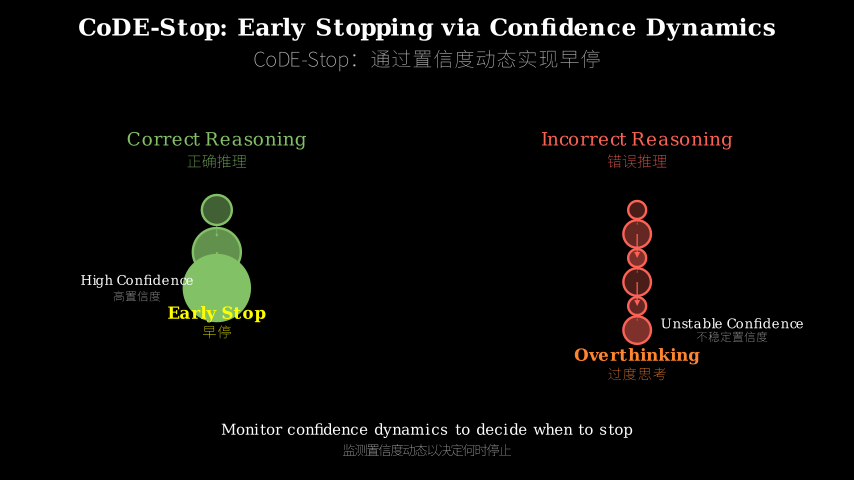
Large reasoning models like o1 and DeepSeek-R1 generate long chain-of-thought sequences to solve complex problems. Current approaches either let models reason to a fixed maximum length or use simple heuristics to stop early. The problem: correct solutions often emerge early but models keep generating tokens, while incorrect reasoning paths spiral into unproductive loops. Prior early stopping methods (like reward model scoring or fixed-length cutoffs) don’t leverage the temporal dynamics of how confidence evolves during reasoning.
Problem: Wasted computation in long reasoning chains
    |
    v
Observation: Confidence behaves differently in correct vs incorrect paths
    |
    +---> Correct: High confidence reached early, then stable
    |
    +---> Incorrect: Low confidence, erratic fluctuations
    |
    v
Method: Track confidence dynamics, stop when pattern indicates answer found
    |
    v
Evidence: 25-50% token reduction, maintained accuracy across benchmarks
    |
    v
Conclusion: Confidence trajectory is a reliable early stopping signal
The Increment
One sentence: Before this paper, models reasoned to fixed lengths or used static scoring; after, we can watch confidence dynamics in real-time to stop reasoning the moment a stable answer emerges.
Core Mechanism
CoDE-Stop monitors intermediate answers during chain-of-thought generation. At each reasoning step, the model can produce a candidate answer. The method extracts confidence scores for these intermediate answers and tracks how confidence changes over time. When confidence reaches a high threshold and stabilizes (stops increasing significantly), reasoning terminates.
The system has three components: (1) an answer extraction module that identifies candidate answers in the reasoning chain, (2) a confidence estimator that scores each candidate, and (3) a stopping criterion that analyzes the confidence trajectory. The confidence estimator uses the model’s own token probabilities—specifically, it looks at how confidently the model generates the answer tokens.
Reasoning Chain Generation:
    |
    v
[Step 1] ---> Extract Answer_1 ---> Confidence: 0.3
    |
    v
[Step 2] ---> Extract Answer_2 ---> Confidence: 0.7
    |
    v
[Step 3] ---> Extract Answer_3 ---> Confidence: 0.85
    |                                      |
    v                                      v
[Step 4] ---> Extract Answer_4 ---> Confidence: 0.87
                                           |
                                           v
                                    Delta < threshold
                                           |
                                           v
                                    STOP & Return Answer_4
Think of CoDE-Stop like a chef tasting soup while cooking. A novice chef keeps adding ingredients and tasting repeatedly, never sure when it’s done. An experienced chef tastes, notices the flavor has reached the right balance, tastes once more to confirm it’s stable, then stops. CoDE-Stop is that experienced palate—it doesn’t just check if the answer is good (high confidence), it checks if the answer has stopped improving (confidence plateau). The “tasting” is confidence measurement, the “flavor balance” is answer quality, and the “stability check” is the dynamics analysis. Just as the chef saves time and avoids over-seasoning, CoDE-Stop saves tokens and avoids overthinking.
Key Concepts
-
Confidence Dynamics: Instead of looking at a single confidence score, this tracks how confidence changes across reasoning steps. Imagine watching a stock price chart versus just seeing today’s price. The chart tells you if the price is rising, falling, or plateauing—that trajectory contains information the single number doesn’t. In reasoning, a confidence that jumps from 0.3 to 0.8 to 0.85 to 0.86 signals “we found it and we’re sure,” while a confidence bouncing between 0.4 and 0.6 signals “still searching.” The dynamics reveal the model’s internal certainty about whether it has solved the problem.
-
Intermediate Answer Extraction: During chain-of-thought reasoning, models don’t just think—they periodically state candidate answers. For a math problem, the model might write “so the answer could be 42” at step 5, then “actually, recalculating gives 37” at step 8. CoDE-Stop parses these intermediate statements to identify answer candidates. This is different from just looking at the final output—it’s like watching a student’s scratch work to see when they first wrote down the correct answer, even if they kept working afterward.
Framework Shift
Before (fixed-length reasoning):        After (CoDE-Stop):

Input --> [Reason] --> [Reason] -->    Input --> [Reason] --> Extract Answer
          [Reason] --> [Reason] -->              [Reason] --> Extract Answer
          [Reason] --> [Reason] -->              [Reason] --> Extract Answer
          [Reason] --> Output                       |            |
                                                    v            v
          (Fixed N steps)                      Confidence   Confidence
                                               Trajectory   Analysis
                                                    |            |
                                                    +-----+------+
                                                          |
                                                          v
                                                    Stop when stable
                                                          |
                                                          v
                                                       Output
From blind iteration to informed termination, the core shift is using the model’s own confidence trajectory as a real-time stopping signal rather than relying on external length limits.
Expert Assessment
Problem choice: This is a real gap. As reasoning models scale, inference cost becomes prohibitive. The observation that correct reasoning reaches high confidence early is empirically grounded and practically important. It sits at the intersection of efficiency and capability—a sweet spot in current LLM research.
Method maturity: Elegant simplicity. The method requires no training, no additional models, just monitoring existing signals. However, the reliance on answer extraction assumes models consistently produce parseable intermediate answers, which may not hold across all reasoning formats. The confidence estimation using token probabilities is straightforward but could be brittle with different decoding strategies.
Experimental integrity: Baselines are reasonable (fixed-length, reward model scoring). The evaluation spans multiple models and benchmarks, which is good. However, the paper doesn’t deeply explore failure modes—when does confidence plateau on wrong answers? The 25-50% reduction is impressive but the variance across problem types isn’t thoroughly analyzed. I’d want to see more on the calibration of confidence scores.
Writing quality: The motivation is clear and the method is well-explained. The confidence dynamics analysis (correct vs incorrect trajectories) is the paper’s strongest contribution but could be expanded. The related work section feels thin—more comparison with adaptive computation methods would strengthen positioning. The experimental section is solid but lacks error analysis.
Verdict: weak accept — Practical method with clear benefits and minimal overhead, but limited theoretical depth and incomplete failure mode analysis. The core insight about confidence dynamics is valuable and the results are convincing enough for practitioners to try it.
Takeaways
Steal the confidence trajectory monitoring pattern. Even outside reasoning models, tracking how a model’s certainty evolves over generation steps can signal when to stop sampling, when to switch strategies, or when to request human input. The key transferable idea: don’t just threshold on confidence magnitude, threshold on confidence velocity (rate of change). This applies to iterative refinement systems, multi-agent debates, or any process where you’re unsure how many iterations to run. Implement it by logging intermediate outputs and their probabilities, then plot the trajectory—you’ll often see the “found it” plateau pattern emerge naturally.
论文: 2604.04930 作者: Parsa Hosseini, Sumit Nawathe, Mahdi Salmani, Meisam Razaviyayn, Soheil Feizi 分类: cs.CL, cs.AI, cs.LG
缺口
像o1和DeepSeek-R1这样的大型推理模型会生成很长的思维链来解决复杂问题。
现有方法要么让模型推理到固定的最大长度,要么用简单启发式提前停止。
问题在于:正确的解往往很早就出现了,但模型还在继续生成token;
而错误的推理路径会陷入无效循环。
之前的早停方法(比如奖励模型打分或固定长度截断)没有利用推理过程中置信度演化的时序动态。
问题:长推理链中的计算浪费
    |
    v
观察:正确路径和错误路径的置信度表现不同
    |
    +---> 正确:早期达到高置信度,然后稳定
    |
    +---> 错误:低置信度,波动不定
    |
    v
方法:跟踪置信度动态,当模式显示找到答案时停止
    |
    v
证据:减少25-50%的token使用,准确率保持不变
    |
    v
结论:置信度轨迹是可靠的早停信号
增量
一句话:这篇论文之前,模型推理到固定长度或用静态打分;
之后,我们可以实时观察置信度动态,在稳定答案出现的那一刻停止推理。
核心机制
CoDE-Stop在思维链生成过程中监控中间答案。
在每个推理步骤,模型可以产生一个候选答案。
方法提取这些中间答案的置信度分数,并跟踪置信度如何随时间变化。
当置信度达到高阈值并稳定下来(不再显著增长)时,推理终止。
系统有三个组件:(1)答案提取模块,识别推理链中的候选答案;
(2)置信度估计器,给每个候选打分;
(3)停止准则,分析置信度轨迹。
置信度估计器使用模型自己的token概率——具体来说,它看模型生成答案token时有多自信。
推理链生成:
    |
    v
[步骤1] ---> 提取答案1 ---> 置信度:0.3
    |
    v
[步骤2] ---> 提取答案2 ---> 置信度:0.7
    |
    v
[步骤3] ---> 提取答案3 ---> 置信度:0.85
    |                                |
    v                                v
[步骤4] ---> 提取答案4 ---> 置信度:0.87
                                    |
                                    v
                             增量 < 阈值
                                    |
                                    v
                             停止并返回答案4
把CoDE-Stop想象成厨师在做菜时尝味道。
新手厨师不停加料、不停尝,永远不确定什么时候做好了。
老手厨师尝一口,发现味道达到了合适的平衡,再尝一口确认稳定了,然后停手。
CoDE-Stop就是那个老练的味觉——它不只检查答案是否好(高置信度),还检查答案是否不再改进(置信度平台期)。
“尝味道”是置信度测量,“味道平衡”是答案质量,“稳定性检查”是动态分析。
就像厨师节省时间并避免过度调味,CoDE-Stop节省token并避免过度思考。
关键概念
- 置信度动态:不是看单个置信度分数,而是跟踪置信度在推理步骤间如何变化。
想象看股价走势图和只看今天的价格。
走势图告诉你价格是在涨、在跌还是在平稳——那个轨迹包含单个数字没有的信息。
在推理中,置信度从0.3跳到0.8再到0.85再到0.86,信号是”我们找到了而且很确定”;
而置信度在0.4和0.6之间跳动,信号是”还在搜索”。
动态揭示了模型对是否已解决问题的内在确定性。
- 中间答案提取:在思维链推理过程中,模型不只是思考——它会周期性地陈述候选答案。
对于数学问题,模型可能在第5步写”所以答案可能是42”,然后在第8步写”实际上,重新计算得到37”。
CoDE-Stop解析这些中间陈述来识别候选答案。
这不同于只看最终输出——就像看学生的草稿纸,看他们什么时候第一次写下正确答案,即使他们之后还在继续做题。
框架转变
之前(固定长度推理):              之后(CoDE-Stop):

输入 --> [推理] --> [推理] -->     输入 --> [推理] --> 提取答案
         [推理] --> [推理] -->              [推理] --> 提取答案
         [推理] --> [推理] -->              [推理] --> 提取答案
         [推理] --> 输出                       |          |
                                              v          v
         (固定N步)                      置信度      置信度
                                          轨迹        分析
                                              |          |
                                              +----+-----+
                                                   |
                                                   v
                                            稳定时停止
                                                   |
                                                   v
                                                输出
从盲目迭代到知情终止,核心转变是用模型自己的置信度轨迹作为实时停止信号,而不是依赖外部长度限制。
专家评审
选题眼光:这是真缺口。
随着推理模型规模扩大,推理成本变得令人望而却步。
正确推理早期就达到高置信度这个观察是有实证基础的,也很重要。
它处在效率和能力的交叉点——当前LLM研究的甜蜜点。
方法成熟度:优雅的简洁性。
方法不需要训练,不需要额外模型,只是监控现有信号。
但是,对答案提取的依赖假设模型始终产生可解析的中间答案,这在所有推理格式中可能不成立。
用token概率估计置信度很直接,但在不同解码策略下可能很脆弱。
实验诚意:基线合理(固定长度、奖励模型打分)。
评估跨越多个模型和基准,这很好。
但论文没有深入探讨失败模式——什么时候置信度会在错误答案上平台?
25-50%的减少令人印象深刻,但不同问题类型的方差没有被彻底分析。
我想看更多关于置信度分数校准的内容。
写作功力:动机清晰,方法解释得好。
置信度动态分析(正确vs错误轨迹)是论文最强的贡献,但可以扩展。
相关工作部分感觉单薄——与自适应计算方法的更多比较会加强定位。
实验部分扎实但缺少错误分析。
判决:弱接收——实用方法,有明确收益和最小开销,但理论深度有限,失败模式分析不完整。
关于置信度动态的核心洞见有价值,结果足够令人信服,值得实践者尝试。
要点总结
偷走置信度轨迹监控模式。
即使在推理模型之外,跟踪模型的确定性如何在生成步骤中演化,可以发出何时停止采样、何时切换策略或何时请求人工输入的信号。
关键的可迁移想法:不要只对置信度大小设阈值,要对置信度速度(变化率)设阈值。
这适用于迭代精化系统、多智能体辩论,或任何你不确定要运行多少次迭代的过程。
实现方法是记录中间输出及其概率,然后绘制轨迹——你通常会看到”找到了”的平台期模式自然出现。