
Paper: 2603.11041 Authors: Shuyao Shang, Bing Zhan, Yunfei Yan, Yuqi Wang, Yingyan Li, Yasong An, Xiaoman Wang, Jierui Liu, Lu Hou, Lue Fan Categories: cs.CV, cs.RO
The Gap
Vision-Language-Action (VLA) models for autonomous driving have adopted Chain-of-Thought (CoT) reasoning to improve decision quality. Textual CoT generates natural language reasoning but lacks fine-grained spatiotemporal understanding of how the world evolves. Visual CoT predicts future frames but introduces massive redundancy—generating full images when you only need to know “that car will cut in front of me.” Neither approach captures world dynamics in a compact, physically grounded form that’s both interpretable and efficient for real-time driving.
Problem: VLA models make driving decisions without explicit world dynamics modeling
    |
    v
Existing approaches:
    Textual CoT: "The car might turn left" (vague, no spatial precision)
    Visual CoT: Predict full future frames (redundant, slow)
    |
    v
Gap: Need compact dynamics representation that's:
    - Spatiotemporally precise
    - Computationally efficient
    - Physically interpretable
    |
    v
Method: Dynamics Tokenizer compresses future evolution into tokens
        + Decouple ego vs environment dynamics
        + Generate dynamics tokens before actions
    |
    v
Evidence: Outperforms Textual/Visual CoT on NAVSIM, Bench2Drive
    |
    v
Conclusion: Dynamics CoT is the right abstraction level for driving VLAs
The Increment
One sentence: Before this paper, driving VLAs reasoned with either vague text or redundant images; after, they forecast compact dynamics tokens that capture “what will happen” before deciding “what to do.”
Core Mechanism
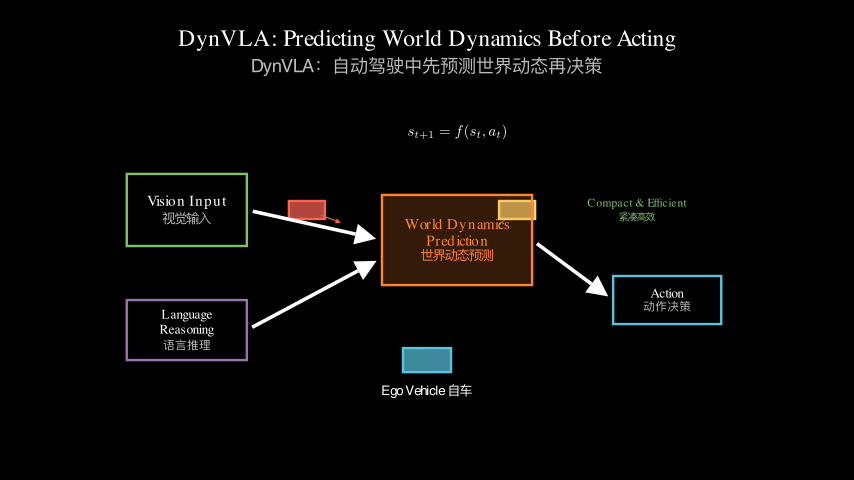
DynVLA introduces a Dynamics Tokenizer that compresses future world evolution into a small set of learned tokens. Instead of predicting full future frames (expensive) or writing text descriptions (imprecise), it learns a discrete codebook where each token represents a pattern of motion or interaction. The model first encodes the current scene, then predicts which dynamics tokens will occur in the next few seconds, then uses those tokens to inform action generation.
The architecture decouples ego-centric dynamics (how my vehicle will move) from environment-centric dynamics (how other agents will behave). This separation is crucial because driving involves both self-motion prediction and interaction modeling. The ego branch predicts your vehicle’s trajectory space, while the environment branch forecasts other vehicles’ movements, pedestrians, traffic light changes. These two streams merge before the action decoder.
Training happens in two stages: supervised fine-tuning (SFT) teaches the model to predict dynamics tokens from expert demonstrations, then reinforcement fine-tuning (RFT) optimizes for actual driving performance metrics. The dynamics tokens act as an intermediate representation—a bottleneck that forces the model to extract only the essential spatiotemporal information needed for decision-making.
Input Scene (camera, lidar, map)
    |
    v
[Scene Encoder]
    |
    +------------------+------------------+
    |                                     |
    v                                     v
[Ego Dynamics Branch]            [Env Dynamics Branch]
    |                                     |
    v                                     v
Predict ego tokens               Predict env tokens
(my future trajectory)           (others' movements)
    |                                     |
    +------------------+------------------+
                       |
                       v
              [Dynamics Tokens]
              (compact world state)
                       |
                       v
              [Action Decoder]
                       |
                       v
              Driving Actions
           (steering, throttle, brake)
Think of DynVLA like a chess player who doesn’t visualize the entire future board position pixel-by-pixel, but instead thinks in terms of “piece dynamics”—“my knight will fork their rook and king” or “their bishop controls this diagonal.” The Dynamics Tokenizer is like learning a vocabulary of chess patterns: each token represents a meaningful configuration or movement pattern. The ego/environment split is like separately tracking “my pieces’ threats” versus “opponent’s pieces’ threats.” When deciding the next move, the player doesn’t need to render the full board state in their mind—they just need these compressed dynamics patterns. The action decoder is then like converting “I want to execute a fork” into the specific move “Knight to e5.”
Key Concepts
-
Dynamics Tokenization: Instead of predicting raw pixels or writing sentences, learn a discrete vocabulary where each token represents a spatiotemporal pattern. Imagine compressing a 5-second video clip into 8 symbols, where each symbol captures a meaningful motion primitive like “vehicle accelerating in left lane” or “pedestrian crossing from right.” This is done via vector quantization—the model learns a codebook of prototype dynamics patterns, and each future state gets mapped to its nearest prototype. The key insight: most driving scenarios involve recurring patterns, so you don’t need infinite resolution; a few hundred learned patterns suffice.
-
Ego-Environment Decoupling: Driving dynamics have two fundamentally different sources: your own vehicle’s motion (which you control) and the environment’s evolution (which you don’t). Mixing these in a single representation is like trying to plan a conversation while someone else is talking—you need to track both “what I’m about to say” and “what they might say next” separately. DynVLA splits the dynamics prediction into two branches: ego-centric tokens encode your vehicle’s future trajectory possibilities, while environment-centric tokens encode other agents’ likely behaviors. This architectural choice reflects the causal structure of the problem: your actions influence ego dynamics directly but environment dynamics only indirectly through interaction.
-
Dynamics CoT vs Visual/Textual CoT: Chain-of-thought reasoning means generating intermediate steps before the final answer. Textual CoT writes reasoning in natural language (“The pedestrian is approaching the crosswalk, so I should slow down”), which is interpretable but lacks spatial precision—where exactly is the pedestrian? Visual CoT predicts future frames, which has full spatial detail but is computationally wasteful—you’re generating millions of pixels when you only need to know a few key facts. Dynamics CoT sits in the middle: it’s more precise than text (tokens encode spatial positions and velocities) but more compact than images (8 tokens vs 100,000 pixels). It’s like the difference between describing a chess position in English, drawing the entire board, or using algebraic notation—the last one captures exactly what matters.
Framework Shift
Before (Textual/Visual CoT):        After (DynVLA Dynamics CoT):

Scene --> [Reasoning] --> Action    Scene --> [Dynamics] --> Action
           |                                   |
           v                                   v
    "Car might turn"                   [Token: ego_accel]
    (vague, no physics)                [Token: env_cut_in]
                                       [Token: ped_wait]
         OR                            (compact, grounded)
           |                                   |
           v                                   v
    [Full future frames]               8 tokens = 64 bytes
    (precise but 100KB+)               (efficient + precise)
From generating reasoning artifacts (text or images) to predicting compressed dynamics representations, the core shift is abstraction level—finding the minimal sufficient representation of “what will happen” that’s rich enough to ground decisions but compact enough for real-time inference.
Expert Assessment
Problem choice: This is a real gap. The autonomous driving community has been struggling with the CoT paradigm—textual reasoning sounds good in papers but doesn’t capture the spatiotemporal precision needed for safety-critical decisions, while visual prediction is computationally prohibitive for real-time systems. The problem sits at the intersection of efficiency and expressiveness, which is exactly where practical systems live.
Method maturity: The dynamics tokenization idea is clever and well-motivated, but the execution feels somewhat incremental. Vector quantization for compression isn’t new (VQ-VAE is from 2017), and the ego/environment decoupling is sensible but not groundbreaking. The real contribution is showing this specific combination works for driving VLAs. I’d like to see more analysis of what the learned tokens actually represent—the paper claims interpretability but doesn’t deeply probe the codebook structure.
Experimental integrity: The baselines are fair and the benchmarks (NAVSIM, Bench2Drive) are standard. The improvements are consistent but not dramatic—typically 2-5% gains. One concern: the “large-scale in-house dataset” lacks details, making it hard to assess generalization. The ablations are thorough, showing each component contributes. No obvious red flags, but I’d want to see failure case analysis—when does dynamics prediction go wrong?
Writing quality: The paper is clearly written but front-loads motivation without enough technical depth early on. The method section could be more precise about the tokenizer architecture and training procedure. The related work section is comprehensive but reads like a literature review rather than positioning the contribution. Rewriting Section 3.2 to include concrete examples of learned dynamics tokens would make the whole paper more tangible.
Verdict: weak accept — Solid incremental contribution with practical value, but lacks the conceptual depth or empirical breakthrough for strong acceptance. The dynamics tokenization framing is useful and the results are convincing, but it feels like an engineering solution rather than a fundamental insight.
Takeaways
Compression as a forcing function: When you can’t afford to predict full future states, forcing a bottleneck (like dynamics tokens) makes the model extract only essential information. This principle transfers beyond driving—any sequential decision problem where you need to reason about the future could benefit from learning compressed dynamics representations instead of predicting raw observations.
Decouple controllable vs uncontrollable dynamics: In any interactive system, separating “what I can influence” from “what the environment will do” as distinct prediction targets improves both interpretability and performance. This applies to robotics, game AI, even UI design (user intent vs system state).
The right abstraction level matters more than model size: DynVLA’s gains come from choosing dynamics tokens as the intermediate representation, not from scaling up parameters. When designing AI systems, spend time finding the minimal sufficient representation before throwing compute at the problem. Text is too vague, pixels are too detailed—what’s the Goldilocks encoding for your domain?
论文: 2603.11041 作者: Shuyao Shang, Bing Zhan, Yunfei Yan, Yuqi Wang, Yingyan Li, Yasong An, Xiaoman Wang, Jierui Liu, Lu Hou, Lue Fan 分类: cs.CV, cs.RO
缺口
自动驾驶的视觉-语言-动作(VLA)模型已经采用思维链(CoT)推理来提升决策质量。
文本CoT生成自然语言推理,但缺乏对世界如何演化的细粒度时空理解。
视觉CoT预测未来帧,但引入了大量冗余——当你只需要知道”那辆车会切到我前面”时,却生成了完整图像。
两种方法都没有以紧凑、物理基础的形式捕捉世界动态,既不够可解释也不够高效,无法满足实时驾驶需求。
问题:VLA模型在没有显式世界动态建模的情况下做驾驶决策
    |
    v
现有方法:
    文本CoT:"那辆车可能左转"(模糊,无空间精度)
    视觉CoT:预测完整未来帧(冗余,慢)
    |
    v
缺口:需要紧凑的动态表示,要求:
    - 时空精确
    - 计算高效
    - 物理可解释
    |
    v
方法:动态分词器将未来演化压缩为token
      + 解耦自车与环境动态
      + 在动作前生成动态token
    |
    v
证据:在NAVSIM、Bench2Drive上超越文本/视觉CoT
    |
    v
结论:动态CoT是驾驶VLA的正确抽象层级
增量
一句话:这篇论文之前,驾驶VLA用模糊文本或冗余图像推理;之后,它们预测紧凑的动态token,先捕捉”会发生什么”再决定”该做什么”。
核心机制
DynVLA引入了动态分词器,将未来世界演化压缩为一小组学习到的token。
它不预测完整未来帧(昂贵)也不写文本描述(不精确),而是学习一个离散码本,每个token代表一种运动或交互模式。
模型首先编码当前场景,然后预测接下来几秒会出现哪些动态token,再用这些token指导动作生成。
架构解耦了自车中心动态(我的车如何移动)和环境中心动态(其他智能体如何行为)。
这种分离至关重要,因为驾驶同时涉及自身运动预测和交互建模。
自车分支预测你的车辆轨迹空间,环境分支预测其他车辆移动、行人、交通灯变化。
两个流在动作解码器前合并。
训练分两阶段:监督微调(SFT)教模型从专家演示预测动态token,然后强化微调(RFT)针对实际驾驶性能指标优化。
动态token充当中间表示——一个瓶颈,迫使模型只提取决策所需的关键时空信息。
输入场景(相机、激光雷达、地图)
    |
    v
[场景编码器]
    |
    +------------------+------------------+
    |                                     |
    v                                     v
[自车动态分支]                    [环境动态分支]
    |                                     |
    v                                     v
预测自车token                     预测环境token
(我的未来轨迹)                  (他人的移动)
    |                                     |
    +------------------+------------------+
                       |
                       v
              [动态Token]
              (紧凑世界状态)
                       |
                       v
              [动作解码器]
                       |
                       v
              驾驶动作
           (转向、油门、刹车)
把DynVLA想象成一个国际象棋选手,他不会逐像素可视化整个未来棋盘位置,而是用”棋子动态”思考——“我的马会叉他的车和王”或”他的象控制这条对角线”。
动态分词器就像学习一套象棋模式词汇:每个token代表一个有意义的配置或移动模式。
自车/环境分离就像分别追踪”我的棋子威胁”和”对手棋子威胁”。
决定下一步时,选手不需要在脑中渲染完整棋盘状态——只需要这些压缩的动态模式。
动作解码器就像把”我想执行叉子”转换为具体走法”马到e5”。
关键概念
- 动态分词化:不预测原始像素或写句子,而是学习一个离散词汇表,每个token代表一个时空模式。
想象把5秒视频片段压缩为8个符号,每个符号捕捉一个有意义的运动原语,如”左车道车辆加速”或”行人从右侧过马路”。
这通过矢量量化实现——模型学习一个原型动态模式码本,每个未来状态映射到最近的原型。
关键洞察:大多数驾驶场景涉及重复模式,所以不需要无限分辨率;几百个学习到的模式就够了。
- 自车-环境解耦:驾驶动态有两个根本不同的来源:你自己车辆的运动(你控制)和环境的演化(你不控制)。
在单一表示中混合这些就像试图在别人说话时规划对话——你需要分别追踪”我要说什么”和”他们可能说什么”。
DynVLA将动态预测分为两个分支:自车中心token编码你车辆的未来轨迹可能性,环境中心token编码其他智能体的可能行为。
这个架构选择反映了问题的因果结构:你的动作直接影响自车动态,但只通过交互间接影响环境动态。
- 动态CoT vs 视觉/文本CoT:思维链推理意味着在最终答案前生成中间步骤。
文本CoT用自然语言写推理(“行人正在接近人行横道,所以我应该减速”),可解释但缺乏空间精度——行人到底在哪?视觉CoT预测未来帧,有完整空间细节但计算浪费——当你只需要知道几个关键事实时却生成数百万像素。
动态CoT处于中间:比文本更精确(token编码空间位置和速度)但比图像更紧凑(8个token vs 10万像素)。
这就像用英语描述象棋位置、画整个棋盘或用代数记号的区别——最后一个恰好捕捉重要内容。
框架转变
之前(文本/视觉CoT):           之后(DynVLA动态CoT):

场景 --> [推理] --> 动作         场景 --> [动态] --> 动作
          |                              |
          v                              v
    "车可能转弯"                    [Token: 自车加速]
    (模糊,无物理)                [Token: 环境切入]
                                    [Token: 行人等待]
         或                         (紧凑,有根据)
          |                              |
          v                              v
    [完整未来帧]                    8个token = 64字节
    (精确但100KB+)                (高效+精确)
从生成推理产物(文本或图像)到预测压缩动态表示,核心转变是抽象层级——找到”会发生什么”的最小充分表示,既足够丰富以支撑决策,又足够紧凑以实现实时推理。
专家评审
选题眼光:这是真实缺口。
自动驾驶社区一直在与CoT范式斗争——文本推理在论文里听起来不错,但无法捕捉安全关键决策所需的时空精度,而视觉预测对实时系统来说计算成本过高。
问题位于效率和表达力的交叉点,这正是实用系统所在之处。
方法成熟度:动态分词化想法巧妙且动机充分,但执行感觉有些渐进。
矢量量化压缩并不新鲜(VQ-VAE来自2017年),自车/环境解耦合理但不算突破。
真正贡献是展示这个特定组合对驾驶VLA有效。
我想看更多关于学习到的token实际代表什么的分析——论文声称可解释性但没有深入探究码本结构。
实验诚意:基线公平,基准(NAVSIM、Bench2Drive)标准。
改进一致但不显著——通常2-5%增益。
一个担忧:“大规模内部数据集”缺乏细节,难以评估泛化性。
消融实验彻底,显示每个组件都有贡献。
没有明显危险信号,但我想看失败案例分析——动态预测何时出错?
写作功力:论文写得清楚,但前置动机过多,早期技术深度不够。
方法部分可以更精确地描述分词器架构和训练过程。
相关工作部分全面但读起来像文献综述而非定位贡献。
重写3.2节加入学习到的动态token的具体例子会让整篇论文更具体。
判决:弱接收 — 扎实的渐进贡献,有实用价值,但缺乏概念深度或经验突破以获得强接收。
动态分词化框架有用,结果令人信服,但感觉像工程解决方案而非根本洞察。
要点总结
压缩作为强制函数:当你无法预测完整未来状态时,强制瓶颈(如动态token)让模型只提取关键信息。
这个原则超越驾驶——任何需要推理未来的序列决策问题都能从学习压缩动态表示而非预测原始观测中受益。
解耦可控与不可控动态:在任何交互系统中,将”我能影响什么”和”环境会做什么”作为不同预测目标分离,能提升可解释性和性能。
这适用于机器人、游戏AI,甚至UI设计(用户意图vs系统状态)。
正确的抽象层级比模型规模更重要:DynVLA的增益来自选择动态token作为中间表示,而非扩大参数。
设计AI系统时,在向问题投入算力前,花时间找到最小充分表示。
文本太模糊,像素太详细——你的领域的恰当编码是什么?