
Paper: 2603.25740 Authors: Zehao Wang, Huaide Jiang, Shuaiwu Dong, Yuping Wang, Hang Qiu, Jiachen Li Categories: cs.RO, cs.AI, cs.CV, cs.LG, cs.MA
The Gap
Current end-to-end autonomous driving systems optimize for generic safety metrics or offer fixed driving modes (eco, sport, comfort). They treat all drivers as identical and ignore two fundamental aspects of human driving: long-term personal habits (how you naturally accelerate, merge, yield) and short-term intentions (verbal instructions like “drive more cautiously”). Waymo drives like Waymo, Tesla drives like Tesla — neither drives like you.
Prior work splits into two camps: imitation learning systems that clone average driving behavior from datasets, and reinforcement learning approaches that optimize for universal reward functions. Both miss personalization. Some recent work explores style transfer, but these systems either require extensive per-user retraining or can’t interpret natural language intent in real-time.
Problem: Generic driving =/= human driving
    |
    v
Assumption: Personal style = long-term habits + short-term intent
    |
    v
Method: Learn user embedding from multi-driver data
        + Condition policy on embedding
        + Add language instruction adapter
    |
    v
Evidence: Closed-loop sim + user recognition study
    |
    v
Conclusion: Personalized VLA enables recognizable driving styles
The Increment
One sentence: Before this paper, autonomous systems drove generically or in fixed modes; after, they can learn your personal driving signature and adjust to verbal instructions on the fly.
Core Mechanism
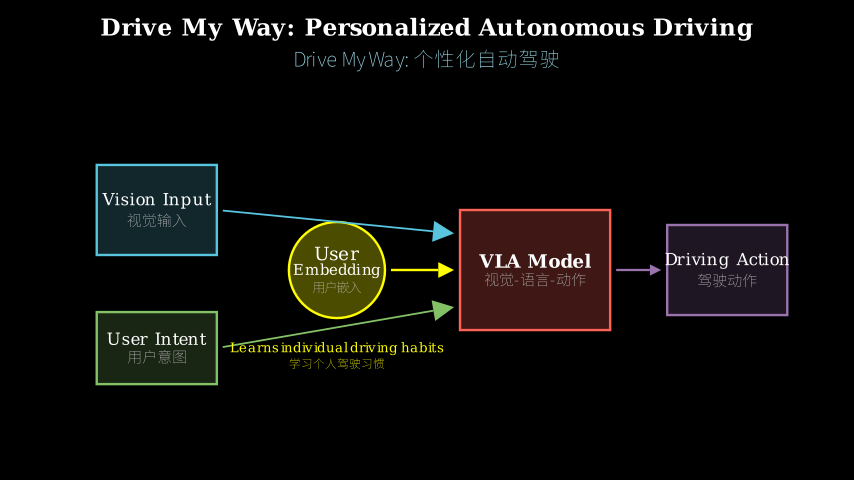
DMW has three components working in concert. First, a user embedding network processes historical driving data from multiple drivers to extract a compact representation of each person’s driving style — their acceleration curves, lane-change aggressiveness, following distance preferences. This embedding is a learned fingerprint, not hand-coded features.
Second, the Vision-Language-Action (VLA) backbone takes camera inputs and the user embedding, then outputs driving actions (steering, throttle, brake). The embedding conditions every layer of the policy network, so the same visual scene produces different actions for different drivers. A conservative driver sees a merge opportunity and waits; an aggressive driver takes it immediately — same input, different embedding, different output.
Third, a language instruction module processes real-time commands like “drive more carefully near schools” or “take the faster route.” This creates a temporary modifier on top of the base user embedding, allowing short-term intent to override long-term habits without retraining. The system learns this dual conditioning through a dataset collected from real drivers across varied scenarios, each annotated with both driver identity and occasional verbal instructions.
Historical drives --> [User Embedding Net] --> Personal signature vector
                                                        |
                                                        v
Camera feed -------> [VLA Policy Network] <------ User embedding
                            |                          ^
                            |                          |
                            v                    [Language Encoder]
                     Driving actions                   ^
                                                        |
                                            "Be more cautious"
Think of DMW like a chauffeur who’s driven with you for months. The chauffeur has internalized your habits — you brake earlier than most, you prefer the left lane, you’re cautious around trucks. That’s the user embedding. Now you get in and say “I’m running late, drive a bit faster.” The chauffeur doesn’t forget your baseline style, but temporarily adjusts within your comfort zone. The embedding is the muscle memory; the language instruction is the real-time nudge. Without the embedding, the chauffeur is generic. Without language, the chauffeur can’t adapt to today’s specific needs. Together, they create a driving partner that feels like an extension of you.
Key Concepts
-
User Embedding: Instead of storing gigabytes of your past drives, the system compresses your driving style into a small vector (think 128 numbers). This vector captures patterns like “this person accelerates smoothly” or “this person leaves large gaps in traffic.” It’s learned, not programmed — the network discovers what dimensions of driving style matter by watching many drivers. Analogy: your handwriting can be recognized from just a few samples because it has a consistent “signature.” The embedding is that signature for driving behavior.
-
Conditional Policy: Most driving models learn one policy for everyone. DMW learns a policy family — the same network architecture produces different behaviors depending on the user embedding fed in. It’s like a single recipe that tastes different based on which spice blend you add. The network’s weights stay fixed after training, but the embedding acts as a control knob that steers the policy toward your personal style without retraining.
-
Dual Alignment: The system balances two types of preferences simultaneously. Long-term alignment comes from the user embedding (your habitual style). Short-term alignment comes from language instructions (today’s specific intent). The key insight: these aren’t competing — language instructions modulate the base style rather than replace it. If you’re naturally cautious, “drive faster” makes you moderately faster, not reckless. The system learns appropriate adjustment ranges for each user during training.
Framework Shift
Before (mainstream approach):        After (this paper):

  Camera --> [Generic Policy]          Camera -----> [Policy]
                    |                                  ^ ^
                    v                                  | |
              Same actions                    User ----+ |
              for everyone                    embedding  |
                                                         |
                                              Language --+
                                              instruction
                                                  |
                                                  v
                                          Personalized actions
                                          (recognizable as "you")
From one-size-fits-all optimization to user-conditioned generation, the core shift is treating driving style as a learnable parameter rather than a fixed target.
Expert Assessment
Problem choice: This is a real gap with practical implications. Current AVs feel alien precisely because they don’t drive like humans — not just in capability, but in style. The problem sits at the intersection of human-robot interaction and autonomous driving, which is underexplored. However, the framing slightly oversells the novelty — personalization in robotics isn’t new, and some prior work in driver modeling exists. The contribution is more in the execution and integration than the problem identification.
Method maturity: The approach is sound but not groundbreaking. Learning user embeddings from demonstration data is established in robotics; adding language conditioning follows recent VLA trends. The clever part is the dual alignment framework and the data collection across real drivers. However, the paper doesn’t deeply explore failure modes — what happens when language instructions conflict strongly with learned style? How does the system handle new users with limited data? These feel like engineering challenges rather than fundamental limitations, but they’re underexplored.
Experimental integrity: The Bench2Drive evaluation is appropriate but limited — it’s a simulation benchmark, not real-world deployment. The user study showing drivers can recognize their own style is compelling evidence of personalization, but the sample size and methodology aren’t detailed enough to assess rigor. Baselines are reasonable (generic policy, fixed modes), though comparisons to recent personalization work in other domains would strengthen the claims. The ablation studies are adequate but not exhaustive.
Writing quality: The paper is clearly written with good motivation, but the related work section glosses over adjacent fields (personalized recommendation systems, style transfer in other domains) that could inform the approach. The method section is detailed, but the discussion of limitations is thin — it reads like the authors are confident everything works, which raises skepticism. Rewriting the limitations and future work section with more honest reflection would elevate the paper significantly.
Verdict: weak accept — solid execution on a relevant problem with decent evidence, but incremental contribution and limited real-world validation prevent strong enthusiasm.
Takeaways
The dual alignment framework (long-term embedding + short-term language) is transferable to any sequential decision-making domain where users have both stable preferences and dynamic intent — think personalized recommendation systems that adapt to “show me something different today” or robot assistants that learn your habits but respond to immediate requests. The key insight: don’t treat personalization and instruction-following as separate problems; make instructions modulate the personalized baseline.
The data collection strategy is worth stealing: gather multi-user demonstrations in varied conditions, annotate with both user identity and occasional instructions. This creates a dataset that supports learning both the embedding space and the instruction adapter jointly, which is more efficient than training them separately.
For practitioners building human-in-the-loop systems: user embeddings are cheaper than per-user models. Train one big model conditioned on embeddings rather than N small models. The embedding approach scales better and enables zero-shot transfer to new users (initialize their embedding and fine-tune with minimal data).
论文: 2603.25740 作者: Zehao Wang, Huaide Jiang, Shuaiwu Dong, Yuping Wang, Hang Qiu, Jiachen Li 分类: cs.RO, cs.AI, cs.CV, cs.LG, cs.MA
缺口
当前的端到端自动驾驶系统要么优化通用安全指标,要么提供固定驾驶模式(经济、运动、舒适)。
它们把所有司机当成一样的人,忽略了人类驾驶的两个基本面:长期个人习惯(你自然的加速、并线、让行方式)和短期意图(口头指令如”开得谨慎点”)。
Waymo开得像Waymo,特斯拉开得像特斯拉——都不像你。
先前工作分两派:模仿学习系统从数据集克隆平均驾驶行为,强化学习方法优化通用奖励函数。
两者都缺个性化。
一些近期工作探索风格迁移,但这些系统要么需要大量的单用户重训练,要么无法实时理解自然语言意图。
问题:通用驾驶 =/= 人类驾驶
    |
    v
假设:个人风格 = 长期习惯 + 短期意图
    |
    v
方法:从多司机数据学习用户嵌入
     + 用嵌入条件化策略
     + 添加语言指令适配器
    |
    v
证据:闭环仿真 + 用户识别研究
    |
    v
结论:个性化VLA实现可识别的驾驶风格
增量
一句话: 这篇论文之前,自动驾驶系统要么通用驾驶要么固定模式;之后,它们能学习你的个人驾驶签名并实时响应口头指令。
核心机制
DMW有三个协同工作的组件。
首先,用户嵌入网络处理多个司机的历史驾驶数据,提取每个人驾驶风格的紧凑表示——他们的加速曲线、变道激进程度、跟车距离偏好。
这个嵌入是学习出来的指纹,不是手工编码的特征。
其次,视觉-语言-动作(VLA)主干接收摄像头输入和用户嵌入,然后输出驾驶动作(转向、油门、刹车)。
嵌入条件化策略网络的每一层,所以同样的视觉场景对不同司机产生不同动作。
保守司机看到并线机会会等待;激进司机立即抓住——同样输入,不同嵌入,不同输出。
第三,语言指令模块处理实时命令,如”在学校附近开得小心点”或”走更快的路线”。
这在基础用户嵌入之上创建临时修饰符,允许短期意图覆盖长期习惯而无需重训练。
系统通过从真实司机在各种场景下收集的数据集学习这种双重条件化,每条数据都标注了司机身份和偶尔的口头指令。
历史驾驶 --> [用户嵌入网络] --> 个人签名向量
                                      |
                                      v
摄像头输入 --> [VLA策略网络] <---- 用户嵌入
                    |                  ^
                    |                  |
                    v            [语言编码器]
                驾驶动作               ^
                                      |
                              "开得谨慎点"
把DMW想象成跟你开了几个月车的司机。
司机已经内化了你的习惯——你刹车比大多数人早,你偏好左车道,你在卡车附近很谨慎。
这就是用户嵌入。
现在你上车说”我要迟到了,开快点”。
司机不会忘记你的基线风格,但会在你的舒适区内临时调整。
嵌入是肌肉记忆;语言指令是实时微调。
没有嵌入,司机是通用的。
没有语言,司机无法适应今天的具体需求。
两者结合,创造出感觉像你延伸的驾驶伙伴。
关键概念
- 用户嵌入: 系统不存储你过去驾驶的几个GB数据,而是把你的驾驶风格压缩成一个小向量(想象128个数字)。
这个向量捕捉”这个人加速平稳”或”这个人在车流中留大间隙”等模式。
它是学习的,不是编程的——网络通过观察许多司机发现驾驶风格的哪些维度重要。
类比:你的笔迹可以从几个样本识别出来,因为它有一致的”签名”。
嵌入就是驾驶行为的那个签名。
- 条件化策略: 大多数驾驶模型为所有人学习一个策略。
DMW学习一个策略族——同样的网络架构根据输入的用户嵌入产生不同行为。
就像一个单一食谱根据你加的香料混合物尝起来不同。
网络权重在训练后保持固定,但嵌入充当控制旋钮,将策略引向你的个人风格而无需重训练。
- 双重对齐: 系统同时平衡两种偏好。
长期对齐来自用户嵌入(你的习惯风格)。
短期对齐来自语言指令(今天的具体意图)。
关键洞察:这些不是竞争的——语言指令调制基础风格而不是替换它。
如果你天生谨慎,“开快点”让你适度加快,不是鲁莽。
系统在训练期间为每个用户学习适当的调整范围。
框架转变
之前(主流方法):              之后(本文方法):

摄像头 --> [通用策略]         摄像头 -----> [策略]
              |                            ^ ^
              v                            | |
        所有人相同动作              用户 ----+ |
                                    嵌入      |
                                              |
                                    语言 -----+
                                    指令
                                      |
                                      v
                              个性化动作
                              (可识别为"你")
从一刀切优化到用户条件化生成,核心转变是把驾驶风格当作可学习参数而不是固定目标。
专家评审
选题眼光: 这是个有实际意义的真缺口。
当前自动驾驶车辆感觉陌生,正是因为它们不像人类那样驾驶——不仅在能力上,更在风格上。
问题位于人机交互和自动驾驶的交叉点,这个领域探索不足。
但是,框架略微夸大了新颖性——机器人学中的个性化不是新东西,驾驶员建模的一些先前工作也存在。
贡献更多在执行和集成上,而不是问题识别上。
方法成熟度: 方法合理但不突破性。
从演示数据学习用户嵌入在机器人学中已确立;添加语言条件化遵循最近的VLA趋势。
巧妙之处在于双重对齐框架和跨真实司机的数据收集。
但是,论文没有深入探索失败模式——当语言指令与学习风格强烈冲突时会发生什么?系统如何处理数据有限的新用户?这些感觉像工程挑战而不是根本限制,但探索不足。
实验诚意: Bench2Drive评估合适但有限——它是仿真基准,不是真实世界部署。
用户研究显示司机能识别自己的风格,这是个性化的有力证据,但样本量和方法论细节不足以评估严谨性。
基线合理(通用策略、固定模式),尽管与其他领域最近个性化工作的比较会加强主张。
消融研究足够但不详尽。
写作功力: 论文写得清楚,动机好,但相关工作部分掩盖了相邻领域(个性化推荐系统、其他领域的风格迁移),这些可以为方法提供信息。
方法部分详细,但局限性讨论单薄——读起来像作者自信一切都有效,这引发怀疑。
用更诚实的反思重写局限性和未来工作部分会显著提升论文。
判决: 弱接收——在相关问题上扎实执行,有不错证据,但增量贡献和有限的真实世界验证阻止了强烈热情。
要点总结
双重对齐框架(长期嵌入+短期语言)可迁移到任何用户既有稳定偏好又有动态意图的序列决策领域——想想个性化推荐系统适应”今天给我看点不一样的”或学习你习惯但响应即时请求的机器人助手。
关键洞察:不要把个性化和指令跟随当作独立问题;让指令调制个性化基线。
数据收集策略值得借鉴:在各种条件下收集多用户演示,用用户身份和偶尔指令标注。
这创建了支持联合学习嵌入空间和指令适配器的数据集,比分别训练它们更高效。
对于构建人在回路系统的实践者:用户嵌入比单用户模型便宜。
训练一个以嵌入为条件的大模型,而不是N个小模型。
嵌入方法扩展性更好,能实现对新用户的零样本迁移(初始化他们的嵌入,用最少数据微调)。