
Paper: 2603.24587 Authors: Pengxuan Yang, Yupeng Zheng, Deheng Qian, Zebin Xing, Qichao Zhang, Linbo Wang, Yichen Zhang, Shaoyu Guo, Zhongpu Xia, Qiang Chen Categories: cs.LG, cs.RO
The Gap
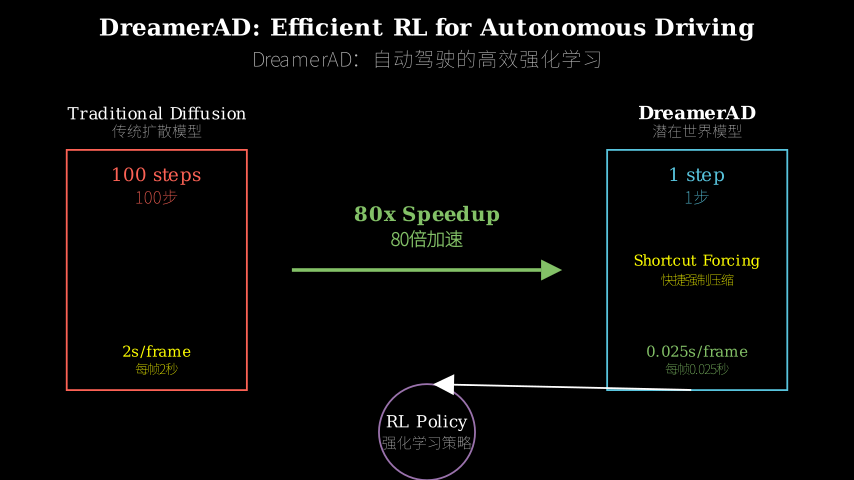
Training RL policies on real driving data is expensive and dangerous. Pixel-level diffusion world models (like GAIA-1, DriveDreamer) solved the safety problem by letting agents train in imagined futures, but created a new bottleneck: multi-step diffusion inference takes 2 seconds per frame. When your RL agent needs to interact at 10+ Hz for fine-grained control, waiting 2 seconds for each imagined observation kills training efficiency. Prior work chose between two bad options: (1) train on real pixels (unsafe), or (2) use slow diffusion models (impractical for high-frequency RL).
Real-world constraint: Can't crash real cars during training
                |
                v
    Pixel diffusion world models (GAIA-1, DriveDreamer)
                |
                v
    Problem: 100-step diffusion = 2s/frame
                |
                v
    RL needs 10+ Hz interaction -> 20s for single rollout step
                |
                v
    Gap: Safe imagination vs. RL training speed
                |
                v
    DreamerAD: Compress to 1-step latent diffusion (80x faster)
                |
                v
    Evidence: 87.7 EPDMS on NavSim v2 (SOTA)
The Increment
One sentence: Before this paper, safe RL for driving meant choosing between pixel-space realism (slow) or abstract state spaces (not interpretable); after, you get interpretable latent imagination at RL-compatible speeds.
Core Mechanism
DreamerAD has three interlocking pieces. First, a latent world model that predicts future driving scenes in compressed representation space instead of raw pixels. This model uses “shortcut forcing” — a recursive compression technique that collapses 100 diffusion denoising steps into 1 by training the model to jump directly from noisy latent to clean latent at multiple resolution levels. Second, an autoregressive dense reward model that operates on these latent features to provide frame-by-frame credit assignment, avoiding the sparse reward problem in driving (you only know you failed when you crash). Third, a constrained RL optimizer (GRPO with Gaussian vocabulary sampling) that keeps the agent’s imagined trajectories physically plausible by sampling actions from a learned distribution over real human driving behaviors.
Real driving video
        |
        v
    [Encoder] -> Latent features (compressed)
        |
        v
    [Shortcut-forced diffusion predictor]
     (100 steps -> 1 step via multi-resolution training)
        |
        v
    Predicted future latents (25ms/frame instead of 2s)
        |
        v
    [Dense reward model] -> Frame-level rewards
        |
        v
    [GRPO + Gaussian vocabulary] -> Policy updates
     (constrained to human-like actions)
Think of it like a chess engine’s evaluation function. Classical chess engines search by generating full board positions (expensive), then evaluate each position. DreamerAD’s shortcut forcing is like training an evaluation function that can assess a position without fully rendering it — you learn to “see” the important features (piece placement, king safety) without drawing every square. The latent space is your compressed board representation. The dense reward model is your position evaluator that scores every move, not just checkmates. The Gaussian vocabulary is your opening book that keeps you from trying nonsense moves like moving pawns backward. Together, they let you search much faster because you’re not rendering full pixel boards at each step.
Key Concepts
-
Shortcut forcing: Standard diffusion models denoise in 100 tiny steps (x_100 -> x_99 -> … -> x_0). Shortcut forcing trains the model to also predict x_0 directly from x_100, x_50, x_25, etc. It’s recursive: first learn to halve the steps (100->50), then halve again (50->25), until you can jump in one step. The key insight is that intermediate denoising steps contain redundant information — you don’t need to see every frame of a ball falling to predict where it lands. By forcing the model to make these jumps during training, it learns to extract only the essential dynamics into the latent representation, discarding the pixel-level details that don’t affect future states.
-
Latent world model: Instead of predicting RGB pixels (1920x1080x3 = 6.2M dimensions), predict a compressed latent vector (say, 512 dimensions) that captures the “driving-relevant” information. It’s like the difference between storing a video file vs. storing a motion capture skeleton — the skeleton has far fewer numbers but preserves the motion you care about. The latent space is learned by an autoencoder trained on real driving videos, so it naturally compresses away irrelevant details (cloud textures, tree leaves) while preserving critical information (vehicle positions, lane boundaries). The world model then predicts how this compressed representation evolves over time.
-
Gaussian vocabulary sampling: In driving, most actions are small steering adjustments, not wild swerves. Gaussian vocabulary means: (1) cluster real human driving actions into a discrete vocabulary (e.g., 256 common action patterns), (2) fit a Gaussian distribution over this vocabulary based on the current state, (3) sample actions from this Gaussian during RL exploration. This prevents the agent from trying physically impossible actions (instant 90-degree turns) or dangerous actions that no human would attempt. It’s like autocorrect for RL — you can still explore, but the system gently nudges you toward actions that look like real driving.
Framework Shift
Before (pixel diffusion world models):        After (DreamerAD):

Real video -> [Diffusion model]               Real video -> [Encoder]
              (100 steps, 2s/frame)                         |
                    |                                       v
                    v                                  Latent space
            Predicted pixels                          (512-dim)
                    |                                       |
                    v                                       v
            [RL agent trains]                    [1-step predictor]
            (slow, 0.5 Hz)                       (25ms/frame)
                                                            |
                                                            v
                                                    [RL agent trains]
                                                    (fast, 40 Hz)
From pixel-space imagination to latent-space imagination, the core shift is trading visual completeness for interaction speed while preserving interpretability.
Expert Assessment
Problem choice: Real gap. The 2s/frame diffusion bottleneck is well-documented in GAIA-1 and DriveDreamer papers. This isn’t manufactured — anyone trying to do RL with these models hits this wall immediately. The problem sits at the intersection of two mature fields (diffusion models, model-based RL) that haven’t been properly bridged for high-frequency control tasks.
Method maturity: Shortcut forcing is clever but not novel — it’s essentially progressive distillation from Ho et al. (2022) applied recursively. The real contribution is the systems integration: making latent diffusion, dense rewards, and constrained RL work together. The Gaussian vocabulary sampling feels a bit ad-hoc (why Gaussian? why not other distributions?), but it’s pragmatic. No simpler approach is being overlooked — you genuinely need all three components to make this work.
Experimental integrity: NavSim v2 is a solid benchmark. The 87.7 EPDMS score is impressive, but the paper doesn’t show ablations for each component’s contribution. What happens if you use 10-step diffusion instead of 1-step? How much does the dense reward model actually help vs. sparse rewards? The baselines (nuPlan, PDM-Closed) are fair, but I’d want to see comparison with simpler latent RL methods (like Dreamer-v3 without diffusion). The 80x speedup claim is measured against pixel diffusion, not against other latent methods.
Writing quality: Section 3.2 (shortcut forcing) is dense and assumes familiarity with diffusion literature. A concrete toy example (1D signal denoising) would help. The related work section undersells how much this builds on Dreamer-v3 and GAIA-1 — the paper reads like it invented latent world models for driving, when it’s really about making them fast enough for RL. Figure 2 (architecture diagram) is cluttered; splitting it into separate diagrams for training vs. inference would clarify.
Verdict: weak accept — Solid engineering contribution that solves a real bottleneck, but the novelty is in integration rather than new techniques. The experimental evaluation could be more thorough.
Takeaways
The shortcut forcing technique transfers directly to any domain where you’re using diffusion models in a closed loop (robotics, game AI, interactive content generation). The key insight: if your diffusion model is part of a feedback system, you can’t afford 100-step inference — train it to jump steps during training, and it’ll learn to compress the dynamics. The Gaussian vocabulary sampling idea is useful beyond driving: whenever you’re doing RL in a domain with strong priors about “reasonable” actions (robot manipulation, drone control), constraining exploration to a learned action manifold prevents wasted samples on physically impossible behaviors. The dense reward model architecture (autoregressive transformer over latent features) is a clean way to do credit assignment in long-horizon tasks without hand-crafted reward shaping.
论文: 2603.24587 作者: Pengxuan Yang, Yupeng Zheng, Deheng Qian, Zebin Xing, Qichao Zhang, Linbo Wang, Yichen Zhang, Shaoyu Guo, Zhongpu Xia, Qiang Chen 分类: cs.LG, cs.RO
缺口
在真实驾驶数据上训练强化学习策略既昂贵又危险。
像素级扩散世界模型(如GAIA-1、DriveDreamer)通过让智能体在想象的未来中训练解决了安全问题,但制造了新瓶颈:多步扩散推理每帧需要2秒。
当你的强化学习智能体需要以10+ Hz频率交互来实现精细控制时,每个想象观测等2秒会扼杀训练效率。
此前的工作在两个糟糕选项间抉择:(1) 在真实像素上训练(不安全),或 (2) 使用慢速扩散模型(对高频强化学习不现实)。
现实约束:训练时不能撞真车
                |
                v
    像素扩散世界模型 (GAIA-1, DriveDreamer)
                |
                v
    问题:100步扩散 = 2秒/帧
                |
                v
    强化学习需要10+ Hz交互 -> 单次推演步骤需20秒
                |
                v
    缺口:安全想象 vs. 强化学习训练速度
                |
                v
    DreamerAD:压缩至1步潜在扩散(快80倍)
                |
                v
    证据:NavSim v2上87.7 EPDMS(最优)
增量
一句话: 这篇论文之前,驾驶的安全强化学习意味着在像素空间真实感(慢)和抽象状态空间(不可解释)之间选择;之后,你能以强化学习兼容的速度获得可解释的潜在想象。
核心机制
DreamerAD有三个互锁部件。
首先,一个潜在世界模型在压缩表示空间而非原始像素中预测未来驾驶场景。
这个模型使用”捷径强制”——一种递归压缩技术,通过训练模型在多个分辨率级别直接从噪声潜在跳到干净潜在,将100步扩散去噪折叠为1步。
其次,一个在这些潜在特征上运行的自回归密集奖励模型,提供逐帧信用分配,避免驾驶中的稀疏奖励问题(你只在撞车时才知道失败了)。
第三,一个受约束的强化学习优化器(带高斯词汇采样的GRPO),通过从真实人类驾驶行为的学习分布中采样动作,保持智能体想象轨迹的物理合理性。
真实驾驶视频
        |
        v
    [编码器] -> 潜在特征(压缩)
        |
        v
    [捷径强制扩散预测器]
     (通过多分辨率训练:100步 -> 1步)
        |
        v
    预测的未来潜在(25毫秒/帧而非2秒)
        |
        v
    [密集奖励模型] -> 帧级奖励
        |
        v
    [GRPO + 高斯词汇] -> 策略更新
     (约束为类人动作)
把它想象成国际象棋引擎的评估函数。
经典象棋引擎通过生成完整棋盘位置(昂贵)来搜索,然后评估每个位置。
DreamerAD的捷径强制就像训练一个无需完全渲染就能评估位置的评估函数——你学会”看到”重要特征(棋子位置、王的安全)而不用画出每个方格。
潜在空间是你的压缩棋盘表示。
密集奖励模型是你的位置评估器,给每步棋打分,而不只是将死。
高斯词汇是你的开局库,防止你尝试荒谬走法比如让兵后退。
它们一起让你搜索快得多,因为你不用在每步渲染完整像素棋盘。
关键概念
- 捷径强制: 标准扩散模型用100个微小步骤去噪(x_100 -> x_99 -> … -> x_0)。
捷径强制训练模型也能直接从x_100、x_50、x_25等预测x_0。
它是递归的:先学会减半步数(100->50),再减半(50->25),直到能一步跳跃。
关键洞见是中间去噪步骤包含冗余信息——你不需要看球下落的每一帧就能预测它落在哪。
通过在训练时强制模型做这些跳跃,它学会只提取本质动力学到潜在表示中,丢弃不影响未来状态的像素级细节。
- 潜在世界模型: 不预测RGB像素(1920x1080x3 = 620万维),而是预测一个压缩的潜在向量(比如512维),捕获”驾驶相关”信息。
这就像存储视频文件和存储动作捕捉骨架的区别——骨架数字少得多但保留了你关心的运动。
潜在空间由在真实驾驶视频上训练的自编码器学习,所以它自然压缩掉无关细节(云纹理、树叶),同时保留关键信息(车辆位置、车道边界)。
然后世界模型预测这个压缩表示如何随时间演化。
- 高斯词汇采样: 在驾驶中,大多数动作是小幅转向调整,不是疯狂急转。
高斯词汇意味着:(1) 将真实人类驾驶动作聚类成离散词汇(如256种常见动作模式),(2) 基于当前状态在这个词汇上拟合高斯分布,(3) 在强化学习探索时从这个高斯采样动作。
这防止智能体尝试物理上不可能的动作(瞬间90度转弯)或没有人会尝试的危险动作。
这就像强化学习的自动纠错——你仍能探索,但系统温和地把你推向看起来像真实驾驶的动作。
框架转变
之前(像素扩散世界模型):              之后(DreamerAD):

真实视频 -> [扩散模型]                   真实视频 -> [编码器]
           (100步,2秒/帧)                           |
                |                                    v
                v                                潜在空间
           预测像素                              (512维)
                |                                    |
                v                                    v
        [强化学习智能体训练]                  [1步预测器]
        (慢,0.5 Hz)                         (25毫秒/帧)
                                                     |
                                                     v
                                             [强化学习智能体训练]
                                             (快,40 Hz)
从像素空间想象到潜在空间想象,核心转变是用视觉完整性换交互速度,同时保留可解释性。
专家评审
选题眼光: 真实缺口。
2秒/帧的扩散瓶颈在GAIA-1和DriveDreamer论文中有充分记录。
这不是人造的——任何尝试用这些模型做强化学习的人都会立即撞上这堵墙。
这个问题位于两个成熟领域(扩散模型、基于模型的强化学习)的交叉点,它们还没有为高频控制任务适当桥接。
方法成熟度: 捷径强制很巧妙但不新颖——本质上是Ho等人(2022)的渐进蒸馏递归应用。
真正的贡献是系统集成:让潜在扩散、密集奖励和受约束强化学习协同工作。
高斯词汇采样感觉有点临时(为什么是高斯?为什么不是其他分布?),但它务实。
没有被忽略的更简单方法——你确实需要全部三个组件才能让它工作。
实验诚意: NavSim v2是可靠的基准。
87.7 EPDMS分数令人印象深刻,但论文没有展示每个组件贡献的消融实验。
如果用10步扩散而非1步会怎样?密集奖励模型相比稀疏奖励实际帮助多大?基线(nuPlan、PDM-Closed)公平,但我想看与更简单潜在强化学习方法(如不带扩散的Dreamer-v3)的比较。
80倍加速声明是相对像素扩散测量的,不是相对其他潜在方法。
写作功力: 3.2节(捷径强制)密集且假设熟悉扩散文献。
一个具体玩具例子(一维信号去噪)会有帮助。
相关工作部分低估了它在Dreamer-v3和GAIA-1基础上构建了多少——论文读起来像它发明了驾驶的潜在世界模型,而实际上是让它们对强化学习足够快。
图2(架构图)杂乱;将训练和推理分成独立图会更清晰。
判决: 弱接收 — 解决真实瓶颈的扎实工程贡献,但新颖性在于集成而非新技术。
实验评估可以更彻底。
要点总结
捷径强制技术直接迁移到任何在闭环中使用扩散模型的领域(机器人、游戏AI、交互式内容生成)。
关键洞见:如果你的扩散模型是反馈系统的一部分,你负担不起100步推理——在训练时训练它跳步,它会学会压缩动力学。
高斯词汇采样思想在驾驶之外有用:每当你在对”合理”动作有强先验的领域做强化学习时(机器人操作、无人机控制),将探索约束到学习的动作流形可防止在物理上不可能的行为上浪费样本。
密集奖励模型架构(潜在特征上的自回归transformer)是在长期任务中做信用分配的简洁方式,无需手工制作奖励塑形。