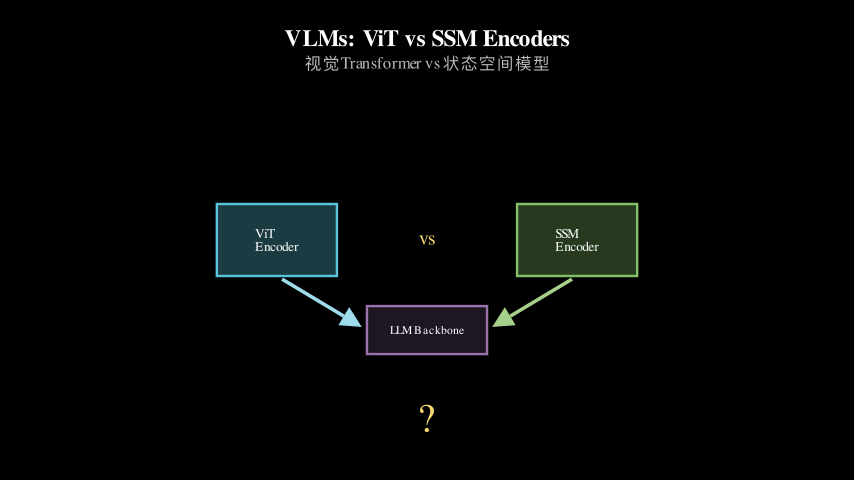
Paper: 2603.19209 Authors: Shang-Jui Ray Kuo, Paola Cascante-Bonilla Categories: cs.CV, cs.LG
The Gap
VLMs have a standard recipe: freeze a ViT-based vision encoder (CLIP-ViT, SigLIP, DINOv2), bolt on a lightweight connector, and feed features into an LM. The assumption baked into this recipe is that transformers are the only serious option for the vision side. Nobody really questioned it — partly because ViTs work well, and partly because SSMs (amba-style architectures) were mostly evaluated on language tasks or standalone vision benchmarks, not as frozen backbones inside VLMs.
The specific gap: we don’t know whether SSM vision encoders can hold up in the VLM context, where the backbone is frozen and the downstream tasks include both coarse VQA and fine-grained localization. Prior comparisons were either unfair (different pretraining data, different scales) or incomplete (only VQA, no grounding).
  Prior State                This Paper
  -----------                    ----------
  ViT assumed default            Controlled comparison
  for VLM vision backbone        (matched ImageNet-1K init)
         |                              |
  SSMs only tested on            SSM vs ViT family
  standalone benchmarks          on VQA + grounding
         |                              |
  No dense-task tuning           + detection/segmentation
  ablation for VLMs              adaptation study
         |                              |
  Gap: is ViT actually           Evidence: SSM competitive
  necessary?                     at smaller scale
         |                              v
  Assumption: yes                Conclusion: no, SSM is
                 a strong alternative
The Increment
One sentence: Before this paper, SSM vision encoders were an untested wildcard in VLMs; after it, they’re a validated efficiency-friendly alternative with known failure modes and fixes.
Core Mechanism
The setup is deliberately controlled. Both SSM backbones (specifically VMamba-family) and ViT-family backbones (ViT-B/L, SigLIP, DINOv2) are initialized from ImageNet-1K checkpoints — same data, matched as closely as possible. Each backbone is frozen, then connected to an LLM via a lightweight MLP or cross-attention connector. The whole system is evaluated on VQA benchmarks (VQAv2, GQA, TextVQA) and grounding/localization tasks (RefCOCO, Flickr30k entities).
The second phase introduces dense-task adaptation: before freezing the backbone for VLM training, it gets fine-tuned on detection (COCO) or segmentation (ADE20K). This is motivated by the intuition that localization-heavy VLM tasks might benefit from a backbone that has seen dense supervision. The paper then measures whether this adaptation helps, and by how much, across both families.
The stabilization piece is the most practically interesting. Some backbones — particularly certain ViT variants — show instability on localization tasks (high variance, occasional collapse). The authors identify this and propose simple fixes: gradient clipping, layer normalization adjustments, and careful learning rate scheduling for the connector. These aren’t novel techniques, but applying them diagnostically to backbone-specific failure modes is useful.
  [ImageNet-1K checkpoint]
          |
          v
  +-------+--------+
  |                |
  v                v
[SSM backbone]  [ViT backbone]
  |                |
  | (optional)     | (optional)
  v                v
[Dense-task     [Dense-task
 fine-tune]      fine-tune]
  |                |
  v                v
  +-------+--------+
          |
          v
  [Frozen backbone]
          |
          v
  [Lightweight connector]
          |
          v
  [LLM]
          |
          v
  [VQA / Grounding eval]
Think of this like hiring a photographer for two different jobs: portrait studio work (VQA — coarse, semantic) and sports photography (grounding — fast, precise localization). ViTs are like photographers trained exclusively in studios — great at portraits, but sometimes shaky when the subject moves fast. SSMs are like photographers who trained in both environments. The “dense-task tuning” is like sending your studio photographer to a sports event for a month before the real assignment. The connector is the camera body — it doesn’t matter much which lens you use if the body is good. The key finding is that the SSM photographer gets comparable shots at smaller camera bag (model scale), and the stabilization strategies are just telling the shaky photographer to brace against a wall.
Key Concepts
-
State Space Models (SSMs) as vision encoders: SSMs like Mamba process sequences by maintaining a compressed hidden state that gets updated as new tokens arrive — think of it like reading a sentence and keeping a running summary rather than re-reading everything each time (which is what attention does). For images, you flatten the 2D grid into a sequence of patches and run the SSM over them. The upside: linear complexity in sequence length instead of quadratic. The downside historically: SSMs struggle with long-range 2D spatial dependencies because the scan order matters and images don’t have a natural “reading direction.” VMamba addresses this with multi-directional scanning (scan left-to-right, right-to-left, top-to-bottom, bottom-to-top, then merge).
-
Frozen backbone in VLMs: When people say the backbone is “frozen,” they mean its weights don’t change during VLM training. Only the connector (and sometimes the LLM) gets updated. This is a deliberate choice — it’s cheaper, and it avoids catastrophic forgetting of the visual representations. But it also means the backbone’s quality is load-bearing: whatever features it learned during pretraining are all you get. This is why the choice of backbone matters so much, and why dense-task tuning before freezing is an interesting lever.
-
Grounding/localization as a stress test: VQA is relatively forgiving — you need to understand the image semantically, but you don’t need to know exactly where things are. Grounding tasks (e.g., “find the red chair on the left”) require spatial precision. This is a harder test for vision encoders because it exposes whether the backbone’s spatial representations are actually well-organized. SSMs, with their scan-based processing, might be expected to struggle here — but the paper finds they don’t, which is the surprising result.
Framework Shift
Before (mainstream approach):        After (this paper):

  [ViT encoder]                        [SSM encoder]
       |                                    |
  assumed necessary                    competitive alternative
       |                                    |
  bigger = better                      scale != performance
       |                                    |
  no dense-task tuning                dense-task tuning
  for VLM backbones                    is a useful lever
       |                                    |
  localization instability             stabilization strategies
  unaddressed                          identified + fixed
       |                                    |
  one backbone family                  two families, controlled
  dominates by default                 comparison, honest tradeoffs
From “ViTs are the only serious option” to “SSMs are a validated alternative with known tradeoffs,” the core shift is moving from assumption to evidence.
Expert Assessment
Problem choice: This is a real gap, not a manufactured one. The SSM-for-vision literature (VMamba, Vision Mamba, PlainMamba) has been growing fast, but almost nobody had done a clean aples-to-apples comparison inside the VLM pipeline. The timing is right — SSMs are mature enough to benchmark seriously, and the VLM community is actively looking for efficiency wins. It’s not a groundbreaking question, but it’s a necessary one.
Method maturity: This is a benchmarking paper, not a methods paper, so “clever insight” isn’t really the right frame. The controlled experimental design is the contribution, and it’s done reasonably well. The dense-task tuning ablation is the most interesting methodological choice — it’s not obvious that this would help, and the fact that it does (and roughly equally across families) is a clean finding. The stabilization strategies are pragmatic rather than principled, which is fine for a benchmarking paper.
Experimental integrity: The matched initialization constraint is the right call and the authors are upfront about it. The honest concern is that “matched ImageNet-1K initialization” still leaves a lot of room for confounds — SSM and ViT architectures have different inductive biases, different optimal hyperparameters, and different sensitivity to the connector design. The paper doesn’t fully disentangle these. The localization instability finding is interesting but the sample of affected backbones seems small — it’s hard to know if this is a systematic issue or a few unlucky runs. The stabilization strategies are presented as fixes but the ablation of each strategy individually is thin.
Writing quality: The paper is clear and well-organized, but the discussion section is where it gets lazy. The “higher ImageNet accuracy doesn’t translate to better VLM performance” finding is stated but not really explained — why not? What does this tell us about what VLMs actually need from their vision backbone? That section, if expanded with a proper analysis of which backbone properties correlate with VLM performance, would elevate the whole paper from “useful benchmark” to “actually changes how people think about backbone selection.”
Verdict: weak accept — solid controlled benchmark that fills a real gap, but the analysis stops just short of the insights that would make it genuinely influential.
Takeaways
A few concrete things worth stealing:
-
Dense-task tuning before freezing a backbone for VLM use is a cheap intervention that consistently helps on localization tasks. If you’re building a VLM and care about grounding, run your backbone through a COCO detection fine-tune first. The paper gives you the evidence to justify this to your team.
-
ImageNet accuracy is a bad proxy for VLM backbone quality. Stop using it as a selection criterion. The paper doesn’t tell you what the right proxy is, but it tells you what the wrong one is — which is still useful.
-
If you’re seeing instability in localization tasks with a frozen backbone, the fix is boring but effective: gradient clipping on the connector, check your LR schedule. The paper documents this failure mode clearly enough that you can recognize it when you hit it.
-
For anyone working on efficient VLMs: SSMs at smaller scale are now a credible option. You don’t need to default to a largeViT-L just because that’s what everyone else uses. The efficiency argument for SSMs (linear vs quadratic complexity) is real, and this paper gives you the empirical backing to make the case.
论文: 2603.19209 作者: Shang-Jui Ray Kuo, Paola Cascante-Bonilla 分类: cs.CV, cs.LG
缺口
视觉语言模型(VLM)有一套固定配方:冻结一个基于ViT的视觉编码器(CLIP-ViT、SigLIP、DINOv2),接上轻量连接器,再喂给大语言模型。 这套配方背后有一个默认假设:Transformer是视觉侧唯一靠谱的选择。 没人认真质疑过这一点——一方面ViT确实好用,另一方面SSM(Mamba类架构)主要在语言任务或独立视觉基准上评测,从未作为VLM内部的冻结骨干被系统考察过。
具体的缺口在于:我们不知道SSM视觉编码器在VLM场景下能否撑得住。 VLM的骨干是冻结的,下游任务既有粗粒度的VQA,也有细粒度的定位(grounding)。 此前的比较要么不公平(预训练数据不同、规模不同),要么不完整(只测VQA,没测定位)。
  现有状态                         本文贡献
  --------                         --------
  ViT被默认为VLM视觉骨干            受控比较
                   (匹配ImageNet-1K初始化)
       |                                  |
  SSM只在独立基准上测试              SSM vs ViT家族
  从未进入VLM流水线                  同时测VQA + 定位
       |                                  |
  没有稠密任务微调的消融              + 检测/分割适配研究
       |                                  |
  缺口:ViT真的必要吗?              证据:SSM在更小规模下
                                   具有竞争力
       |                                  v
  假设:是的                        结论:不,SSM是
                                   强力替代方案
增量
一句话:这篇论文之前,SSM视觉编码器在VLM里是未经验证的黑马;之后,它成了有据可查的高效替代方案,连失效模式和修复方法都一并给出了。
核心机制
实验设计刻意保持受控。 SSM骨干(VMamba家族)和ViT家族骨干(ViT-B/L、SigLIP、DINOv2)都从ImageNet-1K检查点初始化——相同数据,尽量匹配。 每个骨干冻结后,通过轻量MLP或交叉注意力连接器接入LM。 整个系统在VQA基准(VQAv2、GQA、TextVQA)和定位任务(RefCOCO、Flickr30k实体)上评测。
第二阶段引入稠密任务适配:在冻结骨干用于VLM训练之前,先在检测(COCO)或分割(ADE20K)上微调。 动机是:定位密集的VLM任务可能受益于见过稠密监督的骨干。 论文测量了这种适配对两个家族各自的帮助程度。
最有实用价值的是稳定化部分。 某些骨干——尤其是特定ViT变体——在定位任务上表现不稳定(方差大、偶尔崩溃)。 作者识别出这一问题,并提出简单修复:梯度裁剪、层归一化调整、连接器学习率调度优化。 这些技术本身不新,但把它们诊断性地应用到骨干特定失效模式上,是有价值的工程贡献。
  [ImageNet-1K检查点]
          |
          v
  +-------+--------+
  |                |
  v                v
[SSM骨干]        [ViT骨干]
  |                |
  | (可选)         | (可选)
  v                v
[稠密任务        [稠密任务
 微调]            微调]
  |                |
  v                v
  +-------+--------+
          |
          v
  [冻结骨干]
          |
          v
  [轻量连接器]
          |
          v
  [大语言模型]
          |
          v
  [VQA / 定位评测]
用一个比喻来理解这套机制:把视觉骨干想象成摄影师,VLM任务分两种——人像摄影(VQA,粗粒度语义理解)和体育摄影(定位,快速精准捕捉位置)。 ViT像是只在摄影棚训练过的摄影师,拍人像很稳,但拍运动员时手会抖。 SSM像是在两种环境都练过的摄影师。 “稠密任务微调”就是把摄影棚摄影师送去体育赛场实习一个月再上岗。 连接器是相机机身——镜头换来换去,机身好才是根本。 核心发现是:SSM摄影师用更小的摄影包(模型规模)拍出了同等质量的照片,而稳定化策略不过是告诉那个手抖的摄影师靠墙站稳。
关键概念
-
SSM作为视觉编码器:Mamba这类状态空间模型处理序列的方式是维护一个压缩的隐藏状态,随着新token到来不断更新——就像读一篇文章时边读边记摘要,而不是每次都从头重读(注意力机制干的就是这件事)。 用于图像时,把二维图像网格展平成patch序列,再跑SSM。 优势是序列长度线性复杂度,而非二次方。 历史上的劣势是SSM难以捕捉二维空间的长程依赖,因为扫描顺序很重要,而图像没有天然的”阅读方向”。 VMamba用多方向扫描(左到右、右到左、上到下、下到上,再合并)解决了这个问题。
-
VLM中的冻结骨干:冻结骨干意味着VLM训练期间骨干权重不变,只有连接器(有时还有LM)在更新。 这是刻意的选择——更省钱,也避免遗忘视觉表征。 但代价是骨干质量成了承重墙:预训练学到什么,你就只有什么。 这正是骨干选择如此关键的原因,也是”冻结前先做稠密任务微调”这个杠杆值得研究的原因。
-
定位任务作为压力测试:VQA相对宽容——你需要语义理解图像,但不需要知道东西在哪里。 定位任务(比如”找左边那把红椅子”)要求空间精度,这是对视觉编码器更苛刻的考验,因为它暴露了骨干的空间表征是否真的组织良好。 基于扫描的SSM本来可能在这里吃亏——但论文发现它并没有,这是最出人意料的结果。
框架转变
之前(主流方法):                    之后(本文方法):

  [ViT编码器]                          [SSM编码器]
       |