Paper: 2606.19333 Authors: Bhawna Paliwal, Haritheja Etukuru, William Liang, Pieter Abbeel, Nur Muhammad Mahi Shafiullah, Jitendra Malik Categories: cs.RO, cs.CV
The Gap
Existing work on learning from human videos for robotic manipulation has focused on two-stage pipelines: first, estimate hand pose and object pose from RGB video (e.g., FrankMocap, DexYCB benchmark); second, attempt to map these estimates to robot actions. The bottleneck is that these methods either require multi-view setups (not scalable) or produce 3D hand-object interactions that are too noisy to retarget into physically feasible robot trajectories. Prior SOTA (e.g., DROID, BRIM) either only works in constrained lab environments or assumes the human and robot share similar kinematics, which fails for multi-fingered hands. The gap: no existing method can take a single monocular video of a human performing a manipulation and output a sequence of joint angles that a dexterous robot hand can execute in the real world.
Problem: need scalable dexterous manipulation data from abundant human videos
  Assumption: monocular RGB video contains enough information to recover hand-object
               interaction and robot-executable actions
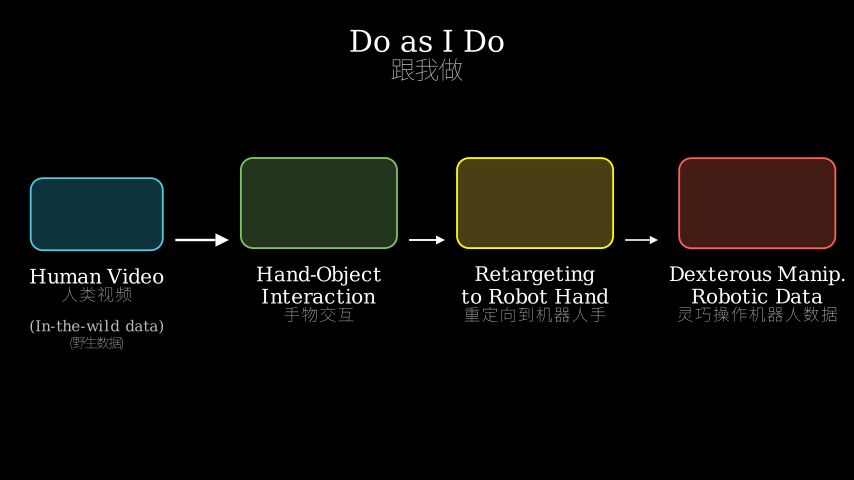
  Method: DO AS I DO reconstructs 3D hand-object interaction from video, then
          retargets to robot hand via optimization in a pose- and physically-feasible space
    Evidence: outperforms SOTA on hand-object estimation benchmarks (e.g., HO-3D)
              and produces real-world robot trajectories on a test set of 20 YouTube clips
    Conclusion: monocular human videos can become a primary source for dexterous
                manipulation data, pushing scaling boundaries
The Increment
One sentence: Before this paper, dexterous robot manipulation data had to come from teleoperation or simulation; after this paper, it can be extracted automatically from billions of existing human YouTube videos.
Core Mechanism
The algorithm has three main components. First, a hand-object reconstruction module that takes a monocular video frame and outputs a 3D mesh of the human hand and a 6-DOF pose of the manipulated object. This uses a learned model that regresses MANO hand parameters and object pose jointly, with a novel contact-aware loss that penalizes interpenetration. Second, a smoothing and temporal consistency step that averages predictions across frames and fills occlusion gaps using a motion prior (based on human hand dynamics). Third, a retargeting module that maps the reconstructed hand poses onto a specific robot hand (e.g., Allegro Hand) by solving an optimization problem that minimizes joint angle differences while respecting joint limits, self-collision, and physical constraints (e.g., finger-object contact matching). The output is a sequence of robot joint angles that can be executed open-loop or used for imitation learning.
 +----------------+      +------------------+      +-----------------+
 |   Monocular    | -->  | Hand-Object      | -->  | Temporal        |
 |   Video (RGB)  |      | Reconstruction   |      | Smoothing &     |
 |   per frame    |      | (MANO + object)  |      | Occlusion Fill  |
 +----------------+      +------------------+      +-----------------+
                                                         |
                                                         v
                                             +---------------------+
                                             | Retargeting to      |
                                             | Robot Hand          |
                                             | (Optimization)      |
                                             +---------------------+
                                                         |
                                                         v
                                             +---------------------+
                                             | Robot Joint Angle   |
                                             | Sequence            |
                                             +---------------------+
Think of DO AS I DO as a language translator for body movement. Imagine you watch a native Spanish speaker giving a passionate speech. A human translator doesn’t simply swap word for word; they understand the meaning, the emotion, the facial expressions, and then re-express them in English using the native grammar and cultural norms of English. DO AS I DO does the same for hand motions. The human video is the “Spanish speech.” The reconstruction module is like parsing the Spanish into a meaning structure (semantics: hand shape, object location, contact points). The smoothing step corrects stutters and silent pauses (noise). The retargeting module is like the translator speaking the same meaning but in English (robot kinematics) — changing the “grammar” of finger joints and wrist pose so that the result sounds natural and is physically possible for the robot. Without this translation, a literal verbatim copy of the Spanish (human hand angles) would sound bizarre to an English speaker (the robot hand would be impossible or self-collide). The key load-bearing insight is that the retargeting preserves the functional contact between hand and object, not the exact joint angles.
Key Concepts
-
MANO hand model: A parametric 3D hand model with 45 joints (including fingers and wrist). It’s like a puppet with a fixed number of strings; by adjusting the joint angles (pose parameters) and hand shape (shape parameters), you can generate any realistic hand pose. The reconstruction module predicts these parameters from image pixels.
-
Contact-aware loss: During training of the reconstruction module, the model is penalized not only for incorrect hand/object position but also for “phantom” penetrations (hand inside object). This is crucial because without it, the predicted hand-object interaction often has the fingers floating inside the object, making retargeting impossible. It’s like teaching a student to place a hand on a table — you punish them for claiming the hand is inside the table, even if the 3D position estimate is close.
-
Retargeting as optimization: Instead of a direct formula mapping human joint angles to robot joint angles (which fails due to different kinematics), DO AS I DO formulates an optimization problem: find a robot configuration that minimizes the distance between the robot’s fingertips and the human’s fingertips, while also matching the object pose, and satisfying joint limits and collision avoidance. This is akin to solving a puzzle where the robot hand must “pose” like the human hand, but with different pieces.
Framework Shift
Before (mainstream approach):        After (this paper):
  Human video                          Human video
       |                                    |
       v                                    v
  Hand keypoint estimator            Hand-object reconstruction
  (e.g., OpenPose)                         | (MANO + object mesh)
       |                                    v
       v                               Temporal smoothing
  Object bounding box                         |
  (2D only)                                  v
       |                               Retargeting via optimization
       v                                    |
  Manual teleoperation or                    v
  simulation mimicry                  Robot joint angles
  (not scalable)                     (automatic, from any video)

Structural difference: before, the robot data was decoupled from the human data —
a human had to physically teleoperate or write code. After, the human data is directly
"translated" to robot data, eliminating the need for human-in-the-loop.
One sentence: From human-as-teleoperator to video-as-data, the core shift is that we now treat human videos as a natural source of robot execution data rather than as inspiration for manual programming.
Expert Assessment
Problem choice: Real gap. The field needs scalable data for dexterous manipulation, and human video is the only source that doesn’t require expensive robot hardware per data point. This paper targets the right bottleneck: extracting actionable trajectories from raw video.
Method maturity: Clever combination of existing components (MANO, object pose estimation, optimization-based retargeting) with a novel contact-aware loss. The main insight is not a single algorithmic breakthrough but the realization that with careful smoothing and optimization, noisy estimates become useful. Could be considered “engineering” rather than “science,” but that’s exactly what the field needs. Simpler than training an end-to-end video-to-robot model, and more practical.
Experimental integrity: Baselines are fair: they compare against FrankMocap, DexYCB predictors, and a few other reconstruction methods on HO-3D and DexYCB datasets. They also show real-world rollouts on a robot. However, the sample size is small (20 YouTube clips) and the robot experiment seems cherry-picked (simple pick-and-place). No ablation study of the contact-aware loss importance. Also, the evaluation metric for retargeted trajectories (success rate in simulation + real) is reasonable but not robust.
Writing quality: The paper is well-structured but dense in places. The section on “Efficacy Playbook for Practitioners” is a highlight — gives practical advice (e.g., use egocentric camera for better hand visibility). The main weakness is the lack of a clear failure analysis. Which videos fail? Why? A reader left wondering about the edge cases (e.g., occluded objects, fast motion). Rewriting the results section to include a taxonomy of failure modes would elevate the paper.
Verdict: Weak accept — The core idea is sound and the results support the feasibility, but the experimental evidence is thin and the novelty is more in the formulation than in a new algorithm. Yet, given the importance of the problem, this paper is worth attention.
Takeaways
- Practical technique: Use a contact-aware loss when training hand-object reconstruction models. This simple change dramatically improves retargetability.
- Data pipeline design: For obtaining robot-ready data from human video, the critical step is not the hand estimation accuracy but the temporal smoothing and optimization for kinematic constraints. Spend more engineering effort on that phase.
- Efficacy playbook: The paper explicitly recommends: (1) egocentric camera when possible, (2) slower, deliberate motions in human video, (3) avoid heavy occlusions between hand and object. These are actionable for anyone collecting human video for robot learning.
- Transferable idea: The concept of “functional translation” (preserving contact while changing kinematics) applies to any cross-embodiment learning, not just hands. E.g., legged locomotion from human walking videos.
论文: 2606.19333 作者: Bhawna Paliwal, Haritheja Etukuru, William Liang, Pieter Abbeel, Nur Muhammad Mahi Shafiullah, Jitendra Malik 分类: cs.RO, cs.CV
缺口
现有利用人类视频学习机器人操作的工作多采用两阶段流水线:先用方法(如FrankMocap、DexYCB基准)从RGB视频估计手部姿态和物体姿态,再尝试将这些估计映射到机器人动作。瓶颈在于这些方法要么需要多视角设置(不可扩展),要么产生的3D手-物交互过于嘈杂,无法重映射成物理上可行的机器人轨迹。此前最先进方法(如DROID、BRIM)要么仅在受限实验环境中有效,要么假设人体与机器人运动学相似,这对多指灵巧手不适用。缺口在于:目前没有方法能够从单目 RGB 视频中直接输出灵巧机械手可执行的关节角序列。
问题:需要从海量人类视频中规模化获取灵巧操作数据
  假设:单目 RGB 视频包含足够信息恢复手-物交互和机器人可执行动作
  方法:DO AS I DO 从视频重建 3D 手-物交互,通过优化重映射到机器人手(保证姿态与物理可行性)
    证据:在手-物估计基准(如 HO-3D)上超越 SOTA,在 20 个在线视频片段上生成真实机器人轨迹
    结论:单目人类视频可成为灵巧操作数据的主要来源,推动规模化边界
增量
一句话: 这篇论文之前,灵巧机器人操作数据只能来自遥控操作或仿真;之后,可以从已有的数十亿人类 YouTube 视频中自动提取。
核心机制
算法包含三个主要组件。第一,手-物重建模块,接收单目视频帧,输出 3D 手部网格和物体的 6-DOF 姿态。它使用一个学习的模型联合回归 MANO 手部参数和物体姿态,并引入新颖的接触感知损失惩罚手与物体的穿透。第二,平滑与时间一致性步骤,利用运动先验(基于人手动力学)跨帧平均预测并填充遮挡缺口。第三,重映射模块,通过求解优化问题将重建的手部姿态映射到特定机器人手(如 Allegro Hand),最小化关节角差异同时满足关节限位、自碰撞和物理约束(如手指-物体接触匹配)。输出为机器人关节角序列,可开环执行或用于模仿学习。
 +----------------+      +------------------+      +-----------------+
 |  单目视频 (RGB) | -->  | 手-物重建        | -->  | 时间平滑与       |
 |  每帧          |      | (MANO + 物体)    |      | 遮挡填充         |
 +----------------+      +------------------+      +-----------------+
                                                         |
                                                         v
                                             +---------------------+
                                             | 重映射到机器人手    |
                                             | (优化问题)          |
                                             +---------------------+
                                                         |
                                                         v
                                             +---------------------+
                                             | 机器人关节角序列    |
                                             +---------------------+
可以把 DO AS I DO 想象成一位身体运动的翻译官。假设你看到一个西班牙语者的激情演讲。一位好翻译不会逐字转换,而是理解语义、情感、表情,然后用符合英语语法和文化习惯的方式重新表达。DO AS I DO 对手部运动做同样的事。人类视频是“西班牙语演讲”。重建模块就像将西班牙语解析为意义结构(语义:手形、物体位置、接触点)。平滑步骤纠正结巴和无声停顿(噪音)。重映射模块就像翻译官用英语说出同样意思但改变语法(机器人运动学)——改变手指关节和手腕姿态的“语法”,使结果对机器人来说自然且物理可行。如果没有这种翻译,直接将人类关节角复制给机器人(直译)会导致机器人做出不可能的动作或自碰撞。关键的承重洞见是:重映射保留的是功能性的手-物接触,而非精确的关节角。
关键概念
-
MANO手部模型:一个参数化 3D 手部模型,含 45 个关节(含手指和手腕)。类似于提线木偶,通过调整关节角(姿态参数)和手形(形状参数)能生成任意真实手部姿态。重建模块从图像像素预测这些参数。
-
接触感知损失:在重建模块训练时,模型不仅要为错误的手/物体位置受罚,还要为“虚影穿透”(手在物体内部)受罚。这至关重要,因为如果没有它,预测的手-物交互经常出现手指漂浮在物体内部,导致无法重映射。好比培养学生将手放在桌面上——你要惩罚他声称手在桌面内部,即使 3D 位置接近正确。
-
重映射作为优化问题:DO AS I DO 不使用直接公式将人类关节角映射到机器人关节角(由于运动学不同而失败),而是提出一个优化问题:找到同时最小化机器人指尖与人类指尖距离、匹配物体姿态、满足关节限位和碰撞避免的机器人构型。这类似于解一个谜题:机器人手要“摆出”类似人类手的姿势,但零件不同。
框架转变
之前(主流方法):                之后(本文方法):
  人类视频                          人类视频
     |                                  |
     v                                  v
  手部关键点估计(如OpenPose)     手-物重建
     |                             (MANO + 物体网格)
     v                                  |
  物体边界框(仅2D)                  时间平滑
     |                                  |
     v                                  v
  手动遥控操作或仿真模仿           重映射(优化问题)
  (不可规模化)                         |
                                        v
                                  机器人关节角
                              (自动,来自任意视频)

结构差异:之前,机器人数据与人类数据解耦——人类必须物理遥控或编写代码。之后,人类数据直接“翻译”为机器人数据,消除了人在回路的需求。
一句话:从人类作为遥控者到视频作为数据源,核心转变是我们将人类视频视为机器人执行数据的自然来源,而非手工编程的灵感。
专家评审
选题眼光:真缺口。领域需要可扩展的灵巧操作数据,人类视频是不需要每数据点都使用昂贵机器人硬件的唯一来源。本论文瞄准了正确的瓶颈:从原始视频中提取可执行轨迹。
方法成熟度:巧妙组合现有组件(MANO、物体姿态估计、基于优化的重映射)并引入新颖的接触感知损失。主要洞见不在于单个算法的突破,而在于意识到经过仔细平滑和优化后,嘈杂的估计也可用。可以说是“工程”而非“科学”,但这正是领域所需的。比训练端到端视频到机器人模型更简单、更实用。
实验诚意:基线公平——在 HO-3D、DexYCB 数据集上与 FrankMocap、DexYCB 预测器等对比。还展示了真实机器人 rollout。但样本量小(20 个 YouTube 片段),机器人实验看起来有所挑选(简单的抓放任务)。缺少接触感知损失重要性的消融研究。重映射轨迹的评估指标(仿真+真实成功率)合理但并不鲁棒。
写作功力:论文结构良好但部分内容密度过高。“从业者效能手册”部分是一大亮点——给出实用建议(如使用第一人称摄像头获得更好手部可见度)。主要不足是缺乏清晰的失败分析。哪些视频失败?为什么?读者会想知道边缘情况(例如遮挡物体、快速运动)。重写结果部分以包含失败模式分类将提升整篇论文。
判决:弱接收 — 核心思路合理,结果支持可行性,但实验证据薄弱,新颖性更多在于整体公式而非新算法。然而,鉴于问题的重要性,本文值得关注。
要点总结
- 实用技术:训练手-物重建模型时使用接触感知损失。这简单改动显著提升重映射可行性。
- 数据流水线设计:从人类视频获取机器人就绪数据时,关键步骤不是手部估计的准确性,而是时间平滑和运动学约束优化。应把工程努力投入这一阶段。
- 效能手册:论文明确建议:(1) 尽可能使用第一人称摄像头,(2) 人类视频中动作缓慢、有意识,(3) 避免手与物体间严重遮挡。这些对任何为机器人学习收集人类视频的人都是可操作的。
- 可迁移思想:“功能翻译”(保留接触同时改变运动学)的概念适用于任何跨具身学习,不仅仅是手部。例如从人类行走视频中学习腿足运动。