Paper: 2605.00776 Authors: Scott Friedman, Ruta Wheelock, Sonja Schmer-Galunder, Drisana Iverson, Jake Vasilakes, Joan Zheng, Jeffrey Rye, Vasanth Sarathy, Christopher Miller Categories: cs.CL, cs.AI
The Gap
Existing sentiment analysis treats each message as having one overall emotional tone—positive, neutral, or negative. But real political rhetoric and online discourse routinely mixes pro-social sentiment (advocacy, compassion) and anti-social sentiment (threats, blame) toward different targets in the same sentence. “We must protect our children from those dangerous policies” contains both care (for children) and hostility (toward policies/policymakers). Standard tools miss this entirely: they can’t report that both sentiments coexist, and they can’t tell you who receives which sentiment.
Prior work on aspect-based sentiment (ABSA) identifies targets but still assigns one polarity per target. Moral framing research in social science recognizes that messages invoke care, harm, fairness, and other moral dimensions simultaneously, but lacks computational tools to extract these at scale from text.
Problem: Mixed sentiments toward multiple targets in one message
    |
    v
Assumption: Sentiment is multi-dimensional (care/harm/fairness)
            and target-specific (spans, not whole documents)
    |
    v
Method: Two-stage transformer pipeline
        Stage 1: Detect target spans
        Stage 2: Score each span on 3 regard axes
    |
    v
Evidence: Annotation study (κ > 0.6), validation on 6 datasets
    |
    v
Conclusion: DSR captures sentiment complexity that
            correlates with real-world social science labels
The Increment
One sentence: Before this paper, sentiment analysis told you if a message was positive or negative; after, you can see that the same message praises group A, blames group B, and offers help to group C—all at once.
Core Mechanism
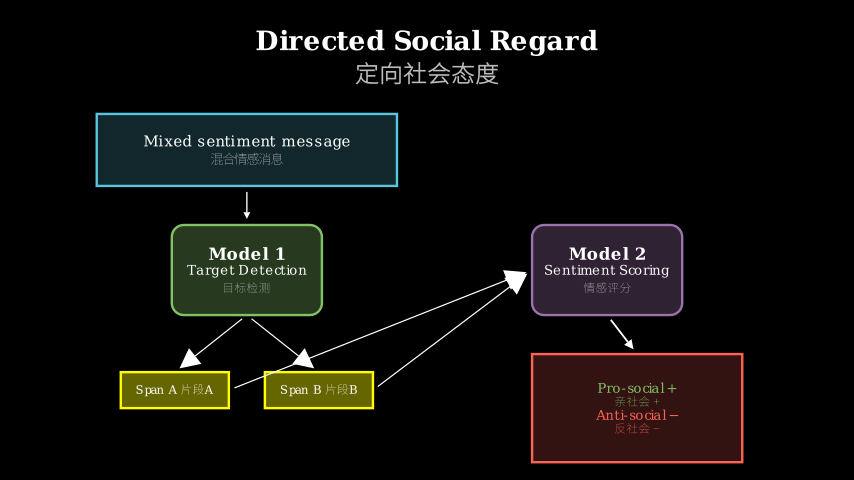
The method has two stages. Stage 1 is a span detection model: given a message, it identifies which text spans are targets of sentiment (people, groups, policies, events). Stage 2 is a regard scoring model: for each detected span, it scores the message’s sentiment toward that span along three axes—Advocacy/Opposition (-1 to +1), Aid/Harm (-1 to +1), and Victimization/Blame (-1 to +1). Both stages use transformer encoders fine-tuned on annotated data.
The key architectural choice is context-aware scoring: when scoring a span, the model sees the entire message, not just the span in isolation. This lets it capture how sentiment toward one target is expressed relative to others. For example, “We must protect our children from those dangerous policies” scores high on Aid for “children” and high on Opposition for “policies,” but only because the model sees both spans in context.
Input message
    |
    v
[Stage 1: Span Detection Transformer]
    |
    +---> Span A: "children"
    +---> Span B: "policies"
    |
    v
[Stage 2: Regard Scoring Transformer]
    |
    +---> Span A in full message context
    |       |
    |       +---> Advocacy/Opposition: +0.2
    |       +---> Aid/Harm: +0.8
    |       +---> Victimization/Blame: +0.6
    |
    +---> Span B in full message context
            |
            +---> Advocacy/Opposition: -0.7
            +---> Aid/Harm: -0.3
            +---> Victimization/Blame: -0.1
Think of it like a courtroom transcript analyzer. Stage 1 is the clerk who highlights every person or entity mentioned in testimony. Stage 2 is the analyst who reads the full testimony and, for each highlighted name, writes down: “Is the speaker defending or attacking this person? Are they describing help or harm toward them? Are they portraying them as victim or perpetrator?” The analyst doesn’t just look at the sentence containing the name—they read the whole testimony to understand the speaker’s stance. That’s why “our children” gets a high Aid score: not because the phrase itself is positive, but because the surrounding rhetoric frames them as needing protection.
Key Concepts
-
Regard axes (Advocacy/Opposition, Aid/Harm, Victimization/Blame): Traditional sentiment is one-dimensional: good or bad. Regard is three-dimensional because social and political messages do three distinct things simultaneously. Advocacy/Opposition captures whether you support or resist an entity’s goals or existence (“We stand with refugees” vs “We must stop illegal immigration”). Aid/Harm captures whether you describe helping or hurting them (“providing shelter” vs “causing suffering”). Victimization/Blame captures whether you frame them as wronged or wrongdoer (“innocent victims” vs “those responsible”). A message can score high on Aid but low on Advocacy (e.g., humanitarian aid to a group you politically oppose), or high on Victimization but low on Aid (acknowledging harm without offering help). These dimensions come from moral psychology research showing that people evaluate actions along multiple moral foundations, not a single good/bad axis.
-
Span-level vs document-level sentiment: Most sentiment tools give one score per document. But “I love my country and hate its corrupt leaders” contains opposite sentiments. Span-level analysis means identifying “my country” and “its corrupt leaders” as separate targets, then scoring each independently. The technical challenge: spans aren’t independent—“corrupt” modifies “leaders,” not “country,” even though both are nearby. The model must learn which sentiment-bearing words attach to which targets. This is why Stage 2 sees the full message: to resolve these attachment ambiguities using context.
Framework Shift
Before (standard sentiment):        After (DSR):

Message                             Message
  |                                   |
  v                                   v
[Classifier]                        [Span Detector]
  |                                   |
  v                                   +---> Target A
Overall score: +0.3                   +---> Target B
(slightly positive)                   |
                                      v
                                    [Regard Scorer]
                                      |
                                      +---> Target A: [+0.8, +0.6, +0.4]
                                      +---> Target B: [-0.7, -0.5, -0.3]

One number for whole text           Three numbers per target
From monolithic document polarity to per-target, multi-dimensional regard profiles—the core shift is decomposing sentiment into who feels what toward whom.
Expert Assessment
Problem choice: Real gap. Political communication researchers have been manually coding this kind of targeted sentiment for decades (content analysis of campaign ads, legislative speeches). Automating it is valuable. The framing through moral disengagement theory (Bandura) and moral foundations (Haidt) is well-motivated, not just feature engineering for its own sake.
Method maturity: Solid engineering, not groundbreaking architecture. Two-stage pipeline is the obvious approach once you frame the problem this way. The interesting choice is the three-axis design—why these three and not others? The paper justifies it through social science theory, but the axes are somewhat correlated (Advocacy and Aid have ρ ≈ 0.6 in their data), suggesting some redundancy. A more parsimonious model might collapse to two dimensions. The context-aware scoring is essential and well-executed.
Experimental integrity: Annotation study is thorough (multiple annotators, reasonable agreement κ > 0.6 on a hard task). Validation on six third-party datasets is the right move—shows the model captures something real, not just fitting to its own annotations. But: no comparison to adapted ABSA baselines. They compare to document-level sentiment tools, which is almost a strawman—of course those fail at span-level tasks. A fairer baseline would be an ABSA model extended to multi-dimensional output. The correlations with external datasets are modest (ρ ≈ 0.3–0.5), which is honest reporting but suggests the model is noisy.
Writing quality: The paper front-loads motivation and theory, which is good for interdisciplinary work but makes the technical contribution feel buried. Section 4 (model architecture) is too brief—glosses over how span boundaries are predicted and how the three scores are jointly trained. The validation study (Section 5) is the strongest part, showing the model’s outputs align with human-coded topics in pre-existing datasets. If I were revising, I’d expand Section 4 with ablations (does context window size matter? what if you score spans independently?) and move some of the social science background to an appendix.
Verdict: weak accept — Useful contribution to a real problem, solid execution, but incremental architecturally and missing key baselines. The value is in the problem formulation and the validated dataset, not the modeling innovation.
Takeaways
For practitioners: The three-axis framing (Advocacy, Aid, Victimization) is reusable beyond this paper. If you’re analyzing political text, customer feedback, or online discourse, ask: “Who is being supported/opposed? Who is being helped/harmed? Who is being framed as victim/perpetrator?” These are orthogonal questions, and collapsing them into one sentiment score loses information. Even if you don’t use this exact model, structuring your annotation schema this way will surface patterns that binary sentiment misses.
For researchers: The two-stage pipeline (detect targets, then score in context) is a template for any task where document-level labels are too coarse. The key insight: don’t score spans in isolation—always condition on the full message. This applies to stance detection, argument mining, and any task where local meaning depends on global framing.
Caveat: The model requires span annotations, which are expensive. If you’re starting from scratch, you’ll need to annotate hundreds of messages with target spans and regard scores. The paper’s annotation guidelines are detailed, but expect inter-annotator agreement to be modest (κ ≈ 0.6) because the task is genuinely hard. Budget accordingly.
论文: 2605.00776 作者: Scott Friedman, Ruta Wheelock, Sonja Schmer-Galunder, Drisana Iverson, Jake Vasilakes, Joan Zheng, Jeffrey Rye, Vasanth Sarathy, Christopher Miller 分类: cs.CL, cs.AI
缺口
现有的情感分析把每条消息当作有一个整体情绪基调——正面、中性或负面。
但真实的政治修辞和网络话语经常在同一句话里混合亲社会情感(倡导、同情)和反社会情感(威胁、指责),针对不同的目标。
“我们必须保护我们的孩子免受那些危险政策的伤害”同时包含关怀(对孩子)和敌意(对政策/政策制定者)。
标准工具完全遗漏了这一点:它们无法报告两种情感共存,也无法告诉你谁接收了哪种情感。
之前关于方面级情感分析(ABSA)的工作能识别目标,但仍然给每个目标分配一个极性。
社会科学中的道德框架研究认识到消息同时调用关怀、伤害、公平等多个道德维度,但缺乏从文本中大规模提取这些维度的计算工具。
问题:一条消息中针对多个目标的混合情感
    |
    v
假设:情感是多维的(关怀/伤害/公平)
      且针对特定目标(片段,而非整个文档)
    |
    v
方法:两阶段 Transformer 流水线
      阶段1:检测目标片段
      阶段2:在3个态度轴上给每个片段打分
    |
    v
证据:标注研究(κ > 0.6),在6个数据集上验证
    |
    v
结论:DSR 捕获的情感复杂性与
      真实世界的社会科学标签相关
增量
一句话:这篇论文之前,情感分析告诉你一条消息是正面还是负面;
之后,你能看到同一条消息赞扬了群体 A、指责了群体 B、向群体 C 提供帮助——全都在一起。
核心机制
方法分两个阶段。
阶段1是片段检测模型:给定一条消息,它识别哪些文本片段是情感的目标(人、群体、政策、事件)。
阶段2是态度评分模型:对每个检测到的片段,它在三个轴上给消息对该片段的情感打分——倡导/反对(-1到+1)、援助/伤害(-1到+1)、受害/指责(-1到+1)。
两个阶段都使用在标注数据上微调的 Transformer 编码器。
关键的架构选择是上下文感知评分:在给片段打分时,模型看到整条消息,而不仅仅是孤立的片段。
这让它能捕获对一个目标的情感是如何相对于其他目标表达的。
例如,“我们必须保护我们的孩子免受那些危险政策的伤害”对”孩子”在援助上得分高,对”政策”在反对上得分高,但只有因为模型在上下文中看到了两个片段。
输入消息
    |
    v
[阶段1:片段检测 Transformer]
    |
    +---> 片段 A:"孩子"
    +---> 片段 B:"政策"
    |
    v
[阶段2:态度评分 Transformer]
    |
    +---> 完整消息上下文中的片段 A
    |       |
    |       +---> 倡导/反对:+0.2
    |       +---> 援助/伤害:+0.8
    |       +---> 受害/指责:+0.6
    |
    +---> 完整消息上下文中的片段 B
            |
            +---> 倡导/反对:-0.7
            +---> 援助/伤害:-0.3
            +---> 受害/指责:-0.1
把它想象成法庭记录分析器。
阶段1是书记员,在证词中高亮每个被提到的人或实体。
阶段2是分析师,阅读完整证词,对每个高亮的名字写下:“说话者是在为这个人辩护还是攻击?
他们是在描述对他们的帮助还是伤害?
他们是把他们描绘成受害者还是施害者?
“分析师不只看包含名字的句子——他们阅读整个证词来理解说话者的立场。
这就是为什么”我们的孩子”得到高援助分数:不是因为这个短语本身是正面的,而是因为周围的修辞把他们框定为需要保护。
关键概念
- 态度轴(倡导/反对、援助/伤害、受害/指责):传统情感是一维的:好或坏。
态度是三维的,因为社会和政治消息同时做三件不同的事。
倡导/反对捕获你是否支持或抵制一个实体的目标或存在(“我们与难民站在一起” vs “我们必须阻止非法移民”)。
援助/伤害捕获你是否描述帮助或伤害他们(“提供庇护” vs “造成痛苦”)。
受害/指责捕获你是否把他们框定为受害者或施害者(“无辜受害者” vs “那些负责人”)。
一条消息可以在援助上得分高但在倡导上得分低(例如,对你政治上反对的群体提供人道主义援助),或在受害上得分高但在援助上得分低(承认伤害但不提供帮助)。
这些维度来自道德心理学研究,表明人们沿着多个道德基础评估行动,而不是单一的好/坏轴。
- 片段级 vs 文档级情感:大多数情感工具给每个文档一个分数。
但”我爱我的国家,恨它腐败的领导人”包含相反的情感。
片段级分析意味着识别”我的国家”和”它腐败的领导人”作为独立目标,然后分别打分。
技术挑战:片段不是独立的——“腐败”修饰”领导人”,而不是”国家”,即使两者都在附近。
模型必须学习哪些带情感的词附着到哪些目标。
这就是为什么阶段2看到完整消息:用上下文解决这些附着歧义。
框架转变
之前(标准情感):              之后(DSR):

消息                            消息
  |                               |
  v                               v
[分类器]                        [片段检测器]
  |                               |
  v                               +---> 目标 A
整体分数:+0.3                    +---> 目标 B
(略微正面)                      |
                                  v
                                [态度评分器]
                                  |
                                  +---> 目标 A:[+0.8, +0.6, +0.4]
                                  +---> 目标 B:[-0.7, -0.5, -0.3]

整个文本一个数字                 每个目标三个数字
从整体文档极性到每个目标的多维态度画像——核心转变是把情感分解为谁对谁感受到什么。
专家评审
选题眼光:真实缺口。
政治传播研究者几十年来一直在手动编码这种定向情感(竞选广告、立法演讲的内容分析)。
自动化它是有价值的。
通过道德脱离理论(Bandura)和道德基础(Haidt)的框架是有充分动机的,不只是为了特征工程而特征工程。
方法成熟度:扎实的工程,不是突破性的架构。
两阶段流水线是一旦你这样框定问题就显而易见的方法。
有趣的选择是三轴设计——为什么是这三个而不是其他?
论文通过社会科学理论证明了它,但这些轴有些相关(倡导和援助在他们的数据中 ρ ≈ 0.6),暗示一些冗余。
更简洁的模型可能会折叠到两个维度。
上下文感知评分是必不可少的,执行得很好。
实验诚意:标注研究很彻底(多个标注者,在困难任务上合理的一致性 κ > 0.6)。
在六个第三方数据集上验证是正确的举措——表明模型捕获了真实的东西,而不仅仅是拟合自己的标注。
但:没有与改编的 ABSA 基线比较。
他们与文档级情感工具比较,这几乎是个稻草人——当然那些在片段级任务上失败。
更公平的基线是扩展到多维输出的 ABSA 模型。
与外部数据集的相关性适中(ρ ≈ 0.3–0.5),这是诚实的报告,但表明模型有噪声。
写作功力:论文前置动机和理论,这对跨学科工作很好,但让技术贡献感觉被埋没了。
第4节(模型架构)太简短——掩盖了片段边界如何预测以及三个分数如何联合训练。
验证研究(第5节)是最强的部分,显示模型的输出与预先存在的数据集中的人工编码主题对齐。
如果我在修订,我会扩展第4节,加入消融实验(上下文窗口大小重要吗?
如果你独立地给片段打分会怎样?
),并把一些社会科学背景移到附录。
判决:弱接收 — 对真实问题的有用贡献,扎实的执行,但在架构上是增量的,缺少关键基线。
价值在于问题表述和验证的数据集,而不是建模创新。
要点总结
对实践者:三轴框架(倡导、援助、受害)在本文之外可重用。
如果你在分析政治文本、客户反馈或网络话语,问:“谁被支持/反对?
谁被帮助/伤害?
谁被框定为受害者/施害者?
“这些是正交的问题,把它们折叠成一个情感分数会丢失信息。
即使你不使用这个确切的模型,以这种方式构建你的标注模式也会浮现二元情感遗漏的模式。
对研究者:两阶段流水线(检测目标,然后在上下文中打分)是任何文档级标签太粗糙的任务的模板。
关键洞察:不要孤立地给片段打分——总是以完整消息为条件。
这适用于立场检测、论证挖掘以及任何局部意义依赖于全局框架的任务。
警告:模型需要片段标注,这很昂贵。
如果你从头开始,你需要用目标片段和态度分数标注数百条消息。
论文的标注指南很详细,但预期标注者间一致性适中(κ ≈ 0.6),因为任务确实很难。
相应地做好预算。