Paper: 2606.12402 Authors: Jadelynn Dao, Milan Ganai, Yasmina Abukhadra, Ajay Sridhar, Mozhgan Nasr Azadani, Katie Luo, Clark Barrett, Jiajun Wu, Chelsea Finn, Marco Pavone Categories: cs.RO, cs.AI, cs.CV
The Gap
Existing work treats test-time compute as a uniform lever: chain-of-thought depth, model size, and memory history are scaled blindly, assuming more compute = better performance. VLABench and RoboMME benchmarks show this assumption is false — gains plateau, latency balloons, and token costs explode. Prior routing methods (e.g., model selection based on input difficulty) ignore multimodal scene context and treat axes independently. The paper identifies that embodied planners need a context-aware router that decides which axis to scale and how much, based on the current visual and linguistic scene.
Problem: Naive scaling of test-time compute yields diminishing returns
  v
Assumption: Compute allocation should depend on scene context, not uniform scaling
  v
Method: DIRECT router - uses multimodal features (visual + linguistic) to select compute strategy
  v
Evidence: Pareto improvements on VLABench, RoboMME; real robot matches stronger model at 65% lower latency
  v
Conclusion: Test-time compute is a multi-axis resource; contextual routing is necessary for frontier performance at real-world cost.
The Increment
One sentence: Before this paper, embodied planners wasted test-time compute by scaling uniformly; after DIRECT, they can allocate compute intelligently per prompt, achieving frontier success rates at a fraction of the cost.
Core Mechanism
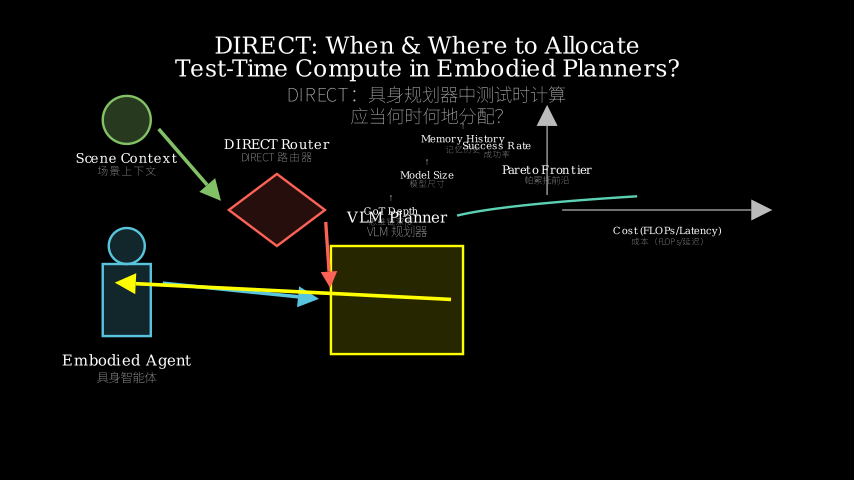
DIRECT is a lightweight routing module placed in front of the VLM planner. Given an input prompt (image + text), DIRECT extracts multimodal features via a frozen vision encoder (e.g., CLIP) and a text encoder. These features are fed into a small MLP that outputs a decision over three scaling axes: chain-of-thought depth (number of reasoning steps), model size (small / medium / large VLM), and memory history length (how many past observations to include). The router is trained via reinforcement learning (PPO) with a reward that balances success (binary) against a cost function (latency + token usage). The policy learns to choose a configuration that maximizes expected reward for each scene.
Input Prompt (image + text)
  |
  v
[Feature Extractors: frozen vision encoder + text encoder]
  |
  v
[MLP Router] --> policy outputs: {CoT depth, model size, history length}
  |
  v
[Executor: load selected VLM with config, run planning]
  |
  v
[Reward: success - cost] --> train router via PPO
Structural Metaphor: Think of the router as a *restaurant sommelier for compute. The customer (prompt) arrives with a dish (scene). A sommelier doesn’t pour the most expensive wine for everyone; they assess the dish’s spices, richness, and the guest’s preference, then recommend a wine that pairs well. The router does the same: the “wine cellar” is a set of VLM configurations (varying CoT depth, model size, history). The “tasting” is the multimodal feature extraction, and the “recommendation” is the configuration. After the meal (planning), the guest’s satisfaction (success) and the bill (cost) update the sommelier’s training. Just as a good sommelier learns which wine works for which dish, the router learns which compute axis fits which scene.
Key Concepts
- Pareto Frontier: A set of points where no configuration can improve both success and cost simultaneously. DIRECT aims to push this frontier outward: for any given cost, achieve higher success than fixed strategies. Prior work stayed inside the frontier; DIRECT breaks through by contextual allocation.
- Test-Time Compute Axes: Three levers the paper studies: (1) chain-of-thought depth (number of reasoning steps), (2) model size (parameter count), (3) memory history (how many past frames/commands to condition on). Each axis has a different cost profile and capability profile. For example, deeper CoT helps symbolic reasoning but hurts speed; larger model helps vision but costs more. The router picks the combination.
- Contextual Routing: Instead of a fixed policy (always use large model + deep CoT), the router adapts per prompt. It uses scene features (e.g., object clutter, task complexity, linguistic ambiguity) to predict which axis will matter most. This is the key epistemic insight: not all test-time compute creates equal value.
Framework Shift
Before (mainstream approach):        After (this paper):
[Fixed configuration for all prompts]  [Context-aware router per prompt]
Example: always use large model +   |  Example: small model + deep CoT for
deep CoT + long history.            |  symbolic tasks; medium model + short
                                    |  history for visual navigation.
                                    |
Cost: high for all prompts,         |  Cost: low for easy prompts, high only when needed
success: uniform but plateau        |  Success: high overall via tailored scaling
                                    |
[ASCII of fixed: all arrows same size]  [ASCII of router: variable arrow sizes]
+-->+   +-->+                       |  +-->[large CoT]-->+
                                     |  +-->[small CoT]-->+
                                     |  +--> [medium]-->+
                                     |  (arrows vary by scene)
One sentence: From uniform compute scaling to contextual compute allocation, the core shift is treating test-time compute as a multi-axis resource that must be routed intelligently per prompt.
Expert Assessment
Problem choice: Real gap. The embodied AI community is rushing to scale compute without questioning where it’s wasted. This paper calls a needed timeout. It sits at the intersection of meta-learning and resource-constrained robotics, a growing pain point as VLMs become mainstream in planning.
Method maturity: Clever insight + practical engineering. The router is lightweight (MLP, not a transformer) so it doesn’t add overhead. The RL training with cost-aware reward is straightforward but effective. Simpler approaches (e.g., threshold-based difficulty heuristics) were not tested; the paper acknowledges this but argues RL captures more complex patterns. Could be overkill for some tasks.
Experimental integrity: Baselines are fair: they compare against fixed model selections (small, medium, large) as well as random and oracle. Real robot validation with DROID setup is a big plus. Numbers hold: the success-cost Pareto plots are convincing. One red flag: the router may overfit to the benchmarks’ scene distributions; real-world deployment may need retraining. The paper doesn’t discuss generalization to unseen tasks.
Writing quality: Clear structure, decent diagrams. The “axes” concept is well-introduced. Weakness: Section 4 (experiments) is dense and could use more intuition about why certain configurations win on certain scenes. A table of success rates broken down by task category would help. The related work feels rushed — missing comparisons to recent adaptive compute works in NLP (e.g., Mixture of Depths).
Verdict: strong accept — timely, well-executed, and provides a concrete framework that makes immediately deployable engineering sense for embodied planning.
Takeaways
- Cost-aware router training: Use RL to optimize for a multi-objective (success + cost) with a customizable cost function. This idea transfers directly to any system where you have multiple model configurations or compute budgets.
- Three-axis decomposition: The insight that CoT depth, model size, and history length are *qualitatively different compute axes is valuable. Practitioners should treat them as separate knobs, not just one “compute budget” knob.
- Real robot validation: The Franka arm experiment shows the router can match a stronger model’s success with 65% lower latency. This is a recipe for deploying frontier VLMs on edge robots with limited compute.
论文: 2606.12402 作者: Jadelynn Dao, Milan Ganai, Yasmina Abukhadra, Ajay Sridhar, Mozhgan Nasr Azadani, Katie Luo, Clark Barrett, Jiajun Wu, Chelsea Finn, Marco Pavone 分类: cs.RO, cs.AI, cs.CV
缺口
现有研究将测试时计算视为一种统一杠杆:盲目扩展链式思维深度、模型大小和记忆历史,假设更多计算等于更好性能。VLABench和RoboMME基准测试表明这一假设是错误的——收益趋于平稳,延迟膨胀,令牌成本飙升。先前的路由方法(例如基于输入难度的模型选择)忽略了多模态场景上下文,并将各轴独立处理。本文指出,具身规划器需要一种上下文感知的路由器,能够根据当前视觉和语言场景决定扩展哪一轴以及扩展多少。
问题:简单扩展测试时计算导致收益递减
  v
假设:计算分配应依赖场景上下文,而非统一扩展
  v
方法:DIRECT路由器——利用多模态特征(视觉+语言)选择计算策略
  v
证据:在VLABench、RoboMME上的帕累托改进;真实机器人以65%的更低延迟匹配更强模型的成功率
  v
结论:测试时计算是一个多轴资源;上下文路由对于以实际成本实现前沿性能是必要的。
增量
一句话:在这篇论文之前,具身规划器通过统一扩展浪费了测试时计算;DIRECT之后,它们可以智能地按提示分配计算,以极低的成本实现前沿成功率。
核心机制
DIRECT是一个轻量级路由模块,放置在VLM规划器之前。给定输入提示(图像+文本),DIRECT通过冻结的视觉编码器(如CLIP)和文本编码器提取多模态特征。这些特征被送入一个小型MLP,输出在三个扩展轴上的决策:链式思维深度(推理步数)、模型大小(小/中/大型VLM)和记忆历史长度(包含多少过去观察)。路由器通过强化学习(PPO)训练,奖励函数平衡成功率与成本函数(延迟+令牌使用量)。策略学会为每个场景选择最大化期望奖励的配置。
输入提示(图像+文本)
  |
  v
[特征提取器:冻结视觉编码器 + 文本编码器]
  |
  v
[MLP路由器] --> 策略输出:{CoT深度, 模型大小, 历史长度}
  |
  v
[执行器:加载选定VLM及配置,运行规划]
  |
  v
[奖励:成功 - 成本] --> 通过PPO训练路由器
结构比喻:把路由器想象成餐厅的**侍酒师*,负责为每道菜配酒。顾客(提示)带来一道菜(场景)。一个好的侍酒师不会给所有人都倒最贵的酒;他们会评估菜肴的香料、浓郁度和客人的偏好,然后推荐与之相配的酒。路由器也是如此:“酒窖”是一组VLM配置(不同CoT深度、模型大小和历史长度),“品尝”是多模态特征提取,“推荐”就是配置选择。餐后(规划),顾客的满意度(成功率)和账单(成本)会更新侍酒师的训练。正如好侍酒师学会哪种酒配哪道菜,路由器学会哪个计算轴适合哪个场景。
关键概念
- 帕累托前沿:一组配置点,其中没有任何一个能在不牺牲另一个的情况下同时提高成功率和降低成本。DIRECT的目的是将这一前沿向外推:对于任何给定的成本,实现高于固定策略的成功率。先前的工作停留在前沿内部;DIRECT通过上下文分配突破了它。
- 测试时计算轴:本文研究的三个杠杆:(1)链式思维深度(推理步数),(2)模型大小(参数数量),(3)记忆历史(包含多少过去的帧/命令)。每个轴具有不同的成本曲线和能力特征。例如,更深的CoT有助于符号推理但损害速度;更大的模型有助于视觉但成本更高。路由器选择合适组合。
- 上下文路由:不是固定策略(总是使用大模型+深CoT),而是路由器根据每个提示进行调整。它使用场景特征(例如物体杂乱程度、任务复杂性、语言歧义性)预测哪一个轴最重要。这是核心认知洞见:不是所有的测试时计算都创造同等价值。
框架转变
之前(主流方法):                之后(本文方法):
[对所有提示使用固定配置]          [每个提示的上下文感知路由器]
例如:总是使用大模型+深CoT+长历史|  例如:符号任务用小模型+深CoT;
                                  视觉导航用中模型+短历史。
成本:所有提示都高,              成本:简单提示低,仅在需要时高
成功率:均匀但趋于平稳            成功率:通过定制扩展实现高整体成功率
                                  |
[ASCII固定:所有箭头相同大小]     [ASCII路由器:箭头大小可变]
+-->+   +-->+                    |  +-->[深CoT]-->+
                                  |  +-->[浅CoT]-->+
                                  |  +-->[中模型]-->+
                                  | (箭头因场景而异)
一句话:从统一计算扩展到上下文计算分配,核心转变是将测试时计算视为一个多轴资源,必须智能地为每个提示分配路由。
专家评审
选题眼光:真缺口。具身AI社区正急于扩展计算而不问浪费在哪里。本文叫了一个必要的暂停。它处于元学习与资源受限机器人学的交叉点,是VLM成为规划主流时日益增长的痛点。
方法成熟度:巧劲+实用工程。路由器轻量(MLP而非Transformer),因此不增加开销。带成本感知奖励的RL训练简单有效。更简单的方法(例如基于难度的阈值启发式)未测试;论文承认这一点但认为RL能捕捉更复杂的模式。对于某些任务可能过度设计。
实验诚意:基线公平:对比固定模型选择(小、中、大)以及随机和理想情况。以DROID设置进行的真实机器人验证是重要加分项。数字令人信服:帕累托图清晰。一个值得警惕之处:路由器可能对基准测试的场景分布过拟合;在未见过的任务上泛化能力未讨论。
写作功力:结构清晰,图表不错。“轴”的概念介绍得当。弱点:第4节(实验)过于密集,缺少为什么某些配置能在特定场景获胜的直觉。按任务类别划分成功率的表格会有所帮助。相关工作部分略显仓促——缺少与NLP中自适应计算工作(如混合深度)的比较。
判决:强接收——及时、执行良好,提供了一个具体框架,对具身规划具有立即可部署的工程意义。
要点总结
- 成本感知路由器训练:使用RL优化多目标(成功率+成本),成本函数可定制。这个思路直接适用于任何拥有多种模型配置或计算预算的系统。
- 三轴分解:链式思维深度、模型大小和历史长度在性质上不同这一点很有价值。实践者应将它们视为独立的旋钮,而非一个“计算预算”旋钮。
- 真实机器人验证:Franka机械臂实验表明路由器能以65%的更低延迟匹配更强模型的成功率。这是在边缘机器人上部署前沿VLM的配方。