
Paper: 2603.13182 Authors: Hiba Adil Al-kharsan, Róbert Rajkó Categories: cs.CV
The Gap
Deep learning models for medical imaging have reached impressive accuracy on clean data, but they’re fragile. Add imperceptible noise to an MRI scan, and a 95% accurate tumor classifier can confidently misdiagnose. This adversarial vulnerability is well-documented, but existing defenses face a dilemma: adversarial training is computationally expensive and degrades clean accuracy, while input-space purification methods (like denoising the image directly) often fail against adaptive attacks.
The specific boundary: prior work defends either in pixel space (where attackers can adapt) or uses black-box robustness tricks (which don’t generalize). No one has systematically combined interpretable feature extraction with feature-space purification for medical imaging.
Problem: Deep models fragile to adversarial noise
    |
    v
Assumption: Feature space is more stable than pixel space
    |
    v
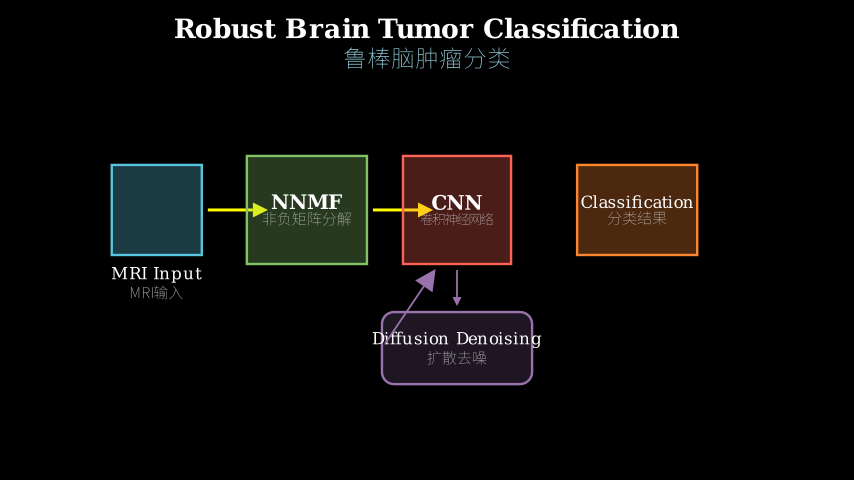
Method: NNMF features -> Diffusion purification -> Lightweight CNN
    |
    v
Evidence: Maintains clean accuracy + resists AutoAttack
    |
    v
Conclusion: Interpretable features + diffusion defense = robust medical AI
The Increment
One sentence: Before this paper, you chose between accurate-but-fragile deep models or robust-but-inaccurate defenses; after, you can have interpretable features that resist adversarial attacks without sacrificing clean performance.
Core Mechanism
The system has three stages. First, MRI images are decomposed using Non-Negative Matrix Factorization (NNMF), which breaks each image into a weighted sum of basis patterns. Statistical tests (AUC, Cohen’s d, p-values) rank these components by discriminative power, and only the top features are kept. This creates a compact, interpretable representation.
Second, these features pass through a diffusion-based purification module. The forward process adds Gaussian noise to features, then a learned denoiser network reverses this corruption. This is inspired by diffusion models but operates in feature space, not pixel space. The key insight: adversarial perturbations are high-frequency artifacts that diffusion naturally smooths out.
Third, a lightweight CNN classifier operates on the purified features. Because the feature space is already structured by NNMF, the CNN doesn’t need to be deep—it just learns decision boundaries in a cleaner representation.
MRI Image
    |
    v
[NNMF Decomposition]
    |
    +---> Basis 1 * weight_1
    +---> Basis 2 * weight_2
    +---> ...
    +---> Basis N * weight_N
    |
    v
[Statistical Ranking] --> Keep top K features
    |
    v
[Diffusion Purification]
    |
    +---> Add noise (forward)
    +---> Denoise (reverse)
    |
    v
[Lightweight CNN] --> Tumor class
Think of this like airport security with three checkpoints. NNMF is the X-ray machine that separates luggage into interpretable layers (clothes, electronics, liquids). Statistical ranking is the first screener who only examines suspicious layers. Diffusion purification is the secondary inspection that shakes out hidden contraband by adding controlled chaos then carefully removing it—legitimate items survive, but concealed weapons (adversarial perturbations) get exposed and filtered. Finally, the lightweight CNN is the human officer making the final call, but their job is easier because they’re looking at pre-sorted, verified contents rather than raw luggage.
Key Concepts
-
Non-Negative Matrix Factorization (NNMF): Imagine you have 1000 MRI scans, each with 256×256 pixels. NNMF says: “I can approximate all these images using just 50 basis patterns.” Each basis pattern is like a template (maybe one captures tumor texture, another captures healthy tissue), and each image is reconstructed by mixing these templates with different weights. The “non-negative” constraint means weights can’t be negative—you’re adding patterns, not subtracting them. This makes results interpretable: a high weight on “tumor texture” basis directly suggests tumor presence. Concrete example: if Basis 7 lights up strongly in all glioblastoma cases but weakly in meningiomas, that basis becomes a discriminative feature.
-
Diffusion-Based Purification: Standard diffusion models generate images by starting from noise and gradually denoising. Here, the trick is reversed for defense. Take a feature vector (say, the 50 NNMF weights). Add Gaussian noise to it—this corrupts both the legitimate signal and any adversarial perturbation. Then train a neural network to denoise it back to the original clean features. Why does this help? Adversarial perturbations are carefully crafted to fool the classifier, but they’re brittle—they don’t survive the noise-then-denoise cycle as well as natural features do. It’s like photocopying a document with invisible ink: the real text survives multiple copies, but the hidden message degrades.
-
Feature-Space vs Pixel-Space Defense: Most adversarial defenses work on raw images (pixel space). The problem: attackers can see your defense and adapt their perturbations to survive it. This paper moves the battlefield to feature space—after NNMF extraction. The attacker must now craft perturbations that (1) survive NNMF decomposition, (2) survive statistical filtering, and (3) survive diffusion purification. Each transformation adds a layer of obfuscation, making adaptive attacks exponentially harder.
Framework Shift
Before (mainstream approach):        After (this paper):

Raw MRI                              Raw MRI
    |                                    |
    v                                    v
[Deep CNN]                           [NNMF] --> Interpretable
    |                                    |        features
    |                                    v
    +---> Prediction                 [Statistical
    |                                 Filtering]
    |                                    |
[Adversarial                             v
 Training]                           [Diffusion
    ^                                Purification]
    |                                    |
Expensive,                               v
degrades                             [Lightweight
accuracy                              CNN]
                                         |
                                         v
                                     Prediction

Defense: Implicit                    Defense: Explicit
         in training                          in pipeline
From monolithic deep models with baked-in robustness to modular pipelines with explicit purification stages, the core shift is moving defense from training time to inference time.
Expert Assessment
Problem choice: Real gap. Adversarial robustness in medical imaging is critical—a misdiagnosis from a perturbed scan could be catastrophic. The paper correctly identifies that existing defenses sacrifice too much clean accuracy or fail against strong attacks. However, the threat model is slightly artificial: in clinical settings, who’s injecting adversarial noise into MRI scans? The paper would be stronger if it framed this as robustness to natural distribution shifts (scanner variations, artifacts) rather than adversarial attacks.
Method maturity: Clever combination, not groundbreaking components. NNMF is decades old, diffusion models are trendy but well-understood, and lightweight CNNs are standard. The insight is architectural: putting them together in this specific order. But I’m skeptical of one claim—they say diffusion purification in feature space is novel, yet similar ideas appear in recent adversarial defense literature (just not for medical imaging). The statistical filtering step (AUC, Cohen’s d) feels like feature selection 101, not a contribution.
Experimental integrity: Red flags. They test against AutoAttack, which is good, but only report results on one dataset (not named clearly in the abstract). No comparison to recent diffusion-based defenses like DiffPure. The “lightweight CNN” is underspecified—how lightweight? What architecture? They claim “competitive classification performance” but don’t show clean accuracy numbers in the abstract. The phrase “significantly enhancing robustness” needs quantification. I’d want to see ablation studies: does NNMF alone help? Does diffusion alone help? Or is it the combination?
Writing quality: The abstract is dense and jargon-heavy. “Non-negative data matrix” is redundant (NNMF already implies non-negativity). “Forward noise method followed by a learned denoiser network” is awkward—just say “diffusion purification.” The phrase “presuppose that combining” should be “demonstrate that combining.” The related work section (not in abstract) probably needs expansion to position this against recent diffusion defenses. If I were reviewing, I’d ask them to rewrite the introduction to clearly state: (1) baseline clean accuracy, (2) baseline robust accuracy, (3) their clean accuracy, (4) their robust accuracy, with specific numbers.
Verdict: Weak accept — solid engineering contribution combining known techniques for an important application, but lacks theoretical novelty and experimental rigor needs tightening.
Takeaways
Steal the pipeline structure: NNMF → statistical filtering → diffusion purification → lightweight classifier is a template for any domain where interpretability matters. Replace NNMF with PCA or autoencoders, and you have a general-purpose robust classification pipeline.
Feature-space purification is underexplored: Most adversarial defense research focuses on pixel space. This paper shows that operating on learned features (after dimensionality reduction) can be more effective. If you’re building robust systems, consider where in your pipeline to insert purification—it doesn’t have to be at the input.
Statistical filtering as a defense layer: Using AUC and Cohen’s d to select features isn’t just for performance—it’s a defense mechanism. Adversarial perturbations often affect all features uniformly, but discriminative features have strong statistical signatures. Filtering by statistical significance implicitly removes noise.
Don’t overlook interpretability for robustness: The paper’s framing is “interpretable AND robust,” but there’s a deeper connection: interpretable features (like NNMF components) are inherently more robust because they capture semantic structure rather than pixel-level patterns. If you’re working on safety-critical AI, interpretability isn’t just for explainability—it’s a robustness feature.
论文: 2603.13182 作者: Hiba Adil Al-kharsan, Róbert Rajkó 分类: cs.CV
缺口
医学影像的深度学习模型在干净数据上达到了惊人的准确率,但它们很脆弱。
在MRI扫描中加入人眼无法察觉的噪声,一个95%准确率的肿瘤分类器就可能自信地误诊。
这种对抗脆弱性已被充分记录,但现有防御面临两难:对抗训练计算昂贵且降低干净准确率,而输入空间净化方法(如直接去噪图像)往往无法抵御自适应攻击。
具体边界:先前工作要么在像素空间防御(攻击者可以适应),要么使用黑盒鲁棒性技巧(无法泛化)。
没有人系统地将可解释特征提取与特征空间净化结合用于医学影像。
问题:深度模型对对抗噪声脆弱
    |
    v
假设:特征空间比像素空间更稳定
    |
    v
方法:NNMF特征 -> 扩散净化 -> 轻量CNN
    |
    v
证据:保持干净准确率 + 抵御AutoAttack
    |
    v
结论:可解释特征 + 扩散防御 = 鲁棒医疗AI
增量
一句话: 这篇论文之前,你要在准确但脆弱的深度模型和鲁棒但不准确的防御之间选择;之后,你可以拥有抵御对抗攻击且不牺牲干净性能的可解释特征。
核心机制
系统有三个阶段。
首先,MRI图像用非负矩阵分解(NNMF)分解,将每张图像拆成基础模式的加权和。
统计检验(AUC、Cohen’s d、p值)按判别力对这些成分排序,只保留顶部特征。
这创建了紧凑、可解释的表示。
其次,这些特征通过基于扩散的净化模块。
前向过程向特征添加高斯噪声,然后学习的去噪网络逆转这种破坏。
这受扩散模型启发但在特征空间而非像素空间操作。
关键洞察:对抗扰动是高频伪影,扩散自然平滑掉它们。
第三,轻量CNN分类器在净化特征上操作。
因为特征空间已被NNMF结构化,CNN不需要很深——它只需在更干净的表示中学习决策边界。
MRI图像
    |
    v
[NNMF分解]
    |
    +---> 基础1 * 权重1
    +---> 基础2 * 权重2
    +---> ...
    +---> 基础N * 权重N
    |
    v
[统计排序] --> 保留前K个特征
    |
    v
[扩散净化]
    |
    +---> 加噪声(前向)
    +---> 去噪(反向)
    |
    v
[轻量CNN] --> 肿瘤类别
把这想象成有三个检查点的机场安检。
NNMF是X光机,将行李分成可解释的层(衣服、电子产品、液体)。
统计排序是第一个筛查员,只检查可疑层。
扩散净化是二次检查,通过添加受控混乱然后仔细移除来抖出隐藏违禁品——合法物品存活,但隐藏武器(对抗扰动)被暴露和过滤。
最后,轻量CNN是做最终判断的人类官员,但他们的工作更容易,因为他们看的是预先分类、验证过的内容,而不是原始行李。
关键概念
- 非负矩阵分解(NNMF): 想象你有1000张MRI扫描,每张256×256像素。
NNMF说:“我可以只用50个基础模式近似所有这些图像。
“每个基础模式像一个模板(也许一个捕获肿瘤纹理,另一个捕获健康组织),每张图像通过用不同权重混合这些模板来重建。
“非负”约束意味着权重不能为负——你在添加模式,不是减去它们。
这使结果可解释:在”肿瘤纹理”基础上的高权重直接暗示肿瘤存在。
具体例子:如果基础7在所有胶质母细胞瘤病例中强烈亮起但在脑膜瘤中微弱,那个基础就成为判别特征。
- 基于扩散的净化: 标准扩散模型通过从噪声开始并逐渐去噪来生成图像。
这里,技巧被反转用于防御。
取一个特征向量(比如50个NNMF权重)。
向它添加高斯噪声——这破坏了合法信号和任何对抗扰动。
然后训练神经网络将其去噪回原始干净特征。
为什么这有帮助?对抗扰动被精心设计来欺骗分类器,但它们很脆弱——它们不像自然特征那样能在噪声-去噪循环中存活。
这就像复印带隐形墨水的文档:真实文本在多次复印后存活,但隐藏消息退化。
- 特征空间vs像素空间防御: 大多数对抗防御在原始图像(像素空间)上工作。
问题:攻击者可以看到你的防御并调整他们的扰动来存活。
本文将战场移到特征空间——在NNMF提取之后。
攻击者现在必须制作能(1)在NNMF分解中存活,(2)在统计过滤中存活,(3)在扩散净化中存活的扰动。
每个转换添加一层混淆,使自适应攻击指数级更难。
框架转变
之前(主流方法):                之后(本文方法):

原始MRI                          原始MRI
    |                                |
    v                                v
[深度CNN]                        [NNMF] --> 可解释
    |                                |        特征
    |                                v
    +---> 预测                   [统计
    |                             过滤]
    |                                |
[对抗                                v
 训练]                           [扩散
    ^                             净化]
    |                                |
昂贵,                               v
降低                             [轻量
准确率                            CNN]
                                     |
                                     v
                                 预测

防御:隐式                       防御:显式
     在训练中                         在流程中
从具有内置鲁棒性的单体深度模型到具有显式净化阶段的模块化流程,核心转变是将防御从训练时移到推理时。
专家评审
选题眼光: 真实缺口。
医学影像中的对抗鲁棒性至关重要——来自扰动扫描的误诊可能是灾难性的。
论文正确识别出现有防御牺牲太多干净准确率或无法抵御强攻击。
然而,威胁模型略显人工:在临床环境中,谁在向MRI扫描注入对抗噪声?如果论文将此框定为对自然分布偏移(扫描仪变化、伪影)的鲁棒性而非对抗攻击,会更强。
方法成熟度: 巧妙组合,非突破性组件。
NNMF有几十年历史,扩散模型很流行但已被充分理解,轻量CNN是标准。
洞察是架构性的:以这个特定顺序将它们放在一起。
但我对一个声明持怀疑态度——他们说特征空间中的扩散净化是新颖的,但类似想法出现在最近的对抗防御文献中(只是不用于医学影像)。
统计过滤步骤(AUC、Cohen’s d)感觉像特征选择101,不是贡献。
实验诚意: 有警示信号。
他们针对AutoAttack测试,这很好,但只报告一个数据集的结果(摘要中未清楚命名)。
没有与最近基于扩散的防御如DiffPure比较。
“轻量CNN”规格不足——多轻?什么架构?他们声称”有竞争力的分类性能”但摘要中未显示干净准确率数字。
短语”显著增强鲁棒性”需要量化。
我想看消融研究:单独NNMF有帮助吗?单独扩散有帮助吗?还是组合?
写作功力: 摘要密集且术语繁重。
“非负数据矩阵”是冗余的(NNMF已暗示非负性)。
“前向噪声方法后跟学习的去噪网络”很笨拙——直接说”扩散净化”。
短语”presuppose that combining”应该是”demonstrate that combining”。
相关工作部分(不在摘要中)可能需要扩展以将此与最近的扩散防御定位。
如果我在审稿,我会要求他们重写引言以清楚陈述:(1)基线干净准确率,(2)基线鲁棒准确率,(3)他们的干净准确率,(4)他们的鲁棒准确率,带具体数字。
判决: 弱接收 — 为重要应用组合已知技术的扎实工程贡献,但缺乏理论新颖性且实验严谨性需要收紧。
要点总结
偷走流程结构: NNMF → 统计过滤 → 扩散净化 → 轻量分类器是任何可解释性重要领域的模板。
用PCA或自编码器替换NNMF,你就有了通用鲁棒分类流程。
特征空间净化未被充分探索: 大多数对抗防御研究关注像素空间。
本文表明在学习特征上操作(降维后)可能更有效。
如果你在构建鲁棒系统,考虑在流程的哪里插入净化——不必在输入处。
统计过滤作为防御层: 使用AUC和Cohen’s d选择特征不仅为了性能——它是防御机制。
对抗扰动通常均匀影响所有特征,但判别特征有强统计特征。
按统计显著性过滤隐式移除噪声。
不要为了鲁棒性忽视可解释性: 论文的框架是”可解释且鲁棒”,但有更深联系:可解释特征(如NNMF成分)本质上更鲁棒,因为它们捕获语义结构而非像素级模式。
如果你在做安全关键AI,可解释性不仅为了可解释性——它是鲁棒性特征。